This post expresses the views and opinions of the author(s) and not necessarily that of 2nd Life Media Alamogordo Town News management or staff.
National Security, Secrecy, and Local Power:
Lessons from New Mexico for an Informed Electorate
By Kim, Great White Owl Murillo,
Founder and CEO-The Academy For The New Humanity
June 29, 2026
Executive Summary
Across New Mexico, four stories—on the surface unrelated—reveal a single pattern:
- The New Mexico IPRA Task Force – A state system where both citizens and public servants are trapped between the need for transparency and an overwhelmed bureaucracy.
- The Alamogordo City Commission – A city manager hiring process marked by secrecy, pre‑decisions, and misrepresentation, now under Open Meetings Act challenge.
- Roswell Revisited – A constitutional look at how “national security” has historically justified government deception and coercion.
- Mount Cristo Rey – A sacred border shrine facing potential federal land seizure for a border wall, testing the limits of government power over religious practice and community identity.
Taken together, they show how secrecy, concentrated discretion, and “greater good” narratives can undermine the rights and dignity of ordinary people—unless citizens insist on transparency, constitutional limits, and ethical public service at every level.
This white paper connects these dots and argues:
A republic cannot survive on “trust us” government.
National security and administrative efficiency are legitimate goals, but they must never become blank checks to lie, to intimidate, to retaliate, or to erase communities and sacred places.
The remedy is not cynicism, but informed, engaged, morally grounded citizenship—the kind willing to hold public servants to both the letter and the spirit of the Constitution.
I. IPRA Task Force: A System Straining Under Its Own Weight
At a recent New Mexico IPRA Task Force meeting, one question kept circling in my mind:
Who could possibly be against the American people having access to public information?
The answer, it turned out, was not enemies of transparency—but often the very public servants tasked with fulfilling IPRA requests. They are not opposed to openness in principle. They are overwhelmed in practice.
Frontline staff described:
- Heavy volumes of requests, especially for police body‑camera footage;
- Large numbers of requests from YouTubers and out‑of‑state content creators;
- A sense that even legitimate local media (such as 2nd Life Media) risk being lumped in with “abusers” of the system simply for using it vigorously.
Citizens, including residents from Alamogordo, spoke about:
- A climate of opacity in local government;
- The difficulty of holding officials accountable without timely, complete information;
- The reality that the governed cannot give informed consent to actions taken in their name if they are not told what is being done.
In a key moment, the Task Force Chair acknowledged it was the first time he had heard—in one room—the deep public need for transparency and the very real overload faced by staff. For a brief moment, citizens and public servants stood on the same side of a broken system.
This dynamic echoes David Osborne’s Breaking Through Bureaucracy: A New Vision for Managing in Government. Osborne argues that:
- Poor performance is not mainly about bad people but about a failing bureaucratic paradigm—central control, rigid rules, and little room for initiative;
- Citizens should be treated as customers whose needs must be met;
- Workers need empowerment and support, not just more rules.
Lesson from IPRA:
New Mexico is at a crossroads. It can:
- Respond to overload by weakening the public’s right to know, or
- Become a national leader by redesigning systems so that:
- The public’s right to information is preserved and strengthened;
- Frontline workers have the tools, staffing, and workflows needed to honor that right without burnout.
Transparency is not a courtesy. It is a constitutional foundation of self‑government.
II. Alamogordo City Commission: Legality Without Legitimacy
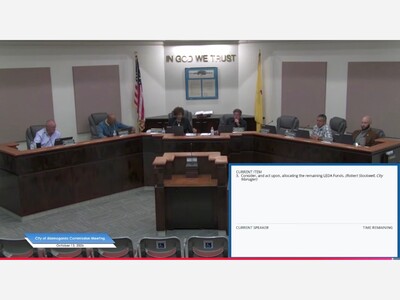
The Alamogordo City Commission meeting on June 23, 2026 revealed in vivid detail what happens when public bodies treat transparency and process as optional instead of essential.
A. From a Unanimous Vote for Dr. Hernandez to a Closed‑Door Settlement
On March 10, 2026, the Commission voted 7–0 in an open public meeting to direct staff to negotiate a permanent City Manager contract with Acting City Manager Dr. Stephanie Hernandez.
At that time there was no operational crisis:
- Dr. Hernandez had led the City for over two years;
- She had a clear transition plan prioritizing, in order:
- The budget,
- Ordinances,
- Hiring a new city manager;
- She had appointed the Chief of Police as Acting Assistant City Manager to support continuity.
City services were functioning. There was no emergency that demanded a rushed or irregular appointment.
Yet, after a series of closed executive sessions, the Commission never delivered the promised contract. On April 28, 2026, by a 4–3 vote (Commissioners Rardin, Burnett, Pattillo, and Al Hernandez in favor), the Commission instead chose to:
- Accept a settlement with Dr. Hernandez related to an EEOC administrative inquiry;
- End her 28‑month tenure as acting city manager;
- Abandoned, without explanation in open session, the unanimous public decision to hire her.
A full nine‑page employment agreement had been drafted for her after March 10. She never saw it.
B. The Dr. Hernandez Contract That Became the Stockwell Contract
Records obtained via the Inspection of Public Records Act and reported by 2nd Life Media show that the employment contract originally drafted for Dr. Hernandez was later repurposed for another candidate, Robert Stockwell:
- A redlined draft in the Stockwell file shows Dr. Hernandez’s name struck out and “Robert Stockwell” inserted line by line;
- The structure remained that of a standard permanent employee contract: at‑will employment, full benefits, retirement, deferred compensation.
The redline also reveals significant changes made to benefit Stockwell:
- Salary increased from $150,000 to $180,000;
- Start date shifted from March 10 to July 1, 2026;
- A city vehicle was swapped for a $500/month vehicle allowance;
- Health coverage was narrowed to employee‑only;
- A one‑time credit of 180 hours of PTO was added “in recognition” of his prior service;
- A new clause was inserted requiring quarterly executive sessions to review his performance.
At the June 23 meeting, Commissioner Josh Rardin publicly claimed that the Stockwell agreement “mirrored” the 2012 hiring of interim manager Bob Carter, and that the City had been “in a jam,” forced to act quickly and model the new deal on that earlier “emergency” arrangement.
The documents do not support that claim.
- The 2012 Carter agreement was a consulting contract—Carter was explicitly “not an employee.”
- Term: strictly interim, up to five months;
- Benefits: none—no retirement, insurance, PTO, vehicle, or severance;
- Termination: either side could end the contract on 10 business days’ notice.
- The 2026 Stockwell agreement is an employment contract—a permanent appointment with full benefits, enriched PTO, and six months’ severance for termination without cause.
If any template was used for Stockwell, it was Dr. Hernandez’s never‑offered contract, not Carter’s.
C. A Contract Approved Before the “Interview”
Emails fill in the rest of the picture:
- On June 12, 2026, Commissioner Baxter Pattillo emailed the commission a markup and “final” version of the Stockwell contract, stating these were the documents he had “brought to the last executive session” and that he had Bcc’d commissioners so they could review them.
- On June 16, 2026, Pattillo emailed HR Manager Osborn attaching a file titled “Stockwell Draft for Meeting,” adding that it had “gained the approval of both Mr. Stockwell and Brian Nichols,” though not yet signed, and asking that City Clerk Rachel Hughs place it on the June 23 agenda.
The June 15, 2026 executive session was noticed only as “Limited Personnel Matters.” Unlike a January 20, 2026 agenda that clearly stated “City Manager Interviews,” the June 15 notice did not tell the public that:
- A specific candidate would be interviewed;
- A candidate‑approved contract was already in hand.
By the time Stockwell met with the Commission in closed session on June 15:
- A near‑final contract, built from a never‑offered Dr. Hernandez agreement;
- Already approved by Mr. Stockwell and outside counsel;
- Had been circulated to the full commission in advance.
The “interview” followed the contract, rather than informing it.
D. The Edwards Case: Open Meetings Act Questions the Court Refused to Dismiss
In Edwards v. Alamogordo City Commission, Case No. D‑1215‑CV‑2026‑00514:
- A citizen challenges whether this hiring sequence complied with the Open Meetings Act.
- On June 25, 2026, District Judge Lori L. Gibson Willard:
- Rejected the City’s standing argument (the citizen can sue);
- Rejected the City’s mootness argument (the case is not over just because Stockwell is in office);
- Allowed the core Open Meetings Act claim to proceed to a hearing on the merits, denying only a temporary restraining order out of concern for leaving the City without a manager.
The court has not ruled on who is right. But it has already ruled that the questions about this process are serious and substantial, not trivial.
E. Culture and Conduct: The June 4 Airport Meeting
The culture that grows around such a process matters. On June 4, 2026, at an Airport Advisory Board meeting:
- District 5 Commissioner Al Hernandez, attending as an elected official, publicly described a city union representative as “getting stupid,” questioned her grasp of the budget, and blamed “the union” for public criticism over roads and recreation.
- He framed many failures as those of “the city” and “somebody,” speaking as if he were not part of the body that sets those priorities.
- He characterized engaged residents as a tiny, impossible‑to‑satisfy group;
- He criticized Mayor Sharon McDonald and local publisher Chris Edwards by name, suggesting residents were “believing crap” unless they called “somebody that actually knows”—meaning himself—while acknowledging he has not been proactive in providing information.
The official minutes later softened his remarks into generic “critical comments regarding union-related public statements” and omitted the personal insult and direct naming of individuals.
The recording tells one story. The minutes most residents will read tell a much paler one.
This is not just about tone. When elected officials:
- Belittle labor and engaged citizens;
- Blame the press and “the city” for problems they help create;
- Allow official records to minimize their own words;
they are modeling a view of government where accountability itself is the enemy.
Lesson from Alamogordo:
When “it’s legal” is used as a shield against transparency and honesty, legality without legitimacy is the result. And when power is used to retaliate against critics and to mislead the public about serious decisions, the foundation of consent begins to crack.
III. Roswell Revisited: National Security as a Justification for Secrecy and Coercion
At the “1947 Roswell UFO Incident – Revisited” program, constitutional law faculty and pre‑law students at the University of New Mexico turned an infamous story into a civics lesson.
They set aside the question “Do aliens exist?” and asked instead:
- If the eyewitness accounts from Roswell residents are true, what did that mean constitutionally in 1947?
- If something similar happened today, would the same abuses repeat in 2026?
A. Major Marcel and the Official Lie
In July 1947, the Roswell Army Air Field (RAAF) issued a press release saying it had captured a “flying saucer.” The next day, the story changed: it became a “weather balloon.”
Major Jesse Marcel, the intelligence officer at Roswell, later testified that:
- He personally went to the crash site;
- The debris he saw was unlike anything he knew on Earth—light, foil‑like material that could not be bent, even with a sledgehammer;
- He was ordered to call it a weather balloon;
- General Ramey told the media what it was “and to forget about it.”
Attorney Peter Gersten, digging through declassified files years later, found an FBI memo describing the object as an “experimental terrestrial kite.” Brigadier General Thomas DuBose confirmed that the weather‑balloon story had been a deliberate cover to keep the press away.
The constitutional question is not about spaceships. It is whether the government may knowingly lie to the public as a matter of policy “for national security.”
B. Frankie Rowe: Intimidation of a 12‑Year‑Old
The testimony of Frankie Dwyer Rowe, 12 years old at the time, goes deeper.
- Her father, a firefighter, went to the crash site and came home convinced the object “was from somewhere else.”
- He described two bodies and one small being alive, “like a child of the earth” insect.
- A state trooper later brought strange debris to the fire station, which Frankie handled.
- Soon after, military police came to her home. One had the family sit while he stood over them. He told her:
- “I understand you were at the fire station the other day.”
- When she admitted it, he said: “You were never there.”
- When she insisted she had handled the material, he repeated: “No, you didn’t. You were not there.”
- As she tried to hold to the truth, he escalated:
- Threatening with a billy club;
- Saying her family could be sent to separate POW camps;
- Making clear that speaking about what she saw could cost her freedom or life.
She stayed silent for decades. She told her husband and children only late in life. Near the end, the son of that military man came and apologized. She forgave him.
Her story is not about UFOs. It is about coercion of citizens by their own government.
C. The Law of Secrecy: Reynolds and Snepp
The panel connected Roswell to two key Supreme Court cases:
- United States v. Reynolds (1953) – The Court allowed the government to withhold an accident‑report evidence from widows of civilians killed in a B‑29 crash, accepting a “state secrets” claim without reviewing the documents itself.
- Snepp v. United States (1980) – The Court upheld restrictions on a former CIA employee’s book, enforcing secrecy agreements and signaling broad deference to national security claims.
Together, they show how, over time, courts have often sided with government secrecy over the public’s right to know.
In New Mexico today, echoes of that same tension appear whenever public bodies invoke process or necessity to shut the public out of decisions—whether in a nuclear‑age crash on a ranch or a modern‑day city manager contract quietly reshaped behind closed doors.
Lesson from Roswell:
Once “national security” or “we know best” is accepted as sufficient to justify lying, silencing, or intimidating the public, the default shifts. Secrecy becomes normal. The burden falls not on the government to justify its secrecy, but on the public to prove it deserves the truth.
IV. Mount Cristo Rey: Sacred Land, Border Walls, and Federal Power
The struggle over Mount Cristo Rey brings these themes into stark relief at the border.
- The mountain sits where New Mexico, Texas, and Mexico meet.
- At its summit stands a limestone statue of Christ the King.
- For decades, thousands have made pilgrimages there, crossing human boundaries in faith.
The federal government now seeks to seize approximately 14,259 acres of diocesan land surrounding the mount to construct a border wall.
For the Diocese and pilgrims, this is not an ordinary land acquisition:
- It threatens the integrity of a sacred shrine;
- It interferes with religious practice and communal pilgrimage;
- It conflicts with Catholic teaching on the dignity of migrants and the sanctity of worship.
From a constitutional and moral standpoint, this raises urgent questions:
- Takings Clause (Fifth Amendment): Is it truly “for public use,” and is “just compensation” meaningful, when what is taken is not only land but a living place of worship and identity?
- Free Exercise Clause (First Amendment): Does militarizing a sacred mount and constricting access impose a substantial burden on religious exercise?
- Freedom of movement and assembly: What happens to the right of peaceful religious assembly when faith communities are fenced in—or out—by federal infrastructure?
Lesson from Mount Cristo Rey:
Even in the name of national security, government power has limits when it collides with religious liberty, property rights, and the dignity of communities. When those limits are ignored, people of conscience have a duty to walk, speak, and witness.
V. Connecting the Dots: A Pattern of Overreach
Across these four stories—IPRA, Alamogordo, Roswell, and Mount Cristo Rey—a pattern emerges:
- Opaque processes justified by “efficiency” or “emergency.”
- IPRA overload becomes an excuse to question access instead of fixing systems.
- The Stockwell hiring is framed as a “crisis” mirroring a 2012 emergency, though the record shows a slow, pre‑decided pivot from Dr. Hernandez’s never‑offered contract to an enriched Stockwell deal.
- Information used as a tool of control.
- At Roswell, citizens were told to say they were “never there.”
- In Alamogordo, a former mayor’s utility account was read from the dais to shame her after she challenged a commissioner.
- At the Airport meeting, union leaders, engaged residents, and the press were portrayed as part of the problem.
- Legality invoked without ethics.
- “It’s legal, not transparent,” as one commissioner summarized a prior appointment.
- “No requirement” for a formal hiring process is cited, even as the City’s own Employee Manual and Open Meetings Act set clear expectations.
- State secrets doctrine is treated as a black‑box shield, with little space for independent oversight.
- Power without ownership.
- Officials speak of “the city” as if it were someone else, even while they vote on budgets and contracts.
- At the border, “national security” is invoked without fully owning its impact on living communities of faith.
The framers of the Constitution anticipated this. They did not trust human nature with unchecked authority. They believed in higher law—a Supreme Being—and built:
- Checks and balances;
- Separation of powers;
- Rights that do not depend on government permission.
Their system assumes that ordinary people must watch, question, and, when needed, correct their public servants.
VI. Recommendations: Building Constitutional Transparency in New Mexico
1. Reform IPRA Without Sacrificing the Public’s Right to Know
- Modernize records systems to reduce repetitive, manual work;
- Use proactive disclosure (posting commonly requested documents online);
- Support adequate staffing and training for records officers;
- Address clearly abusive patterns narrowly, without undermining legitimate oversight.
2. Codify Transparent Hiring Practices in Alamogordo
- Require written job qualifications and a clear, published process for key positions;
- Use consistent agenda language when interviews or key decisions are occurring;
- Place full contract drafts and redlines on the public record in advance whenever feasible;
- Adopt explicit rules against using individualized information (like utility accounts) to retaliate against critics.
3. Take the Open Meetings Act Seriously
- Treat the Open Meetings Act as a floor, not a ceiling:
- When in doubt, notice more clearly, not less;
- Avoid circulating near‑final contracts to a quorum by email outside of public view;
- Describe executive session topics with enough specificity that the public can understand what is at stake.
- Provide public briefings whenever a court keeps an Open Meetings Act challenge alive, explaining what steps will be taken to ensure compliance.
4. Cultivate a Culture of Respectful Accountability
- Train elected officials on the City’s Code of Conduct, with real consequences for violations;
- Model respectful engagement with unions, engaged citizens, and the press;
- Correct minutes that materially soften or misrepresent what was actually said;
- Encourage, rather than fear, hard questions from residents.
5. Defend Sacred and Community Spaces
- Support legal challenges, when appropriate, to overbroad federal takings that burden religious exercise;
- Build coalitions across faiths and civic groups to affirm that sacred sites are part of the common good, not expendable terrain;
- Use peaceful public witness—pilgrimages, processions, prayer, and public testimony—to remind officials that some values are older and higher than any single policy.
VII. Epilogue: A Pilgrimage in the Border Heat
On June 28th, I joined hundreds of others climbing Mount Cristo Rey in 100‑degree heat.
The mountain sits where New Mexico, Texas, and Mexico meet, crowned by a limestone statue of Christ the King. People have been coming there for generations—not to pass legislation or file lawsuits, but to walk in faith, to pray, to seek healing, to remember that there is a law above every human law.
As we climbed, I thought of a line often attributed to Woody Allen:
“If you want to make God laugh, tell Him your plans.”
Under the desert sun, surrounded by families, elders and children, I felt that God has been laughing at human plans for a very long time—not because law and borders do not matter, but because they are never ultimate.
Step by step up that steep path, I thought of Christ carrying the cross to Golgotha, and I felt that I too was carrying a kind of cross: the weight of what our communities are now facing—secrecy presented as necessity, power presented as crisis, neighbors treated as threats, sacred spaces treated as negotiable assets.
I suffered on that climb. But there was also joy.
Joy in knowing that, as Americans and as people of faith, we are still capable of rising together to live the commandments we claim to honor:
To love God with all our heart, soul, mind, and strength,
and to love our neighbors as ourselves.
If we hold to that, the rest will follow.
The stories in this paper—from record rooms and commission chambers to a crash on a ranch and a shrine on a border mountaintop—are not ultimately about villains and heroes. They are about a choice each of us must make:
- Will we accept a government that hides and deflects, that treats scrutiny as an attack and power as its own justification?
- Or will we insist on a government that tells the truth, honors conscience, respects sacred places, and remembers that authority comes from the people and is bound by the Constitution?
New Mexico cannot rewrite the Constitution. But we can remember why it was written: because the framers knew that human beings are tempted by power, and that only a vigilant, informed, and morally grounded people can keep that power in its proper place.
The climb up Mount Cristo Rey was a reminder that the path is steep. But we do not walk it alone.

 63° and Cloudy