
 45° and Clear
Image



Alamogordo N.M. - Delayed meter reads left many of Alamogordo and Ruidoso households with a single bill covering two months of summer power. Here is what happened, how the rate tiers actually work, and what you can do about it.
To many households across Alamogordo, Ruidoso, and Tularosa opened their mailboxes this month to a Public Service Company of New Mexico bill roughly twice the size of anything they had seen before. Some totals ran past $450 for customers accustomed to paying in the low $200s.
The cause was not a rate hike buried in the fine print, and it was not a metering error. It was a staffing shortage in PNM's meter reading operation that pushed bills off schedule and, for many customers, folded two months of the hottest weather of the year into one statement with some meter readings estimated.
PNM says 8,764 meters are in the area with many placed on estimated or delayed billing after the company began estimating reads on July 21. The utility notified customers of the problem on August 3, roughly two weeks after estimation began, and says the staffing shortages have since been resolved.
For households on tight monthly budgets, the arithmetic of a combined bill is punishing regardless of whether it is calculated correctly. A bill that should have arrived as two payments of about $240 instead arrived as one demand for $477.
Much of the confusion and anger circulating locally stems from a genuine misunderstanding of PNM's tiered pricing.
It is worth walking through carefully, because the structure is not intuitive and PNM's bill does very little to explain it.
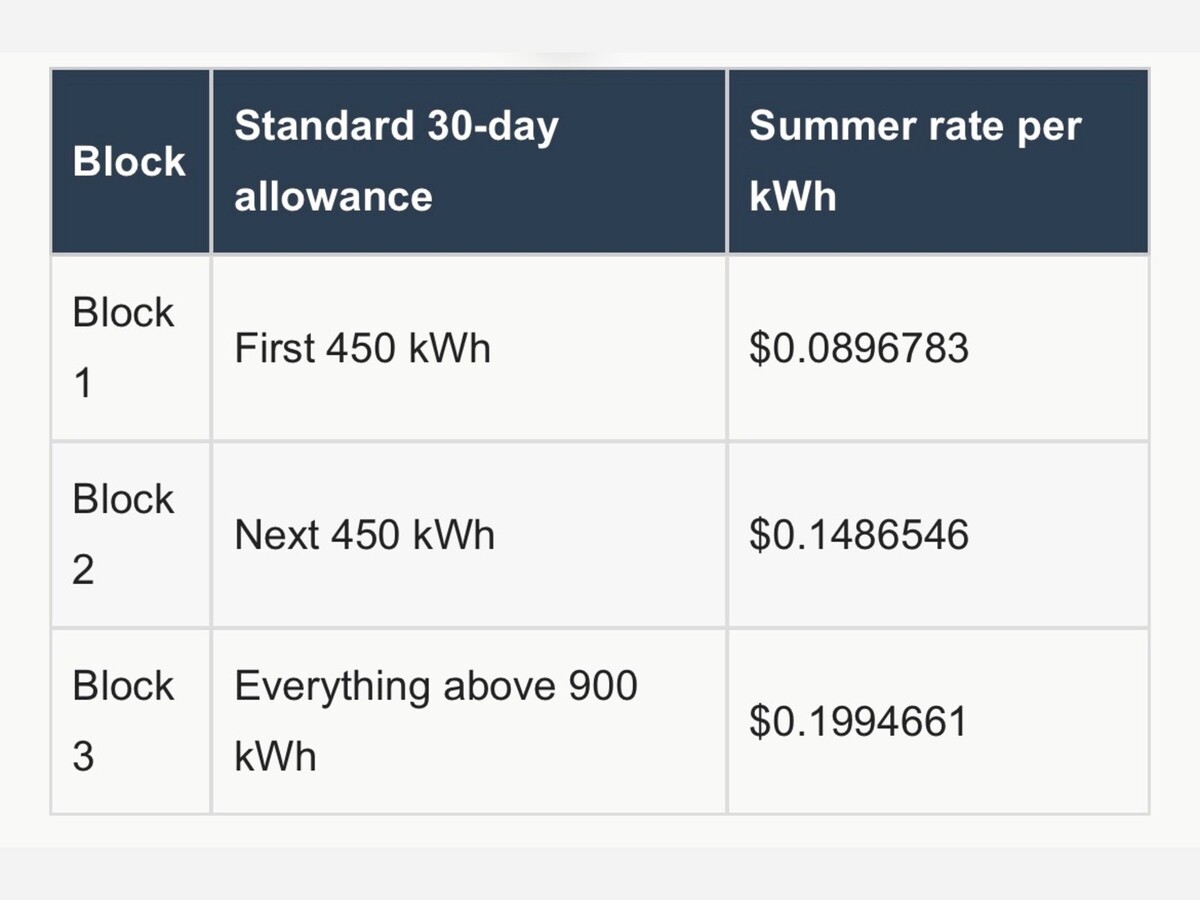
Residential customers on Rate 1A are billed in three blocks, with the price per kilowatt-hour climbing as usage rises:
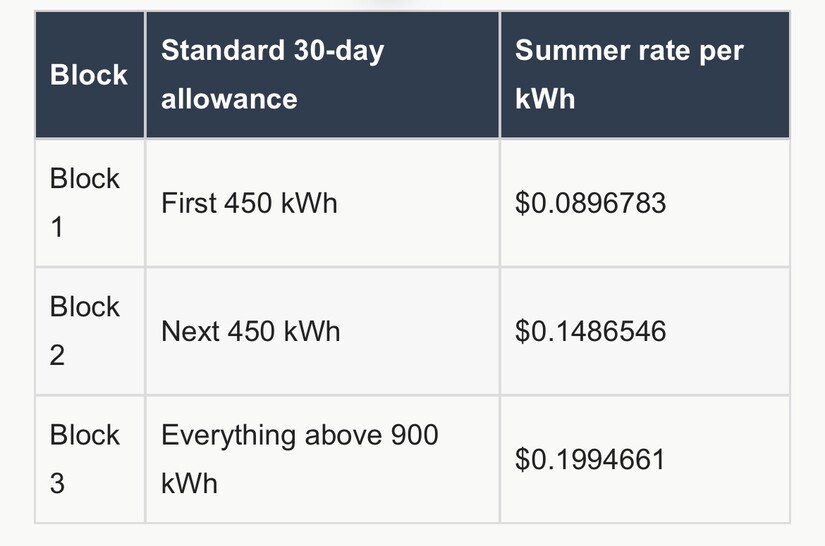
Block 3 power costs more than twice what Block 1 power costs. The structure is deliberate: it is designed to reward conservation and penalize heavy consumption.
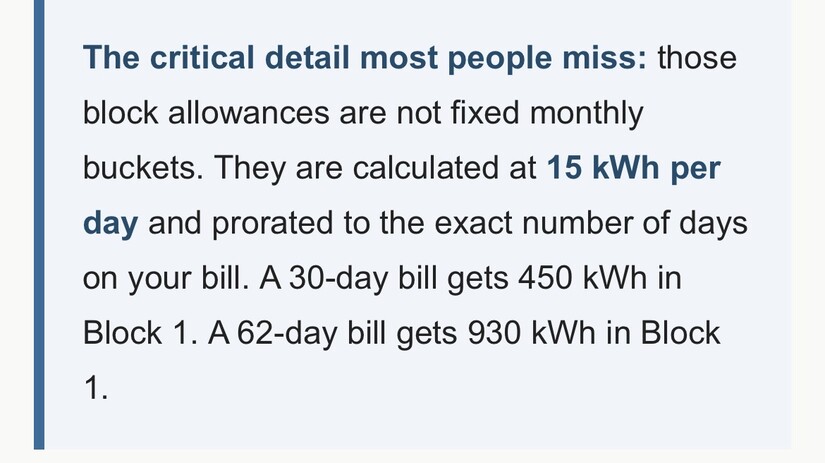
This proration is the mechanism PNM referred to when it told state regulators that on a multi-month bill, "your energy usage will be spread across the applicable billing months before charges are calculated.
The wording is accurate but nearly opaque to anyone who is not a rate analyst, and it appears nowhere in plain language on the bill itself.
One Alamogordo household provided its August statement for this article. The meter was read on August 10 covering 62 days and 2,397 kWh — an average of 38.7 kWh per day, consistent with running air conditioning through a record-hot summer.
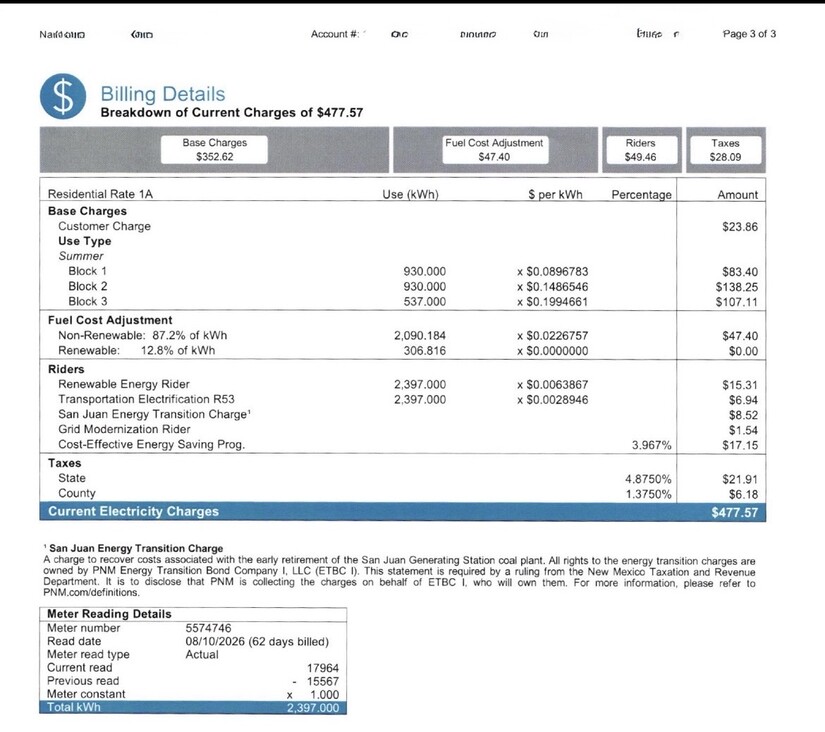
Because the billing period ran 62 days, each block allowance was doubled:
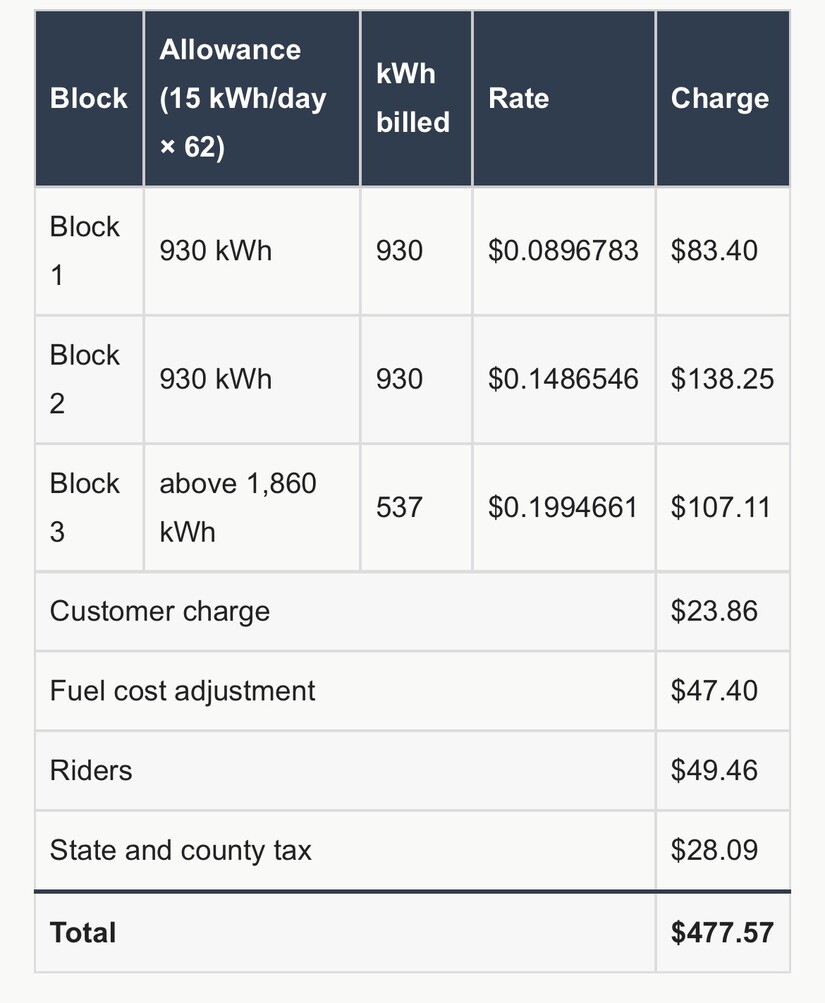
This is the question nearly every affected customer is asking. We ran it both ways.
Split into two 31-day periods at 1,198.5 kWh each, each month would have been allotted 465 kWh in Block 1 and 465 kWh in Block 2, with the remaining 268.5 kWh landing in Block 3.
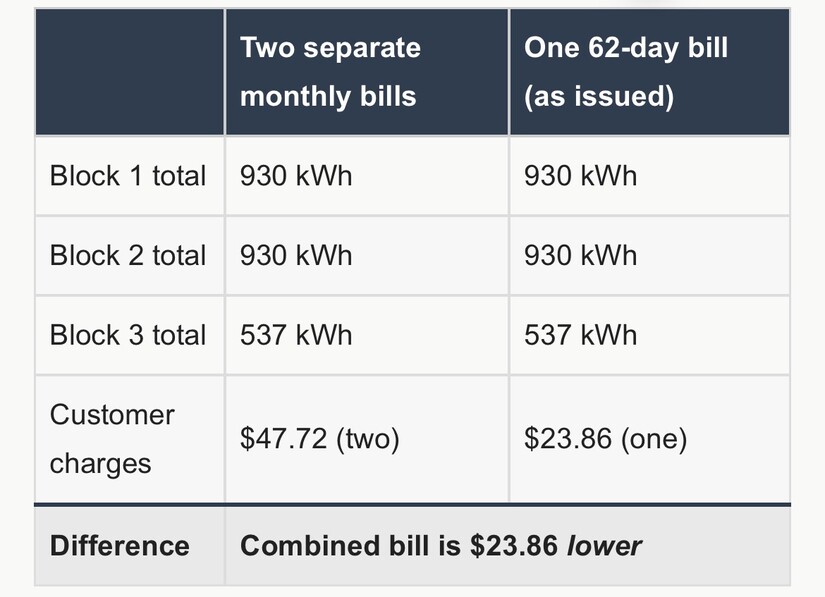
Though there is sticker shock by a combined bill it is actually $23.86 lower
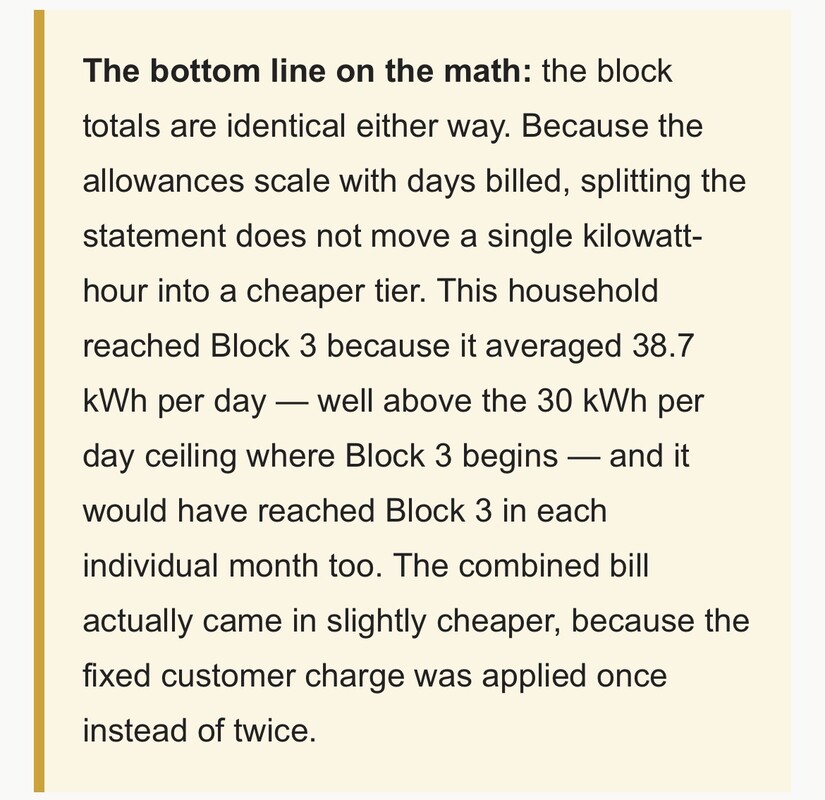
For moderate users, day-based proration is genuinely protective. A household averaging 23 kWh per day — about 700 kWh in a normal month — would use roughly 1,400 kWh over 62 days. Under a fixed 900 kWh ceiling, 500 kWh would have been dumped into the most expensive tier. With proration, that household stays entirely in Blocks 1 and 2 and pays nothing at the Block 3 rate.
The customers hit hardest by combined bills are the heaviest users, who were already in Block 3 every summer month and now see two months of it at once.
Several pressures landed simultaneously this summer, and the delayed bill concentrated all of them into one envelope.
The charges on these bills appear to be correctly calculated under the tariff on file with state regulators. That does not make the episode a non-story.
PNM's meter reading operation failed for a period of weeks, and the resulting cash-flow shock was absorbed entirely by customers. A household that budgets $240 a month for power does not have $477 available on demand simply because the arithmetic is defensible.
The communication failure compounded it. The bill shows "930.000" next to Block 1 with no indication anywhere on the statement that the figure represents 15 kWh per day across 62 days. A customer who knows the standard allowance is 450 kWh sees a number they cannot reconcile and reasonably concludes something is wrong. That confusion has driven a wave of local speculation about deliberate overcharging.
PNM could have prevented nearly all of it with one line of plain text on the affected bills explaining that block limits were doubled for the extended period. It did not.
Alamogordo Town News is continuing to report on this and is seeking answers on several points. We have been in contact with the leadership of PNM to get clarity and bring accurate information to consumers from PNM leaders. We will have a follow- up statement from PNM on Tuesday afternoon regarding…
If your PNM bill covered more than one month, or if you received an estimated read you believe was inaccurate contact PNM.
Methodology: Block thresholds and the 15 kWh per day proration were verified against PNM's published Rate 1A tariff and the company's own bill definitions, which state that the first two blocks are billed up to 450 kWh each with the third block covering usage above 900 kWh. Charges were recalculated independently from an actual customer statement. Usage and rate figures come directly from that bill. PNM's account of the staffing shortage, the estimation start date, and the 8,764 affected meters comes from the company's written response to the New Mexico Public Regulation Commission.
Correction: An earlier version of this report that was not yet validated was published but not pushed for wide release for 3 hours in error, and stated that PNM had improperly shifted usage into higher rate tiers by combining two billing periods. That was incorrect. PNM prorates block allowances by the number of days billed, and the charges reviewed were consistent with the filed tariff. Alamogordo Town News regrets the error, as soon as the error was confirmed, the story was corrected as per above. We regret and apologize for any error in our understanding of the tier 1 limits.

a worthwhile attempt to explain an unfortunate situation, that was combined with a billing system not easily understood. and, yet another opportunity to state that both electrical power generation and public water reserves are limited resources - and data centers should never be allowed access to either.


Received that crime flyer in the mail today. Wow! Mudslinging V2.0 by the blockheads as usual.

Sunny, with a high of 61 and low of 43 degrees. Sunny in the morning, clear in the afternoon and evening,

Couple of people around Santa Fe have told me her highness has been sucking up hard to Ant to get on to a staff job when his pending doom curtain closes here. Queens never learn to really be honest. It's just in their realm of mental health. They live in denial and have pent up retentive r.e.c.t.u.m.s.
His money would have been better spent listing all of his accomplishments while in office. Oh, wait……
Voted twice against the low-income utility rate bill (HB 91) and sponsored the failed 2026 tax on renewable generation (HB 113) which the state confirmed would have further raised PNM rates. We know who has you in their pocket Block. Stop the **** lies!


For those of the civilian public to understand. Every single Airman, marine, sailor and soldier whether Active duty or reserve or national guard has had explicit training on the UCMJ and illegal orders. This includes every “veteran for peace” It is political plain and simple.
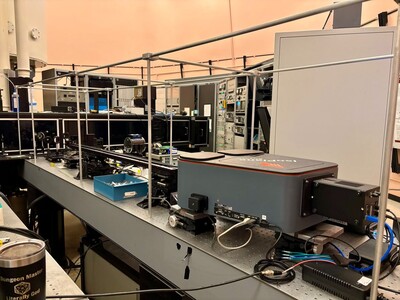
Is there any chance that the Forest Service will allow Sunspot to remain open, after the demolition is completed?

Million-nine for the bakery, million for a theatre scam. These uneducated skells pass out money to sheis for what? They're not even good ideas. 3 mil and they don't know? Why doesn't we hire out side auditor like the FBI?
All that tax money. Is it true that Brien Caesar bought a four hundred k condo in wyoming last year? Heard, it's near Jackson. Someone put that stuff through. No wonder they change managers so often. Once a deals's done you don't have to stick around in this burg anymore.



Graphs lernt in grad school look like kinder. Has money from deals done too probably. Otherwise, would be working instead of lecturing us all.