
 67° and Cloudy
Image
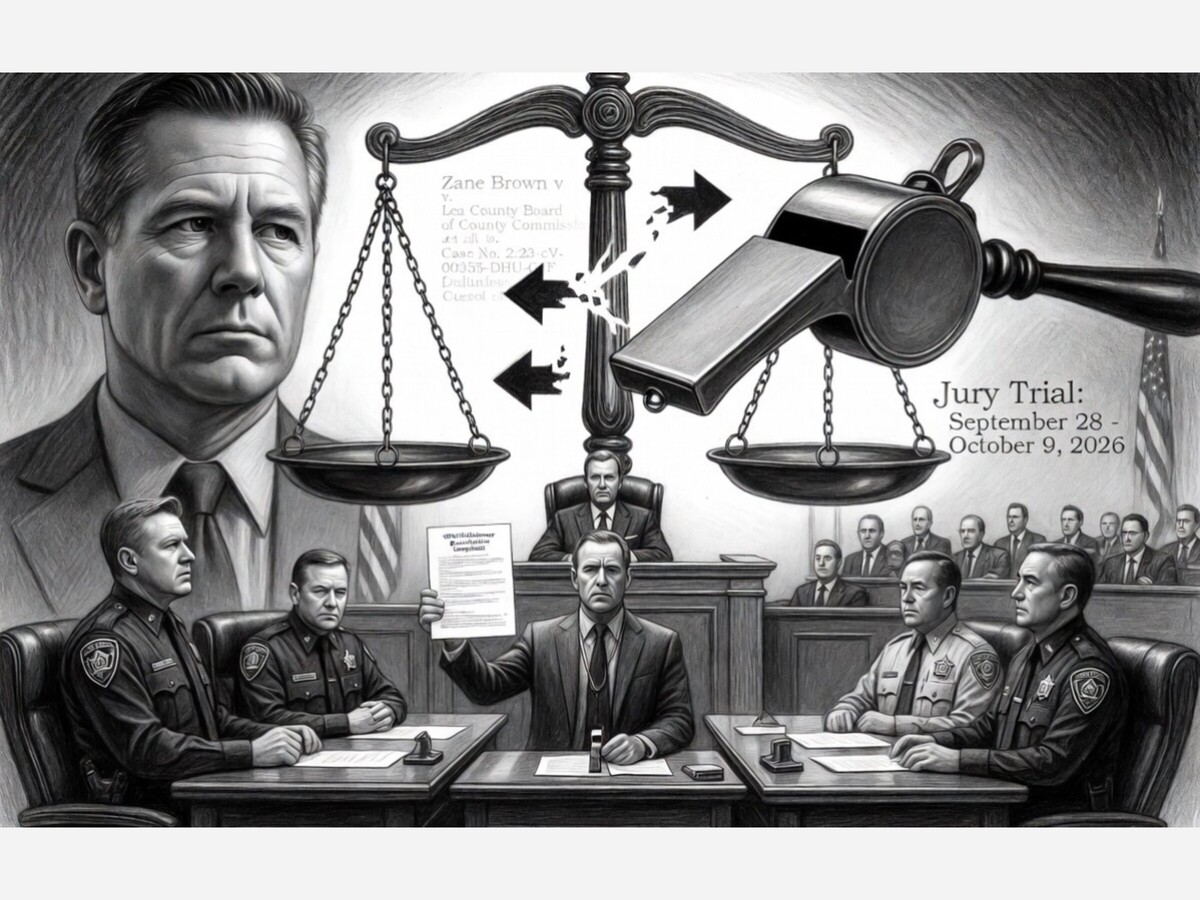



A federal jury will decide whether Lea County retaliated against a former sheriff’s deputy for reporting misconduct within his own department, after a trial scheduled to begin September 28, 2026, survived the county’s attempts to have it dismissed or delayed.
The case, Zane Brown v. Lea County Board of County Commissioners, Corey Helton, and Michael Walker (Case No. 2:23-cv-00355-DHU-GJF), will be heard by Judge David Herrera Urias at the Pete V. Domenici United States Courthouse in Albuquerque. According to a Second Amended Trial Notice filed July 8, the trial is expected to run through October 9. The only change from the previous schedule was a one-week shift in the start and end dates; all other pretrial deadlines remain in place, including a pretrial conference set for September 3.
What the case is actually about
According to court records, Zane Brown worked as an officer at the Lea County Sheriff’s Department (LCSD) in Hobbs, New Mexico, for multiple years without any problems. The trouble began, Brown alleges, after he reported wrongdoing by the Lea County Sheriff and other LCSD officials.
From there, Brown claims a pattern of retaliation:
• He was hit with several “baseless” write-ups and became the target of multiple internal investigations and complaints.
• Undersheriff Michael Walker eventually demoted him — which Brown alleges came after Walker learned Brown had participated in a complaint against Walker himself.
• When Brown tried to find work outside the department, he alleges LCSD officials made sure he wouldn’t get hired elsewhere.
• When Brown tried to file a formal complaint against Walker, the county’s HR director allegedly blocked him from doing so.
• The county manager allegedly knew about this conduct but did nothing to stop it.
Brown sued under 42 U.S.C. § 1983, the primary federal statute allowing individuals to sue government officials for constitutional violations, and the New Mexico Whistleblower Protection Act. At its core, this is a retaliation case — not a use-of-force or public-misconduct case. The central allegation is that Brown was punished internally, professionally and financially, for reporting problems within his own department.
How the case survived toward trial
In a March 2024 ruling, Judge Urias dismissed the Sheriff’s Department itself as a defendant, since police departments generally cannot be sued directly under § 1983 — only the county can. But the judge found Brown’s claims against Lea County plausible enough to proceed, ruling that Brown had adequately alleged both a pattern of retaliatory practice and a direct link between that practice and his injuries. That ruling cleared the way for the case to move toward the jury trial now scheduled for this fall.
Part of a broader pattern of litigation
Brown’s lawsuit is one of several federal civil-rights cases Lea County and its Sheriff’s Office have faced in recent years.
The most prominent is Tello v. Lea County Board of Commissioners, filed in 2024 by former deputy Karina Tello after a 2023 scandal in which colleagues shared an explicit video of her without her consent. Tello alleged wrongful termination and a failure of department leadership to properly investigate or involve state police. The video was reportedly circulated to several people, including Tello’s fiancé, a coworker’s wife, and senior officials within the department — among them Sheriff Corey Helton. Tello’s attorney characterized the department’s response as refusing to investigate the underlying conduct, declining to discipline those responsible, and blaming the victim. The Sheriff’s Office denied the allegations at the time. That case has since been resolved: Lea County agreed to pay $3 million to Tello over the fallout.
The county has also faced other federal civil-rights suits in the same window, including White v. Board of County Commissioners of Lea County (filed 2023).
Taken together, the cases point to a recurring theme in litigation against Lea County’s Sheriff’s Office: allegations that employees who report misconduct or become entangled in it face professional retaliation rather than institutional accountability.
What’s next
With motions to dismiss and delay both denied, the case now heads toward a September 3 pretrial conference, followed by jury selection and trial beginning September 28. As with any pending litigation, the allegations against Helton, Walker, and the county are unproven claims that a jury — not the public — will ultimately decide.
Note: As with any active civil litigation, the claims described above are allegations from court filings and have not been proven at trial. Case citations and quotations are drawn from published court opinions and news reporting as of July 2026 for 2nd Life Media Alamogordo Town News.



Sunny, with a high of 75 and low of 55 degrees. Sunny in the morning, cloudy for the afternoon and evening, clear overnight.


Writing up the incompetence is transparency. Here's how a real professional does it --
I applied for a water job three months ago, and as I was leaving the building, some lady walking next to me said: "You'll never get in because you're not one of them Alamo-Gorditas." I thought everyone in City Hall is 50 pounds overweight, has a terrible haircut, and wears awfully dirty old clothes.



thank you once again, for fighting for access to public records in this and many other situations - democracy truly dies in darkness.
i would not be surprised to learn the capture was not coordinated with any local LEO - that would be consistent with recent history of ICE. it will be instructive to see if the sheriff's department/county administration choses to respond to a request for a clarifying statement.