
 69° and Light drizzle
Image
Eight Months, No Meter: Timberon’s Waiting List Has No Filing, No Vote, and No Explanation - AlamogordoTownNews.org



On Aug. 6 the PRC confirmed Timberon opted into its jurisdiction — the only political subdivision among roughly 26 water utilities it regulates. Under the Water and Sanitation District Act, the power to set connection rules belongs to the elected board, not to staff. Neither a commission filing nor a board vote has been produced.
By Chris Edwards | Alamogordo Town News | August 20, 2026
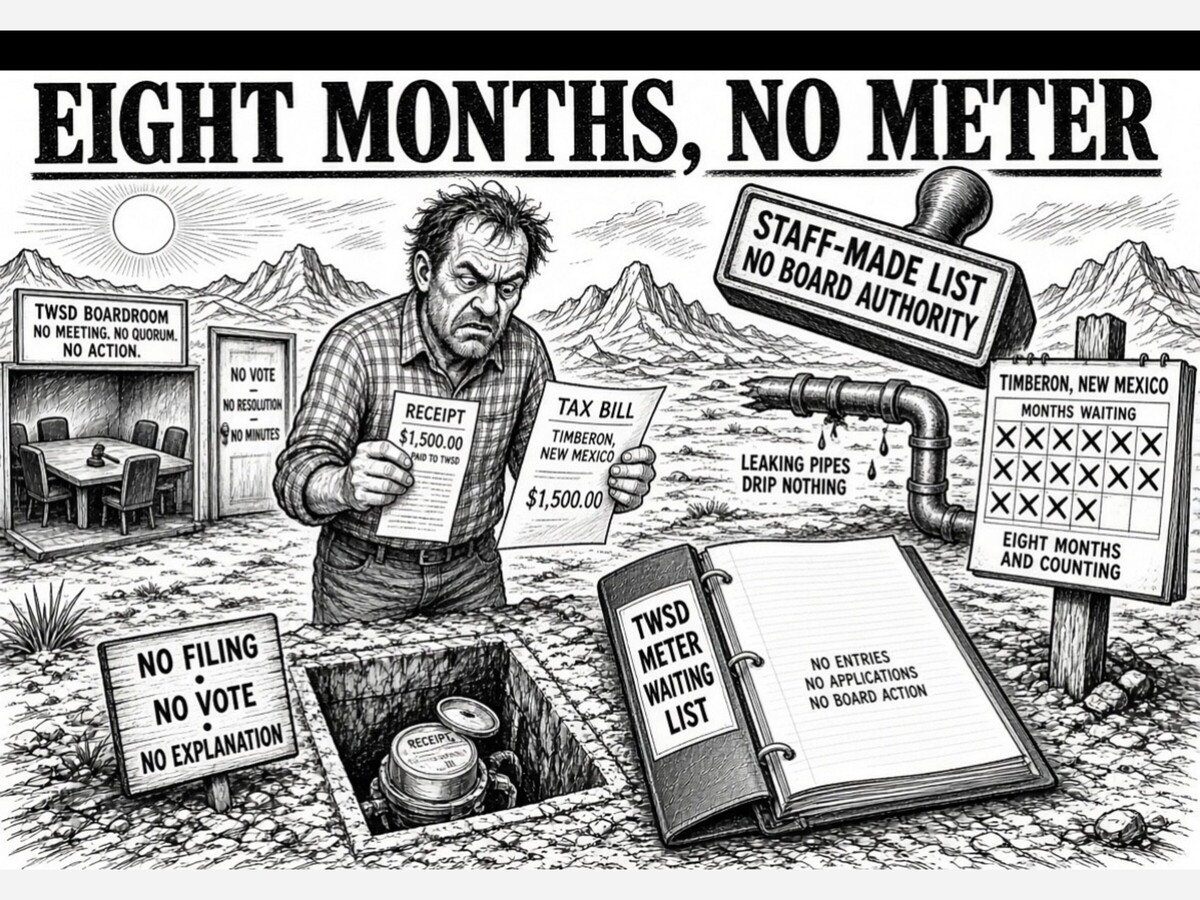
TIMBERON — A Timberon property owner has been waiting roughly eight months for a water meter. They have paid. They have been told there is a list. They cannot get a call back.
Now they are pricing out a storage tank and hauled water, because the alternative is a lot they cannot use. No meter means no water. No water means no functioning septic system. A parcel with neither is not a homesite — it is a tax bill.
“You buy a lot that’s advertised as having water available, you pay the standby charge every year, and then you find out there’s a list nobody told you about,” another property owner said. They asked not to be named, citing concern about further delay and harassment by some locals loyal to the TWSD.
The waiting list is the story.
Not because a small mountain utility with failing pipes has no legitimate problems — it plainly does — but because of who created the list, under what authority, and whether that authority was ever exercised in public.
The regulator has settled the threshold question
Until this month, one point could fairly have been argued: whether the Timberon Water and Sanitation District is a regulated utility at all.
TWSD is a political subdivision organized in 1992 under the Water and Sanitation District Act, NMSA 1978, Sections 73-21-1 to 73-21-55. Water and sanitation districts are not automatically regulated. Section 73-21-55(A) provides that a district may elect, by resolution of its board of directors, to become subject to the jurisdiction of the Public Regulation Commission and to the Public Utility Act. Absent that election, the commission’s reach is narrow — a 1971 attorney general opinion, cited in the annotations to both Section 62-6-4 and Section 73-21-16, concluded that the Legislature left such districts under commission authority only as to approval of the board’s rates, tolls and charges.
That argument closed on Aug. 6. At a PRC special meeting, Legal Division staff identified Timberon as the only political subdivision among roughly 26 water utilities the commission regulates, and stated that the district had opted into commission jurisdiction. “Timberon is a unique utility that we regulate,” staff said.
The election under Section 73-21-55(A) is therefore not in doubt, and neither is what follows from it. The Public Utility Act’s service and rate obligations now govern how this district treats the people it is supposed to serve. Commission staff described the finding as the foundation for potential PRC action on rates, tariffs, service adequacy and reporting requirements, even though the district’s roads, golf course and recreation operations fall outside that scope.
One precision point belongs here, because it cuts the other way. Section 73-21-55(A) contains an express carve-out: “in no event shall Sections 62-9-1 through 62-9-7 NMSA 1978 apply to any district making such an election.” Because TWSD is a district that made such an election, the Public Utility Act’s abandonment and certification provisions do not reach it. There is no abandonment proceeding here and no requirement to file one — a point earlier reporting in this series stated incorrectly, and which is corrected now.
That narrows the legal picture. It does not empty it. Every other duty remains, and one of them does not run through the commission at all.
The power to set connection rules belongs to the board
Section 73-21-16 enumerates the general powers of a water and sanitation district. Subsection L gives the board the power to fix and adjust water and sewer rates, tolls and charges, including standby charges. The same subsection provides that the board shall “prescribe and enforce rules and regulations for the connection with and the disconnection from properties of the facilities of the district.”
Read that again: the board. Not the general manager. Not the billing office. Not a retired employee offering guidance to a successor.
A decision to stop accepting or fulfilling meter requests is a rule regarding connection to the facilities of the district. Under the statute, that is a board function. If the TWSD Board of Directors adopted such a rule, there should be a resolution, a motion, a vote, and minutes. If it did not, then whoever imposed the waiting list exercised a power the Legislature assigned to the elected board.
That also implicates the Open Meetings Act, NMSA 1978, Sections 10-15-1 to 10-15-4, which requires that policy be formed by a public body in meetings open to the public. The TWSD board meets on the second and fourth Tuesday of each month.
Alamogordo Town News has reviewed no minutes reflecting such a vote, and the district has not identified one.
What the filed tariff says — and does not say
TWSD’s tariff contains no moratorium, no waiting list, no cap on connections, and no declared capacity limitation. Rule No. 8 permits the district to set the point of service and to deny an individual meter or line-extension request where added demand would threaten existing customers — a case-by-case determination, made on facts, about a specific property. Rule No. 17 governs line extensions and who pays for them. Neither authorizes a blanket, indefinite halt.
Section 62-8-7(B) governs changes to established charges: no change except after 30 days’ notice to the commission, with proposed changes shown by filing new schedules kept open to public inspection. The Public Utility Act’s architecture is consistent throughout — terms of service live on paper at the commission, and they change on paper at the commission.
A moratorium on new connections is a change in the terms on which the district serves the public. It belongs in a filing. Alamogordo Town News has identified none.
The criminal statute nobody mentions
NMSA 1978, Section 30-13-2 makes denial of service by a utility a petty misdemeanor. The statute defines the offense as a utility refusing to furnish service to another in the area served by that utility, and defines “utility” as any person furnishing water, power, telephone or gas to the public.
It then lists, exhaustively, when refusal is lawful: where the person has not tendered the money required for the expense of construction, if construction is necessary; or where the person has not tendered the amount due for use of the utility.
That is the entire list. The applicants on this waiting list have tendered — $1,500 apiece, in most cases, plus any standby arrears the district required them to clear first.
Two caveats belong here. A 1969 attorney general opinion recognized a defense where a utility refuses service under commission rules because of a genuinely hazardous condition, while placing the burden on the utility to prove both the hazard and the existence of the rule. And whether a special district constitutes a “person” within the meaning of Section 30-13-2 does not appear to have been squarely decided by a New Mexico appellate court. Alamogordo Town News is not aware of a reported prosecution under this section against a water and sanitation district.
It remains on the books, and it remains the only statute in New Mexico that addresses refusal of water service in plain terms.
The $1,500 already collected
The money is the sharpest edge, because it is documentary. Either a meter was installed or it was not.
The $1,500 charge is itself PRC-approved, and that is not in dispute. Approval of an amount is not approval to retain the amount indefinitely without performing the work it was collected for. Charges sit at the core of the commission’s authority over this district, which makes this the most clearly PRC-cognizable question in the matter.
A records-based regulatory analysis prepared for Alamogordo Town News draws the distinction. TWSD’s First Revised Rule No. 6 states that no security deposits will be required and that any held must be returned with accrued interest. A properly identified installation charge is not a prohibited deposit — but substance controls over labeling. Calling money an installation charge does not license a utility to treat it as an open-ended reservation fee, or as working capital, when no installation follows.
● Where a main and usable point of service already exist, advance collection may be permissible — provided the district installs within a reasonable period, documents a legitimate delay, or refunds the unearned payment.
● Where no main exists, the district should identify the required line extension under Rule No. 17 or deny the request under Rule No. 8, rather than bank $1,500 against a connection it has no plan to make.
● Where the district knew installation was unavailable and accepted payment anyway — particularly if the applicant was told it would occur — the analysis identifies that as the strongest potential violation.
● Prompt refund after a denial is substantially more defensible, because no unearned charge is retained.
Three statutes bear directly. Section 62-8-1 requires every rate demanded or received to be just and reasonable. Section 62-8-2 requires adequate, efficient and reasonable service. Section 62-8-6 prohibits unreasonable preference or disadvantage in rates or service — the provision that surfaces the moment some applicants receive meters while others, similarly situated, wait on an unwritten list with no published criteria.
There is an accounting dimension as well. Until installation occurs, the payment arguably belongs on the books as an advance or customer liability rather than earned revenue.
How the district recorded, deposited, spent or refunded these payments — and whether a work order was ever opened — is documentary, discoverable, and public.
Where the list came from
Messages reviewed by Alamogordo Town News suggest the policy was improvised rather than adopted.
In one exchange, a person familiar with district operations stated that a staff member “has come up with a way to create a waiting list for water meters,” adding that “there will still be a wait on them and the requests will be done in order.” In another conversation it was relayed that a former billing employee had told the current manager she “didn’t have to take requests for new meters,” and said changing that would take time.
The district’s problems are real and documented. Residents describe water loss approaching 70 percent of production — a figure Alamogordo Town News has not verified and which the district has not provided. TWSD operates roughly 80 to 100 miles of line, two wells, a springs collection, a filtration plant, five storage tanks and four lakes for about 800 meters, with approximately eight employees. In a December 2010 emergency rate order, the PRC documented roughly $275,000 in past-due standby accounts and warned that district management might lack the experience to overcome what it called years of mismanagement and neglect.
The present is no better. As this article goes to publication, Timberon is under a boil water advisory running through Aug. 21 after E. coli was detected in special samples taken during line repairs. Residents have been told to boil water before using it.
The Aug. 6 meeting put the pattern on the record. The PRC’s Consumer Relations department reported seven outage and service-quality complaints involving Timberon in 2026 alone. New Mexico Environment Department Drinking Water Bureau Chief Joe Martinez identified the district specifically as a system beset by recurring emergencies tied to water loss and management failure. Of more than 50 drinking-water emergencies NMED reviewed, Martinez said roughly 73 percent involved deferred infrastructure maintenance, 42 percent involved governance or management failures, and 23 percent involved financial incapacity. Most such emergencies, he told the commission, are avoidable where a system has adequate technical, managerial and financial capacity.
Commission staff also spent substantial time on New Mexico’s receivership statute and whether it should be amended so courts move faster. Receivership, staff said, is an emergency posture, reached when a community’s water is unsafe or unavailable. Staff announced a Small Water Utilities Task Force and a dashboard drawing on NMED and other agency data, with the stated aim of identifying at-risk systems before they fail rather than after.
The district also has more than one matter pending at the commission. A complaint filed in January 2025 by resident and former TWSD board member Mark Harding, Case No. 25-00011-UT, alleges overbilling and inconsistent application of taxes; during a hearing on that complaint in late November, Commissioner Patrick O’Connell raised the possibility of receivership, asking how many more Timberon issues the commission needed to see before concluding it required a bigger solution than a fine. A separate complaint filed in March 2026 by former board member Michael Gonzalez challenges the district’s facilities and services charge, arguing the district lacks authority to bill property owners for services beyond water and sanitation and never obtained required state approval. Commission staff has issued no final recommendation on that complaint, which reaches rates, service adequacy, governance and the contested charge — a delay now drawing scrutiny from stakeholders following the case.
That complaint is worth watching for a reason beyond its own merits. It turns on whether the district may collect a charge without the state approval the charge requires — structurally the same question raised by $1,500 installation payments taken for meters that were never set.
None of it excuses how the meter decision was made. A district that genuinely cannot serve new customers has lawful ways to say so, and each of them produces a record. A verbal instruction to the billing desk produces none.
The IPRA excuse
Publicly, the district’s defenders have blamed the office’s unresponsiveness on records requests.
In a comment on a community Facebook thread, Shantel Keune wrote that TWSD staff cannot answer the phone “because they are always on the other line and pulling info for the gross number of IPRAs that evil souls flood the office with daily,” and urged residents to leave a message or come by the office. In a later reply she wrote that the district “is currently being bombarded by these requests in order to keep employees from taking care of the business at hand.”
Whatever the commission ultimately does about the meters, one point is not in dispute: TWSD is a public body, and the Inspection of Public Records Act applies to it in full.
Section 14-2-8 requires a custodian to permit inspection as soon as practicable and no later than 15 calendar days after a written request. If inspection is not permitted within three business days, the requester is owed a written response stating when the records will be available. Section 14-2-10 addresses burden directly: an excessively broad or burdensome request buys additional reasonable time, with written notice inside 15 days. It does not buy silence. Guidance published by the New Mexico Department of Justice states the point plainly — neither breadth nor burden justifies denying a request.
The Act also provides that a requester need not state a purpose. A custodian’s view of who is asking, or why, is legally irrelevant to the duty to produce.
Section 14-2-11 allows damages of up to $100 per day for failure to provide a timely written denial. Section 14-2-12 provides for enforcement in district court, with damages, costs and attorney fees. In Faber v. King, 2015-NMSC-015, the New Mexico Supreme Court confirmed that the two sections operate as separate remedies at different stages of a request.
A small office genuinely can be swamped. That is a staffing problem and a transparency problem at the same time — and a high volume of requests is usually a sign that residents have run out of other ways to learn what their utility is doing.
The district was asked
On Wednesday, Aug. 19, Alamogordo Town News emailed TWSD General Manager Wendy Case seeking comment from the office or the Board of Directors on the number of pending meter requests; who decided to stop installing new meters, and why; how long that has been policy; whether the PRC was notified; the average wait; the authority under which the waiting list was created; current water loss figures; and the number of IPRA requests received and fulfilled over the past 12 months.
As of publication, there has been no response.
That silence is part of the record. A public body that will not say who set a policy, when, or under what authority leaves residents with only two remaining forums — the commission and the board — and leaves the rest of us reading a tariff that says nothing about a list.
Meanwhile, a property owner eight months into a wait is getting quotes on a tank.
Where residents can go
● PRC Consumer Relations Division — complaints regarding rates and charges, including collection of an approved installation charge where no installation followed.
● TWSD Board of Directors — second and fourth Tuesday of each month, open to the public. Connection rules are a board power under Section 73-21-16(L).
● NMED Drinking Water Bureau — public water system capacity, compliance and operator certification.
● District court — IPRA enforcement, and, for a taxpaying elector, review of district rate actions under Section 73-21-55(B).
This story will be updated if the district responds.
Sources and Legal Citations
Statutes — New Mexico Statutes Annotated 1978
NMSA 1978, § 73-21-16 — Water and Sanitation Districts; General Powers. Subsection L: board authority to fix rates, tolls and charges, and to “prescribe and enforce rules and regulations for the connection with and the disconnection from properties of the facilities of the district.” https://codes.findlaw.com/nm/chapter-73-special-districts/nm-st-sect-73…
NMSA 1978, § 73-21-55 — Districts not subject to utility laws; option to submit to regulation. Subsection A (election by board resolution; express exclusion of §§ 62-9-1 through 62-9-7); Subsection B (rate-adjustment procedure for non-electing districts; appeal to district court). https://law.justia.com/codes/new-mexico/chapter-73/article-21/section-7…
NMSA 1978, § 30-13-2 — Denial of service by a utility; petty misdemeanor. Exhaustive statutory grounds for lawful refusal. https://law.justia.com/codes/new-mexico/chapter-30/article-13/section-3…
NMSA 1978, § 62-6-4 — Supervision and regulation of utilities. See annotation: “Water and sanitation districts have not been declared to be subject to the jurisdiction of the commission except in the limited area of approving the district board’s rates, tolls and charges.” 1971 Op. Att’y Gen. No. 71-56. https://law.justia.com/codes/new-mexico/chapter-62/article-6/section-62…
NMSA 1978, § 62-8-1 — Rates to be just and reasonable. Chapter 62, Article 8 index: https://law.justia.com/codes/new-mexico/chapter-62/article-8/
NMSA 1978, § 62-9-5 — Abandonment of service. Cited to show what does NOT apply: excluded as to water and sanitation districts by § 73-21-55(A). https://law.justia.com/codes/new-mexico/chapter-62/article-9/section-62…
NMSA 1978, § 62-8-2 — Service; duty to furnish adequate, efficient and reasonable service. https://law.justia.com/codes/new-mexico/2021/chapter-62/article-8/secti…
NMSA 1978, § 62-8-6 — Discrimination; unreasonable preference or disadvantage in rates or service prohibited. https://law.justia.com/codes/new-mexico/chapter-62/article-8/section-62…
NMSA 1978, § 62-8-7(B) — Change in rates; no change in a duly established rate except after 30 days’ notice to the commission, with new schedules filed and kept open to public inspection. https://codes.findlaw.com/nm/chapter-62-electric-gas-and-water-utilitie…
NMSA 1978, §§ 14-2-8, 14-2-10, 14-2-11, 14-2-12 — Inspection of Public Records Act: response deadlines, procedure for excessively burdensome or broad requests, damages for failure to provide written denial, and enforcement. https://law.justia.com/codes/new-mexico/chapter-14/article-2/section-14… and https://law.justia.com/codes/new-mexico/chapter-14/article-2/section-14… — deadline summary: https://www.doit.nm.gov/about-the-department/ipra/
NMSA 1978, §§ 10-15-1 to 10-15-4 — Open Meetings Act.
Case law and attorney general opinions
Faber v. King, 2015-NMSC-015, rev’g 2013-NMCA-080, 306 P.3d 519 — § 14-2-11 and § 14-2-12 create separate IPRA remedies at different stages of a request. Discussed in the annotations to § 14-2-12: https://law.justia.com/codes/new-mexico/chapter-14/article-2/section-14…
Taos Ski Valley, Inc. v. Public Serv. Comm’n, 1984-NMSC-097, 101 N.M. 738, 688 P.2d 775 — protests or appeals from proceedings of special districts, including water and sanitation districts, must first be brought in district court. Noted in the annotations to § 73-21-16: https://law.justia.com/codes/new-mexico/chapter-73/article-21/section-7…
Yarger v. Timberon Water & Sanitation Dist., 2002-NMCA-055, 132 N.M. 270, 46 P.3d 1270 — a water and sanitation district’s powers are limited to those the Legislature conferred; general “public welfare” reasoning does not expand them. https://law.justia.com/cases/new-mexico/court-of-appeals/2002/f580-22fc…
1971 Op. Att’y Gen. No. 71-56 — water and sanitation districts are subject to commission regulation only as to approval of rates, tolls and charges. Reproduced in the annotations to § 62-6-4 (above) and § 62-3-1: https://law.justia.com/codes/new-mexico/chapter-62/article-3/section-62…
1969 Op. Att’y Gen. No. 69-81 — compliance with a commission rule permitting refusal or discontinuance for a hazardous condition is a defense under § 30-13-2, with the burden on the utility to prove both the hazard and the rule. Reproduced in the annotations to § 30-13-2: https://law.justia.com/codes/new-mexico/chapter-30/article-13/section-3…
Regulations
17.12.760 NMAC — Customer Service Rules and Regulations for Water Utilities (PRC). https://www.srca.nm.gov/parts/title17/17.012.0760.html
17.12.810 NMAC — Rate filing procedures for water and sanitation districts that have not elected into the Public Utility Act. https://srca.nm.gov/parts/title17/17.012.0810.html
District documents
TWSD Water Service, rates and PRC tariff rules (Rate No. 1–2; Rules No. 1–23). https://www.timberonwater.com/water-service
TWSD Rule No. 6 — Security Deposits. https://www.timberonwater.com/files/a788cbc5d/Rule-06-Secure-Deposit.pdf
TWSD Rule No. 8 — Service Connection. https://www.timberonwater.com/files/84baac69f/Rule-08-Service-Connect.p…
TWSD Rule No. 17 — Line Extension Policy. https://www.timberonwater.com/files/30e1e9074/Rule-17-Line-Ext-Policy.p…
TWSD Meter Installation / New Water Service Connection agreement ($1,500 charge). https://timberonwater.specialdistrict.org/files/2e9591fba/1METER_INSTAL…
TWSD About Us and FAQs — district formation, system description, standby and facility fees, board meeting schedule. https://www.timberonwater.com/about-us
NM PRC company directory listing for Timberon Water and Sanitation District. https://www.prc.nm.gov/consumer-relations/company-directory/water-compa…
Other reporting and records
New Mexico Public Regulation Commission special meeting, Aug. 6, 2026 — Legal Division staff identification of Timberon as the only political subdivision among roughly 26 regulated water utilities and as having opted into commission jurisdiction; NMED Drinking Water Bureau Chief Joe Martinez on drinking-water emergency causation; Consumer Relations report of seven 2026 outage and service-quality complaints; receivership statute discussion; Small Water Utilities Task Force. Reported in “PRC Acknowledges Timberon Water System as Regulated Utility; Regulator Focus Shifts to Troubled Small Systems,” 2nd Life Media Alamogordo Town News, Aug. 8, 2026.
“TIMBERON PRECAUTIONARY BOIL WATER ADVISORY Continues thru 8-21-26” — E. coli detected in special samples during line repairs. 2nd Life Media Alamogordo Town News, Aug. 17, 2026. https://2ndlifemediaalamogordo.town.news/g/alamogordo-nm/n/384830/timbe…
PRC Case No. 25-00011-UT — complaint of Mark Harding alleging overbilling and inconsistent tax application; Commissioner Patrick O’Connell’s receivership remarks at the late-November 2025 hearing. See “NM utility commissioner floats receivership for troubled water system,” Source New Mexico, Dec. 4, 2025. https://sourcenm.com/2025/12/04/prc-member-floats-receivership-for-trou…
Complaint of Michael Gonzalez challenging the TWSD facilities and services charge, filed March 2026, pending before the PRC; PRC Case No. 10-00366-UT (December 2010 emergency rate order) documenting past-due standby accounts and commission findings on district management. Both reported in “Boil Advisories, Costs, Aging System: Timberon’s Water District Woes,” Cloudcroft Reader, June 2026. https://www.cloudcroftreader.com/p/boil-advisories-costs-aging-system
PRC small water utility task force; commission request for state intervention in Timberon; statewide context on distressed small systems. “NM Public Regulation Commission urges judge to order takeover of San Juan County water system,” Source New Mexico.
New Mexico Department of Justice, Inspection of Public Records Act Compliance Guide. https://www.nmag.gov/wp-content/uploads/2021/11/Inspection-of-Public-Re…
New Mexico Department of Justice, IPRA training materials (2024) — “Neither broadness or burdensome justify denial of a request but can justify extension.” https://www.nmag.gov/wp-content/uploads/2024-IPRA-Training-NMDOJ-LGA-Ju…
Analysis of TWSD Meter Installation Charges, prepared for Alamogordo Town News, Aug. 20, 2026.
Email request for comment to TWSD General Manager Wendy Case, Aug. 19, 2026. No response as of publication.
Facebook comments by Shantel Keune, publicly posted to a Timberon community thread, August 2026. Screenshots on file.
Private messages regarding creation of the meter waiting list, reviewed by Alamogordo Town News. Sender’s identity withheld; screenshots on file.
Editor’s note on the legal analysis: At its Aug. 6, 2026 special meeting, PRC Legal Division staff stated that the Timberon Water and Sanitation District opted into commission jurisdiction and is the only political subdivision among the roughly 26 water utilities the commission regulates. That resolves the election question under Section 73-21-55(A) and brings the Public Utility Act’s service and rate duties squarely into play. Two limits still apply. Because TWSD is a district that made such an election, Sections 62-9-1 through 62-9-7 — the Act’s abandonment and certification provisions — do not reach it, by the express terms of Section 73-21-55(A); earlier reporting in this series suggested otherwise and is corrected here. And whether a special district is a “person” within the meaning of Section 30-13-2 does not appear to have been decided by a New Mexico appellate court. This article states the law as it appears from the statutes, annotations, opinions and proceedings cited above. It is not a legal determination, and readers with a specific claim should consult counsel.

ultimately the price for poor management practices will be equally borne by every property owner in that community - except those who have private wells, i suppose. but even those folks will have a smaller pool of prospective buyers....makes it sound kinda like socialism doesn't it?
I follow theatres across the county, and know, this report is very sparse with details. Impossilbe to spend a million dollars on removing a fly loft, rigging and weights. New roof . . other upgrades, no where near a million bucks. The defamation should be on the managers who awarded inexperienced developers.
2nd Life Media is not an owner. We sold our share and that owner sold it to the present owner. Might want to check your facts. Also LEDA requires receipts and documentation. We had an estimated when we were an owner of aproximately $3 million needed to make it operational. Check your facts.
It will take well over a million dollars to make the theater usable to the public. We have not yet spent a million dollars, but we are far from complete. Our projected open date is Summer/Fall 2027.

Sunny, with a high of 73 and low of 55 degrees. Clear in the morning, patchy rain nearby during the afternoon, overcast in the evening, clear overnight.

another useful example of a politician who is financed almost completely by special interests rather than the folks he's supposed to be representing. he represents the interests of those who pay his way...and only appeals to his voters when it comes time for re-election.





For those of the civilian public to understand. Every single Airman, marine, sailor and soldier whether Active duty or reserve or national guard has had explicit training on the UCMJ and illegal orders. This includes every “veteran for peace” It is political plain and simple.
regrettably, it might be necessary in the days of numerous respected/high ranking/decorated military leaders being fired/demoted/forced into early retirements when they fail to meet the specifications of glorious generalissimo hairgel - grapevine seems to indicate that dear leader is tiring of his various antics - e

Received that crime flyer in the mail today. Wow! Mudslinging V2.0 by the blockheads as usual.

Couple of people around Santa Fe have told me her highness has been sucking up hard to Ant to get on to a staff job when his pending doom curtain closes here. Queens never learn to really be honest. It's just in their realm of mental health. They live in denial and have pent up retentive r.e.c.t.u.m.s.
His money would have been better spent listing all of his accomplishments while in office. Oh, wait……
Voted twice against the low-income utility rate bill (HB 91) and sponsored the failed 2026 tax on renewable generation (HB 113) which the state confirmed would have further raised PNM rates. We know who has you in their pocket Block. Stop the **** lies!

Million-nine for the bakery, million for a theatre scam. These uneducated skells pass out money to sheis for what? They're not even good ideas. 3 mil and they don't know? Why doesn't we hire out side auditor like the FBI?
All that tax money. Is it true that Brien Caesar bought a four hundred k condo in wyoming last year? Heard, it's near Jackson. Someone put that stuff through. No wonder they change managers so often. Once a deals's done you don't have to stick around in this burg anymore.