63° and Cloudy



Image
Why Budget, Policy, and Direction Must Come Before the City Manager - Dr Stephaine Hernandez for Alamogordo Town News
Alamogordo N.M - by Dr. Stephanie Hernandez:
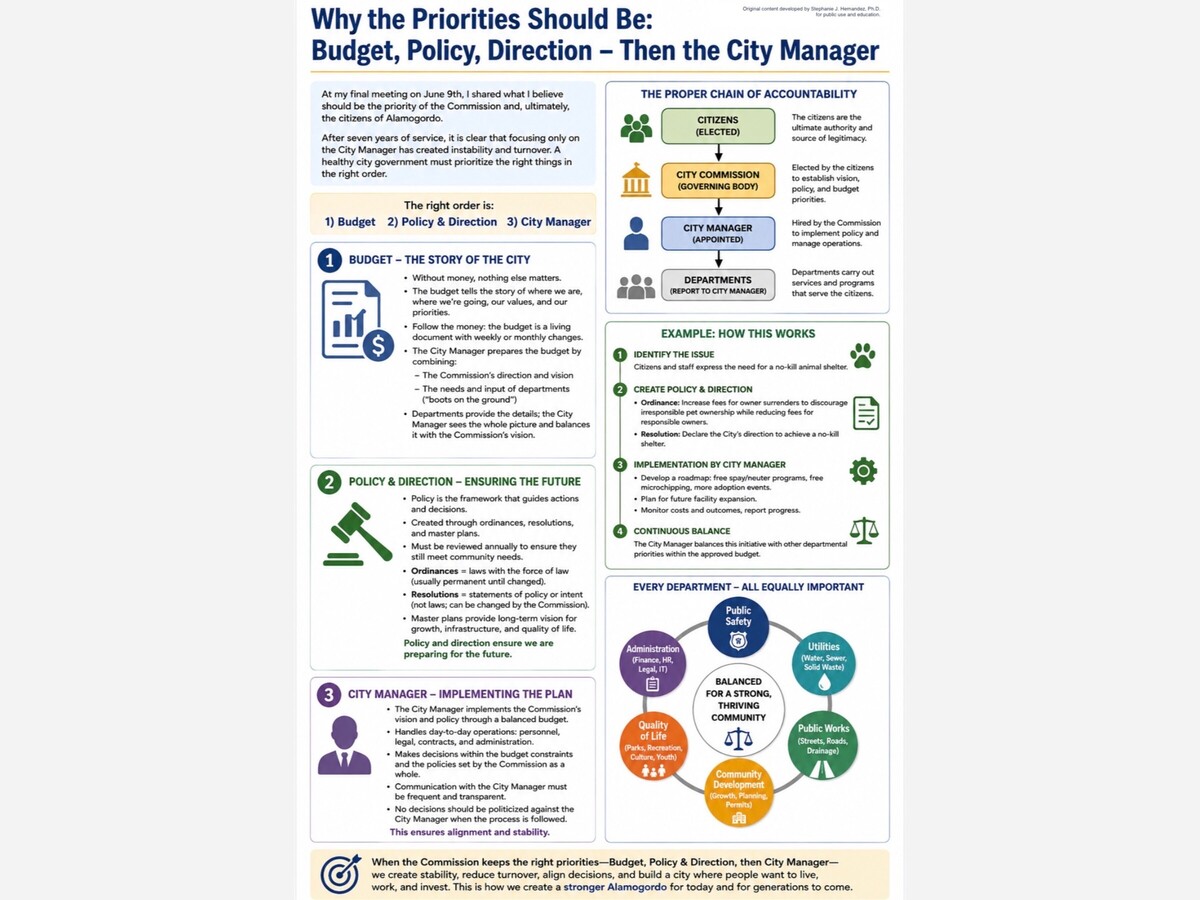
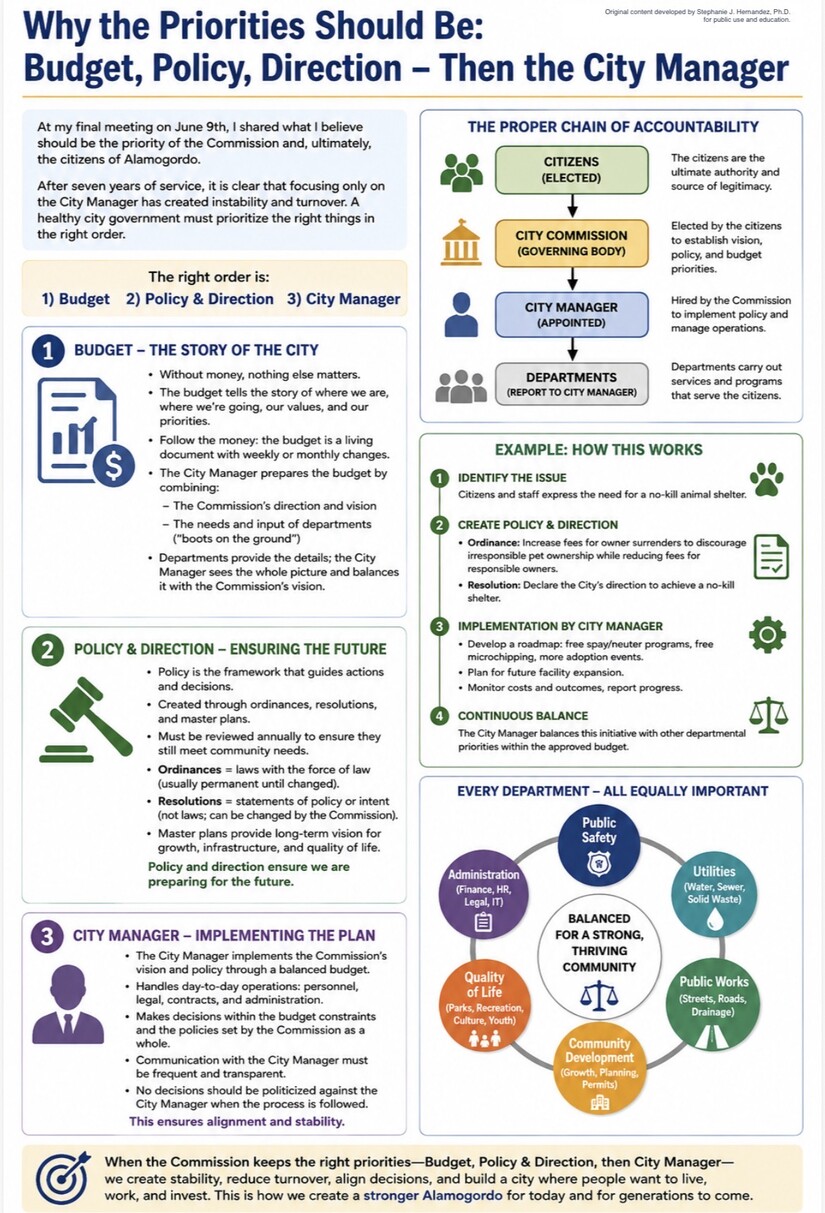
At my final meeting on June 9, I said what I believe should be the priority of the Commission and, ultimately, the citizens of Alamogordo: first the budget, second policy and direction, and third the city manager. Since then, I have been asked by employees and many citizens why I believe that order makes sense.
In my simple way of thinking, after seven years of service, much of the instability the City has experienced can be traced back to one recurring problem: too much focus on the city manager and not enough focus on the systems the city manager is meant to carry out. When the individual becomes the priority instead of the structure, the result can be turnover, inconsistency, and a loss of momentum.
That is why I believe the priorities should be clear: budget first, policy and direction second, and the city manager third. This does not diminish the role of the city manager. It puts the role where it belongs in a commission-manager form of government.
The Structure Matters
The City of Alamogordo operates under a commission-manager form of government. Under the City Charter, the Commission is the governing body and the city manager is the chief administrative officer. The Charter assigns the manager responsibility for carrying out ordinances and policies, managing employees, preparing the budget, and making recommendations concerning the welfare of the City. In other words, the manager is responsible for implementation, not for replacing the policy role of the Commission (City of Alamogordo, 2019; N.M. Stat. Ann. § 3-14-14).
That structure is important because the Commission is elected by the citizens to represent the public’s interests, priorities, and vision for the community. The city manager, as the sole employee of the governing body, is then responsible for turning that collective direction into administration and operations.
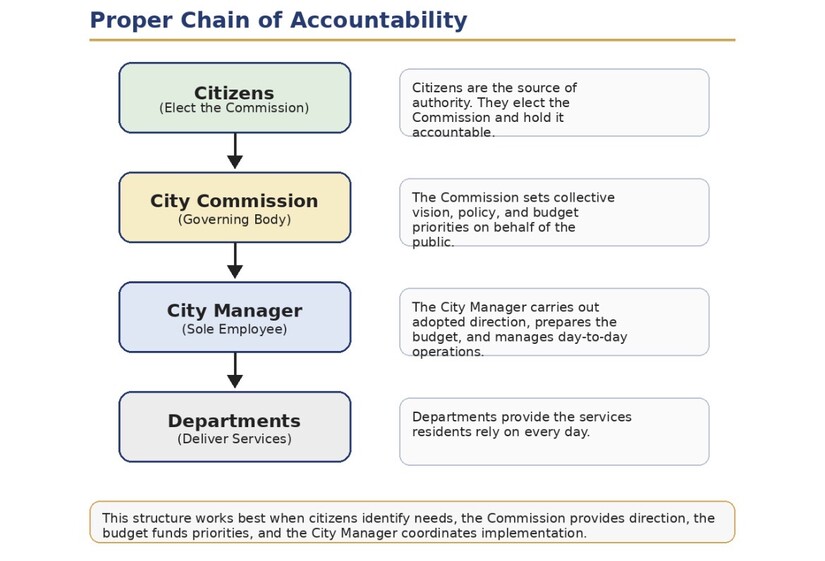
Diagram 1. Proper Chain of Accountability
This chain works best when information flows in both directions. Departments provide operational realities and needs to the city manager. The city manager presents the whole picture to the Commission. The Commission sets priorities on behalf of the citizens. Citizens, in turn, elect the Commission and hold it accountable.
1. Budget: The Story of the City
The budget should come first because without the money, nothing else matters. A municipal budget is not just a spreadsheet. It tells the story of where a city is, what it values, what it has neglected, and where it is trying to go.
There is a common saying: follow the money. Yet in local government, there is often very little sustained engagement with the budget beyond the formal adoption. That is a mistake. The budget should not be viewed only once a year and then forgotten. It is a living, breathing document that changes through the year as revenues fluctuate, projects shift, staffing changes, emergencies happen, and costs increase.
A city manager’s job is to prepare the budget and ensure it reflects both the needs of the departments and the direction of the Commission. The boots-on-the-ground input from departments is crucial because departments understand their operational realities. Public Works knows the condition of streets and drainage. Utilities know when lines and equipment are failing. Police and fire know what is needed to protect public safety. Community development knows where growth barriers exist. Quality-of-life departments understand the amenities that help residents stay and newcomers choose to move here.
Even so, each department naturally sees its own piece. The city manager must see the whole picture and combine all of those needs with the Commission’s vision to prepare a balanced and realistic budget. That is why the budget becomes the place where public priorities, operational realities, and financial limitations meet.
2. Policy and Direction: Ensuring the Future
If the budget tells the story of where the City is now, policy and direction determine where the City is going. This is the part of government that protects the future.
The Commission’s vision should not be only the individual vision of one or two commissioners. It should reflect the needs and priorities of their constituents. That is how the governing body ensures that City resources are working in the best interests of the citizens.
Policy is expressed through ordinances, resolutions, master plans, strategic plans, and other formally adopted actions. These should be reviewed regularly. An ordinance adopted decades ago may still be relevant, but it may also no longer reflect community needs, legal changes, or operational realities. Likewise, master plans should not gather dust on a shelf. They should guide growth, infrastructure, and service delivery over time.
Ordinances and resolutions serve different purposes. Generally, an ordinance creates or amends local law and has ongoing legal effect. A resolution usually expresses a policy position, approval, direction, or administrative decision of the governing body. New Mexico law recognizes the power of municipalities to adopt ordinances and requires certain procedures for proposed ordinances, including public notice requirements in many cases (N.M. Stat. Ann. §§ 3-17-1, 3-17-3, 3-17-4).
3. The City Manager: Implementing the Plan
The city manager should be the third priority because the role is to implement the Commission’s collective policy and budget through day-to-day administration. That includes personnel, legal compliance, contracts, purchasing, project coordination, operations, and countless routine decisions that keep the City functioning.
The manager must make decisions within the constraints of the adopted budget and the direction established by the governing body as a whole. The governing body is the collective boss. In Alamogordo, the mayor and commissioners share equal voting power except where otherwise provided by law or the Charter (City of Alamogordo, 2019).
That means no individual member of the dais should be treated as if he or she alone directs administration. Individual commissioners can and should raise ideas, unique projects, and constituent concerns. But once funding, staff time, or operational changes are involved, direction should be given collectively. If there is disagreement, it should be taken to the dais and resolved through public discussion and a vote, not politicized against the city manager for implementing the Commission’s adopted direction.
When the structure works as intended, there should be far fewer personalized controversies. The debate should be about policy, priorities, and funding, not about whether the city manager should be blamed for carrying out the policy direction of the governing body.
A Simple Example of How the Structure Should Work
Consider one example: the community wants to move toward a no-kill shelter.
1. 1. Identify the issue. Citizens, volunteers, and staff express the need for a no-kill shelter and bring the concern to the Commission.
2. 2. Create policy and direction. If a majority of the Commission agrees, the governing body can begin setting policy. That may include an ordinance adjusting fees to discourage irresponsible owner surrenders while reducing barriers for responsible owners. It may also include a resolution declaring the City’s direction to move toward a no-kill model.
3. 3. Give the city manager a roadmap. Once the governing body has spoken, the city manager can work with staff on how to make it happen. That may include free spay and neuter programs, free microchipping, more adoption events, rescue partnerships, public education, and the long-term goal of a larger or improved shelter.
4. 4. Balance it with other priorities. The city manager must then balance that work with all other city responsibilities and available funding. If the full goal cannot be accomplished in a single fiscal year, the City can phase the work over time while continuing progress in the direction approved by the Commission.
That same process should occur across all departments. Some priorities may move faster than others depending on cost and urgency, but every department should fit into a larger, continuous balancing act.
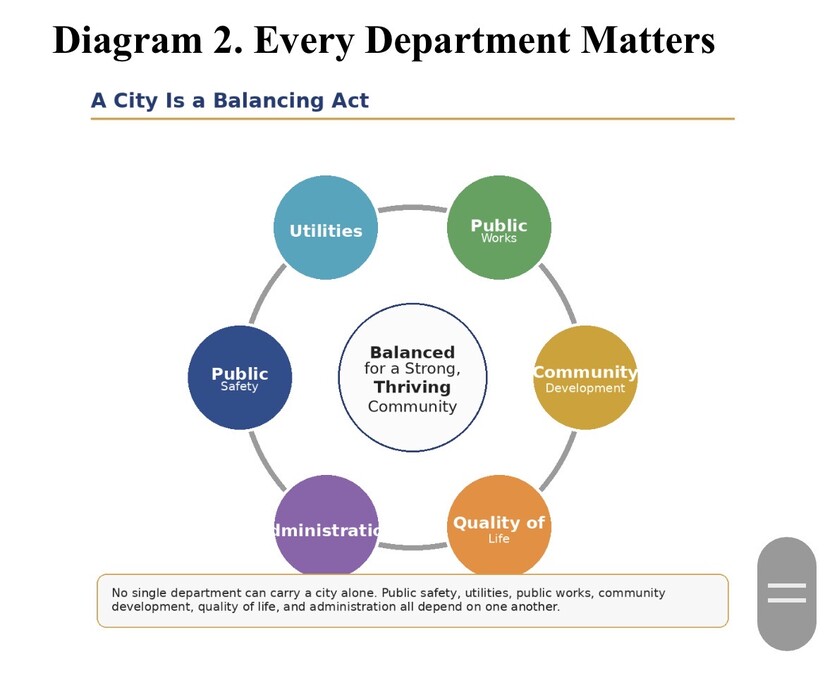
Diagram 2. Every Department Matters
Though core services such as water, sewer, public safety, and roads are critical, quality of life is what helps people want to live, stay, work, and invest here. Public safety, utilities, public works, community development, quality of life, and administration all depend on each other. If one area is ignored too long, the whole system suffers.
What Thriving Cities Often Have in Common
Cities that thrive often have two things in common: a clear vision for the future and consistency in leadership long enough to carry that vision forward. That does not mean a city manager alone makes a city successful. It means the structure stays focused long enough for good ideas to become results.
Examples from the Southwest show how this can work. Rio Rancho, New Mexico has used long-range planning and sustainability planning to connect vision, infrastructure, services, and growth. Las Cruces, New Mexico explicitly ties city-manager administration to mayor and council direction and uses strategic planning to align operations with community goals. Mesa, Arizona pairs council priorities with financial policies, annual balanced budgeting, and performance planning across departments. These cities differ in size, but they demonstrate the value of clear direction, disciplined budgeting, and administrative continuity.
The lesson for Alamogordo is not that we should copy another city line for line. The lesson is that communities are more likely to grow and prosper when they know where they are going and keep their attention on the system, not just on the person serving as city manager.
Why This Matters for Alamogordo
Alamogordo cannot rely forever on asking the same residents to shoulder more of the burden. For a city funded heavily through consumption-based revenues, higher prices alone are not the same thing as real expansion of the local tax base. Inflation can make revenues rise in dollars without producing stronger underlying growth.
That is why smart, steady growth matters. We need people to come live here and work here in every industry. We need housing, business investment, quality infrastructure, and quality-of-life amenities that help families choose Alamogordo and help existing residents remain here. Though we must focus on critical services, quality of life is also essential because it is part of what makes people want to live, stay, and move here.
Researching the past seven years only reinforced that conclusion for me: if Alamogordo wants to become one of the more prosperous and stable communities in the region, then the City must focus on budget discipline, clear policy direction, and consistent implementation. That is how we create an environment where growth can happen thoughtfully rather than accidentally.
Conclusion
So when I said at my final meeting that the priorities should be budget, policy and direction, and then the city manager, I meant exactly that.
The budget tells the story of where the City is and what it can afford to do. Policy and direction establish where the City is going. The city manager then takes those decisions and turns them into administration, operations, and results.
When those priorities are kept in the right order, decisions align better, public discussion becomes more meaningful, and leadership becomes more stable. The governing body can stay focused on representing the citizens, and the city manager can stay focused on carrying out the work. That is not just good governance. It is the best path toward building a stronger Alamogordo for today and for the next generation.
Alamogordo Town News Editorial Note: Dr Stephanie Hernandez is a guest contributor and expert panelist for 2nd Life Media Alamogordo Town News and KALHRadio.org. Dr. Stephanie Hernandez was born and raised in Alamogordo and returned home to serve the community that shaped her. She earned six degrees from NMSU, including a Ph.D. in Education, Leadership and Administration, along with master’s and bachelor’s degrees in economics, accounting, and related fields. After 20 years at NMSU (13 with the Foundation) building expertise in finance, accounting, and organizational leadership, she brought that experience to municipal leadership and public service in Alamogordo as Director of Finance, Assistant City Manager and a combined 27 month tenure as Acting City Manager..She is the spouse of retired Army veteran Cruz, a mother of three and grandmother of two, and currently teaches economics and finance.
References
City of Alamogordo. (2019). City charter. https://www.coa-utilities.com/DocumentCenter/View/7600/City-Charter-Upd…
City of Alamogordo. (n.d.). City Commission. https://www.alamogordolibrary.com/336/City-Commission
City of Las Cruces. (n.d.). City manager’s office. https://www.lascruces.gov/
City of Mesa. (n.d.). Financial policies and budget resources. https://www.mesaaz.gov/
City of Rio Rancho. (2011). Sustainability plan. https://www.rrnm.gov/
International City/County Management Association. (n.d.). Council-manager form of government. https://icma.org/
New Mexico Statutes Annotated § 3-14-14.
New Mexico Statutes Annotated §§ 3-17-1, 3-17-3, 3-17-4.
U.S. Census Bureau. (2026). QuickFacts: Alamogordo city, New Mexico. https://www.census.gov/quickfacts/fact/table/alamogordocitynewmexico/PS…
U.S. Census Bureau. (2026). QuickFacts: Las Cruces city, New Mexico. https://www.census.gov/quickfacts/fact/table/lascrucescitynewmexico/PST…
U.S. Census Bureau. (2026). QuickFacts: Mesa city, Arizona. https://www.census.gov/quickfacts/fact/table/mesacityarizona/PST045225
U.S. Census Bureau. (2026). QuickFacts: Rio Rancho city, New Mexico. https://www.census.gov/quickfacts/fact/table/rioranchocitynewmexico/PST…
I hope Dr. Hernandez is a guest speaker at an upcoming meeting of the Mayor's Youth Advisory Commission. She has so much wisdom and experience to pass on to younger generations.

It's the product of living in a lowly bubble: an immature, undeveloped writing style that has no insight or reasonable conclusion. Those PhD's from Watsamatta U in New Mexico are only a union card for activists to rally 'round and a far cry from what $200k a year should buy.
Your excellence at writing a reply show that you are an intelligent and urbane fellow. Whatever, get me my fries bro.



Sunny, with a high of 67 and low of 47 degrees. Sunny in the morning, cloudy in the afternoon and evening, clear overnight.





For those of the civilian public to understand. Every single Airman, marine, sailor and soldier whether Active duty or reserve or national guard has had explicit training on the UCMJ and illegal orders. This includes every “veteran for peace” It is political plain and simple.
regrettably, it might be necessary in the days of numerous respected/high ranking/decorated military leaders being fired/demoted/forced into early retirements when they fail to meet the specifications of glorious generalissimo hairgel - grapevine seems to indicate that dear leader is tiring of his various antics - e

Received that crime flyer in the mail today. Wow! Mudslinging V2.0 by the blockheads as usual.

Couple of people around Santa Fe have told me her highness has been sucking up hard to Ant to get on to a staff job when his pending doom curtain closes here. Queens never learn to really be honest. It's just in their realm of mental health. They live in denial and have pent up retentive r.e.c.t.u.m.s.
His money would have been better spent listing all of his accomplishments while in office. Oh, wait……
Voted twice against the low-income utility rate bill (HB 91) and sponsored the failed 2026 tax on renewable generation (HB 113) which the state confirmed would have further raised PNM rates. We know who has you in their pocket Block. Stop the **** lies!

Million-nine for the bakery, million for a theatre scam. These uneducated skells pass out money to sheis for what? They're not even good ideas. 3 mil and they don't know? Why doesn't we hire out side auditor like the FBI?
All that tax money. Is it true that Brien Caesar bought a four hundred k condo in wyoming last year? Heard, it's near Jackson. Someone put that stuff through. No wonder they change managers so often. Once a deals's done you don't have to stick around in this burg anymore.