66° and Overcast
Image
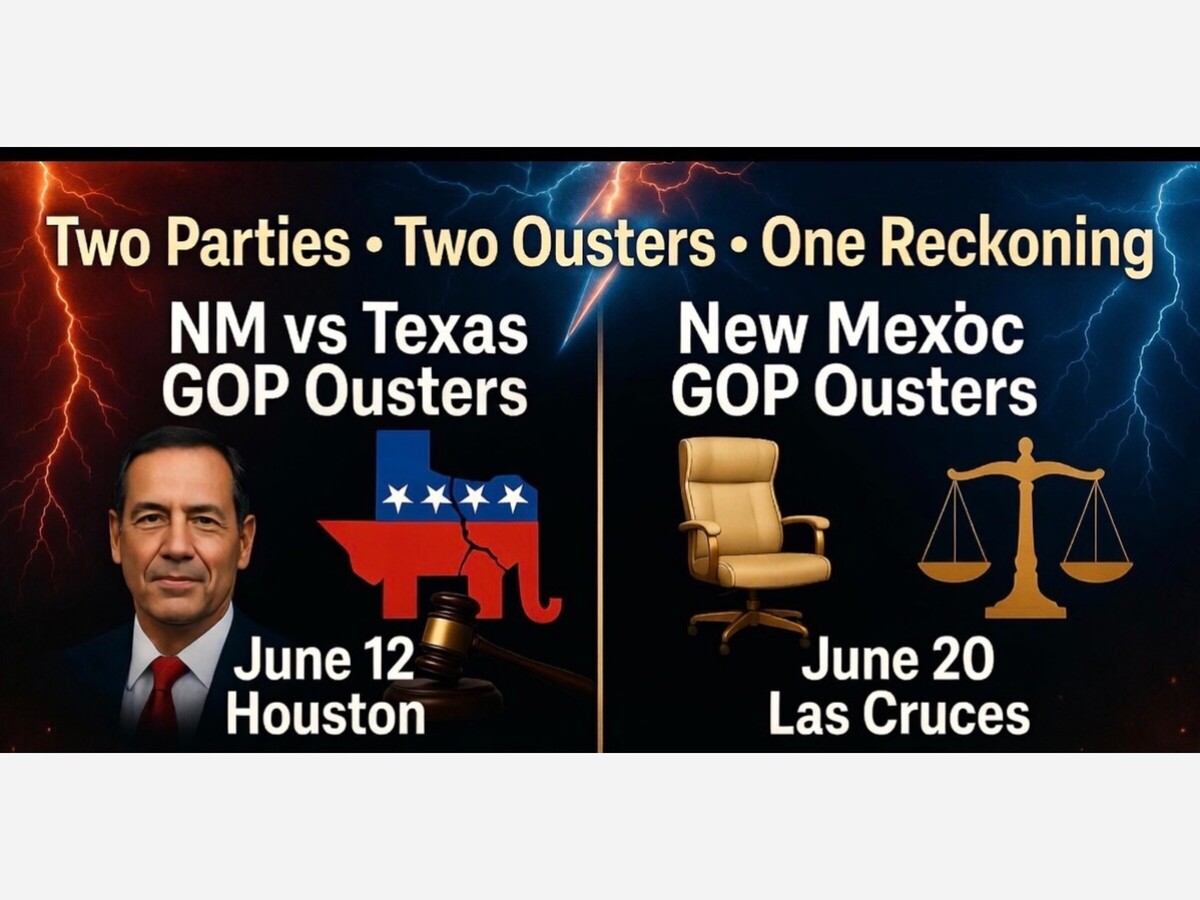



Within the span of a single week, Republican state parties on either side of the Texas-New Mexico border have erupted in leadership crises driven by the same underlying tension: a grassroots base that believes its party has been captured by institutional money, corporate donors, and entrenched insiders who mistake self-preservation for political strategy. The ouster of Texas GOP Chairman Abraham George at the Houston convention on June 12 and the court-ordered removal of New Mexico GOP Chairwoman Amy Barela are not carbon copies — but they are drawn from the same template.
And now, with New Mexico’s State Central Committee set to convene in Las Cruces on June 20 to elect a new chair, the parallels are sharpening in real time — complicated by Barela’s announced bid to reclaim the chairmanship she was stripped of by court order, a rival faction’s attempt to call a competing meeting in Albuquerque on June 27, and an explosive allegation that Barela threatened to pull the party’s southeastern oil and gas funding if she doesn’t get her way.
Texas First: The Houston Ouster
To understand what’s coming in Las Cruces, start in Houston.
On June 12, 2026, Republican Party of Texas Vice Chair D’rinda Randall defeated incumbent Chairman Abraham George at the Texas GOP convention, shaking up the top of the nation’s largest red-state party just months before the 2026 midterms. George conceded in a social media post shortly before the general session began, after delegates overwhelmingly backed Randall in an initial round of votes across Senate district caucuses.
George’s tenure had been marked by genuine legislative victories — private school vouchers passed, a hard-right turn in the Texas House produced a wave of socially conservative new laws — but none of it was enough to save him when the convention opened at the George R. Brown Convention Center in Houston and the hall was conspicuously sparse. Of more than 7,000 registered delegates, huge numbers simply didn’t show up, a visible symbol of grassroots disengagement that handed Randall her central argument.
Trey Trainor, a longtime GOP operative tapped to lead the convention’s platform committee, said George’s ousting stemmed from financial woes and a struggle to engage members. “Look, I think everybody’s incredibly nervous about what happened during the primaries,” Trainor said. “They see that the Democrat Party is incredibly engaged. I think the low turnout that you see here shows some apathy of Republican voters, and they really look to the party leadership to create that enthusiasm and drive people to the polls.”
The financial picture added fuel. A member of the State Republican Executive Committee claimed the party was taking a $651,000 loss to run the convention. George disputed the figure, saying the deficit was closer to $100,000 and would end up in the black when remaining registrations were paid — but that did not appear to allay concerns about the state of the party’s finances heading into the fall midterms.
Some of Randall’s supporters charged that George had been too welcoming to establishment Republicans, after he warmed up to House Speaker Dustin Burrows — whose election as speaker was aided by Democrats — following initial reservations. That line of criticism laid bare the challenge faced by party chairs, who must balance the delegates’ appetite for a grassroots fighter while also raising money from the party’s establishment ranks.
Randall ran on grassroots mobilization, volunteer training programs she personally led, and the return of convention corporate sponsors as a financial win — herself a walking embodiment of the same tension, touting donor relationships while campaigning as the people’s champion.
She won. George was gone.
The Texas ouster carries one additional layer that gives the RPNM’s situation added resonance. George’s removal also arrived at a time when the party is experiencing a wave of anti-Indian sentiment, particularly in George’s backyard of North Texas. George regularly draws racist replies to his social media posts, even when pushing for conservative priorities such as abolishing the H-1B visa program; yet delegates at the convention did not indicate that topic surfaced in deliberations about the chair election. The establishment-versus-grassroots narrative was the public story. What runs beneath it is always more complicated.
New Mexico: The Same Fight, Higher Stakes
The Republican Party of New Mexico was already deep into its own version of this war before Houston happened.
And in New Mexico, the stakes are existentially higher — because unlike Texas, the RPNM is not a majority party with the luxury of internal squabbling while still winning. It is a minority party in free fall, one that entered 2026 without fielding a single candidate for U.S. Senate, state auditor, or state treasurer, leaving Republicans dependent on write-in efforts just to appear on the general election ballot.
The crisis began on March 10, 2026, when Chairwoman Amy Barela filed for re-election to her Otero County Commissioner District 2 seat — two minutes ahead of Republican challenger Jonathan Emery, a retired Otero County Sheriff’s deputy. RPNM Uniform State Rule 1-4-4 was unambiguous: when a state officer files for public office against a fellow Republican, they must immediately vacate their party post. Barela refused. She had, in fact, tried to have USR 1-4-4 removed from the party rulebook at three separate prior SCC meetings — in Farmington, Hobbs, and Ruidoso — and the full SCC defeated the proposal each time. She then violated the rule she couldn’t erase.
The revolt was swift and widening. County parties from Sierra to Bernalillo issued formal demands for her resignation. Two separate lawsuits were filed. On May 27, Thirteenth Judicial District Judge Cindy M. Mercer issued a preliminary injunction removing Barela from the chairmanship. The RPNM appealed. On June 10, the New Mexico Supreme Court unanimously denied the appeal — without explanation. On June 2, Barela lost her primary race against Emery by 46 votes, stripped of both her party title and her county seat in the same week.
First Vice Chair Mike Nelson has led the party since. The State Central Committee is scheduled to meet in Las Cruces on June 20 to elect a new chair.
Barela Is Back — And So Is the Fight
But Amy Barela is not leaving quietly.
As of June 14, 2026, Barela has announced her candidacy for the RPNM chairmanship she was just removed from, launching an “Amy Barela for Republican Party of New Mexico State Chair” campaign with campaign graphics in the New Mexico state colors of red and gold.
Her pitch: that she remains the legitimate steward of the party and that the reform faction’s actions constitute an urban power grab against rural and southern New Mexico.
She has powerful institutional support. The Southern & Rural New Mexico County Officers Coalition — representing counties in the state’s south and southeast — issued a formal joint statement on June 12, 2026 explicitly backing the June 20 Las Cruces meeting as “the legitimate and lawful process for addressing the current vacancy in the office of State Chair,” while strongly opposing a competing SCC meeting being organized in the Albuquerque metro area for June 27.
The Coalition’s statement is worth reading closely, because it frames the entire intra-party conflict as a geographic power struggle rather than a rules dispute:
“For years, State Central Committee meetings have been held almost exclusively in locations convenient to the urban and metro counties, with little to no effort to rotate meetings across the state. This long-standing practice has consistently placed the greater financial and logistical burden on rural and southern counties. By attempting to move the meeting, those who initiated these internal conflicts would gain yet another advantage, further consolidating their influence while continuing to disadvantage rural and southern members who have long carried a disproportionate share of the cost and inconvenience of participation.”
The Coalition further argued that the proposed June 27 Albuquerque meeting falls outside the 30-day procedural window under Rule 2-1-5 B and “would reward efforts to bypass the legitimate process.” They accused a faction within the SCC of acting “as though they represent the full body, marginalizing rural counties and attempting to dictate the terms under which the party operates.”
This is the Barela coalition’s core argument: that the reform movement is not a principled defense of party rules but a northern, urban, establishment power play designed to sideline southern New Mexico’s voice in the party. It is a potent political argument — and it is the same argument that southeastern Republicans have been making for years about their relationship to the state as a whole.
The Funding Threat That Defines the Stakes
Into this already volatile mix has come an allegation that could define the June 20 vote more than any candidate’s platform.
Chair candidate Audrey Trujillo stated publicly on Facebook: “The New Mexico Republican party as it stands has revenue streams coming from private donors mainly tied to oil and gas industry. The past Chair has specifically stated that the funding would leave if she is not elected back in.”
Commenter David J. Cerame, writing in response, went further: “The State Party Chair has implied to EVERYONE in the Party…if she doesn’t get her way, she will take the state’s Southeast funding away from the Party… Does that sound like a principled Republican to you? That’s a threat a Democrat would use to keep their far too greatly apportioned backside in a position of power.”
If accurate, the allegation is transformative. It means the Barela era was not merely characterized by financial dependency on a single-industry donor base — it was characterized by the weaponization of that dependency as a tool of personal political control. The message to SCC members would be stark: re-elect me, or the money goes away.
Trujillo backed up the stakes with hard numbers from FEC filings. The RPNM’s federal committee — Republican Campaign Committee of New Mexico, FEC ID C00020818 — reported total receipts of $996,127.89 for the 2025–2026 cycle through April 30, 2026, including $467,778.12 in transfers from affiliated committees and just $7,000 in party committee contributions, with $406,308.46 cash on hand. Nearly half the party’s total receipts flow through affiliated-committee transfers — money that, if the allegation holds, one political network controls and can threaten to withdraw.
Barela has not publicly addressed the allegation.
The New Mexico RPNM Plan : A Race for the Party’s Soul
As of June 14, at least four candidates have announced for the June 20 chairmanship election, each representing a different theory of what the RPNM needs to survive.
Amy Barela — The ousted and now re-declared incumbent, running on a platform of continuity, rural representation, and the argument that the reform faction’s actions have been an urban power grab that harms the party. She has the backing of the Southern & Rural New Mexico County Officers Coalition and the southeastern donor network.
Her return bid is constitutionally unresolved — her own party attorney argued she’s now eligible since the primary is over; her critics dispute that the court’s injunction fully expires. She carries the weight of presiding over a party that couldn’t field candidates for three statewide offices, and now the funding threat allegation.
Robert Aragon — The Albuquerque attorney and SCC member who filed the lawsuit that removed Barela. A former Democrat who left the party in 2010, Aragon ran for state auditor as a Republican in 2014. He has been blunt about the RPNM’s condition: it is a regional party, capable of winning in San Juan County and Permian Basin communities but nearly invisible in Albuquerque, Las Cruces, and Santa Fe.
He positions himself as the accountability and institutional reform candidate — the man who went to court to enforce the party’s own rules and won at every level, including the New Mexico Supreme Court.
Brandon Vogt — The 96.3 KKOB talk radio host and rancher, Vogt is the highest-profile challenger in terms of name recognition among Republican base voters statewide. He has used his afternoon show throughout the Barela controversy to build a constituency, and he speaks in the language of grassroots populism rather than legal process. He declared after the court ruling: “The judge saw what we all did — Barela was out of compliance and needed to be removed.” Vogt has authored op-eds tracing the party’s decline from its 2008 peak — U.S. Senate seat, two of three congressional seats, and eventually a governorship — to its current state of write-in desperation. He wants to rebuild from the ground up.
John Brenna — The retired law enforcement officer and Valencia County Republican Party chairman brings organizational credibility at the county level. He was among the first to formally announce his candidacy after the court-ordered removal and emphasizes rebuilding the party’s county infrastructure and candidate recruitment bench.
Audrey Trujillo — The Sandoval County-based America First conservative and Hispanic Republican organizer has entered the race with the most detailed and publicly documented platform of any candidate. A two-time statewide candidate — she ran for Secretary of State in 2022 backed by the America First Secretary of State Coalition and for State Senate District 9 in 2024 — Trujillo has deep roots in grassroots organizing: executive director of LUCA (Latinos Uniting Conservatives Action), political director of the Republican National Hispanic Assembly of New Mexico, Ward 1 and 2 chair of the Sandoval County Republican Party.
Her fundraising reform plan is the most substantive policy platform in the race. She calls for transforming RPNM fundraising from single-source big donor dependency into “a statewide membership program + major donor operation + candidate-support machine,” including:
• A $25/month “County Victory Team” recurring donor tier
• A $100/month “Chairman’s Circle” recurring donor tier
• Issue-based fundraising with specific voter-facing asks: “Help register 25,000 new Republican voters,” “Help fund voter contact in 10 target House districts,” “Help train 100 candidates and county leaders,” “Help protect election integrity operations statewide”
• Converting RPNM’s existing WinRed infrastructure from one-time donation asks to recurring giving programs.
Trujillo’s vision is the direct inverse of the Barela model: instead of a party beholden to a handful of Permian Basin operators, a party accountable to thousands of small donors across the state. “We don’t need gate keepers to turn NM Red,” she wrote. “We need a team effort to work together and be unstoppable. I’ll work with anyone whose vision is to help candidates win seats in New Mexico. We need a balanced government and our citizens deserve better.”
The Deep Structural Problem: Oil Money, Urban Voters, and a Party That Can’t Win
The Barela candidacy and the Southern & Rural Coalition statement both reflect a genuine grievance that the reform wing ignores at its peril. Southern and southeastern New Mexico — the Permian Basin counties of Eddy and Lea, the ranching counties of Otero and Chaves, the communities of Carlsbad, Hobbs, Roswell, and Artesia — are the Republican Party’s geographic heartland in New Mexico. They generate enormous economic output, they vote reliably Republican, and they have long felt that the party’s organizational center in Albuquerque treats them as ATMs rather than constituents.
That grievance is real. And the oil and gas industry’s financial dominance of RPNM fundraising reflects it. A party that draws its money from the Permian Basin will naturally orient its messaging, its candidates, and its policy priorities toward that base.
But here is the structural trap: southeastern New Mexico cannot elect a governor. It cannot elect a U.S. senator. It cannot flip a congressional seat in the 1st or 2nd district. It cannot win a majority in the State House or Senate.
To do any of those things, Republicans need to be competitive in Albuquerque — where they currently hold 2 of roughly 20 House seats in Bernalillo County — and they need to at minimum be credible in Santa Fe and Las Cruces.
Robert Aragon captured it precisely when he argued that the RPNM has become “nothing more than a regional party” that “can win elections in San Juan County, the oil-producing Permian Basin and other communities on the state’s east end” but finds GOP victories “rare in Albuquerque, difficult in Las Cruces and almost unheard of in Santa Fe.”
This is the same diagnosis that animates the Texas insurgency in a mirror image. In Texas, the grassroots base felt that George was too close to the urban and establishment wing — too cozy with Speaker Burrows, too focused on institutional relationships over precinct-level mobilization. In New Mexico, the reform wing argues that Barela has been too close to a narrow southeastern donor base — too focused on Permian Basin operators and too disconnected from the working families of Albuquerque, Santa Fe, and Las Cruces who are the key to any statewide Republican future.
Both parties face the same core question: who does the party actually serve? The donors or the voters?
For working families in New Mexico’s cities — struggling with housing costs, public safety failures, inadequate schools, and healthcare access — a Republican Party that functions primarily as the political arm of oil company boardrooms offers little. Its messaging doesn’t connect. Its candidates don’t resonate. Its organizational infrastructure doesn’t reach them. And if the party’s own chairwoman has been threatening to take the money away if she loses a vote, the message to ordinary Republicans is even clearer: this party isn’t yours.
Two Competing Visions for June 20 — and Beyond
The Southern & Rural Coalition’s opposition to the proposed June 27 Albuquerque meeting reveals the deepest fracture in the RPNM. There are now, in effect, two Republican parties in New Mexico: a southern one centered on Permian Basin identity, rural grievance, and institutional continuity, and a reform one centered on Albuquerque’s organizational infrastructure, legal accountability, and a desire to compete statewide.
Neither can win without the other. That is the bitter irony at the center of the June 20 SCC meeting.
A Barela victory would hand the southern faction control of the party machinery and the donor network — but would validate the allegation that the RPNM can be held hostage by a single funding source, and would almost certainly deepen the exodus of Albuquerque-area Republicans who see the reform lawsuit as a principled stand.
A reform candidate’s victory — Aragon, Vogt, Brenna, or Trujillo — would give the party a chance to rebuild its organizational model and compete in urban New Mexico, but would risk losing the southeastern donor network that currently keeps the lights on, at least in the short term.
Trujillo’s small-donor diversification plan is the only proposal on the table that attempts to solve both problems simultaneously: keep the big donors while building a grassroots base that cannot be held hostage by any one of them.
The Lesson From Houston
D’rinda Randall won in Texas because enough delegates concluded that a party chair who manages donor relationships better than he mobilizes voters is not actually serving the party’s mission. George’s convention hall was half-empty. His balance sheet was bleeding. His grassroots had tuned out
The choice was stark.
In Las Cruces on June 20, the RPNM’s State Central Committee will face an even starker version of the same choice — sharpened by a court-ordered removal, a funding threat allegation, a re-declared incumbent, a rival faction trying to call a competing meeting, and a field of challengers each arguing that the current model has failed.
The oil money will still be there on June 21, whatever happens. The question is whether it will continue to be the party’s master — or whether New Mexico Republicans will finally decide to build something that belongs to all of them.
The SCC convenes at Las Cruces. The chair election is June 20, 2026. The clock is running.
Sources: New Mexico Supreme Court records; Thirteenth Judicial District Court preliminary injunction, May 27, 2026; Source New Mexico; Santa Fe New Mexican; Albuquerque Journal; 2nd Life Media Alamogordo Town News; Texas Tribune (Alejandro Serrano and Renzo Downey, June 12, 2026); FEC filings, Republican Campaign Committee of New Mexico C00020818; Audrey Trujillo public Facebook posts, June 14, 2026; Southern & Rural New Mexico County Officers Coalition Joint Statement, June 12, 2026; Amy Barela for Republican Party of New Mexico State Chair campaign announcement, June 14, 2026. The allegation that Barela threatened to withdraw southeastern oil and gas funding has not been independently verified by this publication and has not been publicly addressed by Barela as of press time.

Patchy rain nearby, with a high of 74 and low of 55 degrees. Patchy rain nearby in the morning,

Love your shop in Las Cruces! Haven’t been to the one here in Alamo yet.
Hi Troy,
What do you think of the manga Jaadugar: A Witch's Life in Mongol (Tomato Soup). It's now an anime from Saru Science/Crunchyroll.
Enjoy!


Thank you Sheriff!

She lectures her expertise like she was running SpaceX. Home Service Contractors and Darnold Plumbing could get any of those things built in a month. These unqualified people use it to justify their lives. We have to work to pay off their excess spending.
Neither have the proper license try again!
Hey Rube! I think the point is expertise. A 'proper licesne' is always the thinking of those educated by The Machine. Let the free market rule, not the paper pushers.
He did the same thing when he ran against Rachel. He's a pathological liar who just keeps proving it over and over.
he senses trouble....and i smell blood - time to send him to private sector employment - maybe his oil & gas friends can find something for him to do.
Lets ask the editor.
sir, are you not involved in the campaign?