
Image
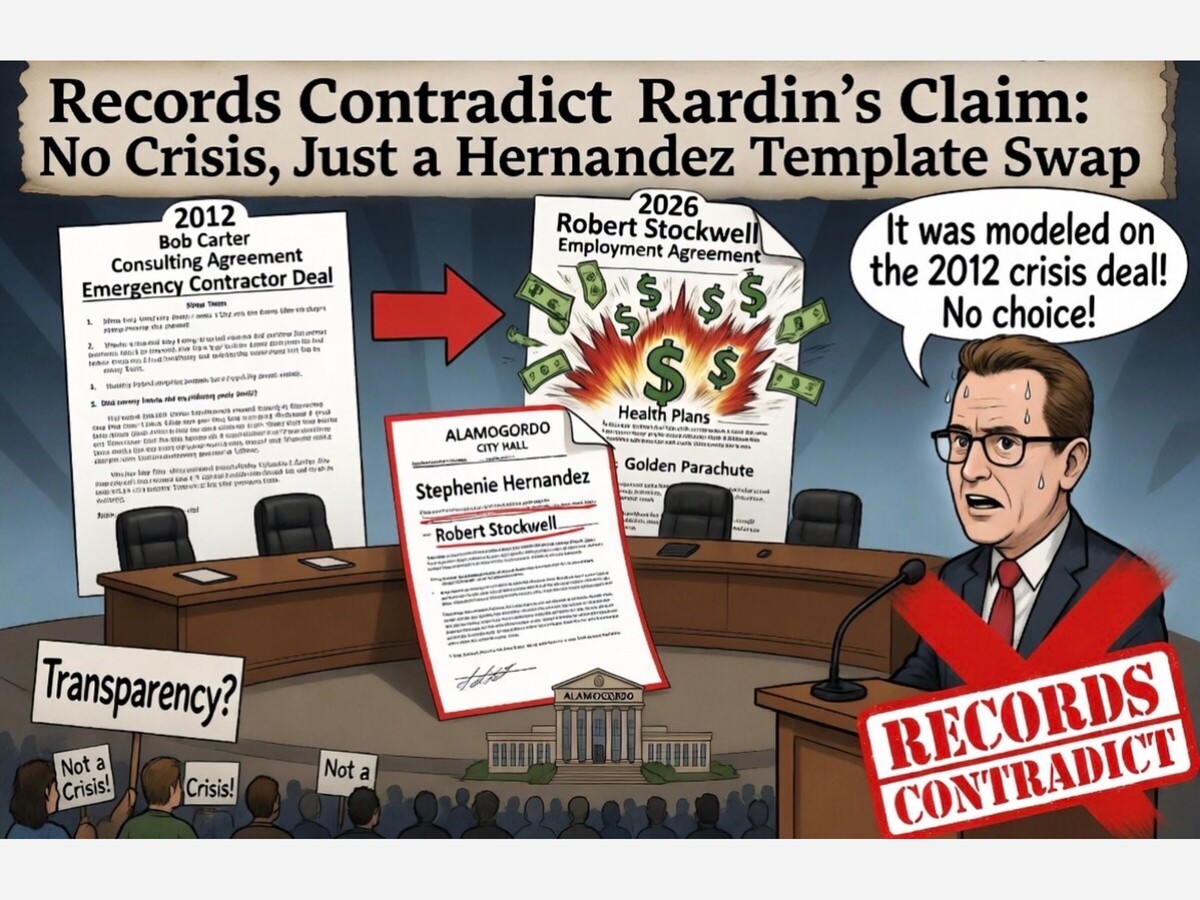
Records Contradict Rardin’s Claim That a “Crisis” Forced a Stockwell Contract Modeled on 2012 Carter Deal - 2nd Life Media AlamogordoTownNews.org



ALAMOGORDO, N.M. — At last Tuesday’s City Commission meeting, Commissioner Josh Rardin told the public that installing Robert Stockwell as city manager “mirrors the 2012 hiring of interim manager Bob Carter. He framed the commission as facing a crisis and being “in a jam,” with no choice but to act quickly, and said both the process and contract terms were modeled on that earlier arrangement.
A side-by-side review of the two contracts secured via IPRA, plus the email record, does not support that account.
The documents describe two fundamentally different hires, governed by different legal instruments, with terms that diverge on nearly every material point.
The paper trail shows the Stockwell contract and process was not built from the Carter agreement at all.
Two Different Instruments
The 2012 agreement with Bob G. Carter is a consulting agreement. It engages Carter as an independent contractor. The document states plainly that he “is not an employee of the City” and would not accrue leave, retirement, insurance, city-vehicle use, or any other employee benefit. It was a strictly interim posting with a hard ceiling: a maximum term of five months beginning Aug. 20, 2012. Either side could end it without cause on 10 business days’ written notice. Carter was paid $10,000 a month, with the city covering gross receipts tax and reimbursing mileage at 55 cents per mile. There was no severance.
The 2026 agreement with Stockwell is an employment agreement. It makes him a permanent, at-will employee serving at the pleasure of the commission for an indefinite term, starting July 1, 2026, at a salary of $180,000 a year (up from $150,000 in an earlier draft). The package includes membership in the New Mexico Public Employees Retirement Association, city-paid health, dental and basic life coverage (narrowed in the final version to the employee only), a 457 deferred-compensation plan, 10 days of executive leave annually, and a city-paid International City Management Association membership. The contract credits Stockwell with 180 hours of paid time off effective immediately “in recognition of the City Manager’s extensive experience and prior employment with the City,” then accrues PTO at 22.5 days per year, plus a $500 monthly vehicle allowance bringing the value of the contract in excess of $200,000 in year one.
Where Carter’s deal was built to end cleanly and quickly with no exit cost, Stockwell’s is built to be difficult and costly to end: termination without cause requires six months’ salary in severance plus 60 days of continued benefits (provided the manager is willing and able to work), and termination for cause requires written notice, an opportunity to respond, and a defined process.
One document is a short-term contractor engagement with no tail; the other is a permanent salaried hire with a full benefits package and a six-month severance cushion.
They are not variations on a theme, and nothing in either document suggests one was used as a template for the other.
What the Markup Shows
The clearest evidence against the “modeled on Carter” claim sits inside the Stockwell file itself. The packet the commission received includes a redlined draft alongside a clean “final” version. The markup shows the Stockwell contract was produced by editing an existing employment agreement that had been prepared for a different candidate — Stephanie Hernandez. Her name is struck through line by line and Stockwell’s name is inserted throughout all nine pages.
The base template was a permanent-employee contract drafted for someone else entirely, Dr. Stephanie Hernandez, not the 2012 Carter consulting agreement.
If the Stockwell deal was modeled on anything in the record, it was modeled on the Hernandez employment agreement.
The redline also shows how terms shifted between draft and final: salary rose from $150,000 to $180,000; the March 10, 2026 retroactive start date was dropped in favor of July 1; a city-provided vehicle was swapped for the $500 monthly allowance; health coverage was narrowed from “employee and eligible family” to the employee only; and the 180-hour PTO credit was added. A new clause was inserted requiring the city manager and commission to meet quarterly in executive session to set and review performance expectations.
Where the Comparison Has a Kernel of Truth
Rardin’s framing is accurate on one narrow point: in both 2012 and 2026 the commission faced a city manager vacancy and acted to fill it. Both contracts route through the same offices — mayor, city clerk, and city attorney as signatories. Stockwell is not new to the building; his résumé lists him as Alamogordo’s city manager from 1992 to 1997, which is the “prior employment with the City” referenced in the PTO credit.
But a shared circumstance is not a shared template, and a vacancy is not a crisis that dictates contract terms. Carter was hired as a temporary contractor with a five-month leash and no benefits. Stockwell is being hired as a permanent employee at $180,000 with full benefits and a six-month severance guarantee.
Describing the second as modeled on the first — or as a circumstance so urgent it required mirroring a 14-year-old emergency contractor deal — is not supported by the documents nor the process witnessed by the public.
Why a Hernandez Contract That Was Never Offered to Her Became the Stockwell Template
The redline answers one question and raises another: if the base document was an employment agreement built for Stephanie Hernandez, why was she never given it?
On March 10, 2026, the commission voted unanimously, 7-0, to direct staff to begin contract negotiations with then-Acting City Manager Hernandez for the permanent position. Local reporting in the weeks that followed found no contract had reached her; the delay was traced to a string of closed executive sessions rather than any public negotiation over terms. Roughly seven weeks after that unanimous vote, the matter was resolved — not with a contract, but with a settlement. On April 28, 2026, the commission voted 4-3 (Rardin, Burnett, Pattillo, and then-Commissioner Al Hernandez in favor) to accept a settlement offer for closure either hire her or pay her a proposed dollar amount to go away. The commission has alluded the settlement was to an EEOC administrative inquiry Hernandez had filed, ending her 28-month run as acting manager. The permanent contract the commission had unanimously authorized negotiating in March was never offered to her.
That timeline explains why the Stockwell agreement reads as it does.
While the commission was — at least publicly — pursuing Hernandez’s permanent hire, counsel and staff had already produced a full nine-page employment agreement built around her position, salary band, and proposed start date.
As the commission pivoted to Stockwell, the document already on hand — not the unrelated 2012 Carter consulting contract — was what got adapted.
The redline bears this out exactly: her name struck through, his inserted, with salary, start date, vehicle terms, and PTO renegotiated around him.
A Second Pattillo Email: Stockwell Signed Off on His Own Contract Before the June 15 Session
A June 16, 2026 email from Commissioner Baxter Pattillo to HR Manager Osborn fills in the timeline. Pattillo wrote that he had “bcc’d the commission” and attached a file titled “Stockwell Draft for Meeting,” noting that the version “has gained the approval of both Mr. Stockwell and Brian Nichols,” though it had “not been signed yet.”
He added that he had distributed that draft to the commission for review “prior to the exec session held on 6/15,” and asked that City Clerk Rachel Hughs place the agreement on the agenda for commission approval at the June 23 meeting.
That email confirms what the earlier record left open: by the time the commission held its June 15 closed session, commissioners already had in hand a contract draft that the candidate himself had approved.
That session was Stockwell’s interview — the agenda brought him in to meet with the commission in closed session, and his appearance was witnessed both by those in the chambers and by residents watching the public portions on the city’s livestream. The agreement was not the product of a negotiation that followed his interview and was then brought to the commission afterward. It had already been signed off on by Stockwell and circulated to commissioners before he was interviewed for the job - and that is a further crux of the open meetings violation questions.
That sequence is worth sitting with: a vacancy filled using a contract built on a different candidate’s unfinished hire (Hernandez’s), approved by the new candidate before the commission’s own closed-door session on his hiring, then defended publicly on Tuesday as modeled on a 2012 emergency contract it does not resemble.
The Process Question
How the Stockwell contract reached the full commission is its own thread — and it raises questions about consistency with established city practice and the Open Meetings Act that a court may ultimately decide.
A June 12 email from Commissioner Baxter Pattillo, forwarded to commissioners, attached a markup and a final version of the agreement and noted these were “the two documents I had brought to the last executive session.
Pattillo wrote that he had “bcc’d the commission,” that the draft had been reviewed and approved, and that the material was being circulated so members could review it over the weekend ahead of a Monday meeting.
That a fully priced, near-final employment contract was carried into a closed session and then circulated to the full body by email is relevant to open-government questions already facing the city.
The contract’s new clause contemplating standing quarterly executive sessions on the manager’s performance is also worth noting on its own terms.
City practice in other recruitments has followed the Employee Manual, including the most recent recruitment involving Rick Holden. Past guidance to the commission has pointed to the manual as the applicable policy, and prior reviews have affirmed it as the guiding document for such processes.
This stands in contrast to any suggestion that no formal process or requirements applied to the Stockwell hiring.
The June 15 executive session itself also deviates from the city’s own past practice on notice.
The January 20, 2026 special meeting agenda (from an earlier city manager recruitment) explicitly disclosed in the executive session item that the closed session was to “Hold City Manager Interviews.
The June 15 agenda did not. It used only the generic description “Limited Personal Matters,” with no mention that interviews were occurring.
Whether this constitutes yet another possibility of a violation of the Open Meetings Act’s notice requirements is a question the commission may now have to answer to the courts and the court of public opinion.
The Bottom Line
The record — the two contracts, the redlined draft showing the Hernandez-to-Stockwell substitution, the June 12 and June 16 transmittal emails, the city’s own past agenda practice, and the consistent application of the Employee Manual to other recruitments — does not back up Rardin’s characterization at Tuesday’s meeting.
The Stockwell agreement was not modeled on the 2012 Carter consulting contract in process or in terms, and the underlying documents show no crisis dictating that it should have been. It is, instead, a standard permanent employment contract adapted from a different candidate’s draft, with materially richer terms than the emergency arrangement Rardin invoked — and a process that appears to have bypassed both the Employee Manual and the city’s normal standards for transparency in executive sessions
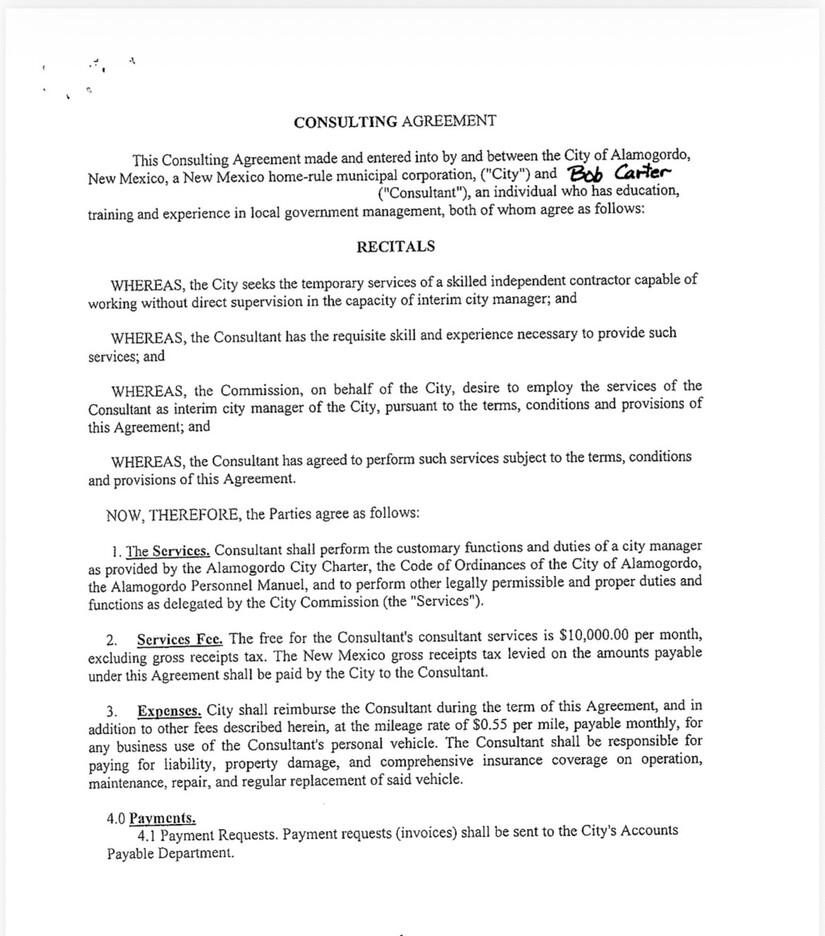 Consulting Agreement nothing like Stockwell agreement as referenced by Commissioner Josh Rardin
 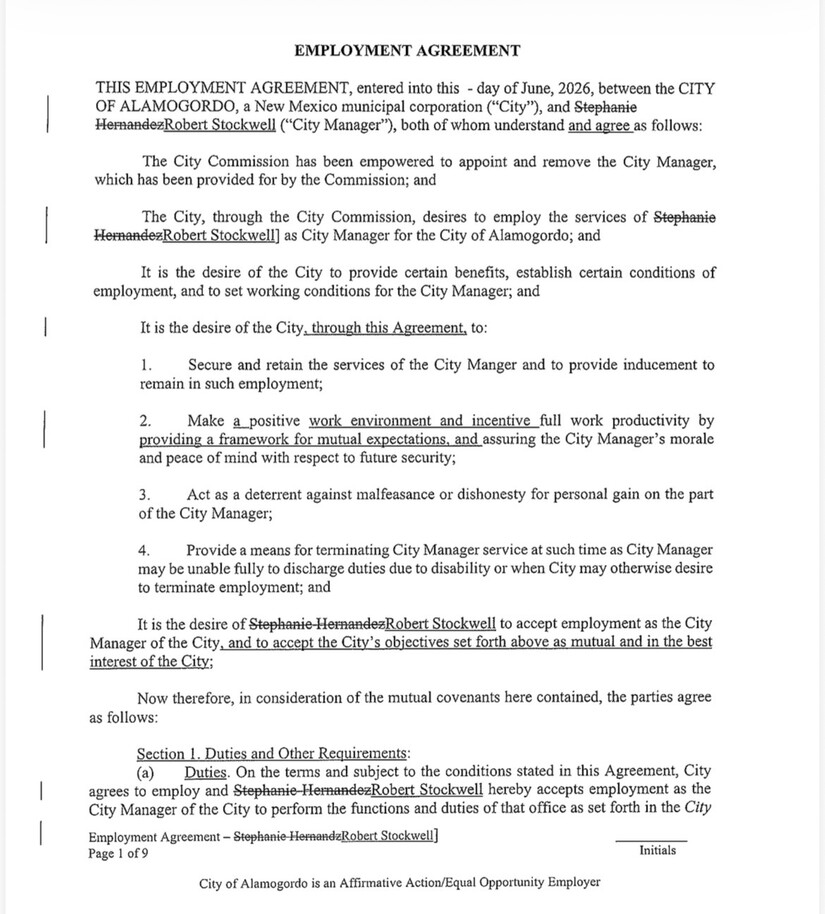 Dr Hernandez agreement never presented but struck thru for Stockwell before the interview on 6-15-26
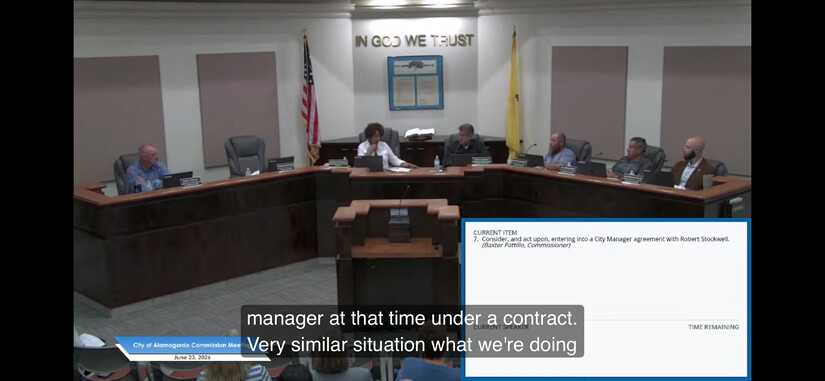 Rardin comparing Stockwell selection and process to Carter selection and process
 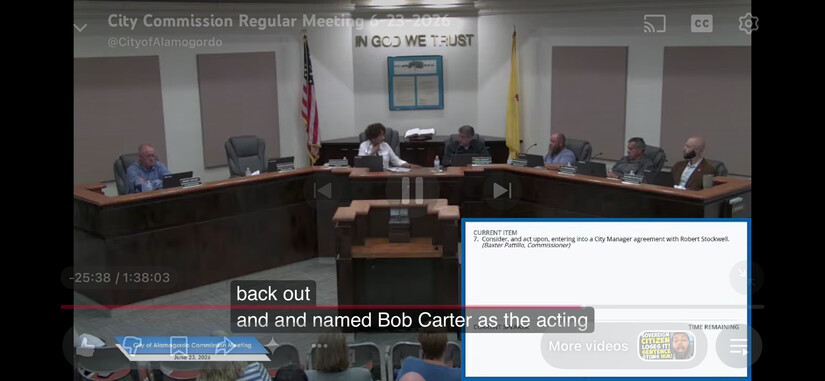 Rardin comparing Stockwell selection and process to Carter selection and process
Document basis: The redlined and final Stockwell employment agreements; Stockwell’s résumé; the Carter consulting agreement executed Aug. 20, 2012; the June 12, 2026 email transmittal from Commissioner Baxter Pattillo to the commission; the June 16, 2026 email from Commissioner Pattillo to HR Manager Osborn; the January 20, 2026 special meeting agenda; and city recruitment practices and prior guidance applying the Employee Manual.

weasel words...



Sunny, with a high of 81 and low of 61 degrees. Sunny in the morning, patchy rain nearby during the afternoon and evening, clear overnight.


Having the Sierra Club endorse you is like drinking the runoff from a lithium mine they spent a decade blocking—then calling the metallic taste “sustainability.” This phoney has a really bad dye job.
Just because you do not like someone does not make them phony.
kinda like not liking the blue kool aid so you hate all the kool aid. Besides doesn’t the editor have a vested interest in her campaign?





as per occam's razor, the simplest explanation for stonewalling a request this basic and straight forward, is that transparency will cast a bad light on lincoln county, and/or the entity they pay to run their jail.
The Albuquerque Journal (9/20/26, page C3) has a column written by Jacob Candelaria that is titled "A blacklist for people who ask too many questions". Basically, in 2025, our NM Legislators were debating House Bill 139 would have let any public body petition to have a person designated as "vexatious", and person's



like 99% of his fellow republicans, block is a servant to the oil & gas industry - a principal constituent of their party.