65° and Patchy rain nearby



Image
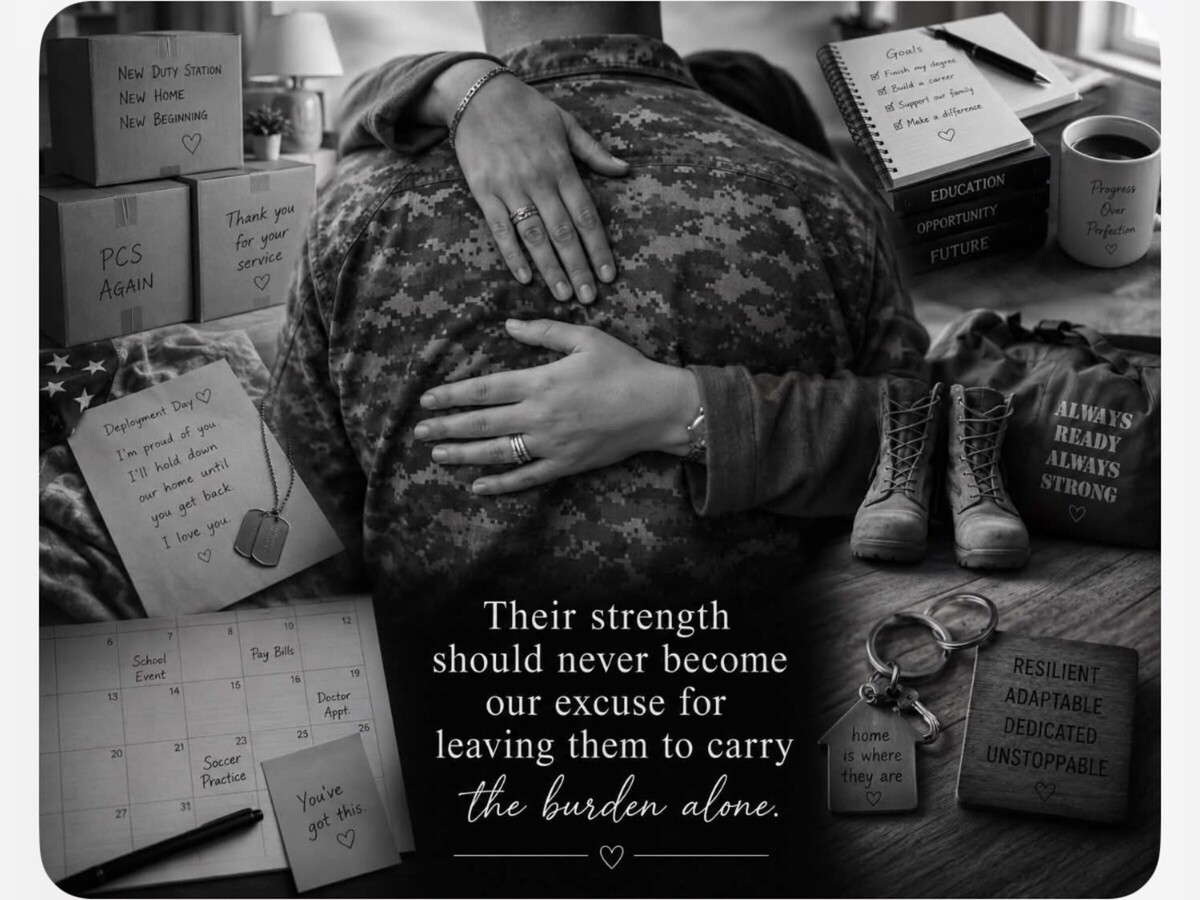
Department of Defense’s Annual Report on Suicide in the Military reported that 146 military family members died by suicide in 2023. 98 were military spouses. The report also found that the overall suicide rate among military family members increased between 2011 and 2023 (U.S. Department of Defense, 2026).
The data cannot tell us what led to any individual death, and we should never presume that they can. However, those numbers should compel us to ask whether military families receive meaningful help before their struggles become crises.
When I read those statistics, they broke my heart. They also brought back memories of the isolation, exhaustion, and pressure I experienced as the spouse of a disabled veteran.
Military spouses are praised for being resilient, adaptable, resourceful, and strong. Those descriptions are usually intended as compliments. But when resilience becomes an institutional expectation, spouses may begin to believe that asking for help means they have failed.
They may wonder: Is it just me? Am I weak? Why does everyone else seem capable of handling this?
The truth is that many military spouses ask themselves those same questions in silence.
Resilience is a personal strength. It is not a support system.
When “Being a Good Wife” Meant Giving Up My Future
My husband enlisted in 1986 and completed his military service in 2004. Because of conditions resulting from that service, he was awarded a 100% service-connected disability rating.
As his medical needs became more complicated, I became more than his spouse. I became his caregiver, advocate, researcher, and the person responsible for trying to make sense of conflicting medical information.
Simultaneously, educational benefits connected to his disability allowed me to continue my education and build a career that could provide financial stability for our family. Yet during one of his VA appointments, a dr. told me that his conditions were complicated and I needed stay home and care for him.
Dumbfounded, I asked, “You mean quit my job?”
His response has remained with me all these years: “That’s what a good wife would do.”
At that moment, I was not treated as a person with my own identity, responsibilities, education, or professional aspirations. I was treated as the system’s unpaid solution to a complicated medical problem.
The same institution providing an educational benefit intended to help financially stabilize our family was telling me that pursuing an education and career made me selfish. The doctor did not offer a care plan, meaningful assistance, or a path for resolving the medical concerns we had raised. Instead, the responsibility was placed entirely on me.
I responded in anger and frustration: “You all broke him. You all need to help fix him.”
Rather than address the issues, the doctor called security and had me escorted out.
That was not our only experience of being dismissed, but it was the defining moment for me. I realized that I had to advocate for my husband, but I also had to advocate for myself.
What My Research Revealed
Years later, when I began my Ph.D. journey, I knew I wanted my research to focus on military spouses. My doctoral study examined the lived experiences of military spouses pursuing postsecondary education at institutions identifying themselves as military-friendly.
Although my research focused on higher education, it revealed a broader need for holistic, family-centered support. Participants described isolation, limited practical assistance, inconsistent institutional support, and a reluctance to ask for help because they did not want to become a burden.
Family and friends often encouraged them emotionally, but geographic separation meant there was little practical help with children, appointments, household responsibilities, work, or school. Participants repeatedly described having to make everything work on their own.
Military spouses were also frequently not identified or tracked as a distinct population. Even at institutions describing themselves as military-friendly, meaningful assistance often depended on one compassionate professor or employee rather than a consistent, institution-wide support system.
Participants hesitated to contact her counselor because she believed the counselor was already busy and did not want to become an additional burden. Another acknowledged that resources might were available but never asked for them.
A program is not necessarily providing meaningful support merely because it exists. Support cannot depend entirely on an overwhelmed spouse having the time, knowledge, confidence, and emotional capacity to identify a need, locate the correct resource, navigate a complicated process, and ask for assistance.
My research celebrated the fortitude, adaptability, and survival skills of military spouses. However, it also concluded that those strengths should never be used to justify inadequate institutional support.
Military spouses often succeed not because systems adequately support them, but because they have developed the survival skills necessary to continue when those systems fall short (Hernandez, 2024).
That is the resilience paradox: We celebrate military spouses for surviving circumstances that better policies and stronger systems could have made less difficult.
A New Opportunity to Get It Right
Federal policy has recognized military spouses before.
In 2012, President Barack Obama signed Executive Order 13607, which established protections for service members, veterans, spouses, and other family members using federal education benefits. The order was an important advancement, but many of the programs and institutional practices that followed remained primarily focused on veterans and service members.
The lesson is simple: Including military spouses in the language of a policy does not guarantee that their distinct needs will be addressed in practice.
On August 3, 2026, President Donald Trump established the President’s Military Spouse Commission. The commission is directed to examine health care, education, employment, housing, deployment-related support, and military-family quality of life. It is also expected to engage with military spouses and provide recommendations to the President (The White House, 2026).
This is an important opportunity to move beyond recognition and create meaningful, coordinated support.
For too long, military-spouse concerns have been divided among separate programs such as employment, health care, education, and childcare. In reality, these issues are interconnected.
The commission has an opportunity to examine military families holistically rather than expecting spouses to navigate each consequence through a separate program.
Its success, however, will depend on whose experiences shape its recommendations.
The spouses of senior military and civilian leaders bring valuable knowledge, perspective, and years of experience. But decades of experience can also create distance from the earliest and most vulnerable years of military life.
The spouse of a senior military leader may understand the system well, yet a newer spouse may not even know which questions to ask.
I was a relatively new military spouse during the most difficult period of my experience. I needed help navigating complicated systems, but instead, I felt alone, selfish, and inadequate for not being able to manage everything myself.
The commission must hear that perspective.
The executive order allows the commission to invite additional participants and establish subcommittees. That authority should be used to ensure that military spouses are not simply recognized in name while programs continue to be designed around someone else.
What the Commission Must Hear
Broaden representation
The commission must include spouses who are in the first ten years of military life.
It should also hear directly from junior-enlisted families, junior officers’ spouses, Guard and Reserve families, male spouses, overseas families, caregivers, spouses pursuing education, families enrolled in the Exceptional Family Member Program, and families navigating the transition from active-duty service to veteran status.
Those who are newer to military life may be the least familiar with the system and the most hesitant to challenge it. Their experiences must be part of the commission’s ongoing work.
Make support proactive, coordinated, and confidential
We cannot wait until a spouse reaches a crisis point and then ask why that person did not request assistance.
Military families should receive proactive contact during known periods of increased stress, including deployments, relocations, medical diagnoses, childbirth, caregiving transitions, overseas assignments, and separation from service.
Spouses should not have to tell their stories repeatedly to disconnected offices. A trained navigator should be able to connect a family with health care, mental health services, education, employment assistance, childcare, financial resources, and caregiver support.
That assistance must also be confidential.
A spouse who believes that asking for help could harm the service member’s career or damage the family’s standing in the military community may remain silent. A resource is not genuinely accessible when fear prevents people from using it.
Strength Should Never Require Silence
Behind every military mission is a family making sacrifices that often go unnoticed.
Military spouses manage households through deployments, interrupt careers and education, advocate for their children, care for injured and disabled service members, and provide the stability that allows service members to focus on the mission. They perform an enormous amount of unpaid labor that sustains military families and, by extension, military readiness.
Recognizing that labor strengthens the entire military institution.
The President’s Military Spouse Commission represents a meaningful opportunity. Its success will depend on whether it listens beyond the most visible and experienced voices to hear from spouses who are new, isolated, overwhelmed, disconnected, or afraid to ask for help.
Military spouses are resilient, but their resilience should never be mistaken for limitless capacity. We must stop using their strength as proof that they can handle more and start asking why they are being expected to carry so much alone.
References:
Exec. Order No. 13,607, 77 Fed. Reg. 25,861 (May 2, 2012). https://www.federalregister.gov/documents/2012/05/02/2012-10715/establishing-principles-of-excellence-for-educational-institutions-serving-service-members-veterans
Hernandez, S. J. (2024). Beyond the label: A phenomenological study on the lived experiences of military spouses in military-friendly universities [Doctoral dissertation, New Mexico State University]. ProQuest Dissertations & Theses Global. https://www.proquest.com/docview/3168574277
The White House. (2026, August 3). Establishing the President’s Military Spouse Commission [Executive order]. https://www.whitehouse.gov/presidential-actions/2026/08/establishing-the-presidents-military-spouse-commission-af64/
U.S. Department of War, Office of the Under Secretary of War for Personnel and Readiness. (2026). Calendar year 2024 annual report on suicide in the military: Including the Department of Defense suicide event report. Defense Suicide Prevention Office. https://www.dspo.mil/Portals/113/2026_CY/documents/DSPO_ReportonSuicide_CY24_20260317_508c.pdf

You said so many important things here, and I really commend you for your strength and dedication to advocate for these important issues. It is especially important for those impacted to have their voices heard. Thank you.


Sunny, with a high of 73 and low of 55 degrees. Sunny during the morning, clear during the afternoon and evening,




Love your shop in Las Cruces! Haven’t been to the one here in Alamo yet.
Hi Troy,
What do you think of the manga Jaadugar: A Witch's Life in Mongol (Tomato Soup). It's now an anime from Saru Science/Crunchyroll.
Enjoy!



Thank you Sheriff!