Image
Timberon Water District : Analysis Finds Gaps in Records, Testing, and Transparency - AlamogordoTownNews.org



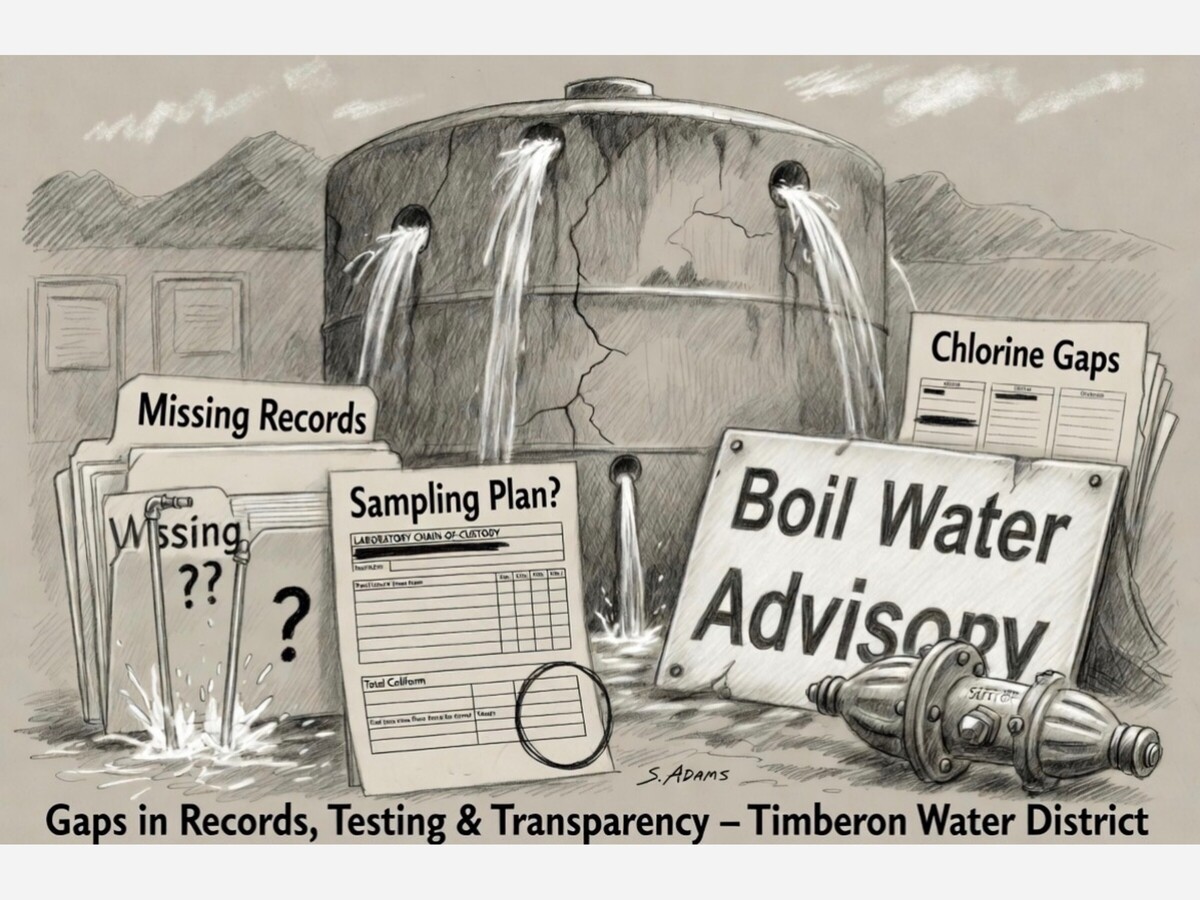
Timberon N.M. - Timberon Water & Sanitation District (TWSD) faces mounting questions about operational transparency and regulatory compliance following the release of two critical compliance documents revealing incomplete water-quality records, missed state auditing requirements, and public information gaps.
Alamogordo Town News has requested multiple sample results and other details via IPRA requests and shared with water system academics and experts to better understand the data and share with our readers and listeners.
A recent 2026 water-sample audit confirmed at least one Total Coliform (TC) bacteriological positive sample collected on July 9, with E. coli absent. A follow-up sample on July 12 tested negative for both contaminants. However, the audit report notes that TWSD's production of 34 laboratory sample records from June and July was not individually classified, leaving the complete picture of water quality unclear. Our expert recommends that each original laboratory form be reviewed individually to provide a definitive count of positive samples.
The positive TC result coincided with a system-wide precautionary boil-water advisory that remained in effect through most of July 2026, affecting the district's approximately 1,200 service connections.
The advisory followed a June Tank 2 transfer-pump repair and pressure-zone issues that prompted multiple precautionary boil-water notices.
Over three months, the district issued three separate boil-water advisories tied to tank pressure drops—a pattern reflecting the aging infrastructure's chronic vulnerability to low-pressure events that can allow contamination.
A Pattern of Water Quality Crises
The July advisory marked the third precautionary notice in five weeks. The district's roughly 50-year-old system has been plagued by distribution-system failures, with prior reporting documenting close to 50 pipe breaks in a single month. A 2023 infrastructure investigation found the system losing an estimated 85 percent of pumped water to leaks, with much of it flowing through thin-walled PVC pipe never rated for pressurized drinking water. Nearly half the community's fire hydrants have been out of service.
Water Sample Test Results: June 2 - July 16, 2026
A TWSD's production archive submitted to our team contained 34 laboratory chain-of-custody forms from NMED-certified lab Diagnostic & Technology Center (Lab #NM0301). All samples used test method SM 9223B, the standard presence/absence test for Total Coliform (TC) and E. coli (EC). Following is the sample-by-sample breakdown:
June 2, 2026 (7 Routine Samples)
Sample 020626-61: TC Absent, EC Absent, Free Cl: 0.31 mg/L Sample 020626-62: TC Absent, EC Absent, Free Cl: 0.30 mg/L Sample 020626-63: TC Absent, EC Absent, Free Cl: 0.29 mg/L Sample 020626-64: TC Absent, EC Absent, Free Cl: 0.32 mg/L Sample 020626-65: TC Absent, EC Absent, Free Cl: 0.31 mg/L Sample 020626-66: TC Absent, EC Absent, Free Cl: 0.31 mg/L Sample 020626-67: TC Absent, EC Absent, Free Cl: 0.30 mg/L
June 6, 2026 (3 Routine Samples)
Sample 060726-36: TC Absent, EC Absent, Free Cl: 0.29 mg/L Sample 060726-37: TC Absent, EC Absent, Free Cl: 0.28 mg/L Sample 060726-38: TC Absent, EC Absent, Free Cl: 0.27 mg/L
June 22, 2026 (6 Routine Samples)
Sample 220626-8: TC Absent, EC Absent, Free Cl: 0.39 mg/L Sample 220626-9: TC Absent, EC Absent, Free Cl: 0.38 mg/L Sample 220626-10: TC Absent, EC Absent, Free Cl: 0.37 mg/L Sample 220626-11: TC Absent, EC Absent, Free Cl: 0.36 mg/L Sample 220626-12: TC Absent, EC Absent, Free Cl: 0.37 mg/L Sample 220626-13: TC Absent, EC Absent, Free Cl: 0.38 mg/L
June 23, 2026 (5 Routine Samples)
Sample 230726-3: TC Absent, EC Absent, Free Cl: 1.08 mg/L Sample 230726-4: TC Absent, EC Absent, Free Cl: 1.11 mg/L Sample 230726-5: TC Absent, EC Absent, Free Cl: 1.09 mg/L Sample 230726-6: TC Absent, EC Absent, Free Cl: 1.12 mg/L Sample 230726-7: TC Absent, EC Absent, Free Cl: 1.10 mg/L
June 29, 2026 (1 Routine Sample)
Sample 290626-2: TC Absent, EC Absent, Free Cl: 0.41 mg/L
July 9, 2026 (5 Special Samples - Tank 2 Pressure Zone)
Sample 090726-7 (Uvaleñi Drive): TC Absent, EC Absent, Free Cl: 0.27 mg/L Sample 090726-8 (Location field): TC Absent, EC Absent, Free Cl: 0.14 mg/L Sample 090726-9 (Corcho Pt/Stallion) — POSITIVE: TC POSITIVE, EC Absent, Free Cl: 1.0 mg/L — Notification to TWSD Office: July 10, 10:45 AM Sample 090726-10 (Uvaleñi Drive): TC Absent, EC Absent, Free Cl: 0.10 mg/L Sample 090726-11 (Location field): TC Absent, EC Absent, Free Cl: 0.10 mg/L
July 10, 2026 (5 Routine Samples)
Sample 100626-3: TC Absent, EC Absent, Free Cl: 0.42 mg/L Sample 100626-4: TC Absent, EC Absent, Free Cl: 0.41 mg/L Sample 100626-6: TC Absent, EC Absent, Free Cl: 0.40 mg/L Sample 100626-7: TC Absent, EC Absent, Free Cl: 0.41 mg/L Sample 100626-8: TC Absent, EC Absent, Free Cl: 0.42 mg/L
July 12, 2026 (Repeat Sample - Response to July 9 Positive)
Sample 120726-11 (Repeat): TC Absent, EC Absent, Free Cl: 0.09 mg/L — Confirmation test following July 9 positive; result negative
July 16, 2026 (2 Routine Samples)
Sample 160726-1: TC Absent, EC Absent, Free Cl: 1.29 mg/L Sample 160726-2: TC Absent, EC Absent, Free Cl: 1.41 mg/L
34 Total Samples: Total Coliform: 1 (July 9, Sample 090726-9) Positive for E. coli: 0 Clean (Both TC and EC Absent): 33 Free Chlorine Range: 0.09–1.41 mg/L Samples Below 0.30 mg/L Free Chlorine: 7 (all from July 9 special samples in Tank 2 pressure zone)
Analysis
The data confirms the finding of one sample tested positive for Total Coliform, and that sample was E. coli-negative, indicating a non-fecal contamination indicator
The follow-up repeat sample on July 12 tested clean for both parameters, which explains why the district later labeled the July 9 result a "false positive" in its records—following standard protocol, a positive result followed by a clean repeat is consistent with a temporary or transient contamination event rather than a systemic failure.
However, the July 9 special samples from the Tank 2 pressure zone show notably lower free chlorine residuals (0.10–0.27 mg/L) compared to routine samples from earlier in June (0.27–0.42 mg/L) and routine samples from July 10 onward (0.40–1.41 mg/L).
These lower residuals, combined with the tank pressure-zone depressurization event that prompted the special sampling, created the conditions under which the positive coliform result occurred. The fact that only one sample tested positive, and that sample was followed by clean results, supports the precautionary approach the district took in issuing boil-water advisories.
State Finds District Failed Customer Notification Requirements
Beyond water-quality testing, state regulators have identified a separate, serious compliance failure.
In June 2026, the New Mexico Environment Department's Water Protection Compliance & Enforcement Bureau issued a Notice of Violation documenting that TWSD received a Ground Water Rule violation in March 2026 but failed to notify its customers within the required 30-day window. State and federal rules require utilities to notify every customer directly by mail or other direct delivery and to certify that notification to NMED within 10 days thereafter—neither step was completed. The notification failure put the district in violation for a second, independent reason beyond the original violation itself.
The notice warned TWSD it could face an Administrative Compliance Order and civil penalties. The district has been added to NMED's public Enforcement Watch list—its second appearance there, following an earlier citation for operating an unregistered solid-waste site dating back to 1996.
Records Compliance Falls Short
A compliance analysis of the district's public records response identified significant gaps, with the custodian's explanations conflating legally distinct categories:
Missing Documents: The current NMED-approved Distribution System Sampling Plan—the document governing where and how the district tests water—has yet to produced to Alamogordo Town News or any other IPRA request pending.
A "corrected sites" attachment referenced in a November 2025 email to NMED remains absent from the production, despite evidence that the file existed per multiple IPRA requesters.
Contradictory Chlorine Records: TWSD stated it was "unable to locate records for the free and total Chlorine measurements," yet the produced laboratory forms contained a "Free" chlorine field with numeric entries (including 0.10 mg/L on July 9 samples and 0.09 mg/L on the July 12 repeat). Our analysis notes this represents a records-management discrepancy that should be clarified to the public’s
Vague Denial Explanations: TWSD's responses to IPRA questions conflate three legally distinct concepts—records that don't exist, records that couldn't be located, and records that were withheld—without identifying which records fall into which category or providing a legal basis for any withholding. There are few exceptions to allow withholding in the IPRA statutes.
Timing Concerns: The district is under significant pressure with multiple apparent deadline violations for IPRA noncompliance across multiple requests from multiple parties.
TWSD received multiple records requests in recent months from multiple sources, closed for 3 days to focus on those requests but continued to issue production letters stating that is "still gathering information." Under New Mexico IPRA, public bodies must respond within fifteen days or provide a written explanation of delays and may produce rolling fulfillment. However a statement by a now unemployed IPRA facilitator of the entity claimed he would not engage in that process.
Operational Transparency Declines and Communications Cut
The analysis findings emerge against a backdrop of decreased public access to operational information. For months, residents relied on one source for plain-language updates about system operations: a board member and former general manager who posted daily water-tank level readings, boil-water advisory status, and repair timelines to a community Facebook group. That communication stream ended abruptly in July 2026, coinciding with increased outside media scrutiny of the district's regulatory troubles.
The board member's exit as the informal public voice came without explanation.
The district indicated future updates would flow through the office treasurer or the district office itself, a shift that centralizes public communication in formal channels—a move that governance experts recognize as a defensive posture for utilities facing active state enforcement review, but one that has resulted in little to no public information flow.
Prior to the communication cutoff, the board member had provided specific, daily operational data: tank levels, advisory status, and repair timelines. Those updates provided residents with real-time visibility into whether the system was filling or depleting storage and how much longer restrictions might remain in effect. The loss of that detail has reduced public access to system performance information.
Most recent board minutes also omitted details of a budget voted on at the district's latest board meeting. A complete budget remains unavailable to the public, limiting residents' ability to understand how district finances are allocated or to evaluate spending priorities for infrastructure, staffing, and water quality management.
Financial Distress and Asset Mismanagement
The district's public statements paint a picture of an operation in financial crisis. TWSD closed the Timberon Community Pool for the 2026 season, citing an operating loss of approximately $26,500 against roughly $3,500 in revenue. A former board chair has estimated the system needs between $45 million and $50 million in infrastructure investment for a complete overhaul.
A state Public Regulation Commission official has publicly raised the possibility of receivership—a mechanism that would strip the elected board of control entirely. More than 200 properties are eligible for foreclosure over unpaid standby fees, and the board has directed its attorney to explore collection and foreclosure options against delinquent ratepayers and is testing legal options against 3 per a recent board discussion.
Against that backdrop, the district's handling of its golf course stands out for scrutiny. In April 2025, the board approved a 10-year lease of the district-owned golf course and lounge building to a private operator for $1 per month, with the lessee keeping 100 percent of profits and assuming responsibility for insurance, maintenance, and utilities. No appraisal of the golf course, lounge, or adjoining parcel appears in the board's record, and no competitive bid process was documented—a contrast with the board's separate launch of a competitive bidding process for waste-management services at the same meeting. Under the lease, TWSD receives $12 annually and no share of profits from an asset it retains ownership of and remains responsible for. Alamogordo Town News is still awaiting details of an IPRA request around that lease agreement and analysis and is prepared to file litigation and a complaint with the AG if those documents are not released timely.
New Mexico's Anti-Donation Clause generally bars public bodies from giving away items of value to private parties without adequate consideration; whether the current arrangement meets that standard has not been publicly addressed.
Heightened Scrutiny from Multiple Outlets
The TWSD water situation has drawn unusual attention from both local and statewide journalism outlets. Alamogordo Town News/2nd Life Media has documented the district's regulatory troubles, including state violation notices, failed customer notification requirements, financial distress, and records-management practices. Source New Mexico, a nonprofit statehouse outlet, has separately covered the district's infrastructure crisis and the state utility commissioner's public suggestion that TWSD be placed in receivership.
Together, these outlets have documented a pattern: years of boil-water advisories tied to low tank levels and aging infrastructure, multiple Open Meetings Act violations, a public records custodian initially slow-walking requests (though subsequently responsive), financial statements indicating the district lacks capacity for basic maintenance, and most recently, the loss of informal daily communication with residents about system operations coinciding with onset of external media scrutiny.
A Study in Contrasts: Tularosa's Transparency vs. Timberon's Defensive Measures
While both communities have experienced water crises, their approaches to transparency and public communication differ starkly—offering a case study in how governance can either serve or isolate residents during emergencies.
Tularosa, facing its own critical water shortage, adopted a markedly different public posture. The village held public meetings to discuss the emergency, with multiple board members and city leadership taking an active public role. Trustees and village officials made direct public statements via social media to keep residents informed. Leadership spoke to local radio stations and engaged with Alamogordo Town News journalists, providing multiple updates and reports as the situation developed.
The Tularosa approach prioritized keeping the public "abreast and aware" through diverse communication channels and consistent messaging from multiple official sources.
Timberon's approach, by contrast, has centered on defensive measures and information control.
The district's informal daily communication through a board member's Facebook updates—the primary real-time channel residents relied on for operational data—ended abruptly as outside media scrutiny intensified. Public communication was centralized in the district office, moving away from knowledgeable individual voices. When records requests came in, responses conflated different categories of missing information without clear explanation. Most recent board minutes omitted budget details voted on at public meetings. The overall pattern reflects a utility under enforcement review retreating from public visibility rather than engaging residents directly.
The contrast is instructive: one community Tularosa is using transparency as a tool to maintain public trust during crisis; the other, Timberon, is using centralized, sparse communication as a defensive posture.
For residents of small water systems with limited staff the difference is substantial.
Transparency—whether through multiple voices, social media updates, radio interviews, or press engagement—allows people to understand what is happening, assess risk for themselves, and hold leadership accountable.
Defensive silence, by contrast add to the workload by creating a public wanting answer and having to resort to IPRA requests to find them. This lack of transparency creates a vacuum that residents fill with speculation and anxiety, and it erodes the trust that utilities depend on to function effectively during emergencies.
The Regulatory and Public Health Picture
The water-testing data produced to media outlets shows that, as of mid-July 2026, the district's bacteriological testing largely came back clean—a positive sign for immediate water safety. However, as a Special sample rather than part of the formal compliance-testing sequence, a single clean result at one location does not rule out contamination elsewhere in a system experiencing recurring low-pressure events. The boil-water advisory remained the precautionary standard.
What is clear from the record is that the district faces multiple, simultaneous pressures: aging infrastructure failing faster than repair crews can keep up with, recurring pressure-zone depressurizations that trigger precautionary boil-water advisories, incomplete or mischaracterized public records responses, a state-documented failure to notify customers of violations, financial inability to invest in needed infrastructure, and a recent shift away from informal public communication to residents about system operations.
What Transparency Means in Practice
The district's response to compliance documents shows an effort to produce responsive records when formally requested verses more transparent and broader public communications via social media and the press’s
However, the pattern of incomplete explanations, categorical statements about missing records contradicted by data on produced forms, and the centralization of public communication away from a knowledgeable board member toward the district office—all occurring during a period of state enforcement action and possible receivership—raises questions about whether residents are getting the complete operational picture they need to make informed decisions about their water system and their own preparedness.
As a public utility, TWSD is obligated to provide safe, reliable water and to operate with transparency. That obligation exists independently of the district's financial distress, aging infrastructure, or the external challenges small water systems face across New Mexico.
Residents have a right to understand the full scope of what is happening with their water system.
Document and Coverage Sources
TWSD Water Sample Test Audit Report, August 2026 TWSD IPRA Compliance Analysis for Alamogordo Town News. August 2026 New Mexico Inspection of Public Records Act (NMSA 1978, §§ 14-2-8, 14-2-11) Alamogordo Town News/2nd Life Media coverage of TWSD water system, June-July 2026 New Mexico Environment Department Notice of Violation, June 2026

Patchy rain nearby, with a high of 73 and low of 55 degrees. Overcast for the morning, thundery outbreaks in nearby in the afternoon, clear during the evening, patchy rain nearby overnight.




Love your shop in Las Cruces! Haven’t been to the one here in Alamo yet.
Hi Troy,
What do you think of the manga Jaadugar: A Witch's Life in Mongol (Tomato Soup). It's now an anime from Saru Science/Crunchyroll.
Enjoy!



Thank you Sheriff!