66° and Overcast
Image
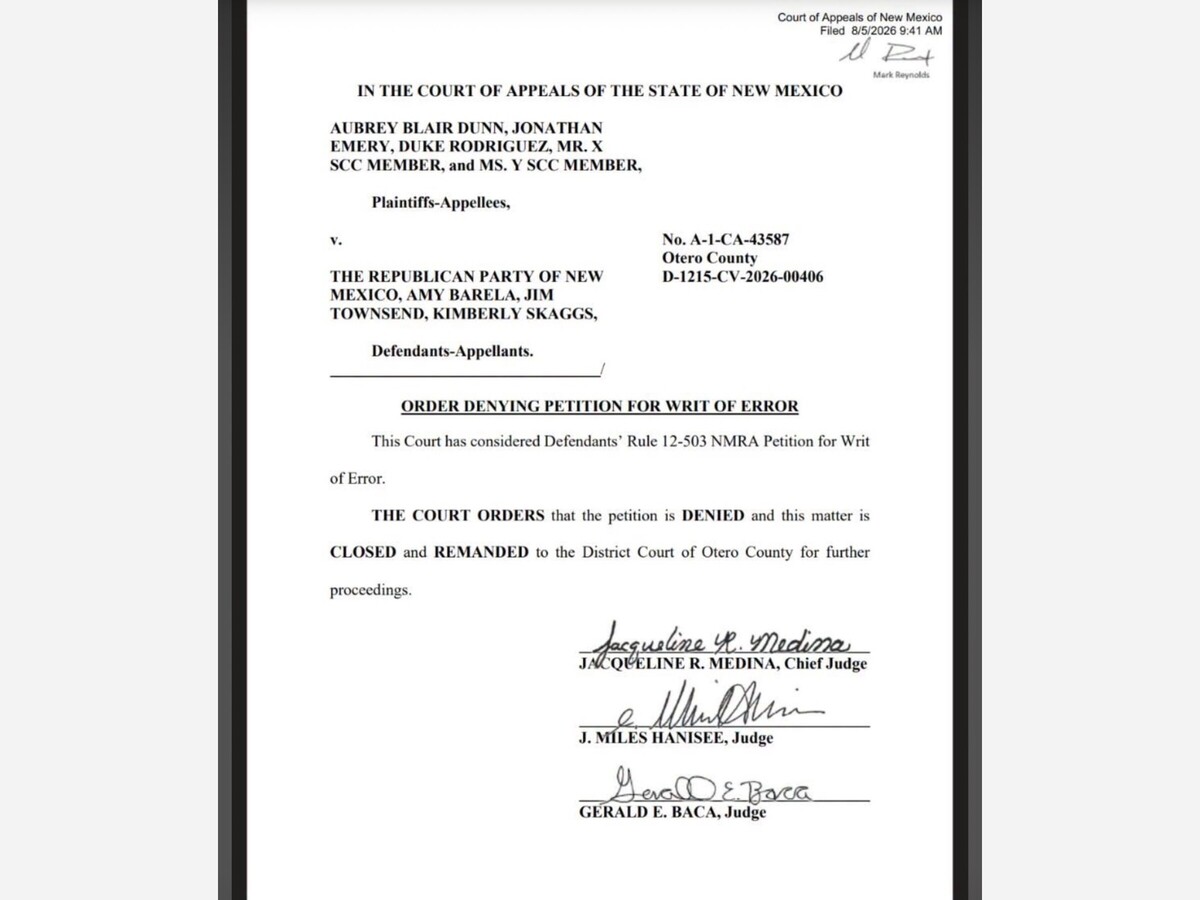



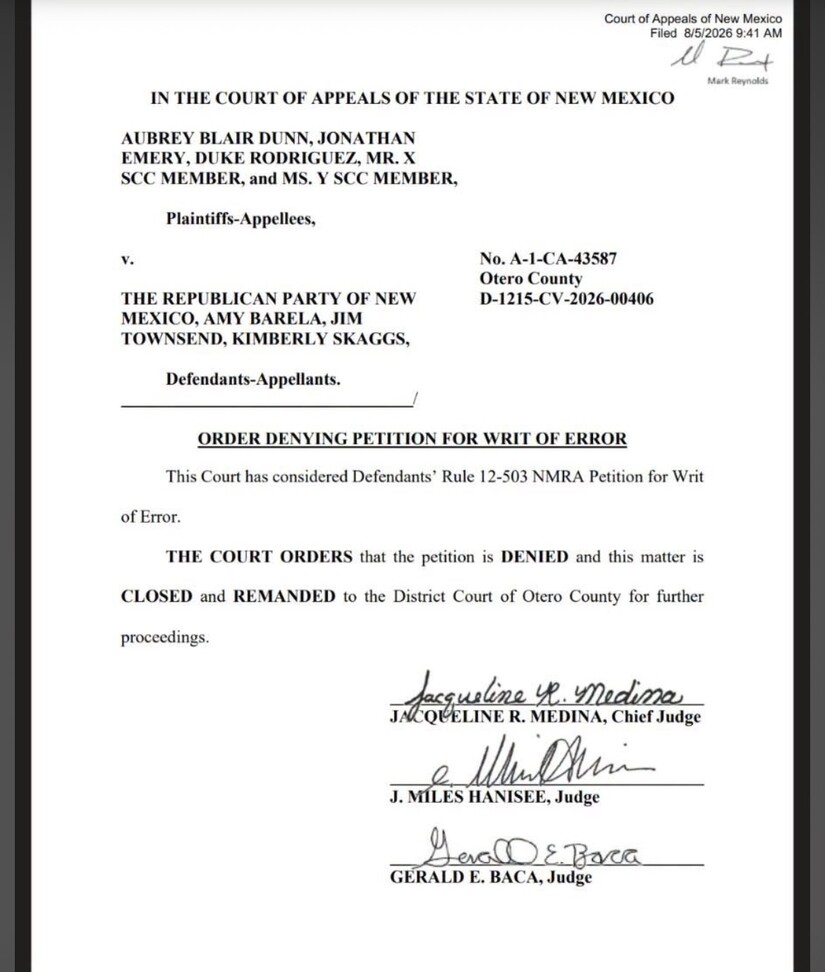
SANTA FE, N.M. — In what may be the final chapter of a bitter intra-party legal battle, New Mexico’s Court of Appeals has denied the Republican Party of New Mexico’s petition for writ of error on August 5, 2026, effectively upholding the lower court’s controversial decision to remove Amy Barela from her position as state party chairwoman.
The three-judge appellate panel, consisting of Justices Jacqueline R. Medina, J. Miles Hanisee, and Gerald E. Baca, remanded the matter back to Otero County District Court for further proceedings. The order closes a legal chapter that has roiled the state’s Republican Party for months and raised questions about the judiciary’s proper role in resolving internal party disputes.
A Party at War with Itself
The conflict that led to this ruling originated when two separate lawsuits were filed in May 2026 seeking the ouster of state GOP chairwoman Amy Barela, with one filed in Bernalillo County and another in Otero County. The plaintiffs — including lieutenant governor candidate Aubrey Blair Dunn, Otero County Commission candidate Jonathan Emery, gubernatorial candidate Duke Rodriguez, and other party members — argued that Barela had violated party rules by refusing to step aside while simultaneously seeking re-election to her Otero County Commission seat.
The central issue hinged on the Republican Party’s own internal rules. Party rules prohibit chairpersons from holding the post while also running in a contested primary. This conflict-of-interest provision was designed to prevent party leaders from using their official positions to advantage their own candidacies.
The Lower Court’s Dramatic Ruling
On May 27, 2026, Thirteenth Judicial District Judge Cindy Mercer issued a preliminary injunction that prohibits Barela from continuing to serve as chair and also orders party officials not to publicly support any of the Republicans running for office during the ongoing primary.
The injunction came just days before the June 2 primary election and sent shockwaves through Republican circles. Aubrey Blair Dunn, who is running for lieutenant governor as a Republican and was one of the plaintiffs, said the party’s decision to appeal is misguided, stating “The judge’s decision was clear, well-reasoned, and plainly correct, and dragging it into an appeal does nothing but waste the Party’s limited resources and the Court’s valuable time.” Gubernatorial candidate Duke Rodriguez, another plaintiff, said an appeal will only distract from the Republican Party’s efforts to win elections.
The Party’s Appeal and Supreme Court Loss
Undeterred by these comments from fellow Republicans, the party and Barela herself filed an emergency petition to the New Mexico Supreme Court. The Republican Party of New Mexico argued that a lower court judge’s ruling was unprecedented and “extraordinary”.
The New Mexico Supreme Court on June 10, 2026, denied the Republican Party of New Mexico’s appeal of the lower court ruling. The state Republican party filed an emergency petition on May 29, arguing it violated party members’ free speech rights and that courts are not the proper venue to resolve intra-party disputes. The New Mexico Supreme Court unanimously denied that petition without explanation.
That rebuke at the state’s highest court set the stage for today’s appellate court decision, which further demonstrates the judicial system’s determination to enforce the will of the lower court.
Political Consequences and Timing
The legal battle’s impact on the 2026 election cycle was immediate and profound. Amy Barela was ousted from the Otero County Commission by a 46-vote margin in the primary election, just days after a judge ordered her to step down from her party post.
The tight loss raises questions about whether Barela’s legal troubles affected her electoral prospects, or whether she was simply defeated by a well-organized opponent. Jonathan Emery narrowly beat Barela in the June 2 primary election.
A Fractious Party
The dispute reflects deeper divisions within New Mexico’s Republican Party heading into a critical election year. The party has struggled with leadership and message coherence, particularly on statewide races. The internal legal war has consumed resources and attention that many Republicans believe should have been focused on challenging Democratic control of state offices.
The broader context involves questions about presidential loyalties within the state GOP. Though not explicitly stated in court documents, the lawsuit emerged amid broader national Republican tensions between traditional party conservatives and more populist wings.
What Happens Next
With the Court of Appeals having remanded the case back to District Court, the matter is not entirely resolved. The lower court will likely address remaining questions about party governance and potential damages. Additionally, questions remain about how the party will move forward in selecting new leadership.
Earlier this summer, the party was scheduled to name a new chair at a June 20 State Central Committee meeting in Las Cruces, though the full details of that process and whether all leadership questions have been resolved remain unclear.
A Lawyer’s Perspective
Aubrey Blair Dunn, one of the plaintiffs and himself a lawyer serving Albuquerque in Administrative Law and Appeals cases, viewed the case as a straightforward application of existing party rules. The Court of Appeals’ decision appears to validate his interpretation that judges do have a role to play when internal party matters rise to the level of contractual disputes governed by written bylaws and rules.
The ruling also suggests that while courts generally try to avoid interfering in internal party politics, they will intervene when a party’s own written rules have been clearly violated and members take legal action.
Looking Forward
Today’s decision by the Court of Appeals effectively closes one chapter of the Republican Party’s internal warfare, though questions remain about whether this ruling will be the final word or if further legal challenges are possible.
For Barela, the defeat marks a dramatic fall from power for the chairwoman who led the party into 2026. She remains an Otero County resident and her political future remains uncertain.
For the plaintiffs — including Dunn, Emery, and Rodriguez — the wins in court and at the ballot box represent vindication of their position that party rules exist to prevent exactly the kind of conflict-of-interest situation Barela allegedly created.
For the New Mexico Republican Party itself, the question now becomes whether it can move forward unified under new leadership, or whether the bitterness of this legal fight will continue to hamper Republican efforts to regain statewide offices.


Patchy rain nearby, with a high of 74 and low of 55 degrees. Patchy rain nearby in the morning,


Love your shop in Las Cruces! Haven’t been to the one here in Alamo yet.
Hi Troy,
What do you think of the manga Jaadugar: A Witch's Life in Mongol (Tomato Soup). It's now an anime from Saru Science/Crunchyroll.
Enjoy!



Thank you Sheriff!

She lectures her expertise like she was running SpaceX. Home Service Contractors and Darnold Plumbing could get any of those things built in a month. These unqualified people use it to justify their lives. We have to work to pay off their excess spending.
Neither have the proper license try again!
Hey Rube! I think the point is expertise. A 'proper licesne' is always the thinking of those educated by The Machine. Let the free market rule, not the paper pushers.
He did the same thing when he ran against Rachel. He's a pathological liar who just keeps proving it over and over.
he senses trouble....and i smell blood - time to send him to private sector employment - maybe his oil & gas friends can find something for him to do.
Lets ask the editor.
sir, are you not involved in the campaign?