
 77° and Patchy rain nearby
Image
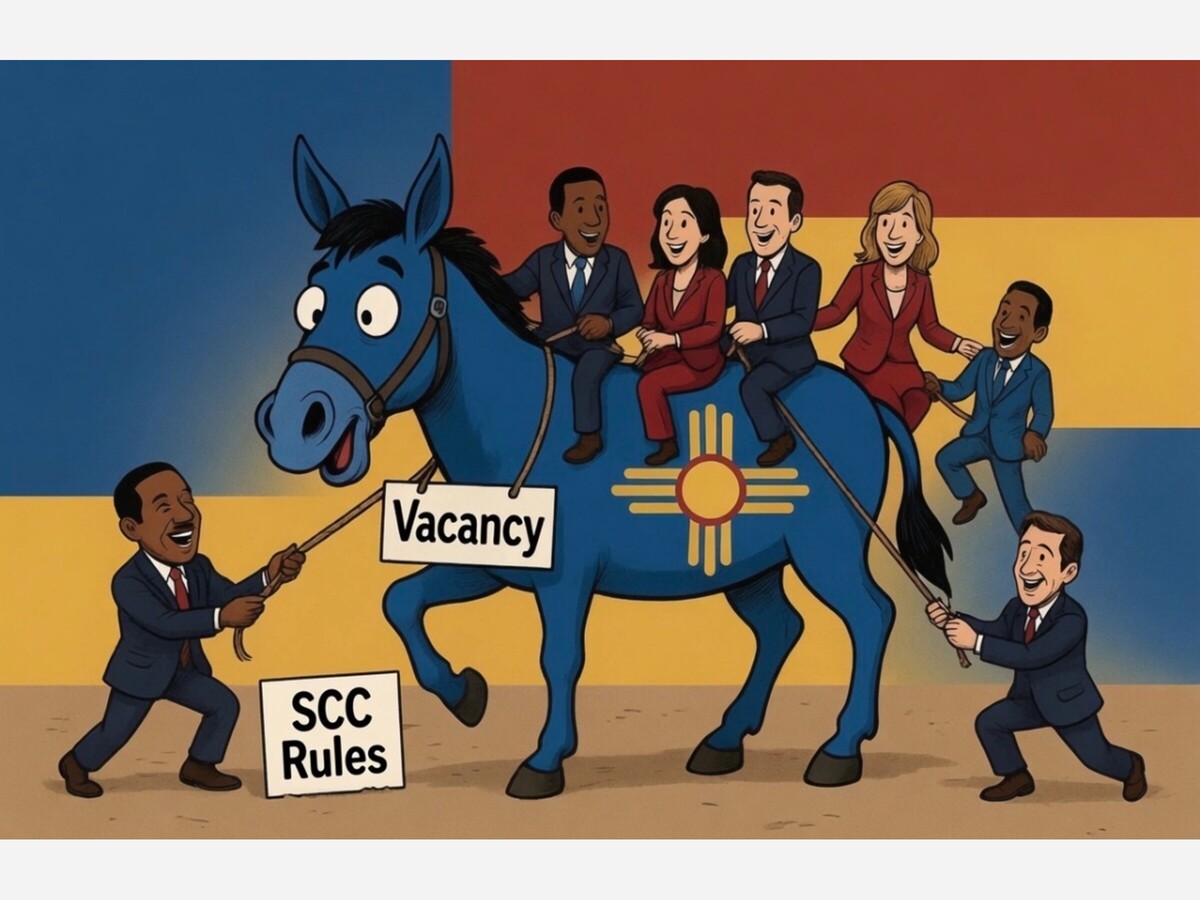



Alamogordo Town News special political report - The New Mexico Secretary of State Maggie Toulouse Oliver suspended her campaign for lieutenant governor on June 18, citing recent changes to her health, just two weeks after winning the Democratic primary in a landslide over state Sen. Harold Pope Jr. (80% to 20%). Her exit ended what would have been the state’s first all-female Democratic ticket alongside gubernatorial nominee Deb Haaland, and it kicked off a selection process most voters rarely think about.
At least seven Democrats have been named as potential replacements, ranging from sitting legislators to a former House Speaker to a former Senate Majority Leader who left office a decade ago. Below is a look at the process itself, followed by a fuller pros-and-cons rundown of everyone in the mix.
The Process: How a Replacement Gets Picked
New Mexico law doesn’t allow parties to hold a second primary election to fill a vacated nomination. Instead, under the rules of the Democratic Party of New Mexico, the State Central Committee — a body made up of county and district party officials and activists, not the general primary electorate — will vote to select Toulouse Oliver’s replacement. The party says the timeline for that vote is still being finalized, and has pointed to past use of this mechanism, including filling a 2021 congressional vacancy and legislative nominations in 2024, as precedent that the process is “secure” and “well-established.”
Pros of the Central Committee process
• Speed and certainty. A special primary would take months and cost money the party doesn’t have time to spend before the November ballot.
• Experienced decision-makers. Central Committee members are party veterans who, in theory, know the candidates’ records and the state’s political landscape well.
• Established precedent. This isn’t a novel process — it’s been used for other vacancies without major incident.
Cons of the Central Committee process
• Limited democratic input. A few hundred party insiders, not the roughly 200,000-plus Democrats who voted in the June primary, will make the call.
• Reduced transparency. The criteria for the decision, and any behind-the-scenes lobbying among candidates and committee members, are largely invisible to the public.
• Risk of perceived favoritism. Whoever is chosen will face questions about whether the pick reflects the party’s broadest interests or the preferences of a narrower insider network, especially given how many former officeholders and party veterans are circling this opening.
The Candidates
State Sen. Harold Pope Jr. (D-Albuquerque)
• Pros: The only Democrat in the field who already ran a statewide primary campaign and received votes from Democratic voters this cycle. Would make history as New Mexico’s first Black lieutenant governor (and only the second Black candidate ever elected statewide in New Mexico, after former state Treasurer James Lewis). Has sitting legislative experience in the state Senate.
• Cons: Lost decisively to Toulouse Oliver, 80%-20%, which some could read as evidence he lacks broad grassroots support beyond his base. Entered the race with a comparatively modest campaign account — roughly $10,000 transferred from his Senate committee — well behind other potential picks in fundraising and name recognition.
State Land Commissioner Stephanie Garcia Richard
• Pros: Twice elected statewide and broadly popular with the party base; reportedly raised significantly more money than her primary rivals before withdrawing from this race last fall. Her office reports raising more than $10 billion for New Mexico schools, hospitals, and universities since 2019, and she’s credited with substantially expanding renewable energy leasing on state trust land. She’s term-limited out of her current office, freeing her to run, and had originally stepped aside only for her husband’s health, not for any controversy.
• Cons: As Land Commissioner, her office approved a State Trust Land lease tied to Castelion’s “Project Ranger,” a solid rocket motor and hypersonic missile manufacturing facility near Rio Rancho. Local environmental groups have criticized the project’s approval process, alleging a lack of a properly noticed public hearing and an incomplete environmental review, and have raised concerns about difficulty obtaining related public records. She also serves as vice chair of the New Mexico State Investment Council, which oversees the state’s permanent funds; critics of the broader national trend of private equity and venture capital flowing into AI-enabled and autonomous weapons companies have raised general concerns about that sector, though I could not independently verify specifics of any single Council vote tied to her tenure. Supporters note the Council’s core mandate is financial returns for public schools and institutions, not industrial policy.
State Sen. Leo Jaramillo (D-Española)
• Pros: Considered a rising star within the party; defeated a longtime incumbent in 2020 on a more progressive platform and has run unopposed since. Would be one of the only openly gay statewide elected officials in New Mexico history. Has a varied professional background, including time as a local news producer and a middle school teacher.
• Cons: Less statewide name recognition than Garcia Richard or Colón, having never run beyond his Senate district. His day job as an operations staff manager at Los Alamos National Laboratory — a federal nuclear weapons research facility — could raise some of the same “ties to the defense and weapons industry” concerns critics have leveled at other candidates in this race, though there’s no indication his position has involved any specific policy conflict.
Former State Auditor Brian Colón
• Pros: Statewide name recognition from two prior elected terms as auditor and a 2022 run for attorney general. As auditor, his office secured a notable financial recovery for seniors defrauded by insurance intermediaries and pursued several high-profile fraud and conflict-of-interest investigations, including into local government finances. Deep relationships across the party, built partly through a stint as state party chairman from 2007-2009, plus current civic roles including on the New Mexico Commission of Public Records.
• Cons: Those same insider ties are exactly what some Democrats argue this selection process should avoid leaning on, given concerns about the optics of a party-insider process picking a party insider. He settled a matter with the New Mexico State Ethics Commission in 2023; I was not able to confirm the underlying details of that matter from available sources. He’s also been out of elected office since 2023 and currently works as a managing partner at a national plaintiffs’ law firm, which critics could frame as a different kind of institutional alignment than the one voters were asked to evaluate in the primary.
Los Ranchos de Albuquerque Mayor Lawrence Rael
• Pros: Decades of executive government experience, including 34 years with the City of Albuquerque (rising to Chief Administrative Officer under three mayors), a stint as a federal Farm Service Agency state director under President Obama, and prior service on U.S. Sen. Jeff Bingaman’s staff. Currently serves as an elected mayor, giving him a present-day governing role.
• Cons: Lost the 2014 Democratic gubernatorial primary and has never won a contested statewide race. He wasn’t elected mayor by voters — he was appointed by the Los Ranchos Board of Trustees in 2025 after the sitting mayor died in office — which undercuts the “voters chose this person” argument some are making in this race. His current office is a small village of roughly 6,000 residents, a much smaller political base than a statewide post.
Former House Speaker Brian Egolf (D-Santa Fe)
• Pros: One of the most experienced legislative leaders available, having served as House Speaker from 2017 to 2023 and helped create the New Mexico State Ethics Commission. An attorney who has litigated civil rights cases, including helping secure marriage rights for a same-sex couple in New Mexico before it was legalized statewide.
• Cons: Resigned a legislative ethics-committee appointment in 2022 rather than face a hearing after the State Ethics Commission found probable cause that he’d violated the Governmental Conduct Act by appointing himself to a panel that nominates utility regulators. He separately faced a complaint alleging he didn’t disclose that his law firm could financially benefit from legislation he was sponsoring; he called both complaints politically motivated distractions. He’s been out of elected office since 2023.
Former Senate Majority Leader Michael Sanchez (D-Belen)
• Pros: Decades of institutional legislative experience, having served in the state Senate from 1993 to 2016 and held the chamber’s top Democratic leadership post for years. Comes from a politically prominent New Mexico family with deep Valencia County roots.
• Cons: Lost his Senate re-election bid in 2016 and has been out of elected office for roughly a decade — by far the longest absence from elected office of anyone in this field, which raises obvious “is he in touch with the current electorate” questions. At 75, he would also be the oldest name under serious discussion.
What’s Next
The Democratic Party of New Mexico says it will release a finalized timeline for the Central Committee vote soon. Whoever is selected will join Haaland on the November 3 general election ballot. With this many current and former officials circling one opening, the choice is likely to be watched as closely for what it signals about how the party balances insider deliberation against the preferences of the voters who already weighed in once this cycle.

So, it went from a semi open primary to a closed selection process limited to registered democrats being eligible for selection? Interesting.
i have participated in a much smaller scope version of this same situation - about 20 years ago, as a precinct chairman of the democratic party in a rural east texas county. after the primary election, the democratic candidate for a seat on the county commission suddenly died. following established party rules, the county chairman convened a recorded meeting of seven precinct chairs whose precincts were in within that county commissioner's district. a period had been established for potential candidates to supply letters of intent stating their interest in becoming the candidate. in this case, we had six applicants; after several hours of discussion two votes were taken - the first narrowed the field to two names, and the second selected the preferred candidate.
this is the clearly established system, long a part of party rules, and precisely detailed in this report. active party officials are viewed as best suited to select a qualified candidate to fill such a vacancy - the process will be recorded and duly reported - as this article clearly shows.
what might be noted is that our officials are conscientiously following the established rules - not fighting among themselves, as evidenced elsewhere.
So any candidate regardless of party affiliation may submit their name for consideration?
No must be Republicans
no - democratic party rules apply to democrats, republican party rules apply to (some) republicans.
Got it. So some democrats follow the rules and some republicans do not.


Sunny, with a high of 78 and low of 62 degrees. Sunny in the morning, patchy rain nearby in the afternoon, clear overnight.

Just thought the one thing all these first-timers have in common is no qualifications. Wanting to serve, help, or partake isn't enough. None of these people have any professional experience. Where are the engineers, CPA's, Ph.D's?
Business owners, a practicing attorney, one with a PHD, seems to me you didn't review the video.
Sounds like the author is a gordito themself.



as per occam's razor, the simplest explanation for stonewalling a request this basic and straight forward, is that transparency will cast a bad light on lincoln county, and/or the entity they pay to run their jail.


like 99% of his fellow republicans, block is a servant to the oil & gas industry - a principal constituent of their party.


like many others, i have experienced work-place environments where favoritism and cliques were present - adding unnecessary stresses to any job. two observations about such places; that the ultimate goal of governmental ethics regulations is to prevent the appearance of imp
Just to weigh in on this. Whatever the editor thinks about his right to publish is certainly his point of view, but it's getting to the embarrassing stage of conjuring divisiveness bent on turning a functioning government he doesn't like, but the people have elected.
The editors point of view is we need a functioning government. The viewpoint allegations were not of the editors making it was mailed to the city with a copy to the editor.
i would say that while our economy is "the hottest in the world" according to el presidente, this would be an excellent time for block to seek employment in the private sector....just like barela.
Pipqueak is a prime example of the defects of their party. They don't recruit qualified leaders. It's duplicitous, unemployed people who know all they have to do is start an internet site and walk the neighborhood dressed up on Sundays. The population here doesn't know how to vote.