
Image
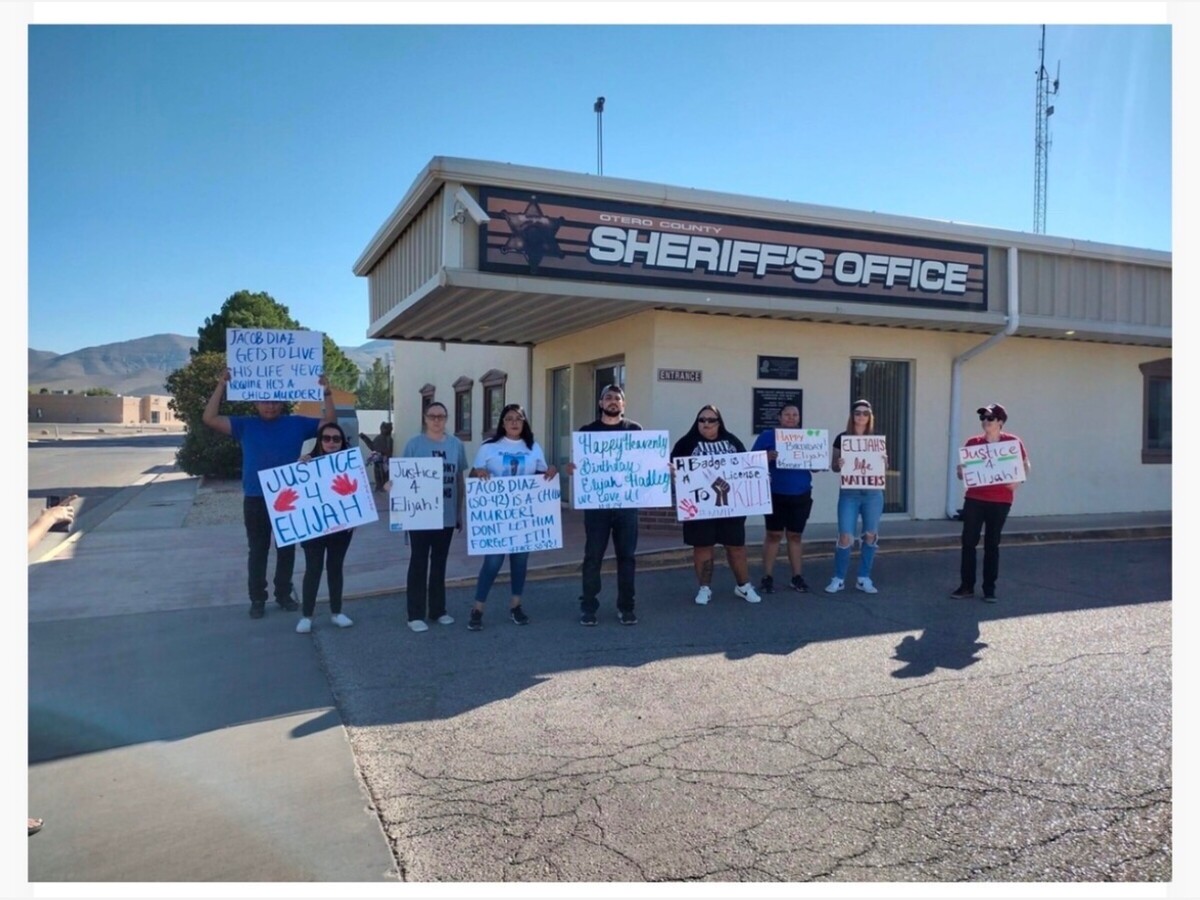
How Regional Media Reported on the Otero County Sheriff's Office, 2024–2026 - AlamogordoTownNews.org



From a roadside shooting to a primary upset: an in-depth look at who reported what, when, and how thoroughly
Editor's Note on Sourcing
This independent analysis is restricted to coverage of the Otero County Sheriff's Office (OCSO) itself — the Hadley case, the Sheriff's race, jail conditions, narcotics enforcement, grants, and partnerships — across five outlets with verifiable, linkable articles: available without paywalls: 2nd Life Media Alamogordo Town News/KALH Radio, the Albuquerque Journal, New Mexico In Depth/Source NM, KOAT-TV, and KRQE-TV. The Alamogordo Daily News is not included: despite repeated searches, no verifiable article from that outlet on this subject could be located that are free and accessible without a paywall access. Jacob Diaz-Austin is charged, not convicted, and is legally presumed innocent until and unless proven guilty in court: quotations describing the shooting are attributed to the outlet that reported them.
The Origin Point: June 25, 2024
Every outlet's coverage in this review traces back to the same event. At approximately 10:45 p.m. on June 25, 2024, OCSO Deputy Jacob Diaz-Austin responded to a welfare-check call for a person walking in the median of U.S. Highway 70 near Mescalero. The person was 17-year-old Elijah Hadley, a member of the Mescalero Apache Tribe. According to dash-camera and body-camera footage later obtained by multiple outlets, Hadley dropped what turned out to be a BB/airsoft pistol as the deputy ordered him to show his hands; Diaz-Austin opened fire, striking Hadley multiple times, and fired additional rounds after Hadley was on the ground. Reported shot counts vary by outlet and by date of reporting — from “at least 19” to “19–22” across different accounts — a discrepancy addressed later in this piece. Hadley died at the scene.
What happened next is where the five outlets' coverage diverges sharply in speed, depth, and editorial posture. This event was a defining moment for most media coverage around the Otero County Sheriff’s Department.
July–September 2024: The Local Outlet Moves First, the Statewide Outlets Move Deeper
2nd Life Media/KALH Radio was on the story within weeks. By late July 2024, it was reporting that “news coverage has been minimal” outside its own outlet and KOAT, and it organized direct coverage of community rallies — including an August 2024 march that drew the outlet's own reporters to interview attendees and Pastor Jerry Martinez on KALH Radio. Its August 15, 2024 article is the moment its editorial posture crystallizes: it published an explicit demand by public groups that Sheriff David Black resign by September 10, 2024 if he did not comply with demands for transparency and accountability warning that a recall effort mighr follow if he did not, and reported that an online petition had reached 236 signatures. This was a turning point in community support for what once was a fairly popular sheriff.
KOAT-TV's contribution, also from this period, was narrower but foundational: in July 2024, it obtained body-camera footage through a public-records request and aired it, becoming the first outlet to put video of the shooting in front of the public.
Every other outlet examined in this review — the Journal, 2nd Life Media, and eventually KRQE — cites or links back to KOAT's video as a primary evidentiary source. KOAT also interviewed a former Bernalillo County sheriff specifically on whether department protocol had been followed, a detail 2nd Life Media's own reporting credits to KOAT directly.
The Albuquerque Journal entered with the most rigorously sourced account published in this window. Its August 29, 2024 story, by staff writer Gregory R.C. Hasman, reconstructed the shooting using the dash and body camera footage obtained from KOAT, and added reporting the local outlets had not: an on-record statement from Otero County Sgt. Sean Jett confirming Diaz-Austin remained employed and on paid administrative leave, and confirmation from the New Mexico Department of Public Safety that the case had been formally transferred to the 2nd Judicial District Attorney's Office for a charging decision. The Journal also reported a detail no other outlet in this review surfaced as clearly: the Otero County Sheriff's Office Facebook page's comment section had become a public venting point for residents and tribal members.
New Mexico In Depth produced the single most independently reported piece in this entire review on September 17, 2024. Reporter Bella Davis attended a memorial walk along U.S. Highway 70 on September 7 and interviewed Mescalero Apache community members in person, including Valerie Vanaya Espinoza, who had passed the shooting scene the morning after and described Hadley as having “complied in every way.” Davis's reporting drew on a review of the dash/body camera footage and, notably, the New Mexico State Police's full 101-page investigative report — a document none of the other four outlets in this review are confirmed to have obtained or cited directly. By 2nd Life Media's own later account, this article was also the first to publicly name Diaz-Austin as the deputy involved.
That story's reach extended well past New Mexico In Depth's own platform: it was republished, with permission, by Source NM, El Semanario, and NMReports.org/KUNM — making it the most widely redistributed single piece of journalism on this case identified anywhere in this review.
January–March 2025: Charges Filed, and the Coverage Splits by Function
On January 13, 2025, the Bernalillo County District Attorney's Office — brought in specifically because the 12th Judicial District had a conflict of interest — filed first-degree murder charges against Diaz-Austin. This is the cleanest point of comparison in the whole timeline, because four of the five outlets covered it within days, each adding a different layer.
The Albuquerque Journal's report was the most legally precise: it named the charge as “an open count of murder,” quoted DA's-office spokesperson Nancy Laflin directly, and included the procedural detail that the 12th Judicial District had “conflicted out” the case the previous July. KRQE's January 14, 2025 report covered the same charge with a different strength — it published an extended, line-by-line transcript of the deputy's radio dispatch communications during the shooting, including the moment he reported “shots fired” and described where Hadley had been hit, giving readers the most granular moment-by-moment account of the incident found in this review.
2nd Life Media's coverage of the charges, published the same week, did something the wire-style outlets did not: it placed the charge inside two years of accumulated local context, explicitly framing it as part of the family's ongoing “quest for Justice for Elijah Hadley” and noting that Sheriff Black's office had responded to the charging news with the same public silence it had maintained since the shooting. The outlet also disclosed its own role in the story for the first time — a filed public-records (IPRA) request seeking OCSO's internal investigative notes, after the outlet reported other news organizations had said the Sheriff's Office “cannot locate” those notes.
By late January 2025, 2nd Life Media was also the only outlet in this review confirmed to be tracking the deputy's own legal filings in real time, reporting on January 27, 2025 that Diaz-Austin's defense had filed a motion to dismiss, and quoting Sheriff Black's on-record comment to the Albuquerque Journal that the deputy would “remain employed by the agency unless he is convicted.” That last detail is a useful marker of how the outlets functioned together rather than in isolation: the quote originated with the Journal's reporting and was carried forward by the local outlet, which lacked the same direct line to Sheriff Black.
In March 2025, District Judge Angie K. Schneider ruled the case would proceed to trial following a preliminary hearing in which Bernalillo County DA Sam Bregman and Chief Deputy DA Natalie Lyon presented video, photo, and testimonial evidence.
2nd Life Media reported the ruling alongside coverage of a peaceful protest held outside the Otero County Courthouse the same week — continuing its pattern of pairing legal-procedure reporting with on-the-ground community coverage no other outlet in this review matched at this stage.
Mid-to-Late 2025: The Civil Suit, the Detention Center, and a Quieter Period for Statewide Outlets
In June 2025, the Hadley family filed a federal civil rights lawsuit in Albuquerque against Diaz-Austin and the Otero County Board of Commissioners, alleging violations of the 4th and 14th Amendments.
The filing, reported by both 2nd Life Media and regional outlet KTSM, included an attorney's on-record statement that Diaz-Austin fired “22 times — many of those shots came as he laid unarmed on the ground, screaming in pain” — a notably higher figure than the “at least 19” reported by the Journal and KRQE seven months earlier, illustrating how the precise shot count shifted across outlets and over time as new filings and reviews of evidence emerged.
During this period, 2nd Life Media was also the only outlet in this review continuing to report on OCSO's other institutional problems unrelated to the Hadley case directly — a July 2025 special report on a reported suicide attempt at the Otero County Detention Center, continuing an investigation the outlet said it had pursued since mid-2024, and routine coverage of OCSO operations: a $570,000 federal community-policing grant, a Flock Safety camera partnership with the Alamogordo Police Department, and the arrest of a fugitive wanted in a New York hit-and-run. None of the statewide or broadcast outlets examined in this review published comparable coverage of OCSO's day-to-day operations in this window; their attention appears to have been concentrated specifically on the criminal case rather than the department as an ongoing institution.
By September 2025, with Sheriff Black term-limited, 2nd Life Media published an analysis explicitly framing the 2026 Sheriff's race as a referendum on “continuity versus accountability,” contrasting candidate Raul Robles's pledge to retain Black as undersheriff against candidate Cesar Ramos's and candidate Geraldine Yazza Martinez platforms of reform.
This is the point at which, in the available record, the criminal case and the electoral race become a single continuous story — a framing not found in the Journal's, KOAT's, or KRQE's coverage from this period.
January–June 2026: Pretrial Motions Meet the Campaign Trail
2nd Life Media is the only outlet in this review confirmed to have provided in-person coverage of the case's pretrial hearings in early 2026. Its January 5, 2026 report on a motion hearing before Judge Schneider included specific rulings: a denied change-of-venue motion, a restriction limiting how the replica weapon could be described to the jury (barring inflammatory terms like “pistol” in favor of “pellet gun” or “replica firearm”), and the exclusion of Hadley's toxicology report as irrelevant. A companion piece the same week, labeled as outside legal commentary, characterized the rulings as having “on balance” favored the prosecution.
A January 16, 2026 Zoom pretrial hearing produced a detail unique to this outlet's coverage: the presiding judge specifically noted for the record that representatives from KALH Radio and 2nd Life Media were signed into the remote hearing, and reminded all press observers that recording was not permitted without prior court approval — direct evidence that this outlet was treated by the court itself as a recognized press presence in the proceedings. That hearing also produced the news that the trial, originally set for March 16, 2026, would be delayed to August 17–24, 2026.
That delay — landing the trial after the June primary but before the November general election — became the subject of a January 19, 2026 “expert analysis” piece modeling how each candidate would be affected: the piece argued the absence of a verdict before the primary would tend to benefit Robles, the continuity candidate, by letting his campaign treat the case as still under investigation, while an eventual conviction or acquittal would carry different general-election consequences depending on timing. No equivalent piece of election-specific legal forecasting was found from any other outlet in this review.
In a separate strand of reporting that same month, a new video — described by 2nd Life Media as leaked internal OCSO interview footage — reportedly showed Diaz-Austin telling investigators he had not been “100% aware” of the department's deadly-force policy, and describing Hadley as having had a “sinister smile.” This is a claim found only in this outlet's reporting among the sources reviewed here; it could not be cross-verified against any of the other four outlets' coverage.
Through the spring of 2026, OCSO's routine operations continued to generate coverage exclusively from the local outlet: a January 2026 activity report showing 1,728 calls for service and 54 arrests countywide, framed explicitly by the outlet as “a new approach to more transparency…as a result of distrust in the Otero community with the handling of the Elijah Hadley murder case”; a March 2026 whistleblower report from detention-center staff describing an unsafe, understaffed jail; and a May 2026 multi-agency narcotics operation, “Operation Desert Sweep,” resulting in roughly 32 arrests.
The campaign itself produced a parallel controversy in May 2026, when 2nd Life Media reported that a deputy's social media posts had raised ethics and possible state-law-violation questions, and published a direct call for Sheriff Black and candidate Robles to publicly condemn the deputy's conduct. The outlet's own site index paired that coverage with a companion piece titled “Fake Profiles, Dirty Tactics, and the Otero County Sheriff's Race.” No comparable reporting on this specific controversy was found from any other outlet examined.
On May 5, 2026, 2nd Life Media and KALH Radio co-hosted the “Voices of Alamogordo” Sheriff candidate forum at Otero Arts, streamed live on the outlet's YouTube channel to a reported 150-plus viewers. Two of three candidates — Geraldine Yazza Martinez and Cesar Ramos — attended; Robles did not appear and sent no representative
This is the only candidate forum specific to the Sheriff's race and the only media sponsored one identified across any outlet in this review.
On June 2, 2026, Otero County voters delivered the result: Geraldine Yazza Martinez won the Republican primary with approximately 54% of the vote (2,818 votes), defeating Robles (29%) and Ramos (17%) — a result 2nd Life Media reported in granular, precinct-confirmed detail the same night, alongside the result of the County Commissioner District 2 primary, in which sitting OCSO Lieutenant Jonathan Emery defeated incumbent Amy Barela by 45 votes.
A Late Arc: Campaign-Season Posting Patterns, and a Notable Silence
Direct screenshots of OCSO's own Facebook page, reviewed for this report, allow a more precise reconstruction of the department's posting pattern than news coverage alone could provide. Through December 2025, the page maintained a modest but steady cadence of roughly one to two posts per week, covering routine community-relations content: a public safety and community engagement update (Dec. 11), a public-assistance request to locate missing property (Dec. 6), a cross-post thanking the department for a nursing-home wellness visit, and a holiday office-closure notice (Dec. 23). This is consistent with ordinary departmental social media use, not an unusual volume in either direction.
That pace continued into the spring. April 2026 posts include a crash-response thank-you shared with the Tularosa Police Department (Apr. 8), a multi-agency wellness-check and community-cooperation post involving a nursing facility (Apr. 9), and a National Public Safety Telecommunicators Week tribute to dispatchers (Apr. 14) — again, routine community content rather than campaign-oriented material.
The pattern shifts visibly in May. On May 21 and 22, 2026, the page carried the two White Mountain Drug Task Force arrest releases already documented in this report (the Landress and Duran arrests), and on May 23 it posted a Sheriff's Office academy graduation and deputy swearing-in announcement — a personnel and morale-oriented post, not an arrest report, but still part of a visible increase in posting frequency in the final two weeks before the primary.
After that, the verified record shows nothing. No post acknowledging Geraldine Yazza Martinez's June 2 primary win has been identified on OCSO's Facebook page, despite the page having posted personnel and ceremonial content (the academy graduation) just days earlier, and despite Martinez's win being a historic result — she is set to become the county's first female and first Native American sheriff assuming a general election win in November which is likely with no Democratic opponent .
A department congratulating its own graduating deputies on May 23 but not acknowledging the outcome of its own leadership election on June 2 is a notable asymmetry: the silence is not limited to arrest statistics or narcotics releases, but extends to ordinary civic acknowledgment of the election result itself.
Whether this reflects a deliberate choice, an institutional transition period, normal staff turnover in who manages the page, or simple inattention cannot be determined from the available record.
What can be said is that the silence is broader than a pause in self-promotional crime statistics: it includes the absence of even a routine, low-cost statement acknowledging a change in the department's own elected leadership — the kind of post nearly every other public agency reviewed in this series (including OCSO itself, historically) has made for far less consequential events.
Conclusion
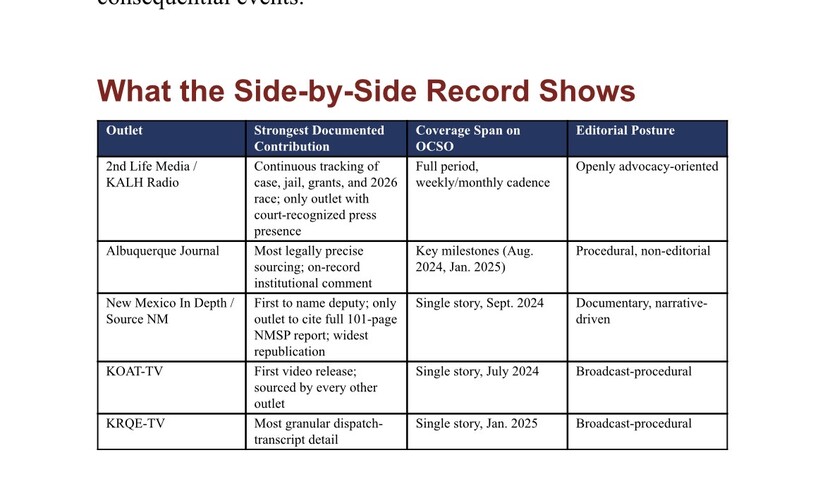
Across two years, no single outlet covered every dimension of this story. The statewide and broadcast outlets — the Journal, New Mexico In Depth, KOAT, KRQE — each contributed a discrete, high-value piece of evidence or sourcing at a specific moment, then moved on. The local outlet, 2nd Life Media/KALH Radio, is the only one documented as having stayed with the story continuously — covering not just the criminal case but its spillover into the detention center, county budget politics, the 2026 election, and the candidates themselves — and the only one with a court-acknowledged ongoing press presence at pretrial hearings. That continuity came paired with an explicit, openly stated advocacy position the other four outlets did not share. Readers evaluating this coverage should weigh thoroughness and continuity against editorial independence accordingly; the record supports strength in both columns for different outlets, but not for any single one in both at once.
The late-arc pattern in OCSO's own communications is among the more concrete findings in this report, verified directly against the department's own Facebook presence rather than inferred solely from news coverage. Routine community posting continued at a modest, steady pace through most of the period studied; arrest and narcotics-bust content concentrated specifically in the final two weeks before the primary; and then, after the vote, the page fell silent — not only on crime statistics, but on the election result itself. No acknowledgment of Martinez's win has been identified, even as a basic courtesy, despite the department having posted ceremonial and personnel content just days before the primary. That asymmetry does not prove intent, and a longer observation window would clarify whether it reflects a deliberate choice or an institutional transition; but it is now a documented silence, not merely an inferred one.
What this media comparison does however is prove the need for more in-depth reporting from across the region and the role and importance that independent media plays in keeping the public informed. The analysis also demonstrates the depth of impact the Elijah Hadley case has had in the region and it was the defining factor in determining the outcome of the Otero County Sheriff’s race via statewide media coverage.
Support local and statewide independent media like New Mexico In Depth, the Cloudcroft Reader and 2nd Life Media by forwarding stories liking their pages and subscribing for free.
A free and robust press ensures a free and strong democracy.
Limitations
This review is based on articles retrievable through web search and not locked behind paywalls. It may not reflect the full publication record of any outlet, particularly broadcast segments without published transcripts or paywalled content not indexed publicly. The Alamogordo Daily News is omitted for lack of any verifiable article on this subject due to paywalls, not because it did not cover local stories.

thank you for a clear review of the coverage of this grievous occurrence. i would make several observations:
most of the news sources referenced are reporting from a distance - to some extent that limits their focus and timeliness. your proximity to this tragedy makes reporting much more detail oriented, and moves it from "just the facts" to more insightful viewpoint.
the OCSO decisions regarding the handling of this case certainly figured in the electoral defeat of the current administration, and will hopefully offer useful instruction for an incoming administration.
the pending cases, both criminal and civil, will be hugely significant.
and, in a round-about fashion, this situation has given you an opportunity to more clearly establish yourself as a journalist, and substantial news source.
A killing is a killing.


Sunny, with a high of 81 and low of 61 degrees. Sunny in the morning, patchy rain nearby during the afternoon and evening, clear overnight.

Having the Sierra Club endorse you is like drinking the runoff from a lithium mine they spent a decade blocking—then calling the metallic taste “sustainability.” This phoney has a really bad dye job.
Just because you do not like someone does not make them phony.
kinda like not liking the blue kool aid so you hate all the kool aid. Besides doesn’t the editor have a vested interest in her campaign?




as per occam's razor, the simplest explanation for stonewalling a request this basic and straight forward, is that transparency will cast a bad light on lincoln county, and/or the entity they pay to run their jail.
The Albuquerque Journal (9/20/26, page C3) has a column written by Jacob Candelaria that is titled "A blacklist for people who ask too many questions". Basically, in 2025, our NM Legislators were debating House Bill 139 would have let any public body petition to have a person designated as "vexatious", and person's


like 99% of his fellow republicans, block is a servant to the oil & gas industry - a principal constituent of their party.