59° and Patchy rain nearby



Image
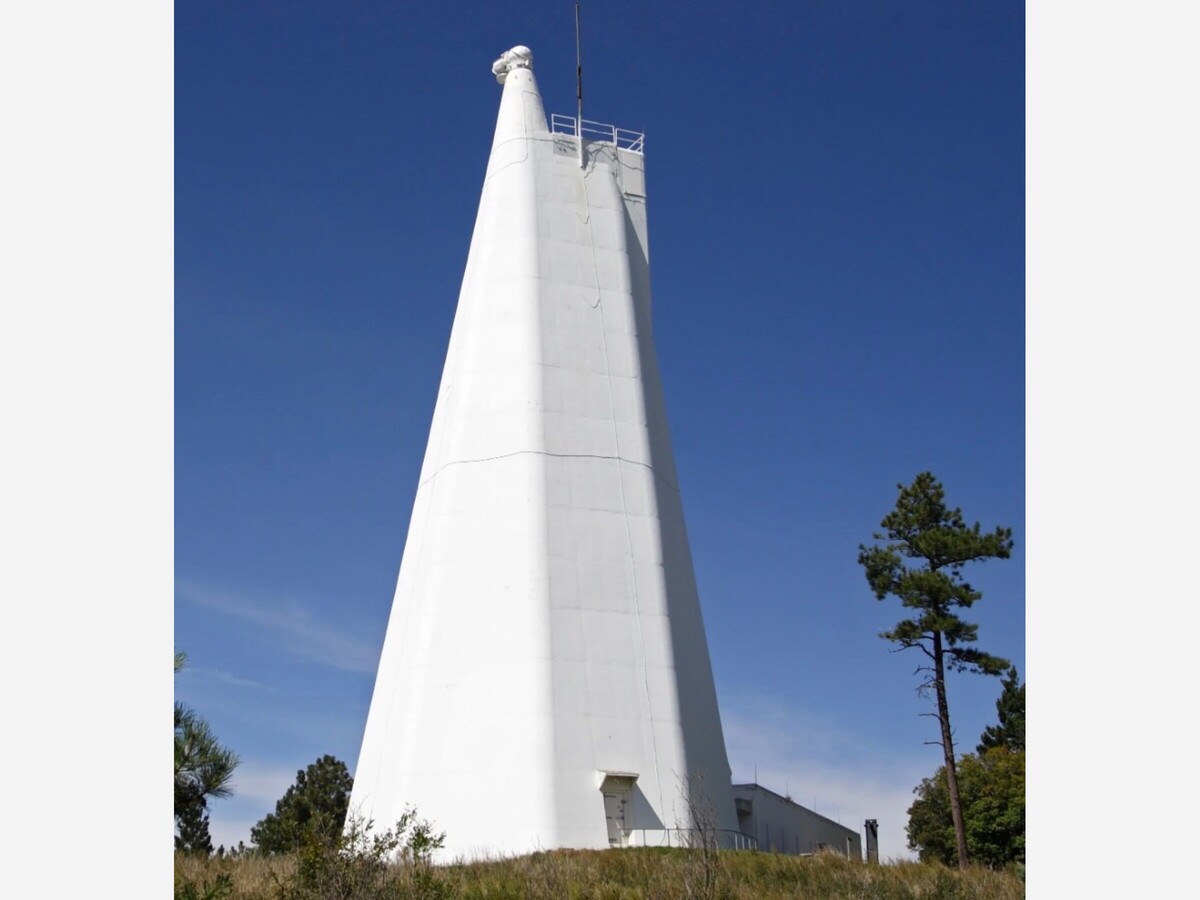
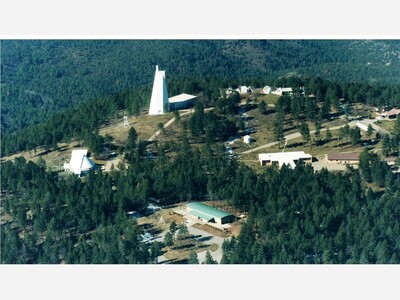
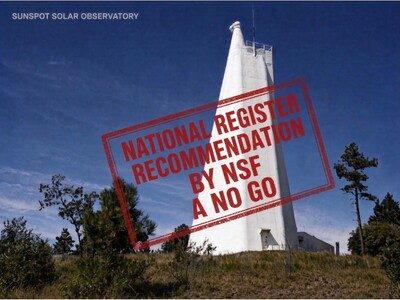
Demolition of Sunspot Solar Observatory is scheduled to start as soon as September and be done by the end of the year. But because the National Science Foundation has been largely silent about Sunspot, a recent rumor had demolition crews en route to the site this week.
“There is no site demolition in progress,” Cassandra Eichner, an NSF media affairs officer, told Alamogordo Town News in a June 17 e-mail.
NSF does plan to demolish Sunspot as a result of a liquid mercury leak in one of the main bearings in the Dunn Solar Telescope. A total of 186 pounds (about six quarts) leaked on Jan. 5, and NSF decided on Feb. 24 to demolish the site.
It is scheduled to start as early as September, Tom Porter, Otero County Road Superintendent, told the County Commission on June 11. Porter learned this in a recent planning meeting with NSF and the U.S. Forest Service at Sunspot.
NSF has not announced any date.
“At this time, NSF is focused on safely addressing the mercury contained within the telescope and conducting market research and acquisition planning for future requirements at the site, such as maintenance,” Eichner wrote. “Once the mercury has been safely removed, NSF anticipates initiation of acquisition planning for the future requirement to demolish the telescope and restore the site for return to the U.S. Department of Agriculture, Forest Service. When the agency has something to share with the public regarding demolition, we will make an announcement.”
While NSF has been silent, some information is available through SAM.gov, the System for Acquisition Management, where opportunities and contract awards are usually advertised, and from USAspending.gov, which reports Federal Account Funding. Alamogordo Town News research shows that only two contracts have been awarded for Sunspot in recent years.
The first, starting January 2022, has paid Jacobs Engineering Group $812,802 for “Phase II Environmental Site Assessment At Sacramento Peak Observatory, To Characterize Environmental Conditions.” This is part of a larger Blanket Purchasing Agreement, and likely is done by CH2M, the environmental firm that assessed Sunspot in 2016 for the Environmental Impact Statement and which Jacobs acquired in December 2017.
The next, reported in an earlier story, is a $320,679 contract to Thornton Tomasetti of New York for the “Sac Peak Mercury Stability Effort.“ This covers “specialized forensic structural engineering expertise to assess the structure and safely remove the liquid mercury,” Eichner said in an earlier e-mail. Last week the contract’s value more than doubled to $650,679 for “authorization to procure long lead material and services” related to the mercury cleanup.
But where does the mercury go? NSF has only said mercury disposition will be “in accordance with federal law.”
The Mercury Export Ban Act of 2008 “Prohibits the sale, distribution, or transfer of elemental mercury [by] federal agencies to any other [agency], except for … storage,” but authorizes “limited essential use exemptions … no more than 10 metric tons [about the same as the Dunn holds] … under specified conditions.” This opens the possibility that NSF can transfer the Dunn’s mercury to Thronton Tomasetti for resale, an approach similar to the U.S. Navy selling old aircraft carriers to ship breakers for a penny. NSF did not answer a inquiry about this.
Meanwhile, Friends of Sunspot have been working to make community leaders aware of the pending loss. Heidi Sanchez, president of the Sunspot Community Center, and this writer, have spoken to the Alamogordo City Commission (go to 0:05:20), Cloudcroft Village Trustees (0:09:00), and the Otero County Commission (1:15:10), and have started contacting State and Federal politicians.
Stay informed stay tuned to Alamogordo Town News for further development.
Report by David Dooling. The author served as education officer at Sunspot during 2002–12 and, yes, he actually rotated the Dunn several times when doing public tours.

i visited the Sunspot observatory on my first trip through the Sacramentos, on a motorcycle ride in 1972, and have always included that site whenever introducing visitors to this many faceted region. it is sad to consider this unique scientific icon being demolished.



Overcast, with a high of 82 and low of 63 degrees. Overcast in the morning,
there is our future, kudos to both the students and the organizers.
Sounds overblown by the reporting of this party. On base we have something like this, but it's training leaders. Pic is a few kids with some volunteers who act to shape their opinions. If the schools were good enough the kids would learns this in a classroom.

the problems facing the republican party of new mexico pale in comparison with those of their national party - as the old saying - Meaning: Problems in an organization or society start at the top, with its leaders.
The fish rots from the head down
True. A prime example of this was the DNC failures in the 2020 election.
I have voted Republican in the past, but not this time. Our church group knows a few people who have tried to run or get involved and the old school fools won't let anyone they don't know get in at all. You can't solve any problem with the same people who created it. That's why we have terrible doctors here.



when public utilities are taken private the ultimate goal is to generate profits for their investors - come on, ray charles could see that.
If they are truly public utilities, why do they charge?
I follow theatres across the county, and know, this report is very sparse with details. Impossilbe to spend a million dollars on removing a fly loft, rigging and weights. New roof . . other upgrades, no where near a million bucks. The defamation should be on the managers who awarded inexperienced developers.

2nd Life Media is not an owner. We sold our share and that owner sold it to the present owner. Might want to check your facts. Also LEDA requires receipts and documentation. We had an estimated when we were an owner of aproximately $3 million needed to make it operational. Check your facts.
It will take well over a million dollars to make the theater usable to the public. We have not yet spent a million dollars, but we are far from complete. Our projected open date is Summer/Fall 2027.