68° and Overcast
Image
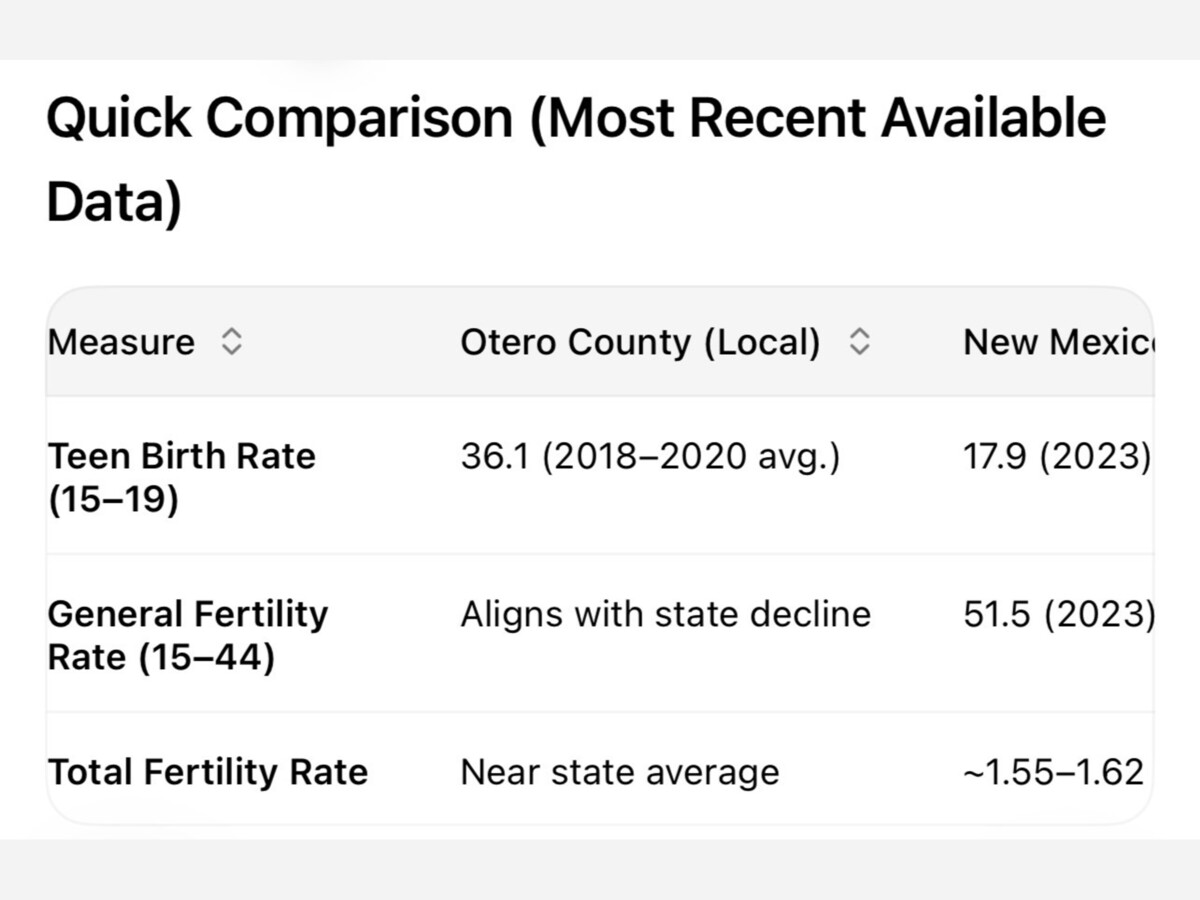



Alamogordo, NM (April 13, 2026) – Teen birth rates in Otero County have historically been elevated compared to broader averages but continue to follow a strong downward trajectory, mirroring encouraging declines seen across New Mexico and the United States. While single-year data for small counties like Otero can be statistically unstable and often rely on multi-year averages, the overall pattern points to meaningful progress in reducing teen pregnancies locally.
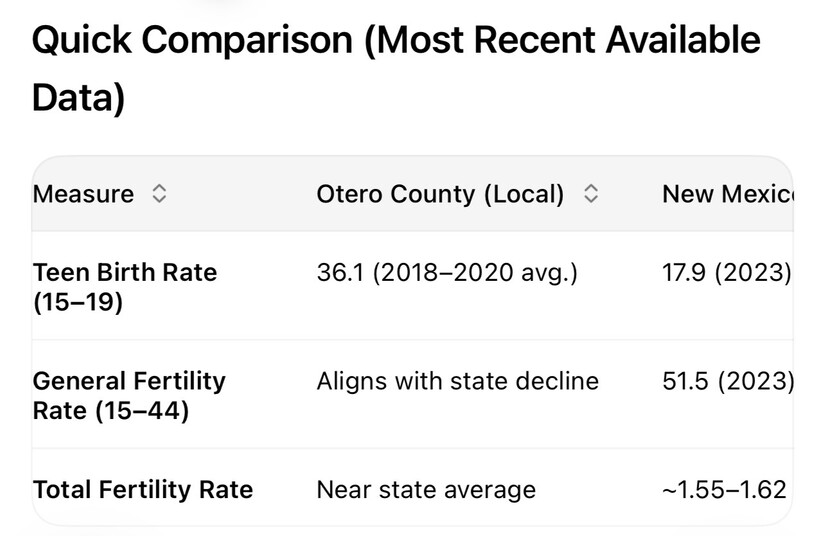
New Mexico Department of Health (NM DOH) IBIS data for 2018–2020 show Otero County’s teen birth rate at 36.1 live births per 1,000 females ages 15–19 (95% confidence interval: 31.3–40.9). This figure exceeded both state and national levels at the time but reflects rural challenges including access to education, family planning, and economic opportunities common in the Tularosa Basin.
Statewide, New Mexico’s teen birth rate reached 17.9 per 1,000 females ages 15–19 in 2023, placing it among the higher-ranking states but representing a substantial drop from earlier years (e.g., 21.8 in 2020). From 2010 to 2020, the state experienced a roughly 59% decline in teen births, slightly outpacing the national drop.
Nationally, the U.S. teen birth rate hit historic lows around 13.1 per 1,000 in 2023, continuing a decades-long decline fueled by improved contraception access, education initiatives, and evolving social norms. Provisional data suggest the trend persists.
These reductions in teen births connect to broader fertility trends affecting women of all reproductive ages. Both New Mexico and the nation have recorded steady decreases in overall birth rates.
• New Mexico (2023): General fertility rate of 51.5 live births per 1,000 women ages 15–44, with 20,951 total live births recorded that year. The state’s total fertility rate (lifetime births per woman) has remained near or below the national average, around 1.55–1.62—well under the 2.1 replacement level needed for population stability.
• United States (2023): General fertility rate of approximately 54.5 per 1,000 women ages 15–44, with the total fertility rate at a record low near 1.62.
For Otero County, NM Tracking data from 2019–2023 indicate an expected total of about 3,952 births among a reproductive-age female population estimated at roughly 62,162, aligning closely with the state’s gradual fertility decline. Historical fertility rates in Otero (often 65–83 per 1,000 women ages 15–44 in the 1990s–early 2000s) were comparable to or slightly above the state average but have followed the same long-term downward path.
Otero County, with a population of approximately 69,000–70,000 and home to Alamogordo, Holloman Air Force Base, and diverse communities, reflects typical rural New Mexico dynamics. Local efforts in youth education, prenatal care, and family planning—supported by organizations like the Otero County Health Department and Gerald Champion Regional Medical Center—appear to be contributing to these positive shifts.
Health Benefits and Long-Term Community Implications
The ongoing decline in teen birth rates brings significant health benefits, including better maternal and infant outcomes, reduced risks of preterm birth and low birthweight, and improved long-term prospects for young parents and their children—such as higher high school completion rates and lower poverty cycles. Lower fertility across all ages also eases pressure on local healthcare systems while allowing families to invest more resources per child.
For the Tularosa Basin community, these trends support stronger economic stability, workforce development, and educational attainment over generations. Politically and for planning purposes, leaders in Alamogordo and Otero County should consider sustained investments in reproductive health services, comprehensive sex education, youth mentorship programs, and family support initiatives. Such forward-thinking strategies can help maintain the downward momentum, foster healthier populations, and build a more resilient future amid shifting demographics and economic needs.
Data are drawn from the CDC National Vital Statistics System, NM Department of Health IBIS and vital records, and NM Tracking systems. County-level figures are best viewed as multi-year averages due to small population sizes. Newer 2024–2025 provisional data indicate the downward trends are continuing.
For local resources on family planning, maternal health, or youth programs, residents are encouraged to contact the Otero County Health Department or visit the NM DOH website.
This article is based on publicly available vital statistics for informational purposes. Small-area data should be interpreted with caution due to potential statistical variability.
Key Sources for Teen Birth Rates
• CDC National Vital Statistics System (2023 data): U.S. teen birth rate of ~13.1 per 1,000 females ages 15–19; New Mexico rate of 17.9 (10th highest among states).
https://www.cdc.gov/nchs/state-stats/births/teen-births.html
https://www.cdc.gov/nchs/products/databriefs/db507.htm (Data Brief 507, August 2024)
https://www.cdc.gov/nchs/data/nvsr/nvsr74/nvsr74-1.pdf (Births: Final Data for 2023)
• New Mexico Department of Health (NM DOH) IBIS – Teen Birth Rate by County (2018–2020 average): Otero County rate of 36.1 per 1,000 females ages 15–19 (95% CI: 31.3–40.9).
https://ibis.doh.nm.gov/indicator/view/BirthTeen.15_19.Cnty.html
• NM DOH IBIS – Summary Teen Birth Rate Report: Statewide historical trends, including ~59% decline from 2010–2020 (to 21.8 in 2020).
https://ibis.doh.nm.gov/indicator/summary/BirthTeen.html
• KFF (Kaiser Family Foundation) Women’s Health Profiles: Confirms New Mexico 2023 teen birth rate (17.9) and general fertility rate.
https://www.kff.org/interactive/womens-health-profiles/new-mexico/maternal-infant-health/
Key Sources for General Fertility Rates and Total Fertility
• CDC (2023 data): U.S. general fertility rate of 54.5 per 1,000 women ages 15–44; total fertility rate ~1.62.
https://www.cdc.gov/nchs/products/databriefs/db507.htm
https://www.cdc.gov/nchs/data/nvsr/nvsr74/nvsr74-1.pdf
• March of Dimes PeriStats / NM DOH Data: New Mexico 2023 general fertility rate of 51.5 per 1,000 women ages 15–44; 20,951 live births.
https://www.marchofdimes.org/peristats/data?reg=35&top=2&stop=1&slev=4&obj=1&sreg=35
https://www.marchofdimes.org/peristats/data?reg=35&top=2&stop=10&slev=4&obj=3&sreg=35
• NM Tracking (NM DOH) – Total Fertility Rate by County (2019–2023): Otero County expected births ~3,952 (reproductive-age female population ~62,162); aligns with state trends.
https://nmtracking.doh.nm.gov/dataportal/indicator/view/BirthEPHTTotatFert.Cnty.html
https://nmtracking.doh.nm.gov/dataportal/indicator/summary/BirthEPHTTotatFert.html
Additional Context and Historical Reports
• NM DOH Bureau of Vital Records and Health Statistics (general vital stats and annual reports):
https://www.nmhealth.org/about/erd/bvrhs/hsp/
• Older Otero County fertility context (1990s–early 2000s):
https://www.nmhealth.org/data/view/vital/583/
For the most current or county-specific queries, visit the interactive NM-IBIS portal (https://ibis.doh.nm.gov/) or NM Tracking (https://nmtracking.doh.nm.gov/). Small-area data (like Otero County) are often presented in multi-year averages due to population size and statistical stability

Sunny, with a high of 80 and low of 63 degrees. Sunny in the morning, overcast in the afternoon and evening,


Love your shop in Las Cruces! Haven’t been to the one here in Alamo yet.
Hi Troy,
What do you think of the manga Jaadugar: A Witch's Life in Mongol (Tomato Soup). It's now an anime from Saru Science/Crunchyroll.
Enjoy!


Thank you Sheriff!

She lectures her expertise like she was running SpaceX. Home Service Contractors and Darnold Plumbing could get any of those things built in a month. These unqualified people use it to justify their lives. We have to work to pay off their excess spending.
Neither have the proper license try again!

He did the same thing when he ran against Rachel. He's a pathological liar who just keeps proving it over and over.
he senses trouble....and i smell blood - time to send him to private sector employment - maybe his oil & gas friends can find something for him to do.
Lets ask the editor.
sir, are you not involved in the campaign?


an impressive guide, that shows the balance needed to be fair to all.