63° and Patchy rain nearby
Image
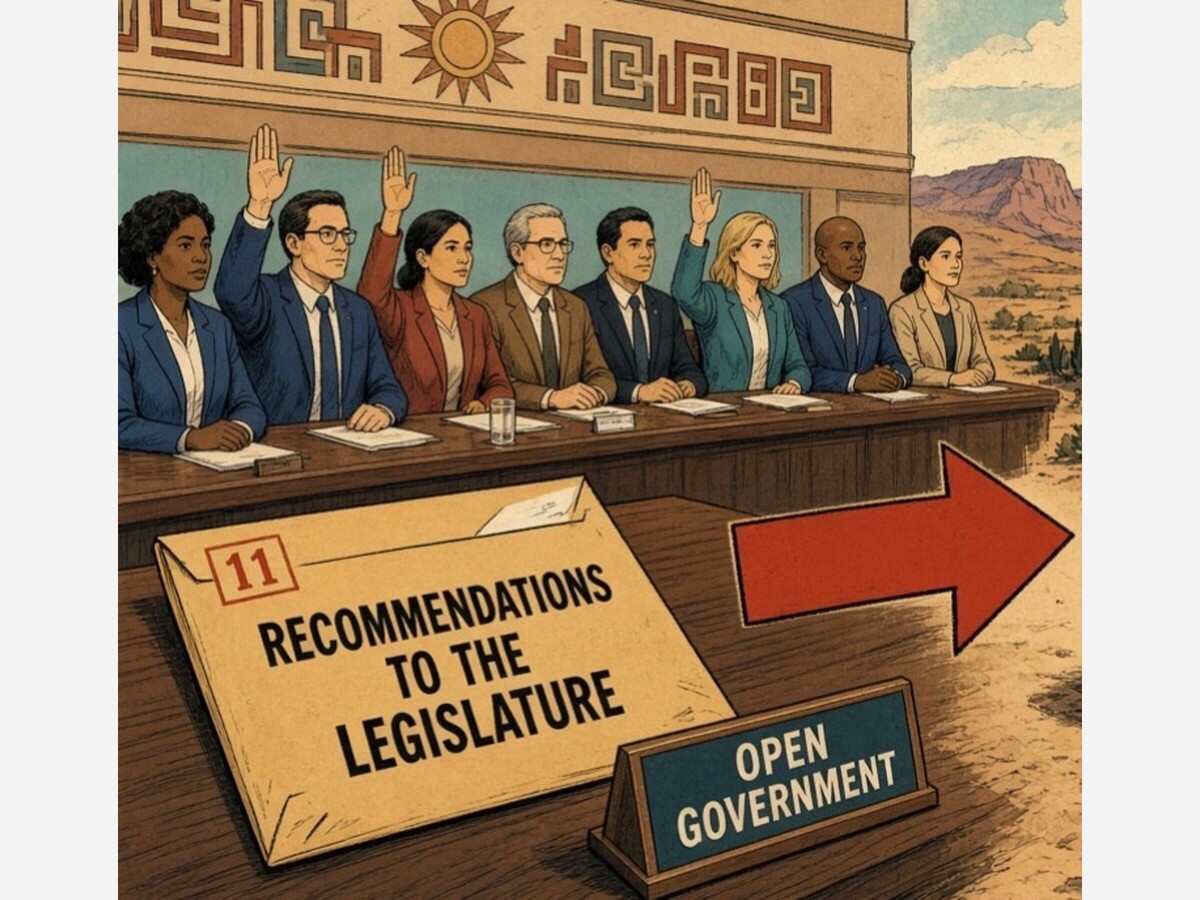



ALAMOGORDO — The state task force charged with reviewing New Mexico’s Inspection of Public Records Act has sent lawmakers 11 recommendations, including an out-of-state fee for police body-camera review, a new ombudsman, and factors courts would weigh before imposing the law’s daily penalties. Open-government members on the panel voted against the pieces most likely to change how the public enforces the statute.
The letter went Thursday to the interim Courts, Corrections and Justice Committee and the Legislative Finance Committee. It is not the final report. The task force said that report, with majority and minority positions and the public comments it received, is due by Oct. 15. House Joint Memorial 2, sponsored by Rep. Cathrynn N. Brown and co-sponsored by Sen. Natalie Figueroa and Rep. Matthew McQueen, directed the New Mexico Department of Justice to convene the panel and report on IPRA’s “workability and effectiveness.”
The Santa Fe New Mexican reported Friday that the letter appeared on the Department of Justice website that morning and that references to it were gone by 5:30 p.m. The task-force page still describes the panel and its listening tour, including the June 22 stop in Alamogordo.
The eight-member panel held 11 public meetings — Clovis, Roswell, Carlsbad, Alamogordo, Las Cruces, Silver City, Gallup, Farmington, Las Vegas, Santa Fe, and Albuquerque — and took 312 comments in person and online. It then held seven deliberative meetings. Members are Madeleine Zaritsky of the Department of Justice, who chaired the panel; Rebecca Martinez of the New Mexico Municipal League; Michael Eshleman of the New Mexico Association of Counties, a former Otero County attorney; Belinda Mills of the New Mexico Press Association; Lalita Moskowitz of the ACLU of New Mexico; Kenneth Stalter, a plaintiff’s attorney; Ethan Watson, a defense attorney; and Greg Williams of the New Mexico Foundation for Open Government.
What drew opposition
The sharpest split is on fees, penalties, and a new office that would sit between requestors and court.
Six members favored a statutory scheme requiring out-of-state requestors to pay the actual cost of reviewing and redacting body-camera footage. Any residency rule, the letter says, should account for victims, people who are indigent or unhoused, legitimate newsgathering, and other out-of-state requestors with a real interest in New Mexico records. Fees collected would have to be dedicated to IPRA staffing, technology, training, and redaction. Moskowitz opposed it. Eshleman abstained.
Six members favored an IPRA ombudsman, or similar office, that would train both sides, run a hotline, issue non-binding advisory opinions, mediate, and collect compliance data for the Legislature. Moskowitz and Williams opposed that recommendation. An advisory office that does not bind agencies can become a delay if custodians treat it as a substitute for the deadlines and damages already in the statute.
Five members favored a non-exclusive list of factors for courts deciding statutory per-diem penalties under Section 14-2-11 and whether a denial was unreasonable. Moskowitz and Williams opposed it. Mills abstained. IPRA’s daily penalty is the main consequence when a custodian misses a deadline or withholds a record without a lawful exemption. A factor list written for agencies can narrow that remedy without an explicit repeal.
What passed with less friction
Three recommendations were unanimous: more money to digitize paper records, including large-format building plans; proactive publication of record classes that do not need redaction, plus a public portal for a person’s own traffic-crash report; and a duty for a requestor to answer a custodian’s good-faith fee demand within a set time or have the request closed.
Seven members backed standardized statewide reporting of IPRA data, possibly with a volume threshold. Martinez opposed it. Seven backed more training tied to custodians’ needs and the Department of Justice training budget. Walker Boyd, sitting as Eshleman’s proxy, opposed it. Seven backed a credentialing program in public records, through a state agency or a New Mexico university. Zaritsky abstained. Seven backed grants so public bodies can buy request-management and redaction software. Stalter did not vote.
Seven members also backed a coordinated review of the Children’s Code, victims’ rights statutes, and IPRA confidentiality rules, with attention to whether protections follow a record when it moves to law enforcement, a district attorney, or another public body. The letter says any change should not create exemptions broad enough to block oversight. Moskowitz opposed it.
Why it matters here
Alamogordo Town News has used IPRA and the Open Meetings Act to obtain city and county records on hiring, budgets, ethics complaints, and closed-door commission business. Those requests are in-state newsgathering, not commercial harvesting of body-camera video. The letter’s own caveat for “legitimate newsgathering” is the line the 2027 session will have to write in statute if the body-camera fee moves forward. A fee that local outlets can waive on paper and still cannot pay in practice is a barrier.
The Department of Justice page frames the review around request volume that has more than doubled since 2020, commercial data brokers, and out-of-state and out-of-country filers. Open-government groups on the panel have argued that volume is not a reason to weaken the right of New Mexicans to inspect the records their governments already hold.
The full report, including rejected ideas and the comment appendices, is scheduled for the same two committees by Oct. 15. Nothing in the letter is law. Each item still needs a bill, a hearing, and a vote in the 2027 session.


Patchy rain nearby, with a high of 78 and low of 57 degrees. Patchy rain nearby during the morning, light rain shower in the afternoon and evening, patchy rain nearby overnight.

Love your shop in Las Cruces! Haven’t been to the one here in Alamo yet.
Hi Troy,
What do you think of the manga Jaadugar: A Witch's Life in Mongol (Tomato Soup). It's now an anime from Saru Science/Crunchyroll.
Enjoy!



Thank you Sheriff!

She lectures her expertise like she was running SpaceX. Home Service Contractors and Darnold Plumbing could get any of those things built in a month. These unqualified people use it to justify their lives. We have to work to pay off their excess spending.
Neither have the proper license try again!
Hey Rube! I think the point is expertise. A 'proper licesne' is always the thinking of those educated by The Machine. Let the free market rule, not the paper pushers.
He did the same thing when he ran against Rachel. He's a pathological liar who just keeps proving it over and over.
he senses trouble....and i smell blood - time to send him to private sector employment - maybe his oil & gas friends can find something for him to do.
Lets ask the editor.
sir, are you not involved in the campaign?