63° and Patchy rain nearby
Image
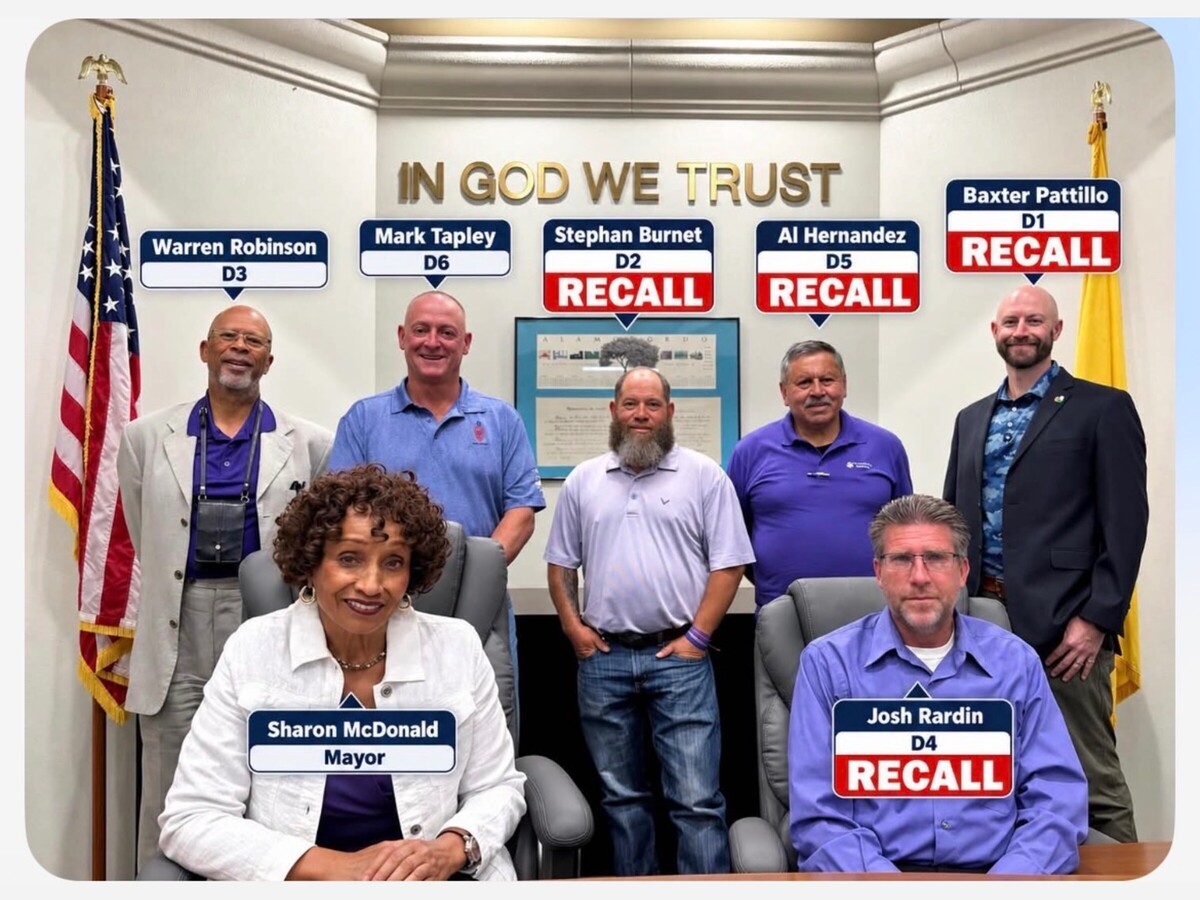



Alamogordo NM- A district judge has dismissed the petition to recall Alamogordo City Commissioner Stephen W. Burnett, ruling that petitioner Kim Murillo did not establish probable cause on any of the three grounds she raised in connection with the city’s two-year search for a city manager.
In a 22-page order filed September 9, Twelfth Judicial District Judge John P. Sugg rejected Murillo’s claims of misfeasance, malfeasance, and violation of the oath of office, finding little evidence presented that Burnett acted with an improper or corrupt motive in the votes at the center of the dispute. The order followed a July 29 hearing at which Murillo called four witnesses: former Mayor Susan Payne, Commissioner Warren Robinson, former Acting City Manager Dr. Stephanie Hernandez, and herself. Burnett, representing himself, called none and introduced three exhibits.
Murillo has until Monday, September 14 to file a notice of appeal with the New Mexico Supreme Court under the Recall Act’s five-day deadline. She does not plan to do so.
No legal duty to explain votes, or to answer constituents
The holding with the broadest reach for Alamogordo residents is that elected officials have no legal duty to respond to constituent inquiries as outlined presently in the city charter.
Murillo’s petition grew out of Burnett’s agreement to answer her written questions about the city manager hiring, followed by his failure to do so. The court found that failure undisputed but not unlawful based on existing charter language. Because Murillo cited no authority via charter, state nor federal law requiring a commissioner to respond, the court, applied the rule that it assumes no authority exists where none is offered, treated Burnett’s silence as a discretionary act.
Judge Sugg acknowledged that the city’s Code of Conduct requires officials to give constituents “a fair and reasonable opportunity to express their concerns, grievances, and ideas,” but concluded that nothing in the city’s ordinances obligates a commissioner to answer every inquiry received. Drawing on the purposes behind the Speech and Debate Clauses of the state and federal constitutions, while acknowledging they “do not apply to city commissioners,” the court wrote that “elected representatives are under no obligation to explain their votes,” and that “there is a difference between having a transparent government and giving individual constituents the right to know the internal thoughts of an elected representative.”
“It is understandably frustrating,” the judge wrote, that Murillo’s representative agreed to communicate and did not follow through, “and while it may be best practice to communicate with constituents, even those you disagree with, nothing in the law presented compels such action.”
The hiring history behind the petition
The recall effort traces to the resignation of City Manager Rick Holden in late 2024. Hernandez, then Assistant City Manager, became Acting City Manager while the commission ran two recruitments, one in-house and one through a national executive search firm. The court found that Hernandez was the only candidate to earn a passing score under the commission’s own rubric in the first round, which was abandoned before final interviews after then-Mayor Payne described the process as “tainted” by commissioners’ public comments about a candidate.
Hernandez reapplied through the search firm and, while that process was under way, filed a charge with the U.S. Equal Employment Opportunity Commission. On March 10, 2026, the commission voted unanimously to offer her the permanent position. In a position statement filed with the EEOC around the same time, the City’s outside counsel acknowledged that the first recruitment had been “improperly conducted pursuant to the New Mexico Open Meetings Act.”
The court found that after the March vote, “the City’s attorneys did not immediately engage in contract negotiations with Dr. Hernandez. Instead, the City’s attorneys moved to dismiss Dr. Hernandez’s EEOC complaint citing the Commission’s unanimous vote.” Hernandez resisted the dismissal and, through an EEOC mediator, proposed two options: finalize her contract with compensation for her claims, or a settlement and separation. According to documents reviewed by ATN, the contract option would have totaled approximately $360,000 over two years.
On April 28, the commission voted 4–3, with Burnett in the majority, to accept the separation option. The court states Hernandez was subsequently paid $485,340.45 and her employment ended. Robinson testified that in the closed session that day Burnett said he believed there were better qualified candidates, but that Burnett never told anyone how he would vote and made no agreement on his vote.
Two months later, on June 15, the commission voted 5–2 to hire Robert Stockwell, who had not applied through either recruitment. Burnett voted in favor. Stockwell’s agreement, approved June 23, carries a $200,000 annual salary plus benefits. The settlement and the first two years of the new contract together commit roughly $1 million in public funds that could have been spent for road repairs as they came out of the general fund, paid from Fund 107 by Resolution 2026-23.
Pattillo and Rardin drove the Stockwell hire, court finds
While the order clears Burnett, its findings place the Stockwell recruitment with two other officials. The court found that Commissioner Baxter Pattillo and Mayor Pro Tem Josh Rardin “had been actively recruiting him for the position since the initial hiring process began,” and that “prior to his interview, members of the Commission were actively recruiting Mr. Stockwell for the position, and Commissioner Patillo circulated a proposed contract to offer Mr. Stockwell” three days before the June 15 closed-session interview.
The order quotes two emails Pattillo sent to Human Resources Director Michelle Osborn with the full commission blind-copied. On June 12 he wrote that the attached draft and final agreements were “the two documents I had brought to the last executive session” and that he had “reviewed the draft with Brian [Nichols] and he approves.” On June 16, the day after the vote, he wrote that the agreement “has gained the approval of both Mr. Stockwell and Brian Nichols” and that he “had distributed to the commission for review prior to the exec session held on 6/15.” Pattillo described the effort in both emails as “my solo legwork.”
“Unquestionably, the Commission moved fast to find a permanent City Manager,” the court wrote.
Whether the findings about Pattillo and Rardin carry consequences for them is a question the order does not reach. A recall against any official would require its own showing of probable cause under the same standard Murillo’s petition did not meet as to Burnett.
Code of Conduct and LEDA claims
Murillo’s remaining grounds also failed. The court found that Hernandez’s testimony that Burnett contacted zoo and golf course employees directly was hearsay, that none of the employees testified, and that seeking information from staff “does not constitute general executive functions” reserved to the City Manager. On the claim that Burnett used his position to advance his sister-in-law’s Local Economic Development Act application, the court found the questions Hernandez recalled him asking occurred in 2025, during his prior term, and that the Recall Act reaches only conduct in the current term. Hernandez testified that Burnett recused himself from the vote on a separate LEDA application his sister-in-law’s business obtained.
Citing Supreme Court precedent, Judge Sugg stressed that New Mexico “provides for recall for cause, and not recall at will,” and that the standard must be limited “to avoid employing recall as a means of harassment or for purely political or personal purposes.”
Analyst: stronger case exists against other commissioners
An out-of-state attorney and legal analyst who reviewed the court record, and who has no role in the litigation, said the findings point to a far stronger case against Pattillo and Rardin than the one brought against Burnett. The attorney said additional evidence of Open Meetings Act issues exists in the City’s own files, including what the attorney described as admissions of prior misconduct, that was not presented at the July 29 hearing and was not before Judge Sugg.
The same attorney questioned the conclusion that no law obligates officials to respond to constituents, pointing to state and federal transparency requirements imposed on government at every level, and argued that the gap may lie in the authority the petition failed to cite rather than in the law itself. The order arguably invites that reading: Judge Sugg rested the holding expressly on Murillo’s failure to cite authority.
On that point the analyst has a case. New Mexico’s Inspection of Public Records Act imposes an enforceable duty with deadlines: a custodian must respond to a written records request within 15 days, with damages and fees available for noncompliance. Had Murillo’s inquiries been framed as records requests, the court would have had statutory authority in front of it rather than the Code of Conduct alone. The Open Meetings Act’s enforcement provisions carry the same weight. The petition invoked neither.
“A small setback”
Murillo said she was disappointed in the ruling but “encouraged by what she has seen from Burnett since, noting he attended a recent community forum and appears more engaged with the district.” She acknowledged Burnett’s was the weaker of the cases she could have brought, but said the court affirmed points that will help future efforts and did not reflect well on Pattillo or Rardin.
Murillo said her goal “is a government responsive to the people, and that rules holding political leadership accountable to constituents need tightening.” She said she intends “to keep pressing for transparency and views the dismissal as a small setback in a larger effort.”
Editor’s note: Chris Edwards, the author, is the petitioner in Edwards v. Alamogordo City Commission, No. D-1215-CV-2026-00514, a pending Open Meetings Act and public-records case against the City that Judge Sugg’s order references. Neither Edwards nor 2nd Life Media was a party to the recall proceeding. This article is based on the court’s September 9, 2026 order, a public record available from the Twelfth Judicial District Court Clerk.

So, 1 down 3 to go. Keep slinging until the doodoo sticks?



Patchy rain nearby, with a high of 78 and low of 56 degrees. Don't forget your umbrella! Light rain shower in the morning, thundery outbreaks in nearby in the afternoon, light rain shower for the evening, patchy rain nearby overnight.


Love your shop in Las Cruces! Haven’t been to the one here in Alamo yet.
Hi Troy,
What do you think of the manga Jaadugar: A Witch's Life in Mongol (Tomato Soup). It's now an anime from Saru Science/Crunchyroll.
Enjoy!



Thank you Sheriff!

She lectures her expertise like she was running SpaceX. Home Service Contractors and Darnold Plumbing could get any of those things built in a month. These unqualified people use it to justify their lives. We have to work to pay off their excess spending.
Neither have the proper license try again!
Hey Rube! I think the point is expertise. A 'proper licesne' is always the thinking of those educated by The Machine. Let the free market rule, not the paper pushers.
He did the same thing when he ran against Rachel. He's a pathological liar who just keeps proving it over and over.
he senses trouble....and i smell blood - time to send him to private sector employment - maybe his oil & gas friends can find something for him to do.
Lets ask the editor.
sir, are you not involved in the campaign?