78° and Heavy rain at times
Image
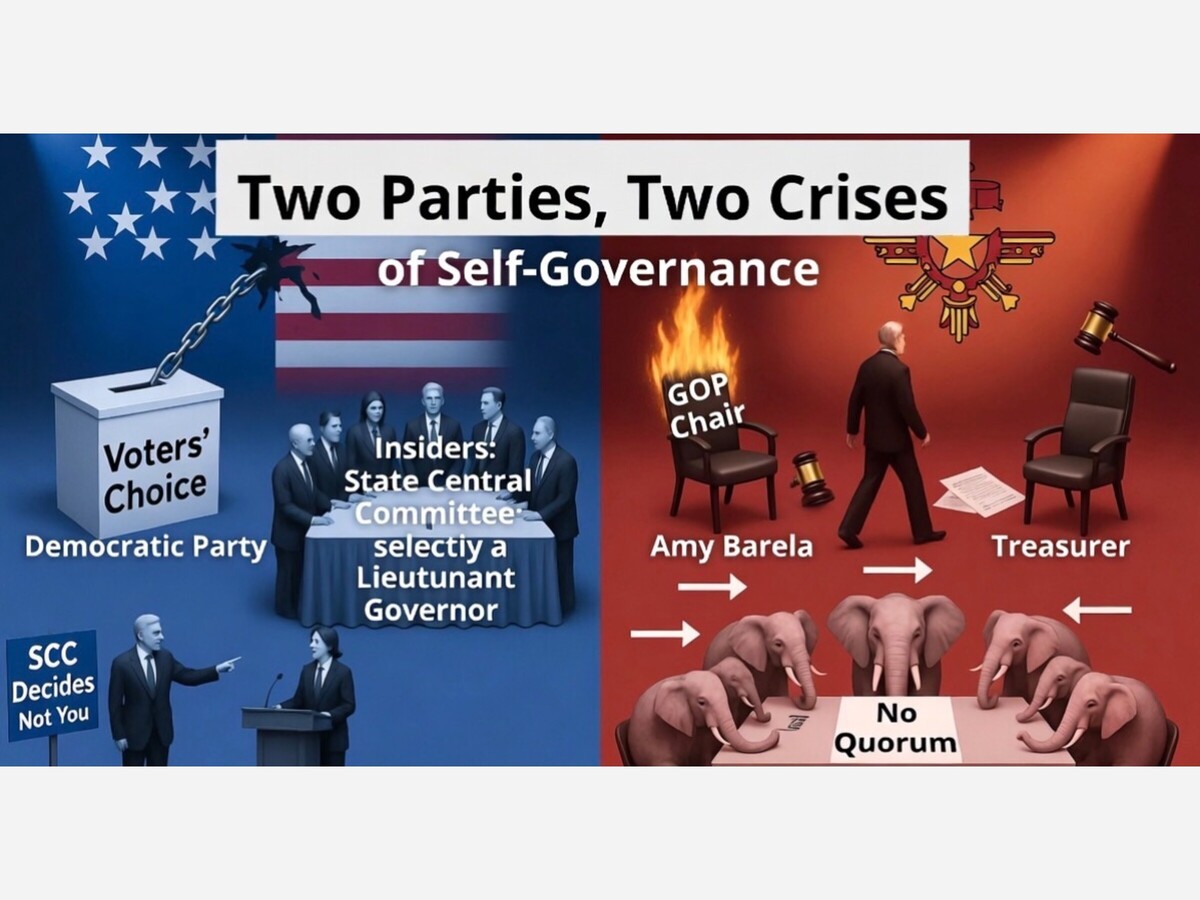
Two Parties, Two Crises of Self-Governance — and a Lieutenant Governor Pick That Voters Won’t Get to Make - 2nd Life Media AlamogordoTownNews.org



SANTA FE — State law is the reason New Mexico voters won’t get a say in who replaces Maggie Toulouse Oliver on the Democratic ticket this November. New Mexico’s election code does not permit a party to re-run a primary once a nominee withdraws. Instead, that authority is ceded entirely to the party’s own State Central Committee (SCC) — roughly 500 county and district officials and activists, not the people who actually cast primary ballots. It’s a legal mechanism, not a backroom improvisation, but it means the lieutenant governor’s race will be decided in a closed room rather than at the ballot box. And as that process plays out, New Mexico’s Republican Party is simultaneously failing, twice over, to govern itself at all — a parallel collapse that’s left voters across the political spectrum asking whether either party can be trusted to run its own house, let alone the state’s.
How Democrats Got Here
Toulouse Oliver, the secretary of state, won the June 2 Democratic primary for lieutenant governor in a landslide over state Sen. Harold Pope. Sixteen days later she withdrew, citing her health. Under the rules described above, the SCC — not voters — will pick her replacement. Party Chair Sara Attleson formally called that meeting for July 25, to be held virtually over Zoom. The SCC is not bound to any particular candidate; it can select anyone, not just whoever gubernatorial nominee Deb Haaland prefers.
Haaland’s Vetting, in Detail
That last point matters, because Haaland has run her own parallel selection process with more visibility than any past New Mexico nominee in this position. Her campaign opened a public application channel: 13 people requested the candidate questionnaire, and nine completed it. From that pool, Haaland’s team narrowed the field to five for in-person interviews — outgoing Land Commissioner Stephanie Garcia Richard, state Sens. Harold Pope and Leo Jaramillo, attorney Antonia Roybal-Mack, and former Veterans Services Secretary Sonya Smith. In her letter announcing the process to SCC members, Haaland framed her involvement as advisory rather than binding, while still asserting she carries “a responsibility to ensure we have the best candidate.”
On June 26, Haaland endorsed Garcia Richard, citing her two prior statewide wins (2018 and 2022), her years as a public school teacher, and her time in the state House. The pick would preserve an all-female Democratic ticket — Garcia Richard had her own brush with this race already, leading the 2026 field in fundraising before suspending her campaign last fall over her husband’s cancer diagnosis, which she says has since improved.
The endorsement didn’t settle internal debate. Former state Sen. Dede Feldman’s public push for Garcia Richard drew pointed pushback from Democrats who felt Pope — who had actually competed and lost in the primary — deserved the nod, with one commenter countering that after a 60-point primary loss, the party needs someone “who can win statewide.” Outside the party, Republicans have compared the substitution to the national Democratic Party’s 2024 swap of Joe Biden for Kamala Harris without a primary-electorate vote — a comparison Democrats reject, noting the mechanism’s use in prior New Mexico ballot vacancies.
Where the Democratic Process Stands
As of this writing, Garcia Richard has Haaland’s endorsement but not the nomination. That rests with the SCC on July 25. Nothing is finalized.
The Republican Party’s Own Legitimacy Crisis
While Democrats sort out a ballot vacancy, the Republican Party of New Mexico (RPNM) has spent months unable to settle who leads it at all — a dysfunction Democrats have been quick to needle. The chairmanship has been vacant since late May, when a state judge ordered then-Chair Amy Barela to step down for allegedly violating a party rule requiring officers to vacate their post if a fellow Republican files against them for the same office — a dispute that began with a two-minute gap between Barela’s and a rival’s filings for an Otero County Commission seat. The state Supreme Court declined to block that order on June 10.
That set up a chair election RPNM has now failed to hold twice. At a June 20 meeting in Las Cruces, only about 163 of the 358 central committee members needed for quorum showed up, amid a boycott by northern New Mexico Republicans. A rival faction called its own session for June 27 in Belen, and party leadership has now confirmed to this outlet that it also fell short of quorum — exactly what party leaders had predicted in court filings before the meeting took place. RPNM’s own attorney has acknowledged that continued quorum failures will probably force a judge to resolve the leadership question. The party has rescheduled a third attempt for July 25 in Albuquerque — the same day, notably, that Democrats’ SCC meets to settle their own vacancy.
The chaos isn’t limited to the chair’s office. The party’s treasurer, Kimberly Skaggs, was removed from her post this week after being charged with two felonies in a fatal hit-and-run near Las Cruces; RPNM said only that she “is no longer affiliated with the Republican Party of New Mexico.” That leaves a second statewide party post effectively vacant heading into a contested general election. A Democratic Party spokesman called the GOP’s repeated quorum failures “indicative of larger problems with the Republican Party of New Mexico” — a jab made easier by the fact that, for now, it’s not wrong.
Bottom Line
Both parties’ leadership failures raise the same ethical question: accountability to whom?
Democrats followed the law, but the law itself lets a handful of insiders — guided by one candidate’s personal preference — decide a statewide nomination voters already settled once. That’s a legitimacy problem, even if it’s not an illegality.
Republicans have a starker one: a chair a court ordered to leave, a State Central Committee that twice couldn’t muster enough members to do its own job, and a treasurer who left office not by resignation but by felony arrest.
Neither party broke the law to get here. Both broke the basic compact that party leadership exists to serve the membership, not the other way around.
Until either side closes that gap, the public is right to treat both processes — and the people running them — with the same skepticism.

respectfully, i will once again submit that the death or withdrawal of an established candidate creates a uniquely problematic crisis. the democratic party has responded to this situation in compliance with both new mexico state laws, as well as long-standing party rules - both conducted very transparently. not sure what else could be said here...

Just thought the one thing all these first-timers have in common is no qualifications. Wanting to serve, help, or partake isn't enough. None of these people have any professional experience. Where are the engineers, CPA's, Ph.D's?
Business owners, a practicing attorney, one with a PHD, seems to me you didn't review the video.


Sunny, with a high of 79 and low of 62 degrees. Sunny for the morning, overcast for the afternoon and evening, clear overnight.


like many others, i have experienced work-place environments where favoritism and cliques were present - adding unnecessary stresses to any job. two observations about such places; that the ultimate goal of governmental ethics regulations is to prevent the appearance of imp
Just to weigh in on this. Whatever the editor thinks about his right to publish is certainly his point of view, but it's getting to the embarrassing stage of conjuring divisiveness bent on turning a functioning government he doesn't like, but the people have elected.
The editors point of view is we need a functioning government. The viewpoint allegations were not of the editors making it was mailed to the city with a copy to the editor.

like 99% of his fellow republicans, block is a servant to the oil & gas industry - a principal constituent of their party.

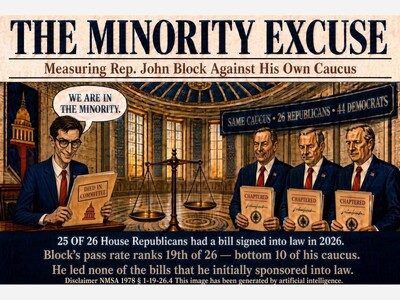
i would say that while our economy is "the hottest in the world" according to el presidente, this would be an excellent time for block to seek employment in the private sector....just like barela.
Pipqueak is a prime example of the defects of their party. They don't recruit qualified leaders. It's duplicitous, unemployed people who know all they have to do is start an internet site and walk the neighborhood dressed up on Sundays. The population here doesn't know how to vote.
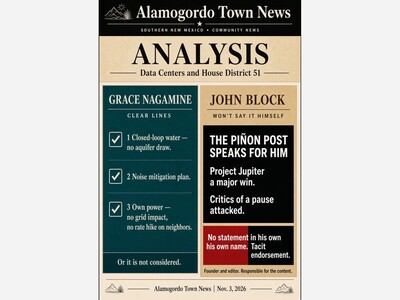
It is so important to understand the differences in the candidates' stand on this critical issue! Protecting our water in the desert is understood by all political parties living here! Nagamine is taking a stand to protect us!
many politicians claim to represent common sense, but here in new mexico, defending our water supplies and electrical power generation is pretty much the definition of common sense - and sucking up to billionaires is not.