
 45° and Clear


Image
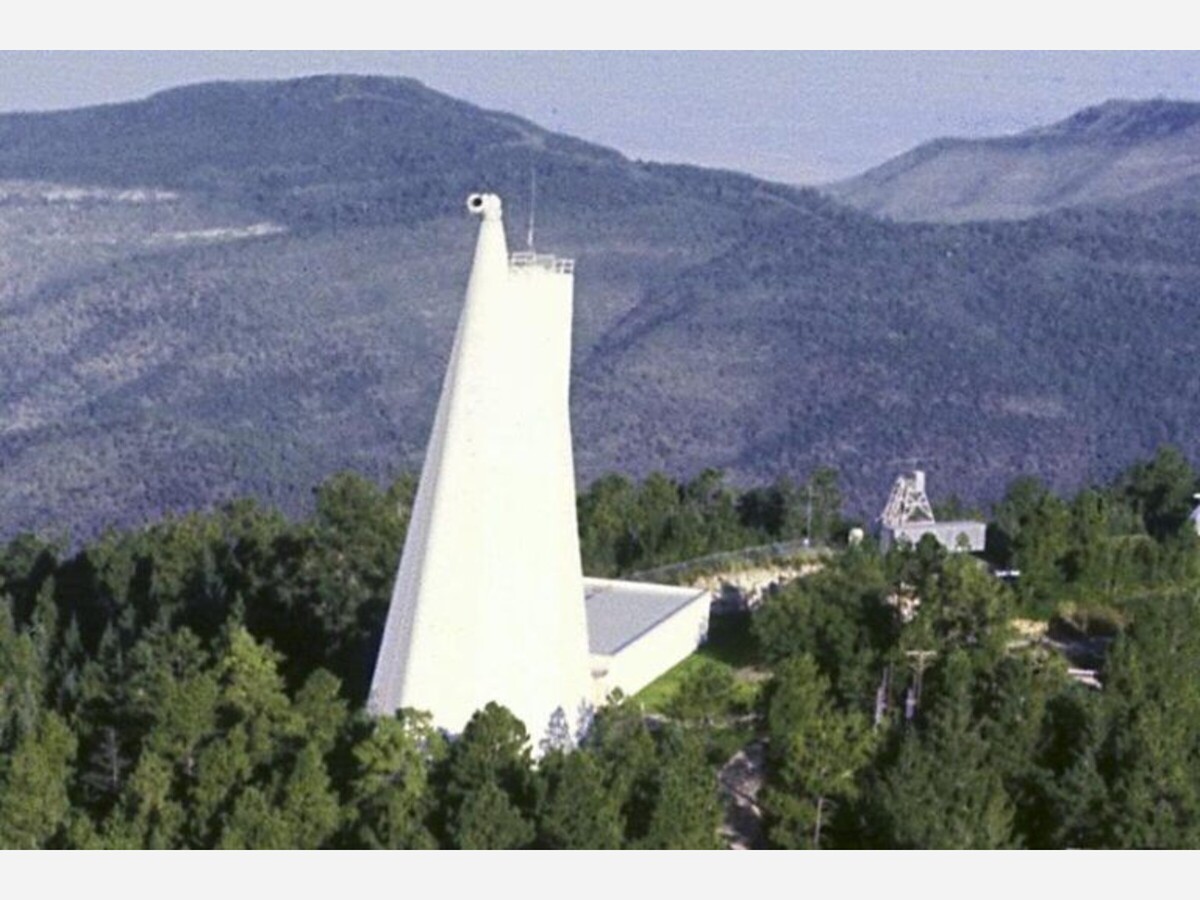
Of what use is an old observatory? The question has floated around since the Dunn Solar Telescope had a small mercury leak. The National Science Foundation recently announced its intention to demolish the entire site — but is open to community ideas.
So, what to do with Sunspot?
Here are some likely questions and answers. But first, a caveat:
The explanations and opinions expressed here are mine alone, based on my time (2002–12) as education officer there and conversations following the leak. These are not necessarily those of the National Science Foundation, National Solar Observatory, or New Mexico State University. You can best express your opinion by contacting NSF directly at NSF_SAC_Peak@nsf.gov.
The lead question: What about the mercury spill?
Yes, mercury, the only metal liquid at room temperature, is one of the most dangerous chemicals anywhere — if it is a vapor or combined with various chemicals. This is why warnings tell you not to vacuum a spill. An easy cleanup is to sprinkle sulfur powder, which forms relatively safe mercury sulfide (this might not be the ideal approach at Sunspot, though).
The spill in the Dunn Solar Telescope was from a bearing, near the top, where the main vacuum barrel is suspended (see my earlier article about the Dunn). The bearing gives a smooth ride as the telescope rotates to follow the Sun. The spill is small and confined to the interior of the Dunn. Staff still live on-site and there is no hazard to the public. The observatory is working on the cleanup, which must precede any choice on Sunspot’s future. The tricky part is ensuring that nothing is left in corners or crevices of equipment and structures.
Can the Dunn return to normal operations without the mercury?
Yes. While the mercury bearing made the Dunn’s design possible in the 1960s, an alternative is possible today. The mercury can be removed and main barrel of the telescope locked in position and rebalanced, although the heliostat (“Sun is still”) must tilt and rotate to direct sunlight to the main mirror, 300+ feet below.
The telescope had to rotate as the Sun crossed the sky to keep the image from rotating on a film plate. A K-mirror can do the job for smaller electronic cameras.
A K-mirror has three flat mirrors, arranged like the letter K, that flip images upside down. Rotating a K-mirror half as fast as the heliostat derotates the image of the Sun. Germany’s 1.5-m (5-ft) Gregor solar telescope in the Canary Islands uses a K-mirror.
Can the Dunn be used without fixing it?
The Dunn could become an exhibit hall highlighting Sunspot’s history in exploring the Sun and hosting hands-on optics and other science exhibits. The 40-foot-wide turntable alone has more than 1,000 square feet of space. More is available in labs attached to the Dunn. This was done recently with the famous McMath Pierce Telescope at Kitt Peak National Obssrvatory.
OK, you can fix it. But what good will it be?
Dunn’s successor is the 4-meter (13-foot) Daniel K. Iouye Solar Telescope, the world’s biggest and best, atop Maui. But even while DKIST was being designed, the team at Sunspot talked about using the Dunn to train future solar physicists and test new instrument designs because we knew from Day One, DKIST would be over-subscribed. This was acknowledged by Dr. David Boboltz, one of NSF’s prgram scientists, during the 2016 environmental impact hearing in Alamogordo:
“[The] observatory itself still has value as an educational and training facility for young solar physicists… . [DKIST] is going to be state of the art, and you're not going to have graduate students up there tinkering with the instrumentation itself … . It's good to have a place where graduates can go and tinker and do things like that.”
Along those lines, New Mexico State University’s Juie Shetye, an associate professor of physics, has secured more than $3 million in NSF and NASA funding for her students to use the Dunn and other work. In addition, Queen’s University Belfast had installed a new set of cameras just before the leak occurred.
What else can you do with Sunspot?
The Dunn is not the only facility that can be used in research and education. Several telescope buildings — Evans, Hilltop, and ISOON —can be reactivated with modern instruments. Housing, including a dorm with VIP quarters, and houses can support extended stays by observers or even solar and forestry science camps or for academic retreats.
My personal favorite is an astronomy RV park where 20 old prefab houses once stood. Those spots can be refitted with RV hookups to existing utilities, and flat pads added for telescopes.
And your ideas? Don’t forget to send them to NSF at NSF_SAC_Peak@nsf.gov.

Received that crime flyer in the mail today. Wow! Mudslinging V2.0 by the blockheads as usual.
Lacks proper education. Illegitimate kids, toxic relationships, social work survivor, homeless lady, owning a non-profit advocacy? Uh, you're supposed to get better, not run for office on that stuff. We won't vote for her because she's not qualified. Word of advice: SALAD, honey.

Sunny, with a high of 61 and low of 44 degrees. Sunny in the morning, clear during the afternoon and evening,



For those of the civilian public to understand. Every single Airman, marine, sailor and soldier whether Active duty or reserve or national guard has had explicit training on the UCMJ and illegal orders. This includes every “veteran for peace” It is political plain and simple.

Couple of people around Santa Fe have told me her highness has been sucking up hard to Ant to get on to a staff job when his pending doom curtain closes here. Queens never learn to really be honest. It's just in their realm of mental health. They live in denial and have pent up retentive r.e.c.t.u.m.s.
His money would have been better spent listing all of his accomplishments while in office. Oh, wait……
Voted twice against the low-income utility rate bill (HB 91) and sponsored the failed 2026 tax on renewable generation (HB 113) which the state confirmed would have further raised PNM rates. We know who has you in their pocket Block. Stop the **** lies!
Million-nine for the bakery, million for a theatre scam. These uneducated skells pass out money to sheis for what? They're not even good ideas. 3 mil and they don't know? Why doesn't we hire out side auditor like the FBI?
All that tax money. Is it true that Brien Caesar bought a four hundred k condo in wyoming last year? Heard, it's near Jackson. Someone put that stuff through. No wonder they change managers so often. Once a deals's done you don't have to stick around in this burg anymore.

Is there any chance that the Forest Service will allow Sunspot to remain open, after the demolition is completed?