49° and Clear
Image
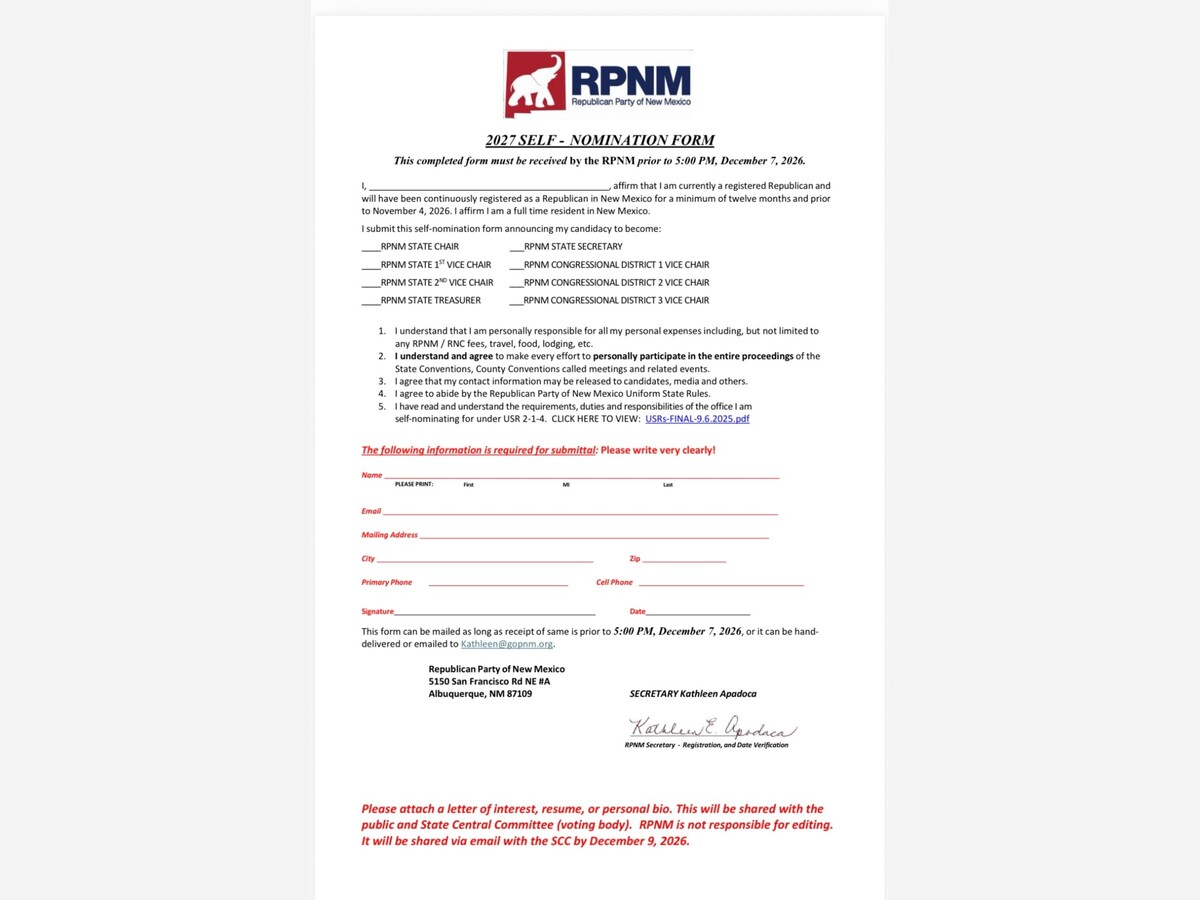



Self-nomination forms for the eight statewide party offices are due by 5 p.m. Dec. 7. Here’s what each job does, who can run, and how the vote works.
November 19, 2026 · Albuquerque by Journalist Chris Edwards
The Republican Party of New Mexico (RPNM) is taking candidates for its top leadership posts for 2027–2028. Any registered Republican in the state who meets the requirements can run, whether they are a longtime county officer or a precinct volunteer who has never sought party office. Change begins from the ground up!
The party’s 2027 Self-Nomination Form lists eight offices: State Chair, First Vice Chair, Second Vice Chair, Secretary, Treasurer, and a Vice Chair for each of New Mexico’s three congressional districts.
The completed form must be received by RPNM before 5:00 p.m. on Monday, December 7, 2026. Mailed forms count only if they arrive by then.
This year’s vote comes after a hard stretch for the party. In 2026, a dispute over whether the sitting chair, Amy Barela broke party rules by running in a contested Republican primary ended in a court order removing her. She attempted to change those very rules and ignored them. Several State Central Committee meetings called to choose a replacement then failed to reach quorum. Whoever wins in December will serve a full two-year term covering 2027 and 2028. The party is fractured and is no longer welcoming many different factions. Under present leadership and staff there continues to be infighting, calling those that don’t toe the leadership line RINOs and an attitude of no inclusion - the New Mexico big GOP tent is not Ronald Reagan’s GOP tent.
The self-nomination form asks every candidate to affirm that they:
Are a registered Republican now, and have been continuously registered as a Republican in New Mexico forat least twelve months, beginning before November 4, 2026
Are a full-time New Mexico resident
Will pay their own way, including any RPNM or RNC fees, travel, food and lodging
Will make every effort to attend state conventions, county conventions, called meetings and related events in full
Agree that their contact information can be released to candidates, the media and others
Will follow the RPNM Uniform State Rules (USRs)
Have read and understand the duties of the office they are seeking, as laid out in USR 2-1-4
The party’s general rules for holding party office (USR 1-2-1 and 1-2-2) also require party officers to be registered Republicans who live at their registered address. An officer who changes party registration or moves out of the area automatically resigns.
Two conflict-of-interest rules matter in particular. State officers may not publicly endorse one Republican over another in a primary (USR 1-4-3).
And if a state officer files for public office in a race where another Republican has also filed, the officer must step down from party office immediately (USR 1-4-4).
That second rule is the one at the center of the 2026 lawsuit over the chairmanship and created significant party division costing Republican unity across New Mexico in 2026.
Read the rules. The Uniform State Rules (the version adopted Sept. 6, 2025) are posted at newmexico.gop/usr. Article 2, and USR 2-1-4 in particular, sets out each office and its duties.
Fill out the 2027 Self-Nomination Form. Check the office you are seeking. Print your name, email, mailing address, city, ZIP code, primary phone and cell phone clearly, then sign and date the form.
Attach a letter of interest, résumé or personal bio. The party says it will share this material with the public and with the State Central Committee, the body that votes, by email no later than December 9, 2026. RPNM says it will not edit submissions, so proofread yours before you send it.
Get the form to the party by 5 p.m. Dec. 7. You can email it to Kathleen@gopnm.org, hand-deliver it, or mail it to: Republican Party of New Mexico, 5150 San Francisco Rd NE #A, Albuquerque, NM 87109. The party secretary checks each candidate’s registration and the date the form was received.
Campaign to State Central Committee members. Rank-and-file Republicans do not vote in this election. Members of the State Central Committee do.
Questions can go to RPNM headquarters at (505) 298-3662, Monday through Friday from 8 a.m. to 5 p.m., or to contact@gopnm.org.
Who votes: the State Central Committee
Under USR 2-1-1, the State Central Committee (SCC) is the party’s governing body, with general supervision and control of its political affairs. It has hundreds of members. Membership comes from several sources:
Members elected by county. Each county gets one, plus one more for every 1,000 votes (or major fraction of 1,000) its voters cast for the Republican nominee for governor in the most recent gubernatorial election.
County party officers. Up to five per county.
Republican officeholders. Incumbents in the federal, statewide and legislative offices listed in the rules (judges excepted).
National committee members. New Mexico’s Republican National Committeeman and National Committeewoman.
Affiliated groups. Three members each from the Young Republicans, the College Republicans and the New Mexico Federation of Republican Women.
Current and former leaders. All former state chairs and former national committee members, the sitting state officers, and the chairs of the State Finance Committee and the Advisory State Rules Committee.
Quorum: Under USR 2-1-5, the SCC can do business only when at least two-thirds of its members, representing at least two-thirds of the counties, are present in person or by proxy. In 2026 several meetings fell short of that bar, so attendance in December will matter.
USR 2-1-4 says state officers are elected at an SCC meeting called between November 15 and January 15 after each general election. The official call for the meeting sets its date and location, and the rules require written notice at least 10 days ahead.
The statewide offices of chair, two vice chairs, secretary and treasurer are elected by the full SCC.
The three congressional district vice chairs are chosen in two stages. First, the SCC members from each district caucus together and nominate one candidate by secret ballot, or by voice vote if only one person is running. Then the full SCC votes to confirm or reject each nominee by majority, which counts as election at-large.
All officers take office the day after they are elected. They serve two years, or until a successor is elected or appointed.
What each officer does, and why it matters
A state party is not the government. It is the volunteer organization that recruits and supports candidates, raises money, trains county parties, runs conventions and pre-primary nominating events, and speaks for Republicans across the state. The eight state officers run that organization between SCC meetings. Under USR 2-1-4(E), each of them is automatically a member of both the SCC and the State Executive Committee (SEC), the smaller body that handles party business between meetings.
The chair is the party’s chief executive and its most visible spokesperson. Under USR 2-1-4(F), the chair:
Presides over SCC meetings and calls them, with proper noticeSets the two-week window in which counties hold party officer and delegate electionsAppoints committees and assistants, plus 15 to 30 members of the State Executive Committee, who serve at the chair’s pleasureCalls a county’s organizational convention if the county fails toHires an executive director together with the SECSubmits an annual party budget by November 30 and approves any spending outside itMakes sure party property and records pass to the next chair
The chair also leads the SEC. With a majority vote of the SEC, the chair can declare a county chair’s office vacant if that county chair refuses to call a required meeting. The chair can be paid: a compensation committee made up of the other elected state officers and the national committee members may recommend an annual salary plus expenses, which the SCC approves or changes.
Why it matters: The chair sets the party’s strategy, controls its staff and budget, and is the public face of New Mexico Republicans going into the 2028 election cycle.
The first vice chair acts as chair whenever the chair is absent. If the chair’s office becomes vacant, the first vice chair must call an SCC meeting within 30 days to elect a permanent replacement. If the chair is away, the first vice chair can also be given authority to approve spending outside the budget.
Why it matters: As 2026 showed, this office can end up leading the party with little warning.
The second vice chair acts for the chair when both the chair and the first vice chair are absent. If the chair’s office becomes vacant and the first vice chair is also absent, the second vice chair must call the meeting to fill it.
Why it matters: It is the second backup for party leadership and adds another voice on the Executive Committee.
Congressional District Vice Chairs (CD 1, CD 2, CD 3)
Under USR 2-1-4(I), the three district vice chairs carry out duties the chair assigns. Each one represents one of New Mexico’s three U.S. House districts.
Why it matters: New Mexico covers a lot of ground, from Albuquerque’s metro area (CD 1), to the southern half of the state (CD 2), to the north and the Navajo Nation (CD 3). The district vice chairs are how each region gets a seat at the leadership table, and in practice they often coordinate the county parties in their districts.
Under USR 2-1-4(J), the secretary keeps the minutes of SCC and SEC meetings, prepares and sends meeting notices with the chair, and keeps a list of the party’s real and intellectual property. The secretary also serves as secretary of the Executive Committee and, under the self-nomination process, checks candidates’ registration and filing dates.
Why it matters: Meeting notices and records decide whether party actions are valid. That has come up repeatedly in recent disputes over meeting calls and quorum.
The treasurer performs the duties the chair and the law require. In practice that means handling the party’s money and its campaign-finance compliance. The rules bar the same person from serving as both chair and treasurer. If the treasurer’s office becomes vacant, the chair names a temporary replacement and the SCC holds an election within 30 days. The Executive Committee must also get an annual audit within 60 days after the fiscal year ends.
Why it matters: The treasurer is responsible for keeping the party’s books accurate, legal and audit-ready and transparent.
If an office other than chair or treasurer becomes vacant, the State Executive Committee fills it, and the SCC confirms the appointment at its next meeting. Any officer can be removed by a two-thirds vote of members present in person at a properly called meeting attended by at least 51% of the membership.
Proxies do not count for a removal vote.
The application can be downloaded from the attached link
https://drive.google.com/file/d/1EMq3SdE8n-k2TMkWmosWIhAZVQlF3SAf/view?usp=drivesdk


Sunny, with a high of 68 and low of 48 degrees. Sunny in the morning, clear in the afternoon and evening,







having consulted with my crystal ball, i will predict that, after some discussion, one of the gang of four will make a motion - which conforms with the city manager's interpretation of the charter. another of the four will second that motion....and the motion will pass - by


And people don't believe the commission is corrupt. Look at our property taxes gone crazy. I'm sure that accounts for their "big" salaries that are NOT justified in this town or NM! A great place going downhill very fast.
yeah, but, somewhere off in the background, some folks' backs are being scratched...