63° and Partly Cloudy
Image
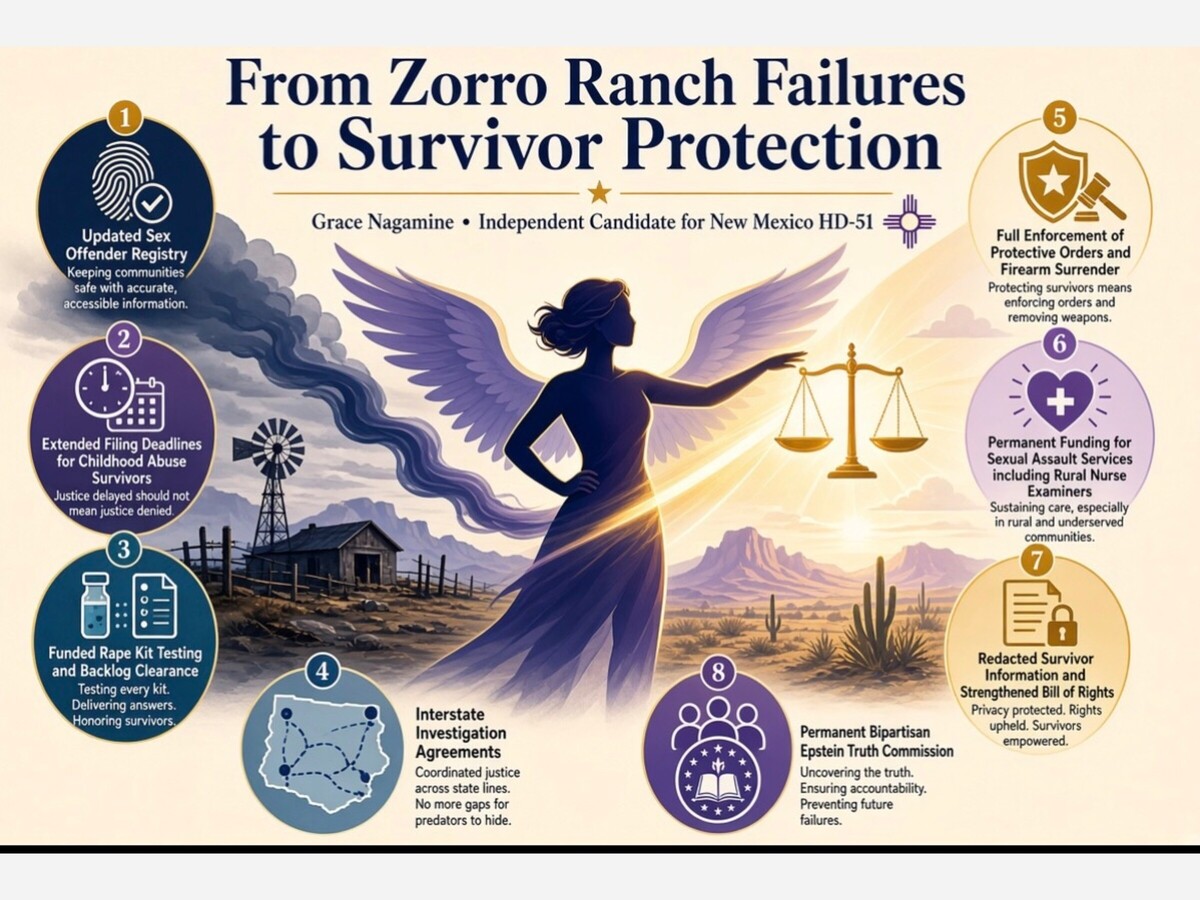



Grace Nagamine, an Independent and survivor of sexual abuse and domestic violence, releases an eight-point agenda on sex-offender registration, survivors' filing deadlines, rape-kit testing and victim services.
ALAMOGORDO — Five days before Election Day, Independent House District 51 candidate Grace Nagamine released a policy brief that treats Jeffrey Epstein's Zorro Ranch not as a political scandal but as a lesson in how New Mexico fails survivors of sexual abuse — and what lawmakers should do about it.
The brief, titled "Lessons From Zorro Ranch: A Survivor's Plan to Protect New Mexicans From Sexual Abuse," lays out what Nagamine calls the Survivor Justice and Predator Accountability Agenda for the 2027 legislative session.
Its eight planks would make a predator's criminal history follow him into New Mexico, give childhood abuse survivors far more time to seek justice in court, force the state to test rape kits on time, tighten domestic violence protections, put permanent money behind survivor services, and build accountability that outlasts any one scandal.
The stakes are not limited to one ranch in Santa Fe County. According to the 2024 New Mexico Crime Victimization Report, cited in a 2026 Senate memorial, 54% of New Mexicans have experienced sexual assault or rape in their lifetimes. Advocates say about two-thirds of survivors never receive professional help.
"Zorro Ranch was allowed to happen because every institution assumed someone else would act," Nagamine said. "That's not only a story about a billionaire. It's how most abuse goes unpunished, here in Otero County too."
Nagamine, a lifelong Alamogordo resident, grandmother, founder of the humanitarian group Royal Angels and a former Mrs. New Mexico, says her own experience of sexual abuse and domestic violence is why the issue is personal rather than political.
"Survivors know what it is to carry abuse in silence, to wonder if anyone will believe you, and to find out the law says you waited too long," “unlike my competitor I have a unique perspective of survival,” she said. "I'll judge every vote by one question: does this help a survivor be believed, be safe, and get justice?"
Grace spoke of survival of childhood sexual abuse at a recent survivors rally spotlighting the needs of domestic abuse and sexual abuse victims:
That perspective shows in the brief's details. It calls for survivors' names and identifying information to be redacted from any investigative files the state releases, for sexual assault nurse examiners within reach of rural towns such as Tularosa and Cloudcroft, and for quarterly county-by-county data on rape-kit testing so survivors can see whether their evidence is moving.
She also ties sexual violence to domestic violence, calling for full enforcement of protective orders and New Mexico's law requiring people under domestic violence protective orders to surrender firearms, plus lethality screening to flag the most dangerous cases early.
Running as an Independent, Nagamine argues that survivors are poorly served by party fights. "Survivors don't have a party, and neither do the people who failed them," she said. "I'll hold Democrats and Republicans to the same standard."
Nagamine's brief pairs every proposal with a failure it is meant to fix. Taken together, the eight reforms reach well beyond Zorro Ranch to the everyday cases that never make headlines.
1. Make a predator's history follow him. Epstein pleaded guilty in Florida in 2008 to a sex offense involving a minor, yet he was never registered as a sex offender in New Mexico, where he owned a 7,600-acre ranch. Nagamine wants a full update of the state's Sex Offender Registration and Notification Act to meet federal standards, building on a 2026 bill, HB 199, that covers offenders who move, work or study here. She would go further, requiring registration for anyone with a sex-offense conviction who owns or regularly stays at property in New Mexico, and funding the Department of Public Safety to clear its backlog of out-of-state conviction reviews. She also wants fingerprint-based background and registry checks for anyone working or volunteering with children, including private camps, ranches and residential programs.
"A predator's record shouldn't stop at the state line," Nagamine said. "If you have a conviction for abusing a child, New Mexico should know who you are the day you buy property here, not decades later."
2. Justice without an expiration date. Under current law, survivors of childhood sexual abuse generally must sue by age 24, or within three years of first disclosing the abuse to a licensed provider. Sponsors of reform legislation have told lawmakers survivors often do not come forward until their 50s. Nagamine would revive HB 151, which the House let die in committee in February, giving survivors far more time to file and reopening expired claims for three years. She would also review criminal limitations on sex crimes against children.
"Children don't get to choose when they're strong enough to speak," she said. "The law shouldn't punish them for how long it took."
3. Test every rape kit, on time. New Mexico once had the nation's worst per-capita backlog of untested sexual assault kits. After nearly a decade and more than $6 million spent, prosecutors warned lawmakers in 2025 that a new backlog was forming, with 134 kits at the state lab past the 180-day testing deadline set in 2019 and cases being delayed or dismissed. Nagamine would fund crime-lab staffing statewide, adopt the recommendations of a 2026 legislative task force on the backlog, and publish quarterly county-by-county testing data.
"An untested kit tells a survivor they don't matter," she said. "Every survivor in Otero County deserves to know where their evidence is."
4. No more deferring to nobody. In 2019, New Mexico's then-attorney general stepped aside for federal prosecutors in New York, shared the state's files and received nothing in return. The case died. Nagamine would require a written agreement guaranteeing the state copies of evidence and regular updates any time it pauses an investigation for another agency, with automatic reopening if that cooperation stops. She also backs Attorney General Raúl Torrez's lawsuit seeking unredacted federal files on Zorro Ranch.
5. Break the link between domestic violence and sexual abuse. Drawing on her own experience, Nagamine argues the two forms of violence often share the same abusers and the same silence. She calls for full funding to enforce protective orders and the state law requiring people under domestic violence protective orders to surrender their firearms, lethality-assessment screening so police and advocates can identify the most dangerous cases early, and more shelter, legal help and safety planning in rural counties.
"Domestic violence taught me that the most dangerous moment is often when you try to leave," she said. "Our laws have to be ready for that moment."
6. Fund the front lines. Federal Victims of Crime Act funding has been cut by roughly 40% since 2022, and 41 sexual assault provider organizations have been surviving on one-time state grants. Nagamine would make $2 million a year in sexual assault service funding permanent and guarantee access to a sexual assault nurse examiner near every community, including Alamogordo, Tularosa and Cloudcroft. Nearly 6,000 survivors used these services statewide last year; almost a third were children.
7. Protect survivors' privacy and dignity. Any investigative files the state releases should redact survivors' names and identifying details and exclude abuse imagery, the brief says. Nagamine would also strengthen the state's 2019 Sexual Assault Survivor's Bill of Rights with clear notice requirements, enforcement and a way to report violations.
8. Make accountability permanent. The House's Epstein Truth Commission has been weakened by disputes over an edited report and members' outside jobs, and is down to three of four members. If its work continues, Nagamine would re-create it in law as a joint House-Senate body with equal partisan membership, a 30-day deadline to fill vacancies, and a rule that every change to an official report be approved by all members and published. She would also require banks operating in New Mexico to train staff to spot and report signs of human trafficking.
"None of this is about one ranch or one billionaire," Nagamine said. "It's about every child and every woman in this state who was told to stay quiet. I was one of them. I'm not quiet anymore."
Epstein owned the ranch near Stanley from 1993 until his death in 2019. A legislative Survivors' Truth Commission reported in August that evidence supports abuse of at least five women and girls there, and that at least 30 more people may have been abused in New Mexico. No agency searched the property until March 2026.
Nagamine is challenging Republican Rep. John Block, who has represented District 51 since 2023. Block voted with the unanimous House in February to create the Truth Commission and called Zorro Ranch a "stain" on New Mexico during floor debate, according to the Albuquerque Journal.
After the commission's interim report came out in August, Block dismissed it in social media posts as "feeble" and a "nothing-burger" that "helps no victims," and said the money spent had gone "into the paper shredder."Nagamine says the difference is what comes after the criticism.
A review of Block's legislative record found no bill to extend survivors' filing deadlines, upgrade sex-offender registration or fund survivor services.
"Calling an investigation a nothing-burger is easy. It scores a point and helps no one," Nagamine said. "Survivors have heard enough politicians turn their pain into a partisan fight. A legislator's job is to write the laws that keep the next child safe. That's what I'll do."
The Truth Commission's final report is due in December, and Attorney General Raúl Torrez's criminal investigation and his Oct. 21 lawsuit against Epstein's lawyer and accountant, who deny the allegations, are ongoing. Nagamine says she would use the commission's findings as a starting point for legislation in the 60-day session that begins in January.
"The report shouldn't be the end of this," she said. "It should be the first draft of better laws."
Read the full policy brief, with sources: Lessons From Zorro Ranch: A Survivor's Plan to Protect New Mexicans From Sexual Abuse. Election Day is Tuesday, Nov. 3.
Survivors seeking support can reach the New Mexico Sexual Assault Helpline at 1-844-667-2457 or nmsahelp.org.

Wow! Sounds like that was some meeting! Everything short of a fistfight in the parking lot.

Interesting article when read in conjunction with the opinion piece by Rene. However the qualifications he listed did not include the personal relationship with the editor who I understand is involved in the campaign of the candidate. By no means do I support the mud slinging by the blockeads.

Patchy rain nearby, with a high of 72 and low of 57 degrees. Cloudy in the morning, patchy rain nearby during the afternoon, clear overnight.

I'm one who supports a salary, but I definitely agree this is such a poorly written bill that I will certainly vote NO.
And thank you, Chris, for such a well researched and documented argument here. I would like to share this.
as always - the devil is in the details - one item i did not see addressed; usually reimbursements (such as per diem) are not subject to federal income tax, is this the case here?
Thank you and please share






Love your shop in Las Cruces! Haven’t been to the one here in Alamo yet.
Hi Troy,
What do you think of the manga Jaadugar: A Witch's Life in Mongol (Tomato Soup). It's now an anime from Saru Science/Crunchyroll.
Enjoy!