
 59° and Light rain shower
Image



2nd Life Media Alamogordo Town News, New Mexico Conservative News Analysis- New Mexico Democrats expanded their margins in the 2026 midterm, but the raw vote counts and party-specific turnout rates tell a more precise story than the percentage margins that dominated much of the national coverage.
Overall turnout was roughly comparable to the last midterm — about 50 percent of registered voters cast ballots this year (roughly 729,000 ballots in unofficial returns out of approximately 1.47 million registered) versus 52.4 percent in 2022 (about 711,000–715,000 ballots out of 1.36 million registered).
The difference was who showed up — and, just as important, who didn't.
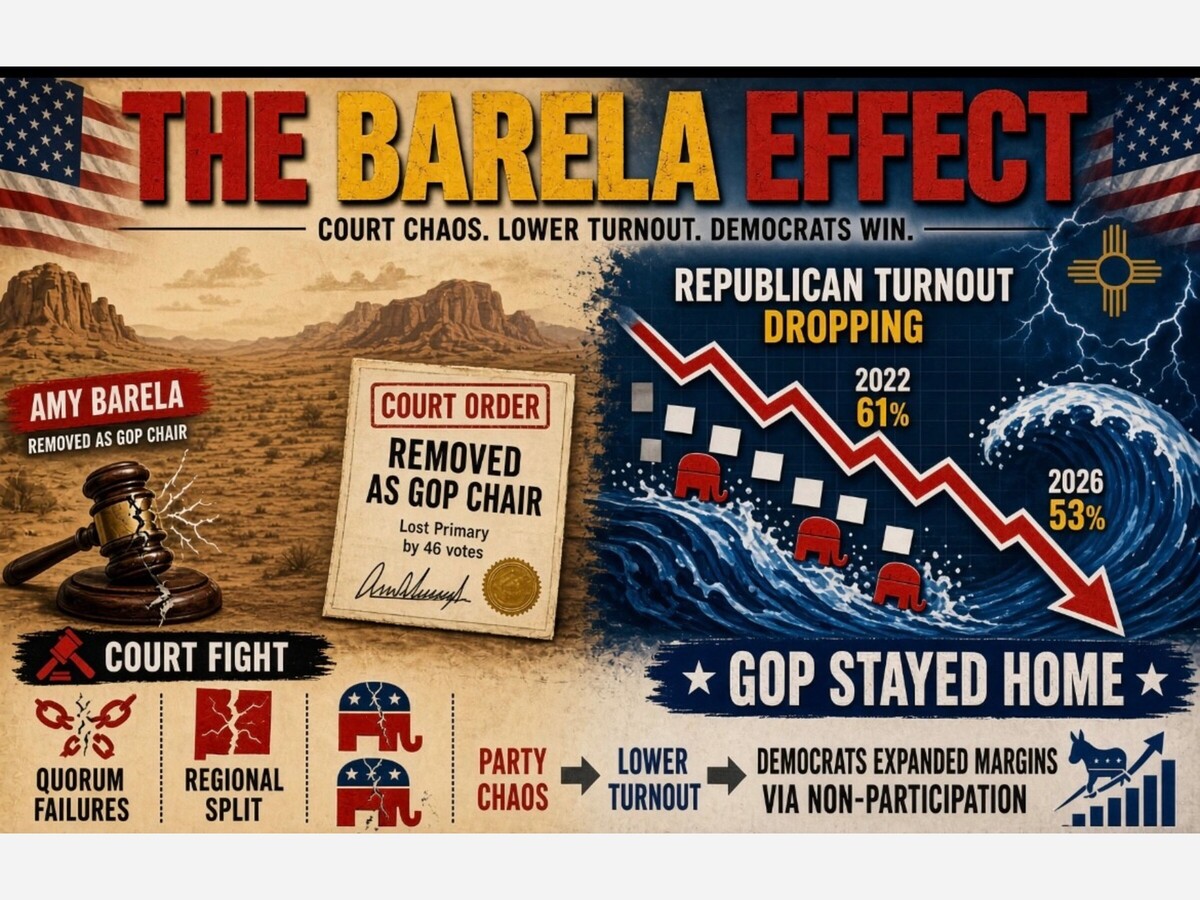
In 2022, Republicans turned out at a higher rate than Democrats. Secretary of State figures reported by Source NM put 2022 turnout at roughly 61 percent of registered Republicans versus 57 percent of registered Democrats. Independents lagged far behind.
In 2026 the rates reversed: Democrats reached approximately 61–62 percent turnout while Republicans fell to about 53 percent and independents remained near 32 percent.
The state's registered voter pool had grown by roughly 100,000 people, which is why total ballots cast were slightly higher even as the percentage declined.
The partisan composition of the electorate, however, shifted.
In the 2022 gubernatorial race, Michelle Lujan Grisham (D) defeated Mark Ronchetti (R) with about 370,000 votes (52 percent) to roughly 325,000 (45.6 percent) — a margin of about 6 points.
In 2026, Deb Haaland (D) received approximately 416,000 votes (57.4 percent) while Republican Gregg Hull received about 309,000 (42.6 percent), a margin of nearly 15 points — far wider than the 6- to 7-point gap fall polling had shown.
Democratic raw totals rose modestly from the previous midterm; Republican raw totals declined. The margin more than doubled.
Similar patterns appeared in other statewide contests, including the U.S. Senate race, where Ben Ray Luján faced no Republican on the primary ballot at all.
Early and absentee voting amplified the difference.
Democrats banked a larger share of their registrants before Election Day in 2026 than they had in 2022 — roughly 238,000 registered Democrats voted early or absentee, compared with about 143,000 Republicans.
Republicans continued their traditional Election Day lean (about 94,000 voted on Nov. 3), but they began from a deficit of more than 100,000 ballots that Election Day could not close.
The clearest illustration is New Mexico's 2nd Congressional District.
Gabe Vasquez first won the seat in 2022 by roughly 1,350 votes (50.3 percent to 49.6 percent) over Yvette Herrell after redistricting.
In the 2024 presidential year he expanded that to about 138,000 votes (52.1 percent) against Herrell's roughly 127,000 (47.9 percent) — a margin of about 4 points or 11,000 votes.
In 2026 Vasquez defeated Republican Greg Cunningham — a Trump-endorsed Marine veteran and retired Albuquerque police officer, and a top National Republican Congressional Committee target — by approximately 37,000 votes (roughly 58.8 percent to 41.3 percent).
Vasquez's raw total dropped from his 2024 figure (about 124,000 versus 138,000).
The Republican total collapsed from 127,000 in 2024 and roughly 96,000 in 2022 down to the mid-80,000s.
The larger margin was produced primarily by the absence of Republican voters, not by a surge in Vasquez's support.
County-level patterns were consistent with differential turnout. Vasquez performed strongly in Doña Ana County and the Bernalillo County portion of the district; Republicans held relatively better in more rural, energy-producing counties such as Otero and Eddy.
Those differences track participation rates more closely than a wholesale shift among previously high-loyalty groups.
The turnout numbers did not emerge in a vacuum.
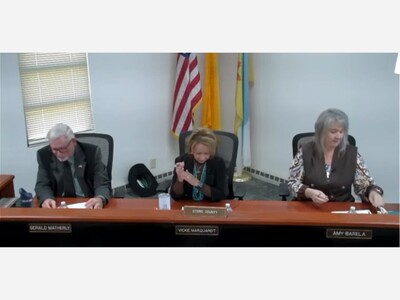
For most of 2026, the Republican Party of New Mexico (RPNM) spent its energy fighting itself rather than Democrats, and the central figure in that fight was its chair, Amy Barela.
Barela, an Otero County commissioner, succeeded former Congressman Steve Pearce as state chair in late 2024. In March 2026 she filed for re-election to her county commission seat — two minutes before a fellow Republican, Jonathan Emery, filed to challenge her.
A long-standing party rule requires a state officer to immediately vacate the party post when they file for an office that another Republican is also seeking.
Bernalillo County Republicans publicly demanded she step down; Sandoval County's party chair accused her of ignoring a rule that had been on the books for two decades.
Barela refused, the party commissioned an outside review from a Dallas firm that cleared her, and her defenders — including executive director Leticia Muñoz — cast the push to remove her as a hostile takeover.
The dispute went to court. Three Republican candidates — gubernatorial hopeful Duke Rodriguez, lieutenant governor candidate Aubrey Blair Dunn and opponent Johnathan Emery — sued, alleging the party was not only flouting its rules but favoring certain candidates in contested primaries.
On May 27, District Judge Cindy Mercer issued a preliminary injunction barring Barela from serving as chair and prohibiting party leaders from backing one Republican over another in contested primaries, citing as evidence a party social media post that promoted only selected candidates. On June 2, Barela narrowly lost her commission primary to Emery — by 46 votes. On June 10, the New Mexico Supreme Court unanimously denied the party's appeal.
Then Barela on social media went onto the attack of this media outlet and its affiliates and a constant barrage of ongoing attacks on this journalist rather than accepting personal accountability for her actions and her loss.
Then, she announced on social media that she would run to get her old job as state chair back.
What followed was a summer of leadership paralysis.
First Vice Chair Mike Nelson took over on an interim basis. A State Central Committee meeting in Las Cruces on June 20 drew only about 160 members in person or by proxy — far short of the 358 needed for a quorum — after most northern New Mexico Republicans boycotted it. Northern Republicans called a rival meeting in Belen; the party called another in Albuquerque for late July. The split was explicitly regional: a coalition of southern and rural county officers backed Barela and the southern meeting sites, while one northern candidate for chair warned that her return would amount to southern New Mexico having "bullied their way to a chairmanship."
The practical result: heading into a general election, the state party had no elected chair.
One former local official summed up the situation after Election Day, calling the RPNM a "nonfunctioning party" that had no chairman and had poured its energy into internal fights.
Muñoz, Barela's ally, offered the mirror-image diagnosis: the counties that lost Republican House incumbents, she argued, had spent their time trying to remove Barela instead of turning out voters.
The infighting had concrete consequences on the ballot
The RPNM under Barela’s leadership failed to field candidates through the normal process for U.S. Senate, state auditor and state treasurer.
Republicans were left scrambling for late write-in candidates: former oil and gas operator Larry Marker for Senate and Sam Kane for attorney general.
Northern Republicans blamed Barela directly for the failure to field several high-profile candidates for November.
The race for governor nearly lost a candidate, too — state Sen. Steve Lanier was disqualified from the GOP primary over a missed filing deadline.
Money followed the same pattern.
Haaland raised a record of roughly $19 million to about $2.5 million for Hull.
Even in the spring, Republican gubernatorial candidates had raised about one-tenth of what Democrats had. Critics after the election said the state party raised almost nothing and could not help Hull raise money.
Former GOP congressional candidate Mick Rich wrote that the oil and gas industry declined to fully back the legislative strategy or the gubernatorial nominee, suggesting donors walked away once their preferred primary candidate lost.
During the chair fight, one candidate claimed publicly that the party's donor base was heavily tied to oil and gas and that Barela had said the money would leave if she were not returned to the chair — a claim that could not be independently verified but that circulated widely among activists.
National Republicans, meanwhile, largely left Hull on his own. Trump never endorsed him, no major conservative outside group came to his aid, and a Democratic Governors Association–backed committee ran TV ads tying him to the president anyway.
From the start, the RPNM's civil war was fought in public.
In March, state Sen. Jim Townsend of Artesia published a lengthy Facebook post scolding Barela's critics; county chairs answered with posts calling her a hypocrite and warning her conduct would cost the party in November.
Sandoval County's GOP chair circulated infographics questioning the chair's neutrality, while the state party issued statements asking members whether they would stand with Barela or against the mission to flip New Mexico red.
After Election Day, the recriminations intensified.
Aubrey Blair Dunn, the former lieutenant governor candidate and one of the plaintiffs, posted on Facebook that Haaland owed her victory to the RPNM and named Pearce, Townsend and Barela among those responsible — arguing the party had run candidates too closely tied to Trump and pushed independents toward Democrats by attacking Republicans who criticized the president.
A graphic circulating among Republicans calls for firing the party's entire executive committee and holds it responsible for campaign transfers, mailers and messaging; its dollar figures have not been verified. Barela's defenders continue to argue that the effort to oust her was itself the distraction that sank Republicans.
The next round is already scheduled.
Officer elections for the next two-year term are set for Jan. 9 in Clovis — assuming the party can reach the quorum it has repeatedly failed to muster. Whether Barela seeks the chair again, and whether northern and southern factions show up in the same room, will shape whether the party enters 2028 rebuilt or still divided.
New Mexico's results were part of a national wave in which Democrats won control of the U.S. House.
In New Mexico, Democrats swept every statewide and congressional race and flipped four Republican-held state House seats — HD-7 (Los Lunas), HD-38 (Elephant Butte), HD-39 (Silver City) and HD-57 (Rio Rancho) — giving them 47 of 70 seats and a two-thirds supermajority. New Mexico has not elected a Republican statewide in a decade.
The environment worked against Republicans from the top down.
Two April polls put Trump's support in New Mexico at just 37 percent, and voters described the election as a referendum on the president and rising living costs. Exit polling and local commentary pointed to gas prices, affordability, tariffs and trade policy, and immigration enforcement as issues that energized Democrats.
Republican legislators pointed to the historical pattern of midterm losses for the president's party and predicted the pendulum would swing back.
Nationally, Republicans have begun their own round of blame, with some insiders privately faulting Trump for the scale of the losses in New Mexico the reasons are well beyond Trump.
The single most important fact in the turnout data is that the missing Republican voters did not, for the most part, become Democratic voters.
They became non-voters.
Roughly 237,000 registered Republicans cast ballots in 2026. Had Republicans matched their 2022 participation rate of about 61 percent, the party would have banked tens of thousands of additional votes statewide — enough to cut deeply into, though not erase, Haaland's margin.
National analysis points the same direction.
Data scientist Lenny Bronner, studying detailed results from 13 states including New Mexico, estimated that about 75 percent of Democratic gains came from a turnout gap and only about 20 percent from Republicans switching sides.
In his words, it looks like "more Trump voters who didn't vote Republican stayed home rather than switching.
Political scientist Michael McDonald likewise found that Trump's older voter base was more likely to sit out.
Which Republicans stayed home?
Voter files do not record ideology, so the answer requires inference — but several signals point toward the party's less ideological, more moderate and lower-engagement members:
They had no one to vote for down-ballot. In races where the party never fielded a nominee — U.S. Senate, auditor, treasurer — there was little reason for a casual Republican to show up beyond the governor's race.
The party's public face was its own feud. For months, the most visible RPNM activity was litigation, quorum fights and Facebook warfare. Mainstream Republicans who care more about crime, schools or the economy than party bylaws saw a party that could not govern itself — exactly the argument Democrats made in their own statements.
The candidate built for them was left alone. Hull ran an issues-focused campaign, kept Trump at arm's length and tried to court Democrats and independents. That positioning is designed to win moderate Republicans and swing voters — but without party money, national support or a functioning state organization, the campaign lacked the infrastructure to find and turn them out.
The Trump drag hit the middle hardest. Democrats spent heavily tying Hull to an unpopular president anyway. For moderate Republicans uneasy with Trump but unwilling to vote for a Democrat, skipping the election was the path of least resistance. Dunn's post-election critique — that the party drove away Republicans and independents who criticized the president — reflects this argument from inside the GOP.
Independents behaved the same way. Unaffiliated voters, now 28 percent of the electorate and growing, cast only about 16 percent of early ballots and turned out at roughly 32 percent overall. Many of them are former moderate Republicans or Republican-leaning voters, and their absence follows the same pattern.
The distinction matters. A voter who switches parties has to be persuaded back; a voter who stays home only has to be motivated to return.
As Bronner put it, those voters are easier for the GOP to win back — which is both a warning for Democrats and an opening for a reorganized Republican Party.
Several factors combined to produce the Republican participation decline:
No presidential race at the top of the ticket. Donald Trump has repeatedly demonstrated the ability to mobilize lower-propensity Republican and some independent voters who often sit out midterms; those voters were less present in 2026.
A referendum on the second Trump term. Concerns over cost of living, tariffs and immigration enforcement motivated Democratic voters while leaving portions of the Republican base less energized.
A state party in disarray; the Barela Effect- No elected chair, failed quorums, lawsuits, unfilled ballot slots and little money meant there was no coordinated effort to counter Democrats' early-vote advantage. Ego over party unity.
Weaker local stakes. Competitive local races and residual energy from the post-2020 environment helped keep Republican turnout relatively stronger in 2022. Those conditions were weaker in 2026.
Independents also turned out at low rates. Meanwhile, the Democratic share of the overall registered electorate has declined in recent years while the independent share has grown, yet in this midterm the participation-rate advantage went to Democrats — the reverse of 2022.
The 2026 results do not require a permanent realignment to explain them. Statewide and district margins expanded largely because one side participated at a lower rate than it had four years earlier. If Republican and independent turnout returns closer to 2022 or 2024 levels in the next presidential cycle — particularly with a strong mobilizing figure at the top of the ticket — the arithmetic changes.
But whether that happens depends heavily on what the RPNM does in the next few months In New Mexico.
A party that resolves its leadership fight in January, recruits candidates for every statewide race and rebuilds a donor base can realistically bring stay-home Republicans back.
A party that carries the Barela fight and the Barela Effect into 2027 risks turning a one-cycle turnout dip into a habit.
Raw vote totals and party-specific turnout rates remain more transparent measures of what occurred than percentage margins alone — and they suggest the Republican problem in New Mexico in 2026 was less about persuasion than about showing up.


Patchy rain nearby, with a high of 60 and low of 49 degrees. Patchy rain nearby during the morning, light rain shower for the afternoon, patchy rain nearby for the evening,




Chris, when the heck are you going to see through this regurgitated manure? No educated investors will ever get involved in anything with the corrupt tentacles of layers of incompetent bureaucrats who know nothing about entrepreneurialism. Cut to the chase Amigo and WTFU