
Image
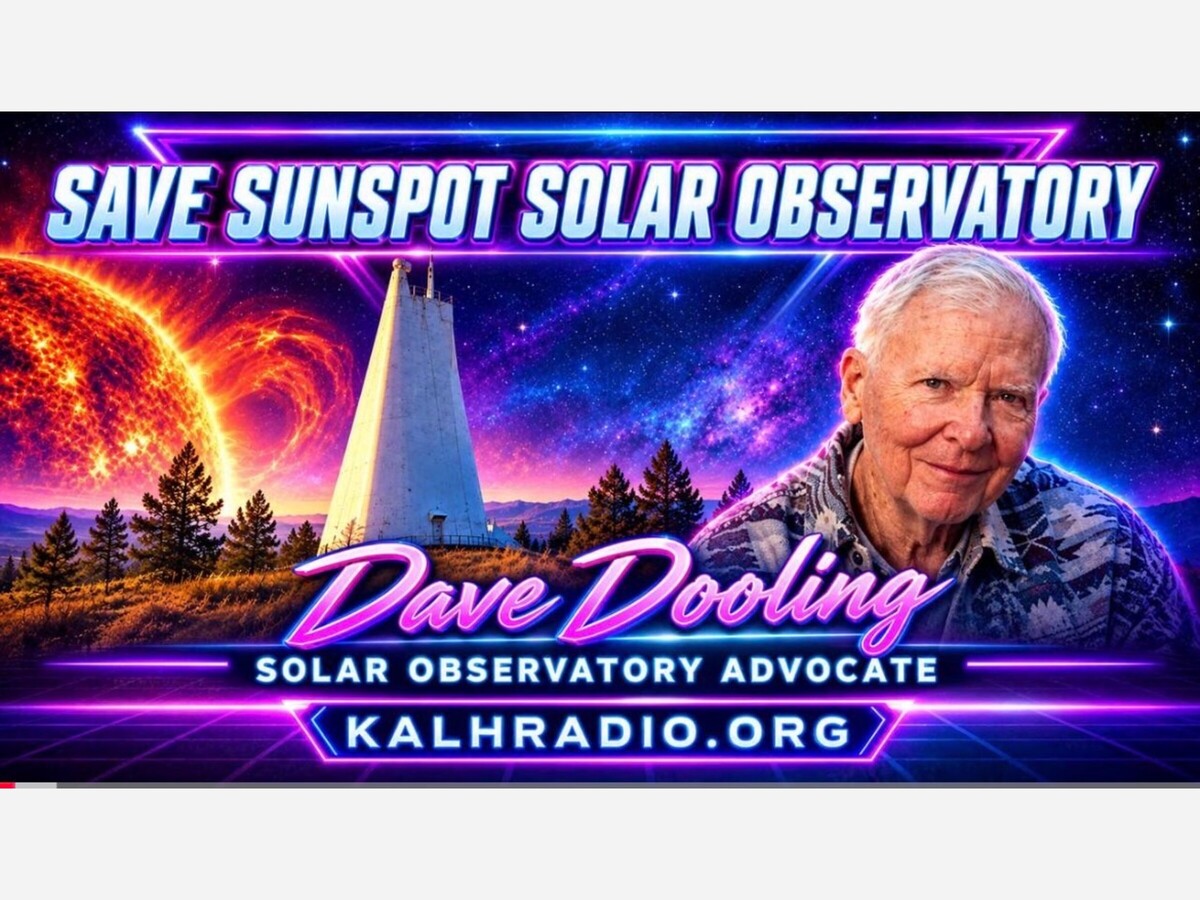
Alamogordo Town News- Advocate Pushes to Save Sunspot's Dunn Solar Telescope as Demolition Nears



SUNSPOT, N.M. — In an interview with Alamogordo Town News streaming editions Anthony Lucero, Science Reporter Dave Dooling discusses Sunspot options, facts about the Dunn demolition, what’s ahead and what could be.
Demolition crews are preparing to take down the Dunn Solar Telescope, the tall, obelisk-like landmark visible from across the Tularosa Basin. Some community members are asking federal officials to pause and consider another path.
"The national resource is about to go away, and we'd really like to save it," said Dave Dooling, who lived in the mountaintop village of Sunspot for nine years and later handled education and outreach for the National Science Foundation's solar telescope in Hawaii.
A mercury leak and a demolition contract
According to Dooling, trouble began on January 5, when liquid mercury leaked from one of the main bearings that allow the telescope to rotate. About 186 pounds escaped, roughly six quarts, out of the 18,000 pounds held in the bearing. Operations were shut down immediately, the area was sealed off, and a follow-up contract of about $3 million paid for draining the mercury. That work was completed in August.
The contractor's report concluded that decades of microscopic leaks and vapor may have compromised the building's metal structure and concrete. It recommended demolishing the entire telescope for safety. The same company has since received a contract worth nearly $10 million for the demolition, which runs through the end of March next year. Dooling said crews are expected on site soon to survey the facility, stage equipment, and plan where the debris will go.
Mercury is highly toxic. Inhaled vapor can travel directly into the nervous system and cause permanent damage. Dooling stressed, however, that the leak posed virtually no risk to Otero County residents. "It was all contained inside the Dunn Solar Telescope building, and that was sealed off immediately," he said, adding that workers wore proper hazmat gear.
"Still doing front-line observations"
The Dunn has operated since 1969. Sunspot Observatory, under various names, dates to 1947. Dooling said the telescope was still producing research-quality work before the leak. Queen's University Belfast had recently installed a new instrument worth several million dollars. It was eventually meant to go to a two-meter telescope in India. Other experimental instruments were also in use. Advocates hope that equipment can be removed and sent to other observatories rather than lost.
Dooling rejects the idea that the telescope is beyond saving. He said the building could be remediated, with its surfaces sealed and any remaining mercury removed or isolated. It could then be repurposed as a museum with hands-on optics exhibits, or even returned to operation.
He noted that the NSF acknowledged in 2016 that the Dunn would be an ideal site for training graduate students. The 4-meter Daniel K. Inouye Solar Telescope on Maui is too busy to pause for training, and its instrument room is a clean room that requires full "bunny suits." At the Dunn, by contrast, visitors could walk onto the observing platform and watch scientists at work.
A vision for astrotourism
Management at Sunspot is layered. The U.S. Forest Service owns the land, and the NSF owns the facilities. Operations have passed from the U.S. Air Force to the National Solar Observatory and now to New Mexico State University.
Dooling said the Forest Service has sounded interested in reusing the site. Sunspot still has 16 redwood family homes, a visitor center, a community center with a small commercial kitchen, and a dormitory. The sites of 21 former prefab houses, since donated to Habitat for Humanity and similar groups, still have driveways and utility connections.
That infrastructure, he said, could support high-end bed-and-breakfast rentals and a full-hookup RV park aimed at amateur astronomers. Many of them spend tens of thousands of dollars on equipment and seek out dark skies. At 9,200 feet in the Lincoln National Forest, with Apache Point Observatory next door, Sunspot offers thin air, little turbulence, and minimal light from nearby cities.
"The people who are attracted to the woods for observing the stars are also interested in the forests themselves," Dooling said. He described astronomy and forest science education as "a one-two punch" for tourism.
Why solar research matters
Sunspot began during and after World War II as one of the first space weather forecasting stations. Military planners had learned that solar activity could disrupt radio and radar. Today, Dooling said, space weather affects satellite communications, power grids, and airline crews on polar routes, who face higher radiation exposure during solar storms. He pointed to March 1989, when a geomagnetic storm collapsed the Hydro-Québec power grid.
"Also, the Sun is the nearest star," he said. Studying it helps scientists understand other stars, and vice versa.
How to get involved
Dooling urges residents to contact their members of Congress and state legislators. He has also written to state agencies and the governor's office, with limited response so far.
"If the National Science Foundation would just pause for a bit and listen with their heart as well as their head," he said, "there's just a tremendous amount of possibilities."
Hear the complete uninterrupted interview with Dave Dooling: https://youtu.be/5Dr6B4y-v8Q?is=GiGCQTeTQBLCGRHU

Another disgruntled employee pandering to the government to save whatever failed in real life? Public employees are totally brainwashed into thinking that every problem has to be, and can be, solved by the government. Only they know. Why can't this guy raise the money and buy it to do what his vision is? They'd probably be happy to unload it for a song.
Imo, Mr. Dooling’s suggestions seem like a great way to preserve the observatory. If we stand by and watch it be demolished ($10m demo cost), where would the contaminated materials go?
I don’t know if it’s feasible to contain the mercury contamination, but it’s certainly worth studying before tearing it down.
if we went with Dave’s ideas , it could be a good source of revenue for Cloudcroft, and Otero County.
Source of Revenue? For who? Some non-profit that gets government grants to pay for incompetent managers? They can't keep a liquor store open in Cloudcroft. Now, maybe they can make it an RV park.
An Rv park? Awesome idea! May I reserve a slot from June through September every year?

Sunny, with a high of 79 and low of 61 degrees. Sunny for the morning, clear in the afternoon and evening,




as per occam's razor, the simplest explanation for stonewalling a request this basic and straight forward, is that transparency will cast a bad light on lincoln county, and/or the entity they pay to run their jail.


like 99% of his fellow republicans, block is a servant to the oil & gas industry - a principal constituent of their party.

Just thought the one thing all these first-timers have in common is no qualifications. Wanting to serve, help, or partake isn't enough. None of these people have any professional experience. Where are the engineers, CPA's, Ph.D's?
Business owners, a practicing attorney, one with a PHD, seems to me you didn't review the video.
Sounds like the author is a gordito themself.