71° and Sunny



Image
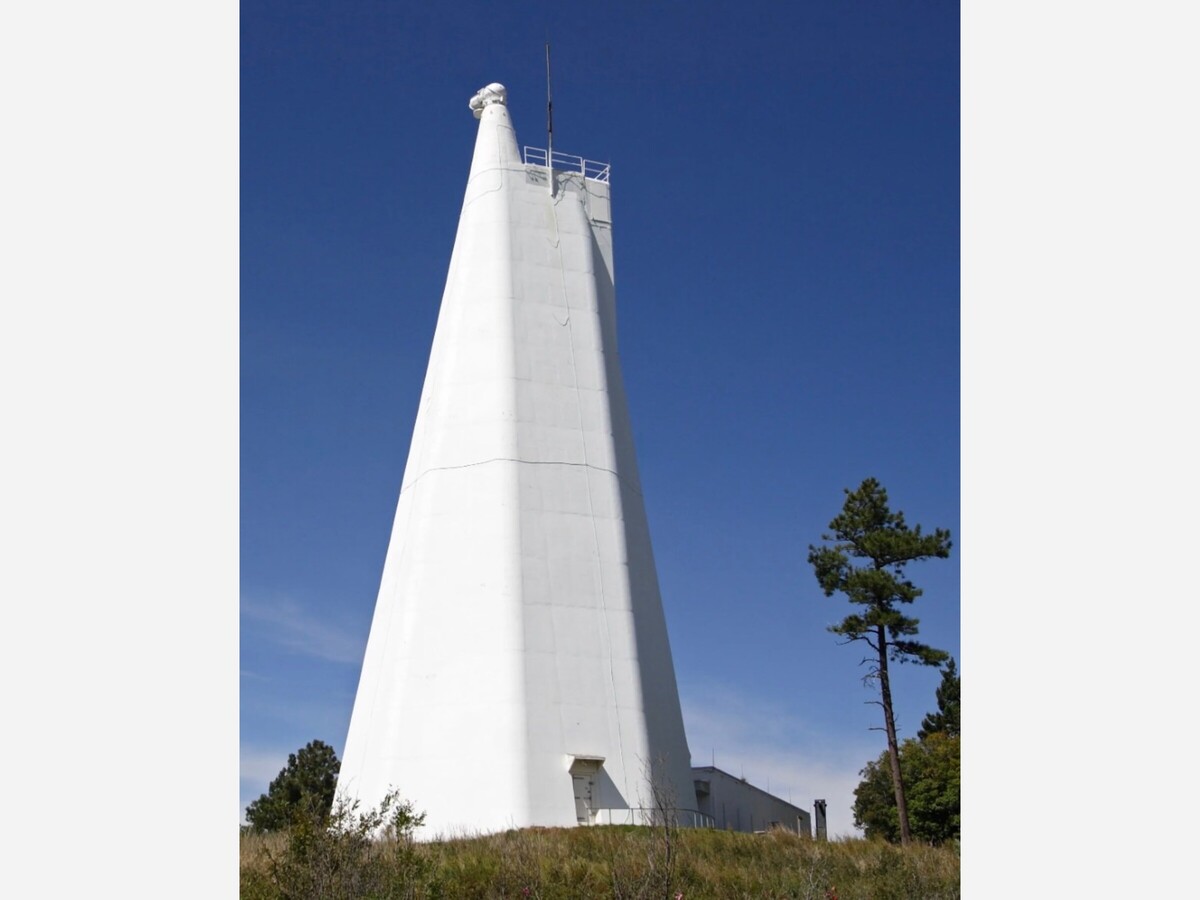
Dunn Solar Telescope to Start Soon - A 2nd Life Media Alamogordo Town News Special Breaking News Report by Science Journalist Dave Dooling
Demolition of the Dunn Solar Telescope at Sunspot Solar Observatory is slated to begin as early as next week and will proceed through March 2027, Alamogordo Town News has learned.
The Dunn, an iconic feature of the Sacramento Mountains skyline since 1969, used three liquid mercury bearings to ensure smooth rotation of its vertical telescope as it studied how sunspots, flares, and other solar features form. On Jan. 6, one of the two upper bearings leaked about 186 pounds of mercury (about 6 quarts), prompting NSF to close the Dunn.
On Feb. 24, NSF concluded that the Dunn should be demolished given the highly toxic nature of mercury. Thornton Tomasetti, a major engineering firm based in New York, was contracted to analyze and then to remove an estimated nine tons of mercury. On Aug. 27, Thornton Tomasetti reported that while the mercury was removed, decades of small leaks and vapors had likely compromised the telescope’s structure.
While not been formally announced, the National Science Foundation today confirmed that demolition will proceed under a new $9,999,334 contract, with a Sept. 23, 2026–March 23, 2027 period of performance.
This brings the total value of Thornton Tomasetti’s three contracts to $13.7 million, listed first as “SAC PEAK MERCURY STABILITY EFFORT” and twice as “SAC PEAK MERCURY DRAINING EFFORTS.”
Three aspects of the latest contract are unusual.
First, it was awarded as a “draining effort” after NSF confirmed that mercury had been drained. NSF said this description was a mistake.
“Regarding the task order description, we appreciate you bringing this to our attention, as the current description is incorrect,” an NSF spokesperson wrote is response to an ATN inquiry. “The correct task order description is ‘SAC Peak DST Demolition MERCURY REMEDIATION Effort,’ which includes both the ongoing mercury remediation activities and the associated demolition efforts.”
Second, the award amount is $666 below the $10 million threshold of the Federal Truth In Negotiations Act, “a powerful fraud enforcement tool [requiring contractors] to provide full and complete price and cost information when submitting for bids,” as described in a 2024 article in The National Review.
Third, the $3 million mercury removal contract (posted July 10) and this new $10 million demolition contract (posted Sept. 10) were not published on the government’s System for Award Management (SAM.gov) where most purchases are solicited and then announced. ATN found the contract amounts by searching on USASpending.gov, which lists obligations and outlays.
ATN asked why neither was advertised, giving the appearance of a sole-source, unadvertised contract, and asked for a copy of the statement of work.
NSF’s reply did not fully answer the question: “For public information on the contract, please refer to the justification posted on April 30, 2026, on SAM.gov under Notice ID NSF260002, which includes the justification for a sole source contract [the first contract, with a final value of $670,679] and the services required to meet the agency’s needs: https://sam.gov/workspace/contract/opp/570137d5bba64869b2cc4dd13d0280fa/view.”
That announcement was a brief explanation of the mercury remediation contract being sole-source/CUI (Confidential, Unclassified Information). A 2010 Executive order defines CUI as “unclassified information throughout the executive branch that requires safeguarding or dissemination controls [and replaced an] inefficient, confusing patchwork” of regulations.
ATN reported the CUI explanation for the Dunn in a previous story, “Sunspot Telescope leak was small, but dangerous.”
Note: The author, Dave Dooling, is a veteran science writer and former education officer at Sunspot.

this is a sad ending, but certainly not unexpected.

Overcast, with a high of 71 and low of 55 degrees. Overcast in the morning, thundery outbreaks in nearby during the afternoon, clear in the evening, patchy rain nearby overnight.



Love your shop in Las Cruces! Haven’t been to the one here in Alamo yet.
Hi Troy,
What do you think of the manga Jaadugar: A Witch's Life in Mongol (Tomato Soup). It's now an anime from Saru Science/Crunchyroll.
Enjoy!



Thank you Sheriff!