
Image
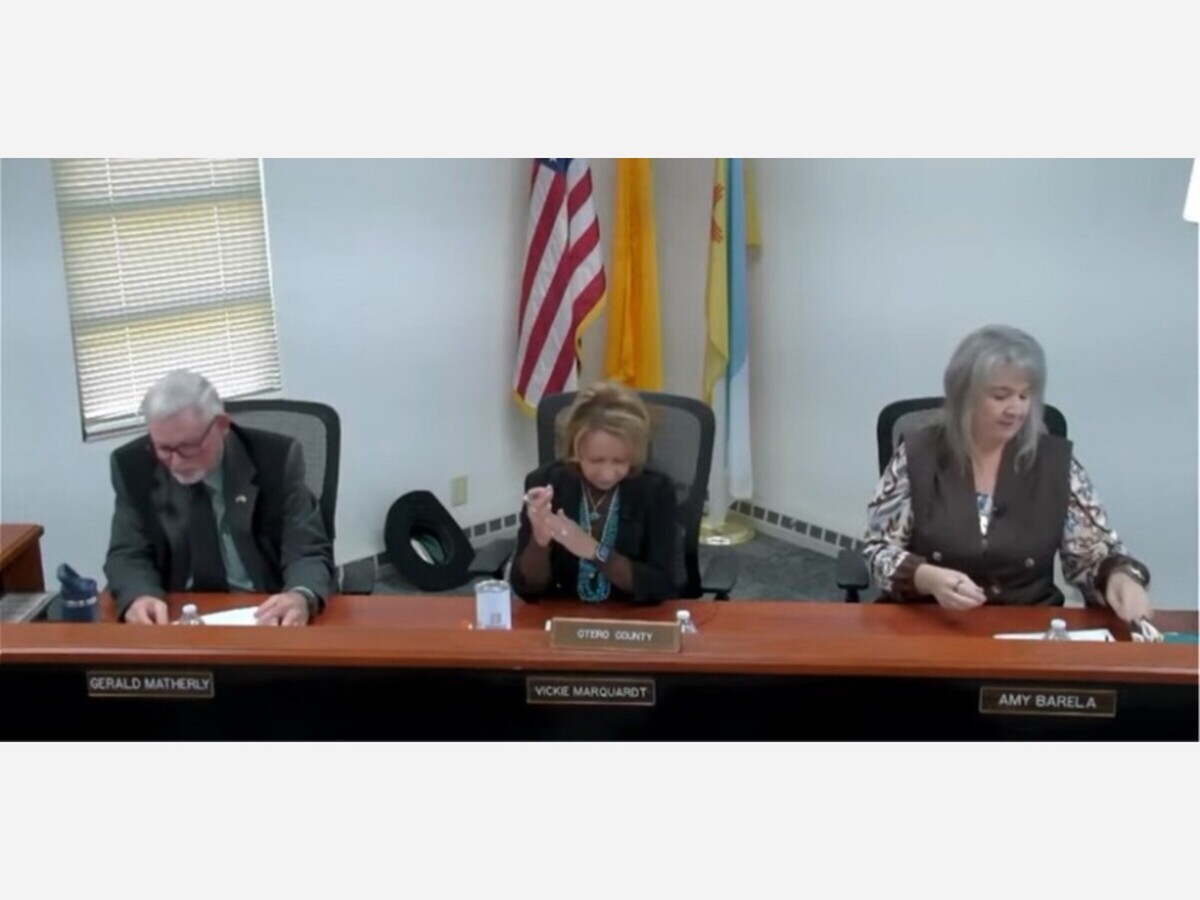



ALAMOGORDO, N.M. — The Otero County Commission on Tuesday, Nov. 10, formally asked the National Science Foundation and the Lincoln National Forest to hold off on tearing down the historic Sacramento Peak Observatory campus at Sunspot. The county wants an independent assessment of which buildings can be saved before any more come down.
The resolution was the centerpiece of a long meeting. Commissioners also certified the 2026 general election canvass, backed a Union Pacific–Norfolk Southern railroad merger with conditions, and approved a regional economic development pact with Lincoln County. They passed a 17-item consent agenda carrying more than $10 million in state infrastructure money.
Chair Vickie Marquardt and Commissioners Gerald Matherly and Amy Barela were all present. The meeting opened with a Veterans Day proclamation honoring the roughly 40 veterans on the county payroll and World War II tank hero Willie E. Estrada, an Otero County native.
Resolution 11-10-26/115-28 asks the NSF and the Forest Service to defer demolition pending a public reuse evaluation. It also requests records on the campus water system and asks that the county be confirmed as a consulting party in the federal historic preservation review. It passed on a motion by Commissioner Matherly.
County Attorney R.B. Nichols said the NSF plans to demolish the campus in phases. A contract has already been awarded to take down the Richard B. Dunn Solar Telescope, where leaking mercury was found earlier this year. A contract for the remaining structures could be awarded anytime between now and March, he said.
Those later phases would take in housing, a dormitory, a community center and a visitor center that drew 12,000 to 15,000 people a year. They would also take in the community water and wastewater system that serves the neighboring Apache Point Observatory and the county's own Sunspot fire station.
Nichols pointed to the NSF's 2019 record of decision, which says buildings or utilities are to be transferred rather than demolished if the Forest Service or another entity identifies a need for them. A 2018 programmatic agreement contemplates the same outcome. "As far as I can tell, that evaluation has not been done," he said.
"Remediation is going to be required, whether the buildings are demolished or preserved," Nichols said. The question, he argued, is whether a building needs "$10,000" of work or is "a $10 million project to save a $500,000 building. We don't know because that detailed assessment has not occurred."
He acknowledged the county is "late to the game." It was not asked to the table, and the issue drew little attention until the mercury leak. But he said New Mexico State University has signaled it would continue research and run the visitor center if an operator can be found for the buildings. NMSU has also obtained quotes for two economic studies on astrotourism potential.
The county has sent the NSF two letters. Nichols said the agency acknowledged them Monday, referred them to its Freedom of Information Act office and classified the county as a "commercial requester." He has written back asking the agency to correct that and to answer the county's request for a pause.
Nichols also raised a federal notice requirement. He said the appropriations act Congress passed in January requires the NSF to notify House and Senate appropriators 30 days before divesting any facility worth more than $2.5 million. The NSF moved ahead with demolition a month after that law took effect and has since obligated at least $13.7 million, he said. He asked the county's congressional delegation to find out whether that notice was given.
Earlier in the meeting, acting Lincoln National Forest Supervisor Cecilia Clavette said the Forest Service shares the goal of preserving Sunspot's history but not its buildings. "We do not believe preserving that history requires preserving the unsafe or deteriorating buildings," she said.
She described an 80-year-old site with asbestos, lead paint and failing utilities, including asbestos water piping underground. Returning the buildings to public use "would require extensive remediation and substantial reinvestment," she said. The current plan grew out of a process that began in 2016 with environmental analysis, historic review and public comment.
Clavette said the agency wants to work with the county on the site's future after cleanup, including a dark-sky recreation area, and on the best path forward for the fire station. Nichols said the Forest Service's vision includes a campground and new visitor center, with most existing buildings removed. Agency officials told him rehabilitation is cost-prohibitive and not in their budget.
Matherly questioned whether demolition is really cheaper. Abatement of asbestos and lead must be paid for either way, he noted, so sealing up some buildings might cost less than tearing them down and hauling debris off the mountain. His top concern, he said, is keeping the water system that is "essential for the mountain community safety."
He also challenged the plan for the Dunn telescope, whose structure extends about 220 feet underground. He said he understood it would be cut down below grade and covered with dirt. That falls short of the full reclamation the Forest Service demands of others, he said, citing the county's old Tully motocross track. "I just want everybody to play by the same rules."
Marquardt said the issue "is just coming to a head now" after years in the works, accelerated by the mercury cleanup. After the vote she told supporters, "We're gonna keep fighting."
Dave Dooling, president of the Sunspot Community Center and the observatory's education officer from 2002 to 2012, said the Dunn's mercury has been removed. It is being held on site in a secure container while the NSF negotiates with the Department of Energy to store it, he said.
His understanding is that the telescope's pieces will be cut away and dropped into the 220-foot pit below, which will then be capped. "There's no contact with an aquifer," he said. He described the $13.7 million as covering assessment, mercury removal and the Dunn's demolition. Later phases could run $15 million to $25 million based on an old NSF estimate adjusted for inflation, he said.
Dooling named three buildings as most worth saving: the visitor center, the Evans Solar Facility and the Hilltop Dome. He said the latter two mainly suffer from peeling paint and could be "mothballed" — an option the NSF itself once considered — until grant money is found. Lead paint and asbestos must be removed before any bulldozing anyway, he noted, "otherwise you turn that stuff into dust" and spread it through the woods.
He said improvements could come in stages and that the community center "could start with dry camping tomorrow if the NSF will let us do it." Sunspot rates a 2 on the 9-point Bortle dark-sky scale, he said: "just about as good as it gets."
Asked whether the county could seek a cease-and-desist order, Dooling said lawyers have told supporters it is hard to direct the federal government on its own property. A cultural heritage lawyer, Ricardo St. Hilaire of New Hampshire, has filed records requests on their behalf, he said. He expects work on the Dunn to start around January, with its contract running through March 23.
Heidi Sanchez, who worked at Sunspot for eight years, spoke remotely after technical trouble. "I'm not saying every building must be saved," she said. "But age alone should not be the justification for demolition. In fact, age is often what makes a place worthy of preservation." She urged a coalition of partners rather than reliance on any single agency. "Once these structures come down, there is no second chance."
Claudia Powell, who spent 10 years with Alamogordo MainStreet, said the architect behind some of Sunspot's 1950s buildings also designed buildings at Los Alamos and the State Capitol Roundhouse. Apart from the science, she said, "this is a really valuable piece of property that we should work really hard to save."
Commissioners certified the canvass of the 2026 general election after a report from County Clerk Selena May. She said 18,158 ballots were cast, for 42% turnout. Same-day registration added 184 voters during early voting and 329 on Election Day.
All polling locations balanced, May said. One provisional ballot was accepted, and 189 ballots were hand-tallied: 80 regular and 109 from military and overseas voters. Ten absentee ballots were rejected — four for missing signatures or Social Security digits, and six with no outer envelope or with the identifying sticker removed.
The one significant problem came in Chaparral, where a polling site ran low on ballot paper. Replacement stock borrowed from Doña Ana County turned out to be 17-inch paper, not Otero's 14-inch, and 26 voters waited about 15 minutes for the right stock. "Longest 15 minutes of my life," May said. Everyone in line got to vote.
May said this was the last election in Room 101 of the county administration building. On Sheriff David Black's advice, the clerk's office will no longer hold early voting there because the building must stay open to the public for long stretches. Officials cited people entering to use the restrooms, including at least one homeless person this cycle. The county is seeking a new early voting site and has until next June to set polling locations.
The consent agenda passed in a single vote. Major items included:
|
Item |
Amount |
|---|---|
|
VitalCore Health Strategies renewal, jail medical and mental health care |
$2,446,919.97 |
|
Colonias infrastructure loan/grant, Bent–Round Mountain Road drainage and roadway |
$5,356,654 |
|
Colonias infrastructure loan/grant, 1.4 miles of La Luz Gate Road reconstruction |
$4,679,173 |
|
State grant, Chaparral Public Safety Facility |
$770,030 |
|
State grant, dump truck |
$473,000 |
|
State grant, dispatch center expansion |
$426,564 |
|
Operation Stonegarden grant management (Laura Garcia) |
$21,915.86 |
The board also endorsed New Mexico Counties' 2027 legislative priorities, November budget adjustments, an FY2027 sick leave buyback and quarterly financial reports. It awarded the state lobbyist contract to DeVore Aragon.
The commission closed with an executive session to discuss litigation and the purchase, acquisition or disposal of real property.



Sunny, with a high of 66 and low of 46 degrees. Sunny for the morning, clear in the afternoon and evening,



Chris, when the heck are you going to see through this regurgitated manure? No educated investors will ever get involved in anything with the corrupt tentacles of layers of incompetent bureaucrats who know nothing about entrepreneurialism. Cut to the chase Amigo and WTFU






just like the old fram oil filter commercials, timberon is experiencing a pay me now - or pay me later revelation. the longer they wait, the more they will pay - at this point receivership looks like the only real option.

Isn't disagreement about ******* legal?
I think it's Rardin, not Riordin