49° and Patchy rain nearby
Image
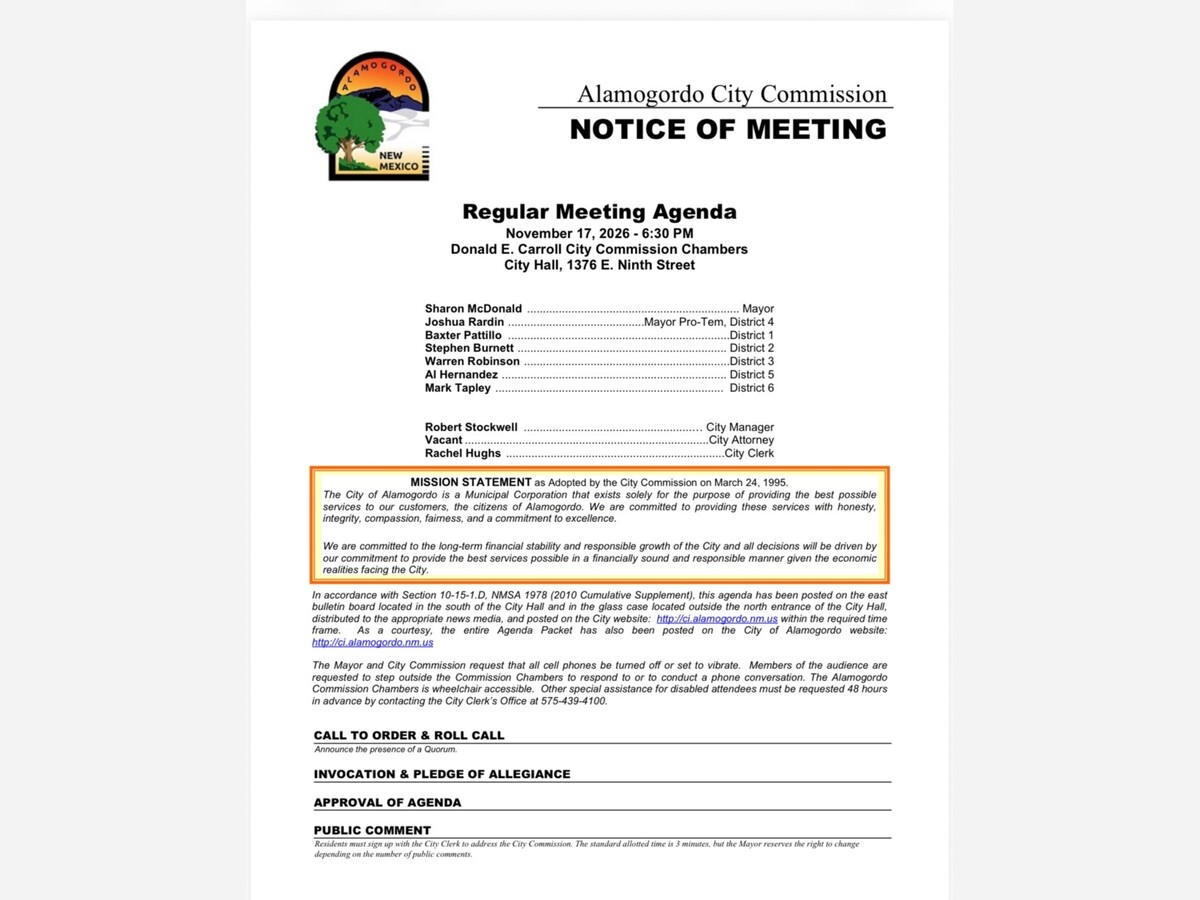



ALAMOGORDO, N.M. — A dispute in interpretation of Charter rules between Mayor Sharon McDonald and City Manager Robert Stockwell will play out on two fronts Tuesday, when the Alamogordo City Commission is set to decide how much control the mayor should have over meeting agendas and, behind closed doors, to consider a complaint involving Stockwell himself.
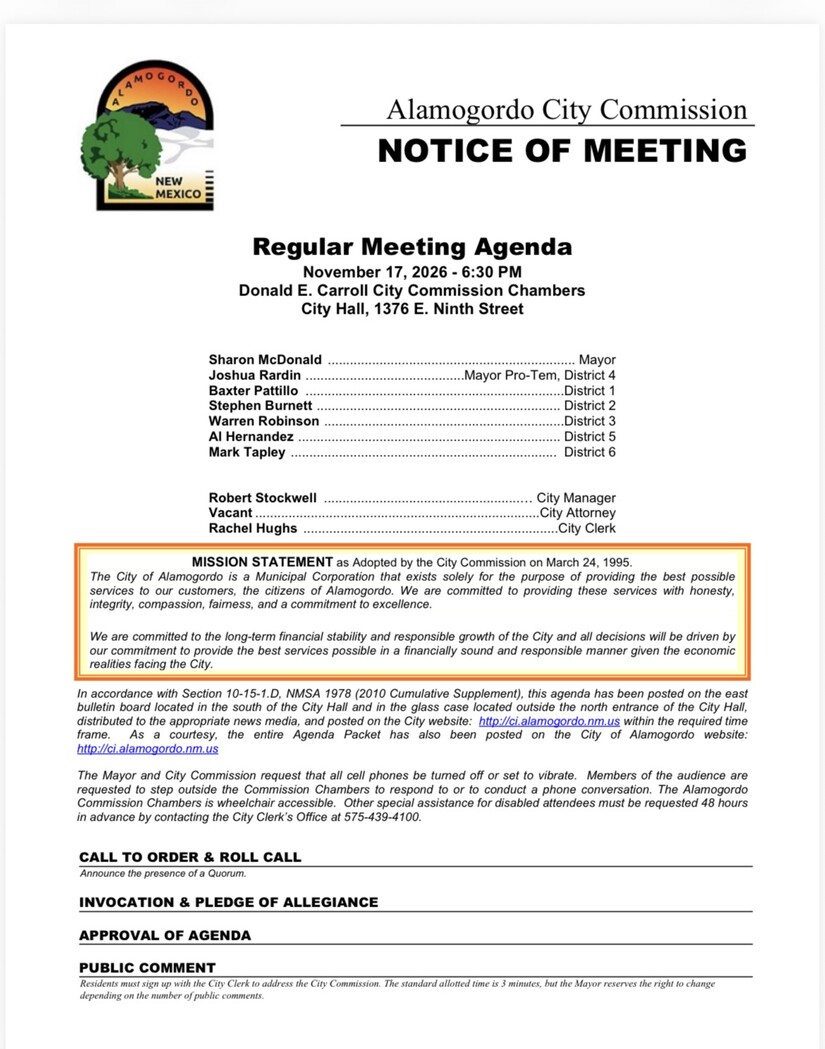
The regular meeting begins at 6:30 p.m. Nov. 17 in the Donald E. Carroll City Commission Chambers at City Hall, 1376 E. Ninth St.
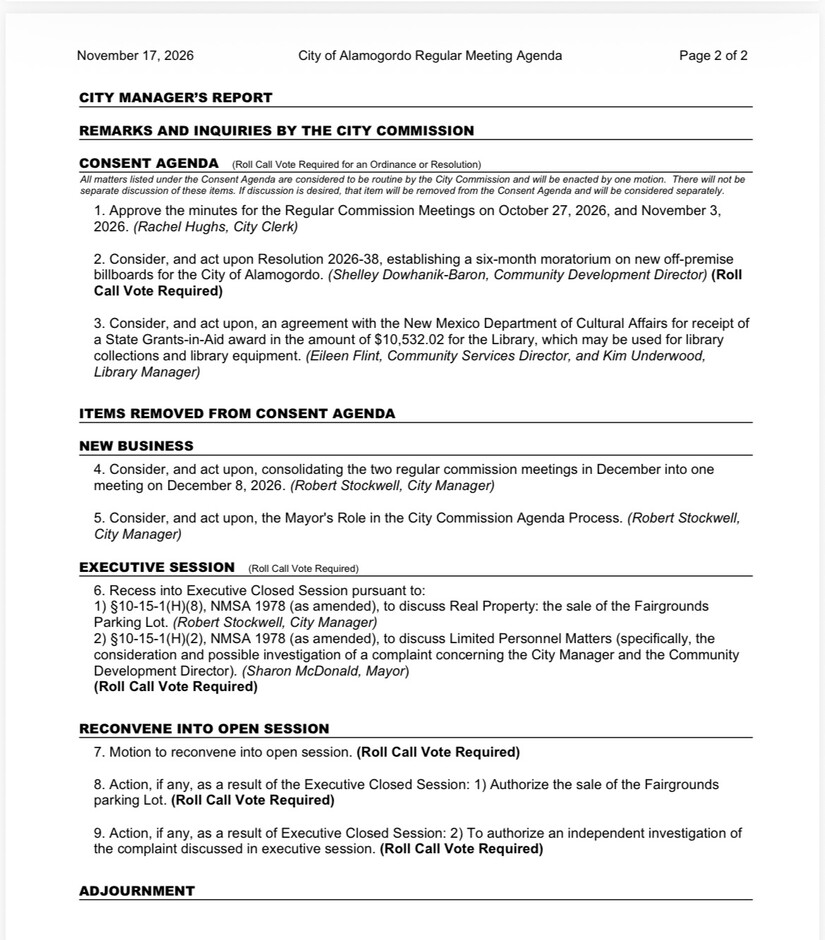
Under an item titled "the Mayor's Role in the City Commission Agenda Process," Stockwell asks commissioners to clarify Rule 5(a) of Resolution 2018-08, which says only that the city clerk "shall consult with the City Manager and the Mayor" when preparing agendas.
According to Stockwell's written report in the agenda packet, McDonald recently emailed him and City Clerk Rachel Hughs saying she would take a more active role in building and finalizing agendas. She asked to receive a preliminary draft of each agenda with enough time to review it and meet with both officials before publication, and to be consulted on any later removal or significant change to agenda items. McDonald wrote that as presiding officer she has "a responsibility to be informed and adequately prepared," according to the report.
Stockwell argues the request adds steps that could delay getting the full packet to commissioners. Agenda items are due at noon the Tuesday before a meeting, he wrote, and building in time for the mayor's review would push that deadline back to the previous Friday. He noted that past mayors have occasionally sat in on agenda review meetings but were never given approval authority, and that the agenda is not formally adopted until the full commission votes on it at the start of each meeting.
Stockwell said he directed the clerk to follow the mayor's process for Tuesday's agenda, and his report lays out how that went: the first draft went to McDonald at 10:18 a.m. on a Tuesday, revisions followed at 3:04 p.m., and a reminder that staff were awaiting her approval went out at 4:45 p.m. McDonald gave her approval at 4:54 a.m. the next day, the report says. Stockwell added that an error was later found in identifying which department director the mayor wanted investigated, requiring yet another review before the agenda could be finalized.
"If the City Commission feels the request of the Mayor to enlarge her role in the agenda process is appropriate, then Rule 5(a) should be amended to clarify the process," Stockwell wrote.
Stockwell's report quotes from McDonald's email but does not include it. The full text of the email, addressed to Stockwell and City Clerk Rachel Hughs, reads:
City Manager Stockwell and City Clerk Hughs,
I am requesting that, effective immediately, I be included in the review of all City Commission agendas before they are finalized and published.
Under Resolution No. 2018-08, Rule 5(a), the City Clerk is required to consult with both the City Manager and the Mayor in preparing the agenda. Additionally, Rule 5(c) establishes that any Commission member may direct that matters within the Commission's jurisdiction be placed on the agenda.
As Mayor and presiding officer of the City Commission meetings I have a responsibility to be informed and adequately prepared for the business coming before the governing body. Meaningful participation in the agenda preparation process allows me to fulfill that responsibility, identify potential concerns, and ensure that matters requiring Commission consideration are appropriately presented.
While I recognize your respective administrative responsibilities, the agenda serves the governing body, and my involvement should occur before it is finalized.
Moving forward, I would like to receive a preliminary draft of each agenda with sufficient time to review it and meet with both of you before publication. I also expect to be consulted regarding any proposed removal or significant modification of agenda items following our review meeting.
This is not about interfering with administrative responsibilities. It is about ensuring that the Mayor's responsibilities and the procedures established by the City Commission are respected.
Please confirm that this review process will be incorporated into the preparation of future Commission agendas.
Thank you,
Mayor Sharon McDonald, City of Alamogordo
The email asks for review before publication and consultation on later changes. It does not claim authority to approve or veto agenda items. Stockwell's report contrasts the request with past mayors, who he says did their jobs "without asserting a role of approving drafts and the final submission" of the agenda.
Alamogordo has a commission-manager form of government: an elected commission sets policy and hires a manager to run the city day to day.
State law. Under NMSA 1978 Section 3-14-10, the mayor "shall preside at all meetings of the commission and perform other duties, consistent with his/her office, as imposed by the commission," and holds all the powers of a commissioner, including a vote on every question. Section 3-14-12 vests the city's governing powers in the commission as a body, and Sections 3-14-13 and 3-14-14 give daily administration to the manager. The law gives the mayor no administrative authority of her own, but leaves the commission free to assign her additional duties.
The city charter. Article VIII, Section 2 of the Alamogordo City Charter makes the mayor the presiding officer of commission meetings and the representative and voice of the city.
The commission's own rules. Resolution 2018-08 sets the commission's meeting procedures. Rule 5(a) states that "the City Clerk shall consult with the City Manager and the Mayor" in preparing the agenda. The consultation is required, but the rule does not say when it must happen, what form it takes, or whether the mayor may approve, change or hold back items.
Past practice. Stockwell's report acknowledges that mayors have "on occasion" attended agenda review meetings with the manager and clerk, though he says those meetings never gave a mayor approval authority. McDonald has said pre-publication agenda meetings were routine under her three predecessors — Susie Galea, Richard Boss and Susan Payne — and that she is asking to restore that practice, not create a new one.
Former Mayor Susan Payne confirms McDonald’s assessment and disputes Stockwell’s assertion as an attempt to undermine over two decades of precedent.
What commissioners must decide. The dispute comes down to what "consult" means. Read narrowly, as Stockwell reads it, the requirement is met by the existing manager-clerk review, with the agenda finalized when the full commission votes on it at the start of each meeting. Read broadly, it calls for the mayor's input while the agenda is still being drafted. Because state law lets the commission define the mayor's additional duties, commissioners can settle the question by leaving Rule 5(a) as written or by amending it to spell out the process — the option Stockwell's report raises.
Public comment is encouraged as the mayor is the only at large publicly elected official on the commission to represent the public at large.
Later in the meeting, the commission is scheduled to recess into executive session to discuss "the consideration and possible investigation of a complaint concerning the City Manager and the Community Development Director," an item placed on the agenda by McDonald. Shelley Dowhanik-Baron is the city's community development director.
The agenda lists a possible follow-up vote in open session to authorize an independent investigation of the complaint. The packet does not say who filed the complaint or what it alleges, and no supporting documents were included.
The city has no city attorney; the position is listed as vacant on the agenda. Resolutions in the packet are signed "approved as to form" by Stockwell.
Personnel issues in the Community Development Department have surfaced at recent meetings. During public comment on Oct. 27, former employee Justen Boyle told commissioners he believed his firing was retaliation for raising ADA-compliance and ordinance concerns with human resources, and that his grievance hearing was canceled with less than 24 hours' notice, according to draft minutes. At the same meeting, commissioners voted 7-0 after a closed session to have HR Director Michelle Osborne hire an independent reviewer for a separate personnel matter involving the city's senior project manager, with a deadline of Nov. 17. The agenda does not indicate whether either matter is connected to the new complaint.
Commissioners will also meet privately to discuss real property — specifically the sale of the Fairgrounds parking lot — with a possible vote afterward to authorize the sale. The packet does not name a buyer or a price.
On the consent agenda, Resolution 2026-38 would impose a six-month moratorium on new off-premise billboards, including new electronic billboards and conversions of existing billboards to electronic displays.
It would be the city's seventh such moratorium since 2018. The most recent one expired June 2, 2026. The resolution says billboards "can significantly detract" from the city's goals for aesthetics and image, and that the pause is meant to hold while the city updates its code of ordinances, including its sign rules. It covers elevated off-premise signs at least 4 feet off the ground with a face of 100 square feet or more.
Residents who want to speak during public comment must sign up with the city clerk; the standard time limit is three minutes. The full agenda packet is posted on the city's website. People needing disability accommodations should contact the City Clerk's Office at 575-439-4100 at least 48 hours in advance.
Sources: IPRA and City of Alamogordo Regular Meeting Agenda Book, Nov. 17, 2026, including agenda reports and draft minutes of the Oct. 27 and Nov. 3, 2026, meetings; Alamogordo City Charter; Resolution 2018-08; NMSA 1978, Sections 3-14-10 through 3-14-14.



Patchy rain nearby, with a high of 59 and low of 48 degrees. Patchy rain nearby for the morning, light rain shower in the afternoon, patchy rain nearby for the evening,






Chris, when the heck are you going to see through this regurgitated manure? No educated investors will ever get involved in anything with the corrupt tentacles of layers of incompetent bureaucrats who know nothing about entrepreneurialism. Cut to the chase Amigo and WTFU