
Image
Federal Roadblocks and One Lawmaker's Shameful Attack: New Mexico Epstein Commission Faces Dual Resistance - AlamogordoTownNews.org



When the New Mexico Survivors' Truth Commission released its interim report on August 5, 2026—phase one of its investigation into Jeffrey Epstein's crimes at Zorro Ranch—two forms of obstruction became starkly apparent: political sabotage from within New Mexico, and systematic non-compliance from the federal government.
Truth Commission Interim Report
https://static1.squarespace.com/static/6a07526f760116498ce6b908/t/6a73873d602963594874bfaa/1785956157891/Interim+Report_Final+Draft_v5.pdf
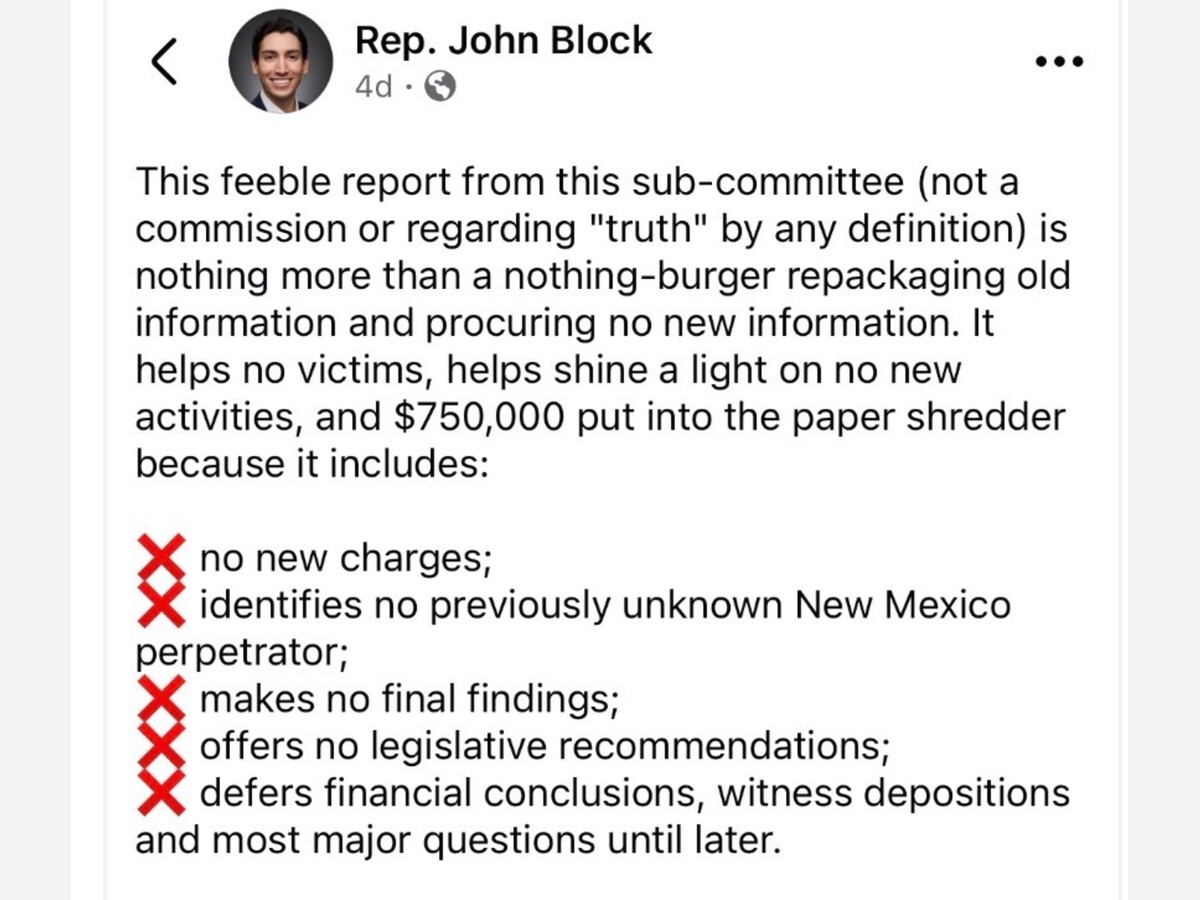
Rep. John Block, a Republican, wasted no time condemning the work. He called the interim report "feeble," a "nothing-burger," and declared it "helps no victims." He criticized the $750,000 investment as "put into the paper shredder" and cynically asked: "Did we ever think they would hold anyone accountable? I hoped so, but now we have our answer: Nope."
Block's attack studiously avoided mentioning survivors—the women and girls groomed, trafficked, and abused at Zorro Ranch. His criticism was purely fiscal and dismissive, devoid of empathy for victims whose lives were destroyed.
But Block's obstructionism pales beside the federal government's systematic refusal to provide the truth.
The Real Blockade: Federal Agencies Deny Access to Evidence
The interim report was never intended to be final. It is foundational work: organizing 3.5 million pages of documents, issuing subpoenas, identifying witnesses, and establishing investigative procedures. The final report is due December 31, 2026, with extensive depositions and legislative recommendations to follow.
Yet the Commission faces a wall of federal resistance that mirrors the very institutional failures it is investigating.
Of 20 subpoenas issued, only 10 received full compliance. Multiple federal agencies either refused to comply or ignored the Commission's requests entirely:
The U.S. Attorney's Office for the Southern District of New York (SDNY), which prosecuted the federal case against Epstein, refused to comply
The U.S. Attorney's Office for the Southern District of Florida rejected compliance
The Federal Bureau of Investigation has not responded
The Federal Aviation Administration has not responded
JPMorgan Chase, which processed millions in transfers for Epstein, has not responded
U.S. Attorneys' offices in Michigan, South Carolina, and the U.S. Virgin Islands have ignored the Commission's subpoenas
The Epstein Files Transparency Act released 3.5 million of an estimated 6 million pages of documents—but with inconsistent and opaque redactions that obscure critical information. Epstein's emails span only 2009-2019, leaving the 1990s and early 2000s—critical years of his New Mexico operations—undocumented and beyond reach.
This is not accident. This is systematic obstruction by the federal government itself—the very institutions that failed to investigate Epstein's crimes in New Mexico for over three decades.
Block's Constituents Reject His Callousness
The response to Block's attack was swift and unforgiving. One constituent, using the handle "Blockhead," reminded him that the Truth Commission is bipartisan, with "2 of your Republican colleagues" serving—"a former District Attorney & a retired FBI agent" who are "highly respected...not just within RPNM, but across the aisle." The commenter concluded: "You should be ashamed of yourself—just for being you. Stop whining & actually work on something constructive. And support your colleagues."
Another constituent was blunt: "Quit trying to cover for pedophiles."
A third: "What a disgusting representative he is truly deplorable."
Block's position isolated him even within his own party. While 61 of his colleagues, including respected Republicans on the commission, recognize the vital importance of seeking truth, Block prioritized budget criticism over survivors' need for answers.
Institutional Failures Repeated: Federal Obstruction Continues
The obstruction the Commission now faces from federal agencies is itself evidence of the very institutional failures the investigation seeks to document and that Block should be using his position and working to address. The U.S. Attorney for the District of New Mexico (USAO-NM) and the New Mexico Attorney General assumed for years that SDNY would investigate Epstein's New Mexico activities. SDNY never did, focusing instead on crimes in New York, Palm Beach, and the Virgin Islands.
No criminal investigation into Epstein's sex trafficking enterprise in New Mexico was ever opened by federal or state authorities. No search warrants were executed at Zorro Ranch until March 2026—nearly seven years after Epstein's death in August 2019.
Now, when the Truth Commission seeks to finally fill that void, those same federal agencies are refusing to cooperate.
SDNY's refusal to comply with a state subpoena is particularly troubling: they led the federal prosecution of Epstein but apparently have no interest in New Mexico's pursuit of the truth.
A Bipartisan Commission Stands Firm Despite Obstruction
The Truth Commission was established unanimously by House Resolution 1 (HR-1) on February 16, 2026, by a 62-0 vote. This bipartisan support—from both Republican and Democratic lawmakers—reflects a shared commitment that survivors deserve answers and the public deserves to know what happened in their state.
Yet this consensus does not extend to all. Block's criticism, combined with federal non-compliance, represents a coordinated resistance to transparency and accountability.
The message sent is clear: the institutions and elected representatives that failes survivors once are not eager to have that failure documented nor are they outwardly pushing and using their influence to find answers for the victims with empathy and compassion.
The 7,600-acre Zorro Ranch near Stanley, purchased by Epstein from Governor Bruce King in 1993, became the focal point of what should have been a straightforward investigation. Instead, it has become a window into how institutional obstruction, budget cynicism, and bureaucratic indifference continue to protect secrets at the expense of victims.
What the Interim Report Reveals—And What Remains Blocked
Despite the roadblocks, the interim report documents troubling evidence:
Evidence of abuse occurring at Zorro Ranch beginning at least in 1996. A minor was flown to the ranch at age 15 and sexually molested. Another victim reported being trafficked to the ranch multiple times between 2007 and 2010.
A sophisticated operation supported by multiple enablers: Ghislaine Maxwell, who recruited and groomed victims; Sarah Kellen, who arranged logistics; Brice and Karen Gordon, who managed operations; and numerous employees and contractors who facilitated the enterprise.
Federal and state law enforcement failures spanning three decades. The New Mexico AG opened a criminal review in May 2019 but deferred it to SDNY by July, where it died.
Yet critical evidence remains inaccessible. Banks won't provide full financial records. Federal prosecutors won't release case files. Agencies refuse to respond to subpoenas. Email records exist only from 2009 onward. Half of the estimated 6 million pages of documents remain withheld.
The Final Report Will Tell What Federal Agencies Won't
The Commission's work continues. By December 31, 2026, extensive witness depositions will be conducted. The evidentiary record will be analyzed comprehensively. Institutional failures will be documented. Legislative recommendations will be made.
But this investigation will proceed despite federal obstruction, not because of federal cooperation. Survivors deserve better. The public deserves better.
Rep. Block was wrong and provided an insensitive statement not showing true empathy for the victims: the interim report already helps victims by documenting what happened and establishing that someone in government still believes survivors deserve answers, even if federal agencies have made clear they do not.
The New Mexico Survivors' Truth Commission's full interim report is available at www.nmtruthcommission.com. The Commission continues to seek federal compliance with its subpoenas and welcomes information from survivors and witnesses.
SOURCES & TRANSPARENCY
This article is based on the following documented sources:
- New Mexico Survivors' Truth Commission Interim Report (released August 5, 2026)
- Rep. John Block's official social media statements (public posts)
- Public responses to Rep. Block's posts from constituents
- New Mexico House Resolution 1 and legislative voting record
- Subpoena compliance data from the Truth Commission
All direct quotations are verbatim from these official sources. The
characterization of Block's position as lacking empathy for survivors
represents editorial commentary based on his public statements, which
notably omit any reference to survivors' needs or experiences.

block is JAR - just another republican - co-operating to "block" the evidence that their dear leader was involved in plenty of the nastiest of the epstein shenanigans. i can only hope that the survivors, and the public, live long enough for the truth to be revealed.
Is that kinda like being a RINO?



Sunny, with a high of 79 and low of 61 degrees. Sunny during the morning, clear in the afternoon and evening,


as per occam's razor, the simplest explanation for stonewalling a request this basic and straight forward, is that transparency will cast a bad light on lincoln county, and/or the entity they pay to run their jail.

like 99% of his fellow republicans, block is a servant to the oil & gas industry - a principal constituent of their party.

Just thought the one thing all these first-timers have in common is no qualifications. Wanting to serve, help, or partake isn't enough. None of these people have any professional experience. Where are the engineers, CPA's, Ph.D's?
Business owners, a practicing attorney, one with a PHD, seems to me you didn't review the video.
Sounds like the author is a gordito themself.