
 67° and Cloudy
Image
Timberon Water District Calls an Open Records Request a ‘Scheme’ — Then Won’t Say When It’ll Comply - 2nd Life Media Alamogordo Town News



Timberon, N.M. — “I have other work to do than play street lawyer with you.” That is how Leo McAtee, the records custodian for Timberon Water and Sanitation District, characterized his exchange with this newspaper this week over a routine public records request — one seeking basic documentation on the district’s golf course lease and its ongoing boil-water advisories. In the same exchange, McAtee stood by his earlier description of the request as a “scheme,” told this reporter he should have “been a responsible adult,” and said he saw “no requirement to trickle you out bits and parts of data.”
The exchange comes as this newspaper continues reporting on the district's finances and governance, and it raises a question distinct from tone: whether the request, and the district’s response to it, are being handled the way New Mexico’s public records law actually requires.
The request, filed July 9 under the New Mexico Inspection of Public Records Act (IPRA), sought ten categories of records: the 2025 commercial lease between TWSD and Discover Timberon Incorporated (DTI); board minutes, staff reports, and appraisals related to that lease; records on whether the lease was competitively bid; conflict-of-interest disclosures; insurance certificates required under the lease; septic-maintenance records; TWSD budgets and audits for 2023 through 2025; boil-water advisories and related correspondence with the New Mexico Environment Department; and records concerning the water transfer pump at the center of the district’s current outage.
A timely extension, an untimely tone
TWSD responded July 13, within the three-business-day window IPRA allows. The response invoked NMSA 1978 § 14-2-10, which states in full: “If a custodian determines that a written request is excessively burdensome or broad, an additional reasonable period of time shall be allowed to comply with the request. The custodian shall provide written notification to the requester within fifteen days of receipt of the request that additional time will be needed to respond to the written request.” On initial response timing, the District complied. But the statute asks a custodian to make a determination about the records requested — not simply to react to how the request is worded.
“When language such as ‘ALL’ ‘ANY’ ‘OR ANY RELATED’ AND multiple bullet point lines are included in any one IPRA request you in essence make at an assembly of multiple IPRA(S) with an unreasonable and burdensome process,” wrote Leo McAtee, identified in the letter as the official responsible for the request. The letter stated the request would be “recommend[ed]” to the District’s attorneys and, in an attached exhibit, reproduced the request’s ten items with the words “all” and “any” underlined in red.
That objection runs into a separate part of IPRA. Under § 14-2-8(C), a requester only has to describe records with “reasonable particularity” — enough for the custodian to identify and locate them, not word-for-word precision — and each of the ten items here names a specific lease, a specific date range, or a specific party. The words “all” and “any,” bounded by that kind of specificity, are standard IPRA drafting; this is not the open-ended, unlocatable request the particularity requirement is meant to screen out.
Applied item by item, the picture is uneven, not uniform — which matters, because § 14-2-10 asks a custodian to make that kind of determination, not a blanket one. Item 1 (the named May 5, 2025 lease and its addendum), Item 5 (conflict-of-interest records tied to two named DTI officers), Item 6 (insurance certificates tied to two specific lease sections), and Item 10 (records about one named water-transfer pump) describe single documents or narrowly bounded categories that should already exist in identifiable files. Item 2 (board minutes and recordings spanning January 2024 to the present across three related topics), Item 3 (staff reports and appraisals with no defined date range), Item 8 (three fiscal years of budgets and audits), and Item 9 (boil-water communications and NMED correspondence since January 2026) are genuinely broader in scope. Treating all ten as equally burdensome, as McAtee’s letter does, elides a distinction the statute itself asks the custodian to draw.
Alamogordo Town News replied the same day, not disputing the timeliness of the extension but asking the District to identify, item by item, which of the ten categories it considered burdensome and why — consistent with a determination that is supposed to attach to specific records, not to a request treated as a single undifferentiated block. The reply also asked for a specific anticipated production date rather than an open-ended extension, and for rolling production of the items — including the named lease, its addendum, and related insurance certificates — that do not appear to require an extended search.
“You’ve left me no recourse”
McAtee’s written response later that day still did not say when records would actually arrive. It read, in part: “I can not get all you want done in any timely manner and since you want ten bullet points worth of any and all this and that, you’ve left me no recourse. I see no requirement to trickle you out bits and parts of data anywhere in the IPRA manual or pander to you as I accumulate all the data you request. Perhaps you should have been a responsible adult and filed smaller chunks at a time?”
That refusal cuts against how New Mexico’s courts have read the extension itself. In Britton v. Office of the Attorney General, 2019-NMCA-002, the Court of Appeals held that by letting custodians take extra time specifically “to comply” with a burdensome request, the Legislature foreclosed any defense that a public body simply couldn’t fully respond — the extra time exists to make a complete response possible, not to justify withholding records indefinitely, including ones that are easy to locate.
McAtee’s specific suggestion — that a “responsible adult” would have filed the request “in smaller chunks” — has no basis in the statute either. IPRA does not limit a requester to one record per submission, and its declared purpose runs the other way: NMSA 1978 § 14-2-1 grants “every person” a right to inspect public records, and § 14-2-5 states that persons are entitled to “the greatest possible information regarding the affairs of government.” New Mexico courts, including Britton, have read those provisions to mean IPRA is construed to maximize disclosure, not to reward whichever framing is most convenient for the custodian to process.
Splitting one request about a single lease and a single ongoing water crisis into ten separate submissions would not change what TWSD ultimately has to produce — it would only multiply the number of extension letters required to say so.
On the earlier “scheme” characterization, McAtee wrote that he stood by it, adding that he considered it “the most accurate and civil” description available to him.
Alamogordo Town News sent a second written reply reiterating the request for a firm completion date and for clarification of a separate line in McAtee’s letter suggesting records would be provided electronically “instead of having to make copies and bill you in advance.”
That line runs into § 14-2-9, which governs fees directly. A custodian may charge only a reasonable fee for copies — not to exceed $1 per page for records 11-by-17 inches or smaller — and for electronic records, only the actual cost of downloading or transmitting them, not a separate charge for the convenience of an electronic format. If TWSD intends to waive fees for electronic delivery, § 14-2-9 already permits that. If it intends to charge for electronic copies, the fee has to reflect actual transmission cost, not an advance-payment requirement layered on top of a format decision. McAtee's letter reads as if it could mean either. Alamogordo Town News asked him to say which; as of publication, he has not.
That Alamogordo Town News reply also noted that the New Mexico Department of Justice’s own IPRA Compliance Guide instructs records custodians that “requests should not be viewed... as a burden or adversarial” and that custodians should attend to “the tone and quality of their communication with requesters, who are exercising one of their many legal rights to participate in our democracy.”
As of publication, the District has not responded further, has not set a completion date, and has not produced any records. That silence has a statutory clock attached to it. Under NMSA 1978 § 14-2-11, a request not permitted within fifteen days is “deemed denied” — unless it has been determined excessively burdensome or broad, which TWSD did here, in writing.
That determination takes the fifteen-day clock off the table on its own. It does not, however, make the extension open-ended: the New Mexico Court of Appeals held in Henry v. New Mexico Livestock Board, No. A-1-CA-40127 (N.M. Ct. App. Mar. 6, 2024) — an unpublished memorandum opinion, and persuasive authority on how the court reads the statute — that a public body cannot invoke the burdensome exception retroactively; where no such determination is made and communicated at the time, the fifteen-day clock controls regardless of what the agency argues later. TWSD’s notice came in writing and on time, but courts can still test whether an extension has stopped being “reasonable” the longer it runs with no records and no date.
If this were to reach a courtroom, the stakes shift further. NMSA 1978 § 14-2-12, IPRA’s enforcement provision, requires — not merely permits — a court to award damages, costs, and reasonable attorney’s fees to a requester who succeeds, and New Mexico courts have read “successful” broadly: in ACLU of New Mexico v. Duran, 2016-NMCA-063, the Court of Appeals upheld a fee award even though the requester only obtained the records after suing. Separately, Faber v. King, 2015-NMSC-015, is why the procedural path matters: it distinguishes the remedies available for non-response under § 14-2-11 from those for wrongful denial under § 14-2-12, and the two carry different available damages — § 14-2-11 permits statutory per-day damages that § 14-2-12 does not.
ANALYSIS: Where the Exception Has Backfired Before in New Mexico
TWSD is far from the first New Mexico public body to invoke § 14-2-10, and the specific gaps raised above — no item-specific finding, no date, no follow-through — are exactly where the exception has gone wrong elsewhere.
In Santa Fe, the city in 2024 declared a resident’s records request “excessively burdensome and broad” thirteen days after it was filed, telling the requester it would need a full month to respond. Within two hours of sending that notice, the city closed the request outright, claiming no responsive records existed — only reopening the search, and resuming its work, after a reporter asked city officials to account for the discrepancy, according to the Santa Fe New Mexican. The episode illustrates how a burdensome designation issued without a documented, item-specific basis can collapse the moment it draws outside scrutiny.
In Las Cruces, a requester named Hays sued the city after it cited the excessively-burdensome-or-broad exception while withholding and heavily redacting records — including broad, undifferentiated attorney-client-privilege claims across multiple pages — without the statutorily required explanations. The city eventually paid penalties and voluntarily released the improperly withheld material, later acknowledging in a statement that a subset of documents was “arguably overly redacted.” The requester's attorney, Peter Goodman, said the litigation cost the city more than compliance would have, according to the Las Cruces Bulletin.
In Albuquerque, the Southwest Public Policy Institute sued the city and City Clerk Ethan Watson in 2024, alleging the city had for years cited the request being “excessively burdensome” to withhold access to its own internal database tracking IPRA requests. The lawsuit goes further than a timing dispute, alleging certain requesters were being “unfairly targeted for unreasonable or malicious delay or denial” — in other words, that the burdensome label was applied to the requester rather than to any genuine difficulty in producing the records.
None of these cases mirrors TWSD's situation exactly — the District's initial extension notice, unlike Santa Fe's, was itself timely, and no lawsuit has been filed here yet. The common thread across all three is what happened after the burdensome designation was issued: whether the public body followed through with a genuine, item-specific accounting and a defined endpoint, or instead treated the label as a door closing. That is the question this newspaper will keep tracking as this dispute develops.
Primary sources for this analysis
Britton v. Office of the Attorney General, 2019-NMCA-002 (published opinion): caselaw.findlaw.com/court/nm-court-of-appeals/1953720.html. Henry v. New Mexico Livestock Board, No. A-1-CA-40127 (unpublished memorandum opinion, March 6, 2024): coa.nmcourts.gov/wp-content/uploads/sites/43/2024/03/March-6-2024-Nancy-Henry-v.-New-Mexico-Livestock-Board-No.-A-1-CA-40127.pdf. Faber v. King, 2013-NMCA-080 (Court of Appeals opinion, reversed in part on the damages question by the controlling 2015-NMSC-015, which was not located at a free public link at the time of this writing): casemine.com/judgement/us/5914e5d4add7b0493490906f. ACLU of New Mexico v. Duran, 2016-NMCA-063, was likewise not located at a free public link; readers with access to the New Mexico Compilation Commission's database (nmonesource.com) or a legal research service can pull it directly by citation.
The backdrop
The records request was filed the evening of July 9, hours after Alamogordo Town News published “Boiling Water, Empty Taps, and an Unreported Violation — While Timberon's Water District Gave Away Its Golf Course for $1 a Month,” which examined TWSD’s finances, its aging distribution system, the unreported NMED violation, and the board’s April 8, 2025 decision to lease the district-owned golf course and lounge to Discover Timberon Incorporated for $1 a month without a documented appraisal or competitive bid. A follow-up story, “Timberon’s Water Crisis: A Clean Sample, a Month Without Reliable Service, and a Hidden Violation,” ran July 11, two days before the District’s extension notice. Whether that timing reflects anything more than coincidence is a question this newspaper cannot answer on the current record — but it is one the record itself invites.
Leo McAtee and the TWSD Board are welcome to provide comment or a fuller account of the District’s records-production timeline for the record. Correspondence can be sent to ChrisEdwards@KALHRadio.org.
Sourcing: IPRA request dated July 9, 2026; TWSD extension notice and Exhibit A, July 13, 2026; TWSD records custodian correspondence, July 13, 2026; Alamogordo Town News correspondence, July 13, 2026 (two letters); New Mexico Inspection of Public Records Act, NMSA 1978 §§ 14-2-1, 14-2-5, 14-2-8, 14-2-9, 14-2-10, 14-2-11, 14-2-12; NMDOJ IPRA Compliance Guide. Case citations and links appear under “Primary sources for this analysis,” above. Additional reporting: Santa Fe New Mexican, “City struggles to ‘manage the volume’ of records requests”; Las Cruces Bulletin, “City pays penalties in public records lawsuit”; Cibola Citizen, reporting on Southwest Public Policy Institute v. City of Albuquerque.

Wonder what their commissioner is doing about this?
Wonder if you track who the owners of DTI are you’ll see some familiar names…


Sunny, with a high of 75 and low of 55 degrees. Sunny in the morning, cloudy for the afternoon and evening, clear overnight.



Writing up the incompetence is transparency. Here's how a real professional does it --
I applied for a water job three months ago, and as I was leaving the building, some lady walking next to me said: "You'll never get in because you're not one of them Alamo-Gorditas." I thought everyone in City Hall is 50 pounds overweight, has a terrible haircut, and wears awfully dirty old clothes.




thank you once again, for fighting for access to public records in this and many other situations - democracy truly dies in darkness.
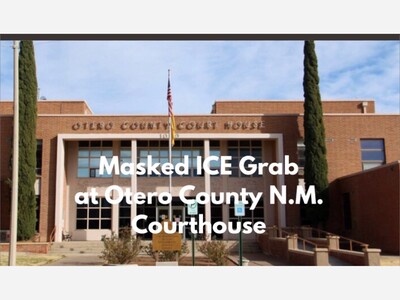
i would not be surprised to learn the capture was not coordinated with any local LEO - that would be consistent with recent history of ICE. it will be instructive to see if the sheriff's department/county administration choses to respond to a request for a clarifying statement.