Image
Pattern of Suppression: How New Mexico Government Officials Are Using Courts to Silence Citizens—and Losing - AlamogordoTownNews.org



From Santa Fe to Lea and Eddy Counties, Citizens Are Fighting Back Against Unconstitutional Restraints on Free Speech and IPRA Violations
Across the state, a clear pattern emerges: Government officials are threatening to weaponize the courts to silence criticism and block public records. But citizens and courts are fighting back and winning at every turn. Government officials be on notice.
When a County Director Files a Restraining Order Against a Critic
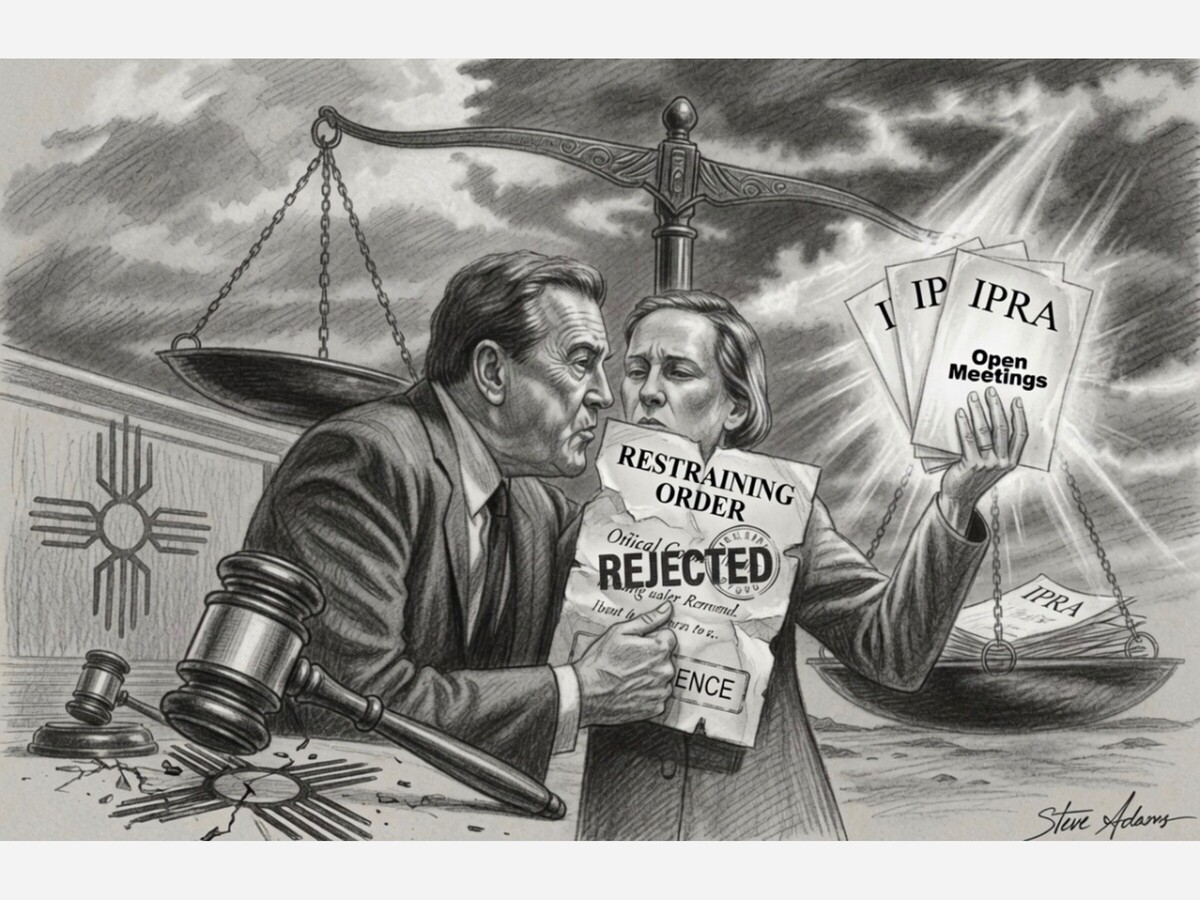
On July 24, 2026, Judge Kathleen McGarry Ellenwood made a stark ruling: A Rio Arriba County Health and Human Services Director's attempt to silence a citizen through a restraining order was unconstitutional.
Ahmed Dadzie had filed suit against Cynthia Lentini for posting criticism of his official conduct on social media. Lentini, a community activist and Facebook group administrator, had commented publicly about how Dadzie ran his department. Dadzie wanted to silence her.
The judge was unequivocal: The restraining order "constitutes a prior restraint of speech in violation of the First Amendment to the United States Constitution and Article II, Section 17 of the New Mexico Constitution."
As a public official, Dadzie bore a higher burden of proof. He failed to meet it. The evidence was "speculative, and much of it is not tied to Mr. Dadzie." The court determined that "Ms. Lentini was [not] responsible for actionable content regarding Mr. Dadzie."
But the cost to Lentini was already paid: thousands of dollars in legal fees, weeks of her life, defending constitutional rights that should never have been questioned. She filed a formal complaint with Rio Arriba County Manager Jeremy G. Maestas: "If a county employee can file an unconstitutional restraining order against a citizen for speaking about matters of public concern, then every resident should be concerned."
Maestas announced an independent investigation into Dadzie. The message was delivered: Use the courts to suppress criticism and you face investigation—and potentially your job.
The Pattern Escalates: Eddy County and the IPRA Battle
In Eddy County, the conflict reveals how government resistance to transparency cascades into years of expensive litigation.
Jason Sanchez, an Eddy County resident, filed IPRA requests seeking personnel files for deputies Jared Rostro and Eric Threlkeld. Sanchez believed the officers had mishandled his domestic custody case. The county released the files in response to his IPRA request.
Sanchez then posted screenshots of those personnel documents on Facebook under "Eddy County Wall of Shame," arguing they demonstrated a pattern of officer misconduct. He used the information to support his own lawsuit against the deputies for wrongful prosecution.
The deputies responded in January 2024 by suing both Eddy County and Sanchez in federal court, alleging wrongful disclosure under IPRA and invasion of privacy. Their attorney argued that "the county disclosed more than what was allowable" under IPRA's exemptions for personnel records.
Sanchez's defense raised the opposite concern: that law enforcement was attempting to silence him for publicizing potential misconduct. "Mr. Sanchez proceeded to post these matters of high public interest and concern to Facebook," his attorney wrote in a motion to dismiss.
A federal judge partially denied the deputies' motion to dismiss in April 2024, allowing Sanchez's underlying wrongful prosecution case to proceed. The litigation continues—years of expensive federal court battles in disputes that reveal a fundamental tension: IPRA mandates broad public access to government records, yet agencies resist disclosure by claiming exemptions. Citizens obtain records and publicize them. Officials sue. Years pass. Taxpayers pay.
The pattern is not accidental. It's designed to make transparency costly and painful.
The Statewide Squeeze: How Officials Are Blocking IPRA and OMA Rights
In Lea County, real-property records disputes led to litigation over IPRA requirements. The New Mexico Court of Appeals ruled the Recording Act governed those particular records, but the case exposed how counties create legal ambiguity to restrict access. Federal litigation continues over similar transparency disputes.
In Alamogordo, the city commission voted 7-0 publicly to hire Dr. Stephanie Hernandez as permanent city manager. Seven weeks later, they reversed that vote— without public explanation nor disclosure of the terms only made available by Alamogordo Town News via IPRA requests. They approved a $485,000+ taxpayer settlement without public debate nor detailed comment. Commissioners held at least 10 executive sessions which are being questioned by citizens and the court filing.
When sued for violating the Open Meetings Act, the city initially moved to squelch a temporary restraining order: More recently they filed a motion. dismiss the case with a hearing scheduled for August 12th. On Friday they rescinded that motion, effectively conceding their legal defense was indefensible as filed and the August 12th dismissal hearing will more than likely be canceled by the court.
Across all these cases, a consistent strategy emerges: Resist transparency. Use legal technicalities. Delay responses. Withhold records. Characterize transparency requests as "schemes." When forced to court, fight to the last moment, then cave when the legal ground crumbles.
The courts have responded consistently. Judge Ellenwood found Dadzie's restraining order unconstitutional. Federal judges allowed transparency cases to proceed.
The New Mexico Supreme Court issued a landmark May 28, 2026 ruling placing the burden on government agencies to justify record withholding—not on citizens to justify access.
But court victories are costly and slow. Even when citizens win, they've already spent thousands of dollars and months of their lives in time wasted just to seek records that should be easily accessible to the citizens.
This Is About Your Right to Know
Here's what's at stake: Your right to know what your government is doing. Your right to speak about official conduct without fear of litigation. Your right to access public records about how your tax dollars are spent.
When a county director can file a restraining order against a citizen for criticizing his department, what message does that send to the next person thinking about speaking up?
When commissioners can reverse public votes in secret and approve settlements without debate, what control do you have over government decisions?
When agencies can delay IPRA requests indefinitely without penalty, what value does the public records law have?
The pattern across New Mexico shows government officials testing the limits of what they can get away with.
The Rio Arriba case tests whether litigation can silence critics.
The Eddy County case tests whether officials can use counter-suits to intimidate transparency activists.
The Alamogordo case tests whether technical legal arguments can avoid accountability for secret meetings and hidden reversals.
Each time, courts have sided with citizens. Each time, government loses. But each loss doesn't stop the next official from trying.
What Needs to Change
1. Make Non-Compliance Expensive: If a citizen has to sue to get public records, the government should pay not only attorney fees but for the citizens time and effort. Right now, agencies can delay and obstruct with no real penalty.
2. Protect Transparency Activists: If a government official files a frivolous lawsuit against you for requesting records or criticizing conduct, you should be able to recover your legal fees and have them deferred during the trial process.
The chilling effect works perfectly for the government to silence critics: People see what happened to others and decide it's not worth the risk.
3. Stop Impunity: When officials deliberately obstruct transparency through IPRA delays, improper executive sessions, or litigation against critics, there should be consequences. Discipline. Investigation. Removal from Office. Not just a court ruling that they have to comply next time.
4. Clear Standards: The Attorney General should establish statewide training for government officials on what IPRA requires and what the Open Meetings Act requires. Right now, different agencies use different excuses.
5. Accountability Mechanisms: Establish authority to investigate IPRA and OMA violations and create meaningful disciplinary procedures for officials who obstruct transparency.
The Courts Are Protecting Your Rights—For Now
The New Mexico Supreme Court's May 28, 2026 ruling strengthened protections statewide. Judge Ellenwood's ruling protected Lentini's right to speak. Federal judges allowed transparency cases to proceed when they might have been dismissed on technicalities.
Courts are telling New Mexico government: You cannot suppress speech. You must provide public records. You must hold open meetings.
But here's the reality: Courts can only do so much. They can order records released. They can block unconstitutional restraining orders. They can reject frivolous lawsuits. What they cannot do is make government officials comply voluntarily.
That requires something else. It requires citizens filing IPRA requests and refusing to accept delays. It requires journalists covering government and publicizing obstruction. It requires residents showing up to meetings and demanding answers. It requires people understanding that transparency is not a gift from government—it's a constitutional right.
The Choice Before Us
The Dadzie case. The Eddy County litigation. The Alamogordo meeting violations. These aren't isolated incidents or bureaucratic errors. They're evidence of a statewide pattern—a systematic effort to squeeze the rights that IPRA and the Open Meetings Act provide. Government officials are testing whether they can suppress criticism, block records, and hold secret meetings without consequence.
Across New Mexico, courts have answered: No.
But the tests continue. And they will keep continuing until government agencies understand that resistance is costly and compliance is mandatory.
The question before every New Mexico resident is this: What happens when the courts aren't available? What happens when the next official decides the risk is worth it? What happens if we don't demand that government agencies comply voluntarily with transparency laws?
Your right to know. Your right to question. Your right to hold government accountable. These depend on IPRA working. These depend on the Open Meetings Act being respected. These depend on citizens using these tools and refusing to accept obstruction.
The courts have proven the tools work. Now it's on us to make sure they're used.
Key Court Cases
Ahmed Dadzie v. Cynthia Lentini, Santa Fe District Court (July 24, 2026) - Judge dissolves restraining order as unconstitutional prior restraint on speech
Rostro and Threlkeld v. Eddy County Board of Commissioners and Jason Sanchez, U.S. District Court (January 16, 2024) - Deputies sue over IPRA disclosure; federal judge allows case to proceed
TexasFile LLC v. Board of County Commissioners of Lea County, New Mexico Court of Appeals (February 12, 2019) - Real property records dispute reveals IPRA ambiguity
Tello v. Lea County Board of Commissioners, U.S. District Court (April 2024) - Federal litigation continues over transparency disputes
Edwards v. Alamogordo City Commission, Otero County District Court (June 2026) - City rescinds motion to dismiss Open Meetings Act violations case; heads to trial
New Mexico Supreme Court IPRA Ruling (May 28, 2026) - Landmark decision strengthens public records access standards statewide

Excellent and well written with supporting documentation and citing references. Unfortunately this is the pattern of government in this state since it was a territory.
Yes, it's an important right that is an ongoing battle here in NM, not knowing where to turn for unanswered questions about things in the dark that may or may not be legal, but sure don't seem right. I'd like to see us have more public offices tied to government agencies that are designated to empower the people, in their right to know, see and expect in standards and examples for each office. Because right now, we have no oversight that could and should prevent lawsuits. We have no real oversight for much of anything I the state.

an impressive guide, that shows the balance needed to be fair to all.


Overcast, with a high of 81 and low of 61 degrees. Overcast in the morning,



She lectures her expertise like she was running SpaceX. Home Service Contractors and Darnold Plumbing could get any of those things built in a month. These unqualified people use it to justify their lives. We have to work to pay off their excess spending.
Neither have the proper license try again!
He did the same thing when he ran against Rachel. He's a pathological liar who just keeps proving it over and over.
he senses trouble....and i smell blood - time to send him to private sector employment - maybe his oil & gas friends can find something for him to do.
Lets ask the editor.
sir, are you not involved in the campaign?


there is our future, kudos to both the students and the organizers.
Sounds overblown by the reporting of this party. On base we have something like this, but it's training leaders. Pic is a few kids with some volunteers who act to shape their opinions. If the schools were good enough the kids would learns this in a classroom.
Glad to hear that the base has a youth group. Now kids in Alamo, with no way to join that group, can also have a group where they can openly discuss their concerns, experiences, and work together to present solutions.
and, no, a PhD didn’t come up with this program. A very smart, educated woman suggested it.

the problems facing the republican party of new mexico pale in comparison with those of their national party - as the old saying - Meaning: Problems in an organization or society start at the top, with its leaders.
The fish rots from the head down
True. A prime example of this was the DNC failures in the 2020 election.
I have voted Republican in the past, but not this time. Our church group knows a few people who have tried to run or get involved and the old school fools won't let anyone they don't know get in at all. You can't solve any problem with the same people who created it. That's why we have terrible doctors here.