62° and Moderate rain at times
Image
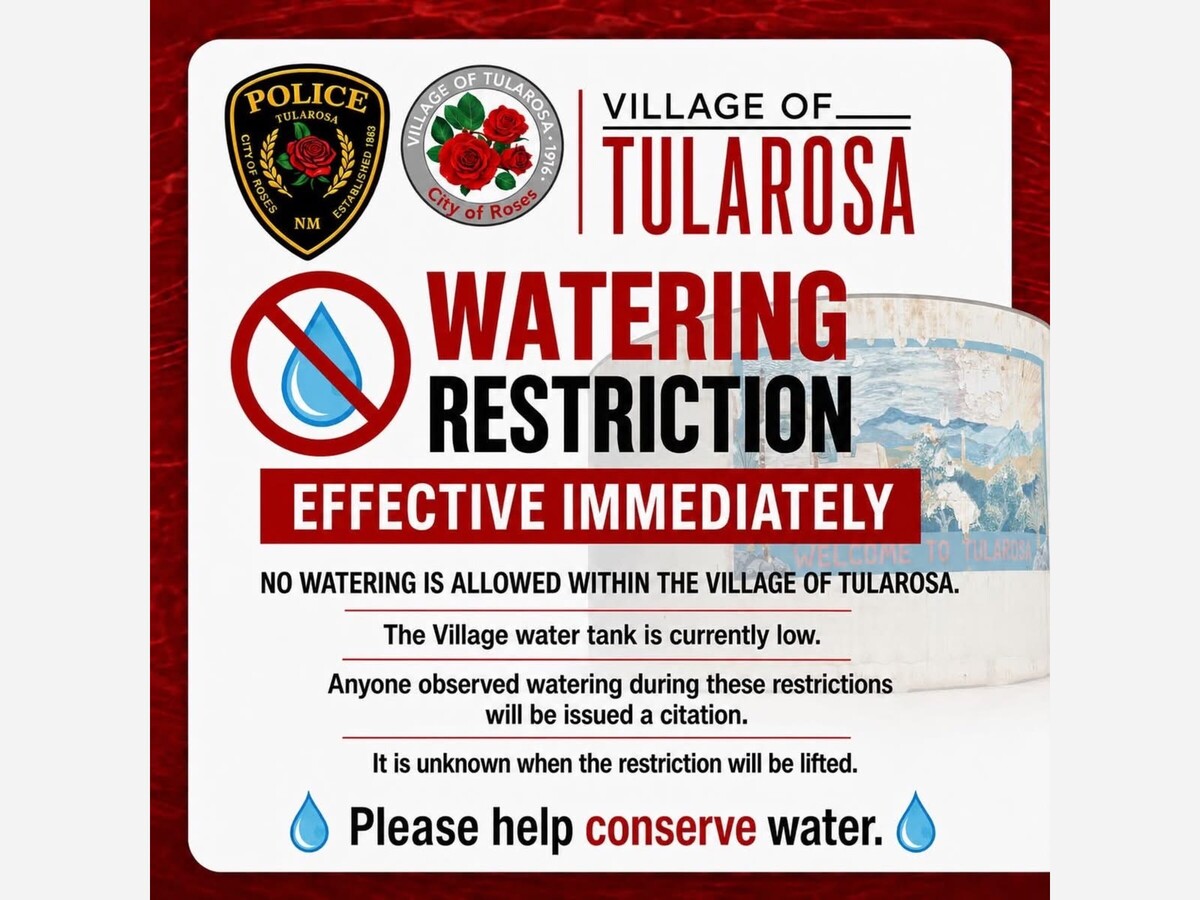
CRISIS: Tularosa Declares Emergency Water Shortage — Complete Watering Ban Enacted - AlamogordoTownNews.org



TULAROSA, N.M. — The Village of Tularosa has declared a critical water emergency and issued an immediate, total ban on all outdoor watering. Water storage tanks are nearly empty, prompting village officials to take unprecedented enforcement action.
“We are in a crisis with our water situation and our tanks are almost empty at this point,” village officials stated in an emergency community alert. “We really need everyone to abide by the NO WATERING restriction and minimize water usage for daily use.”
The emergency arrives amid a statewide crisis. Approximately 94% of New Mexico is under drought conditions as of July 21, 2026, placing the 2,593-resident Otero County community on the front lines of the state’s water emergency.
Zero-Tolerance Enforcement
Tularosa is not requesting voluntary compliance—officials have made clear that enforcement will be swift. According to official notices, “Anyone observed watering during these restrictions will be issued a citation.” The Tularosa Police Department is actively monitoring compliance, with violators facing legal consequences and fines.
Effective immediately, all outdoor watering is prohibited—including landscape watering of lawns and gardens, lawn maintenance, and decorative water features such as fountains. Village officials emphasize this is not an inconvenience but a mandatory emergency measure to protect critical water supplies.
Community Response Needed — Daily Use Must Be Reduced
The watering ban extends to all outdoor use, but village officials are also calling residents to reduce daily household water consumption. Water plant operators are working overtime to manage the emergency. “Our water plant operators are working around the clock and doing everything they can to keep water flowing and replenish our storage,” village leadership stated.
Despite the clear warning, officials have heard from residents claiming they plan to violate the restrictions. “Comments from people saying they’re going to water anyway or that the restrictions don’t matter are concerning,” officials noted. “The reality is that they do matter. Every gallon that is conserved today helps protect our community’s water supply for tomorrow.”
Village leaders are clear about priorities: preserving water for household consumption, drinking water, sanitation, emergency services, fire protection, and critical infrastructure like hospitals and schools.
“Tularosa has always been a community that steps up when it matters most. This is one of those times,” village leadership appealed to residents.
Steps Residents Must Take
Officials urge immediate household-level action: shorter showers, full laundry loads, and efficient dishwashing. Fix leaking faucets immediately—even small drips add up during a crisis. Suspend car washing and do not fill or top off swimming pools or decorative fountains. On outdoor landscaping, consider temporary reliance on drought-resistant plants.
The situation is indefinite. “It is unknown when the restriction will be lifted,” officials stated, making this a long-term commitment for the community, not a temporary inconvenience.
Part of Statewide Water Emergency
Tularosa’s crisis is not isolated. Scientists predict New Mexico will face a shortage of 750,000 acre-feet of water within 50 years as climate change causes temperatures to rise — reducing snowpack and runoff. More immediately, when today’s high school graduates reach retirement age, New Mexico will have 25% less water than it currently has in already over-stressed communities and farms.
The Tularosa Basin’s geography compounds the problem. Ground water is recharged primarily from precipitation falling on Sierra Blanca, with as little as 7.5% of this precipitation estimated to reach the aquifers in the mountain areas. With limited recharge rates and sustained drought conditions, the region’s water vulnerability is severe.
Long-Term Solution: Brackish Water Desalination Project
Village officials are not waiting for state-level solutions. Tularosa is pursuing a long-planned brackish water treatment project. The project draws on the village’s Montezuma Well groundwater rights and would treat brackish groundwater—with total dissolved solids around 2,500 milligrams per liter—through a reverse osmosis system housed in a roughly 60-by-100-foot building near the village’s existing water tank site, recovering about 82 percent of pumped water as usable supply.
The timeline is critical: Construction is estimated to begin around spring 2027 and take approximately 15 months. This means the emergency restrictions will remain in place through at least late 2027, possibly into 2028.
Tularosa’s approach aligns with state strategy. New Mexico is systematically exploring deep brackish groundwater as a supplemental water supply, which can be treated through reverse osmosis for potable water and irrigation. The region benefits from existing research infrastructure—the Tularosa Basin National Desalination Research Facility was established in Alamogordo in 2004 as a joint project of the Federal Bureau of Reclamation and Sandia National Laboratories.
The village is also reaching out for external assistance. “We are currently reaching out for help for this situation,” officials stated, indicating that state and federal resources will be needed to supplement local efforts.
What’s at Stake
For Tularosa residents accustomed to a small-town rhythm, this crisis represents an unprecedented test. The village has no flexibility—compliance is not optional. The desalination project offers hope for 2028, but until then, Tularosa faces months of restricted water and enforced conservation. Village leaders are counting on residents to understand the stakes: fire protection, emergency services, drinking water, and the village’s long-term survival.
The region’s broader context—a state losing a quarter of its water over the next 25 years—underscores that Tularosa’s crisis is not unique. Other New Mexico communities will likely face similar emergencies if conservation efforts fail and long-term water infrastructure projects lag. For now, all eyes are on Tularosa, where a community of 2,593 people faces the harsh reality that water—long taken for granted in residential life—is the rarest resource of all.

It would be advised that everyone take heed and start with the same measures willingly.

Love your shop in Las Cruces! Haven’t been to the one here in Alamo yet.
Hi Troy,
What do you think of the manga Jaadugar: A Witch's Life in Mongol (Tomato Soup). It's now an anime from Saru Science/Crunchyroll.
Enjoy!


Patchy rain nearby, with a high of 80 and low of 60 degrees. Patchy rain nearby in the morning, overcast for the afternoon and evening,

an impressive guide, that shows the balance needed to be fair to all.


Thank you Sheriff!

She lectures her expertise like she was running SpaceX. Home Service Contractors and Darnold Plumbing could get any of those things built in a month. These unqualified people use it to justify their lives. We have to work to pay off their excess spending.
Neither have the proper license try again!

He did the same thing when he ran against Rachel. He's a pathological liar who just keeps proving it over and over.
he senses trouble....and i smell blood - time to send him to private sector employment - maybe his oil & gas friends can find something for him to do.
Lets ask the editor.
sir, are you not involved in the campaign?


there is our future, kudos to both the students and the organizers.
Sounds overblown by the reporting of this party. On base we have something like this, but it's training leaders. Pic is a few kids with some volunteers who act to shape their opinions. If the schools were good enough the kids would learns this in a classroom.
Glad to hear that the base has a youth group. Now kids in Alamo, with no way to join that group, can also have a group where they can openly discuss their concerns, experiences, and work together to present solutions.
and, no, a PhD didn’t come up with this program. A very smart, educated woman suggested it.


the problems facing the republican party of new mexico pale in comparison with those of their national party - as the old saying - Meaning: Problems in an organization or society start at the top, with its leaders.
The fish rots from the head down
True. A prime example of this was the DNC failures in the 2020 election.
I have voted Republican in the past, but not this time. Our church group knows a few people who have tried to run or get involved and the old school fools won't let anyone they don't know get in at all. You can't solve any problem with the same people who created it. That's why we have terrible doctors here.