Image
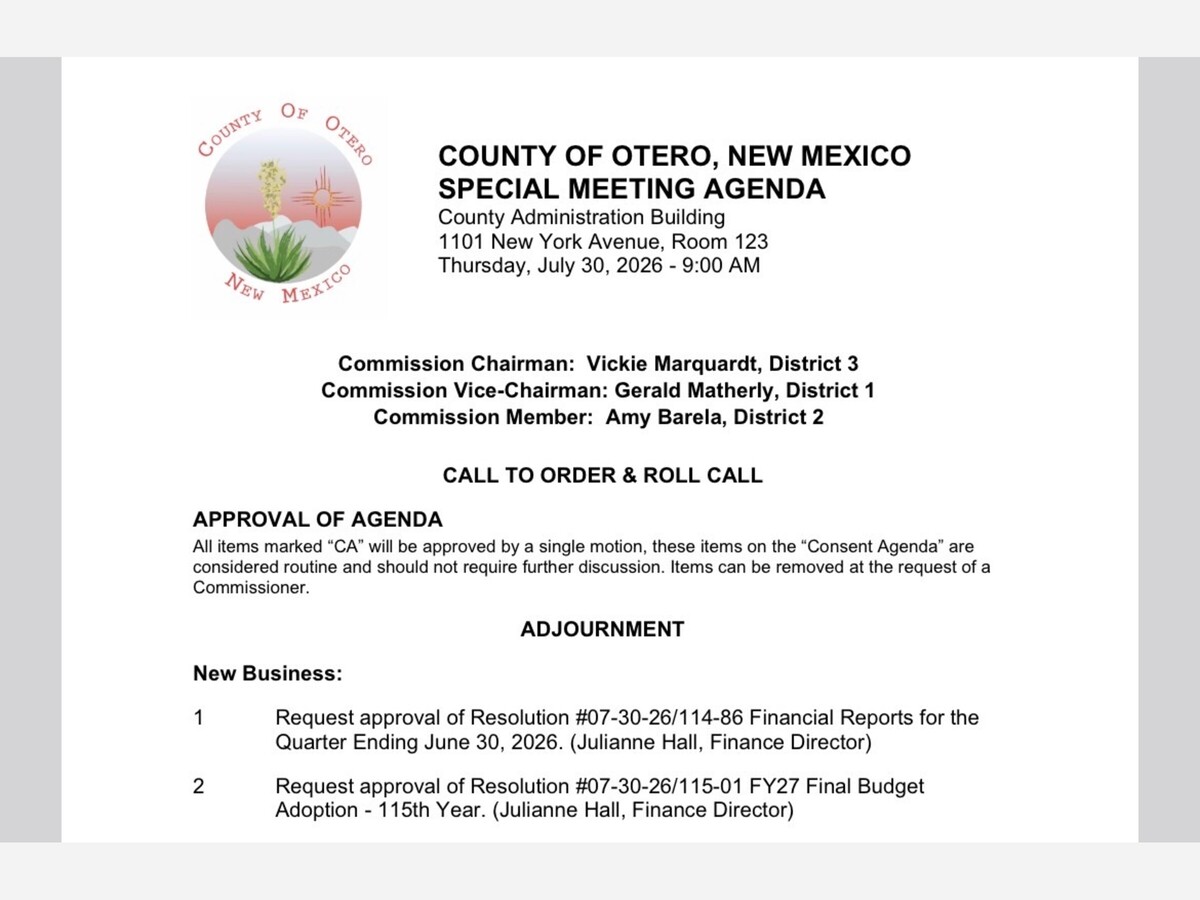



The Otero County Commission’s approval of the FY2027 budget on July 30, 2026 highlighted a critical but often misunderstood aspect of county government: the distinct roles and responsibilities of two separate financial leadership positions that work in tandem to manage public funds.
As Karl Melton assumes his position as Otero County Treasurer—an elected position—and the Finance Department continues its oversight of daily operations and budget compliance, understanding this dual structure is essential to comprehending how counties manage taxpayer resources.
The Treasurer’s Role: Cash Management and Investments
The county treasurer serves as the property tax collector and investment officer for public funds in Otero County. This elected position, which carries a four-year term limited to two terms, carries specific and narrowly defined responsibilities focused on cash flow and investment strategy.
To understand the distinction listen to Karl Melton on Alamogordo Town News streaming via KALHRadio.org
https://www.youtube.com/live/tbwcASsVwRY?is=TviPizTF3q1UBsnV
Karl Melton, who took office in January 2026 after winning the November 2024 election, manages the county’s liquid assets and investment portfolio. Upon taking office, Melton stated that “we will immediately work on increasing the transparency of county investments, improving the investment portfolio to increase returns, and generating more revenue for the county’s budget.”
The treasurer’s authority is circumscribed by law and regulation. Importantly, the treasurer does not make decisions on the allocation of funds nor sets policy on tax spending. Instead, the treasurer operates within parameters set by statute, county policy, and the commission’s budget directives.
The Otero County Finance Department: Operations and Compliance
In contrast, the Finance Department—headed by a director appointed by the county—manages the daily operational side of the budget. This includes expenditure tracking, revenue projections, fund allocation to departments, budget performance analysis, and ensuring compliance with county financial policies and state regulations.
The Finance Director presented the FY2027 budget to the commission, detailed year-to-date budget reports, discussed revenue projections, and made recommendations on fund allocation and department spending. This individual works closely with department heads to ensure spending aligns with approved budgets and identifies variations between projected and actual expenditures.
How They Work Together
The relationship between these two offices is complementary but separate:
• Treasurer’s Office: Safeguards cash reserves, manages investments in bonds and securities, ensures funds are invested in compliance with county investment policy, collects property taxes, and pursues tax collection strategies
• Finance Department: Allocates those available funds to departments, tracks spending against budget, projects revenues and expenditures, identifies budget variances, and ensures regulatory compliance
Together, they create a system of checks and balances where one office manages the county’s money while the other determines how it’s spent—with the County Commission serving as the body that sets overall financial policy and approves the budget framework.
FY2027 Budget Approval Reflects Dual Structure
The county’s approval of its FY2027 budget reflected this dual responsibility. The Finance Director presented detailed spending plans, revenue projections, and departmental allocations. The commission discussed and approved these operational parameters. Meanwhile, the Treasurer’s Office—under Melton’s leadership—will manage the actual cash positions, investments, and liquidity necessary to support those operations.
The budget includes a projected General Fund ending cash balance of $1.8 million, with a mandatory three-month reserve of $6.6 million dictated by law. The Treasurer’s Office will be responsible for managing those reserve levels and ensuring compliance with investment policies. The Finance Department will track whether actual expenditures align with the approved budget allocation.
The slightly better then expected financial picture for the county enabled commissioners to approve a $1.50 per hour across-the-board pay increase for all county employees and elected officials—something that appeared impossible at the beginning of the fiscal year.
“We have some extra money coming in, and if we’re gonna do it, it would be a good time to do it,” commissioners stated, emphasizing both the improved financial position and the practical necessity of competitive compensation to retain skilled employees.
The county also approved funding for three new positions: two part-time animal shelter assistants, two transfer station attendants, and one legal department custodian to address overwhelming documentation workload.
However, the county’s budget reveals a financially constrained operation. The General Fund is projected to maintain only $1.8 million in ending cash balance—a figure that becomes even tighter when accounting for the mandatory $6.6 million three-month reserve requirement mandated by state law. The Road Fund, similarly operating under a one-month reserve requirement, is projected to end the year with essentially zero dollars.
Contrasting Narratives: County vs. City Financial Reporting
The structural difference between the treasurer and finance roles reflects a broader distinction in how county and city governments present their financial pictures to the public—a difference evident in how Otero County and the City of Alamogordo reported their respective budgets on the same day.
The City of Alamogordo’s financial reporting emphasizes detailed numerical documentation. The city provided “a recap summary of all funds, showing beginning cash, revenues, transfers, expenditures, investments and ending cash,” along with “a year-to-date budget report for the period ending June 30, 2026” that “illustrates how the actual revenues and expenditures compare to the budgeted amounts.” The city’s approach relies on comprehensive data presentation and comparative analysis.
Otero County’s budget approval, by contrast, employed a more narrative and discussion-based approach. Finance Director presented the budget verbally to the commission, emphasizing that revenues “ended up being a bit more than I had expected” and highlighting specific policy decisions such as allocating subsidized funds “to the penny” of what they need. The county commission engaged in extended dialogue about the implications of budget positions, employee compensation needs, and strategic priorities.
The city’s approach—detailed financial tables, comparative budget analysis, and numerical precision—reflects a government managing substantially larger revenues ($98.5 million in half-year revenues) and maintaining significantly larger reserves ($109.8 million in combined cash and investments).
The county’s more narrative approach—discussion of revenue surprises, strategic budget allocation decisions, and qualitative assessment—reflects an organization operating with tighter margins where every dollar allocation carries greater significance. With a General Fund of only $1.8 million in ending balance before mandatory reserves, the county’s finance leadership must discuss trade-offs and strategic choices in ways a larger government need not.
Conclusion
The distinction between Otero County’s Treasurer and Finance Department reflects a fundamental principle of governmental financial management: separation of custody from allocation. The Treasurer safeguards and invests public money; the Finance Department directs its use. This division protects taxpayers by ensuring no single official can both determine spending priorities and control the funds implementing those priorities.
However, the contrasting narratives between county and city reporting reveal a deeper truth about scale and financial resilience.
When a government operates with substantial reserves and predictable revenues, it can afford detailed numerical reporting and comparative analysis.
When a government operates closer to its financial limits, as Otero County does, the emphasis shifts to strategic narrative—explaining why this year revenues exceeded expectations, why certain departments received only what they absolutely need, and why employee compensation became possible only through disciplined budget management.
Both approaches serve a level of transparency with the city providing line by line transparency in discussions with the public, but they reflect different financial realities. The county encourages citizens to call the finance director or the treasurer for transparency. Mr Melton the County Treasurer, in an earlier interview encouraged citizen engagement, Otero County finance less so.
The City of Alamogordo can present the numbers and let them speak due to their level of transparency and a city focused on building a sound budget via Dr Hernandez’s tenure as City Manager. Mr Stockwell inherited a city in a strong financial position. The county by contrast in recent years has struggled with audit results and tight budgets with little wiggle room.
Otero County must explain the story behind the numbers to help stakeholders understand how limited resources are allocated strategically for maximum benefit to county residents the contrast in positions and leadership is glaring.

I don't work for the city and I don't know anyone who does but, as we all know it's expensive to live these day's. They do a fine job and I want them to have the money. I would like to thank the city counsel for the extra money for them. They deserve it and so do there families. Charles Town.

an impressive guide, that shows the balance needed to be fair to all.


Overcast, with a high of 81 and low of 61 degrees. Overcast in the morning,



She lectures her expertise like she was running SpaceX. Home Service Contractors and Darnold Plumbing could get any of those things built in a month. These unqualified people use it to justify their lives. We have to work to pay off their excess spending.
Neither have the proper license try again!
He did the same thing when he ran against Rachel. He's a pathological liar who just keeps proving it over and over.
he senses trouble....and i smell blood - time to send him to private sector employment - maybe his oil & gas friends can find something for him to do.
Lets ask the editor.
sir, are you not involved in the campaign?


there is our future, kudos to both the students and the organizers.
Sounds overblown by the reporting of this party. On base we have something like this, but it's training leaders. Pic is a few kids with some volunteers who act to shape their opinions. If the schools were good enough the kids would learns this in a classroom.
Glad to hear that the base has a youth group. Now kids in Alamo, with no way to join that group, can also have a group where they can openly discuss their concerns, experiences, and work together to present solutions.
and, no, a PhD didn’t come up with this program. A very smart, educated woman suggested it.


the problems facing the republican party of new mexico pale in comparison with those of their national party - as the old saying - Meaning: Problems in an organization or society start at the top, with its leaders.
The fish rots from the head down
True. A prime example of this was the DNC failures in the 2020 election.
I have voted Republican in the past, but not this time. Our church group knows a few people who have tried to run or get involved and the old school fools won't let anyone they don't know get in at all. You can't solve any problem with the same people who created it. That's why we have terrible doctors here.