Image
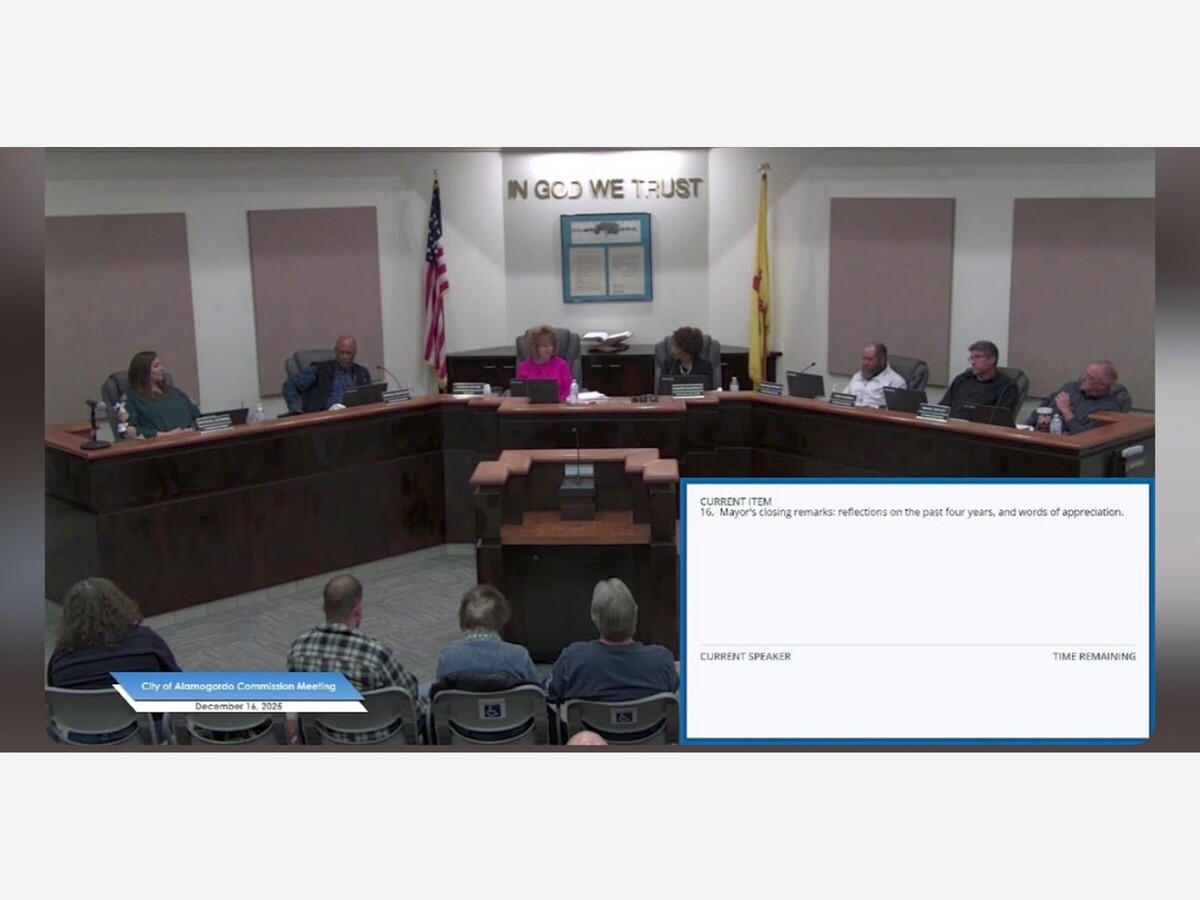



Facing an administrative vacuum of its own making, the Alamogordo City Commission accepted a 60-day transition plan from Dr. Stephanie Hernandez on Tuesday — the same woman, four commissioners are quietly seeking to remove by not offering her a permanent contract, without public debate. The actions of the 4 commissioners has opened the city up to a potential state investigation and or potential lawsuit from citizens.
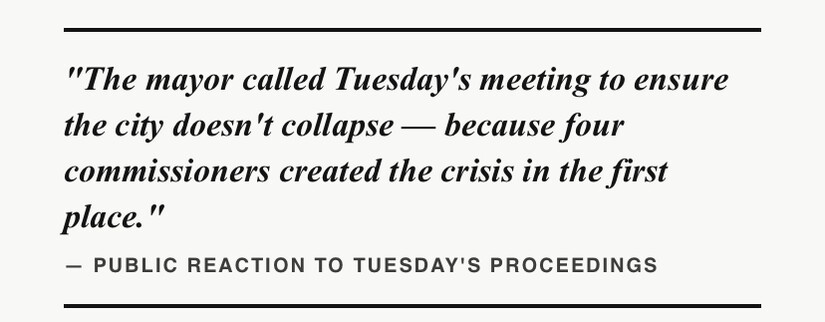
Mayor McDonald, convened Tuesday's city commission meeting with a clear and urgent purpose: to establish, at minimum, a contingency plan ensuring that city operations do not collapse in the wake of the commission's own decision to reverse the hiring of Dr. Stephanie Hernandez as city manager.
What followed was a now-familiar sequence — executive session, return to open meeting, vote taken, no public discussion, no explanation offered to the residents of Alamogordo.
The commission voted, again in silence, to accept Dr. Hernandez's offer of a structured 60-day transition, (the public was not made aware of what it entails due to no public disclosure)— a plan she voluntarily proposed after presenting commissioners with a sweeping accounting of the city's active obligations, its upcoming projects, and the institutional knowledge that would need to be transferred to ensure continuity of government.
The irony was not lost on observers: the body that had moved to discard her leadership was now relying on her professionalism to clean up the consequences of that decision.
For 28 non-consecutive months, Dr. Hernandez has carried the workload of two senior positions simultaneously — serving as acting city manager while also filling the role of assistant city manager, a position that has gone unfilled beneath her throughout her tenure. The weight of that dual responsibility is made concrete by the project list she laid before the commission: dozens of active infrastructure, public safety, and planning efforts at various stages of completion…
THE WORKLOAD DR. HERNANDEZ LEAVES BEHIND
ACTIVE PROJECTS
– Dispatch system
– Lower/Upper Heights water line replacement
– Cell 6 landfill development
– Fairgrounds intersection
– 5-site water tank program (Lower Alamo, Ocotillo, Calahan, West Side – paint, and others)
– Fire Station 2
– F4 Phase 2
– Zoo Duck Bond
– White Sands Blvd. water line replacement
– COPE
– Senior Center parking
– Library
– Bonito access & camping
– 21-channel ditch system overhaul (some channels untouched for decades) — including 16th Street, KOA, Biggs, German School, Eagle, Oasis, Pecan, Snow, Sunrise, Arizona, Desert Lakes, Dry Canyon, 4th Street, Walker Ave, Mescalero, Mesquite St, Wright Ave, and Water Ditches (4)
– Crosswalk repainting & striping
– Real Time Crime Center
– Subdivision ordinance & P&Z rewrite
– Airport vault replacement
– Dudley Building & La Luz Reservoir
UPCOMING PROJECTS
– WSRP 001 Oregon Phase 2 & WSRP 002 corridors
– Highway 54/70 corridor work
– Wastewater plant headworks
– Marble Basin & Washington Basin
– Dudley Playground
– Natatorium
– Grading and sloping for ditches
– Storm drain at 10th & White Sands (flooding mitigation)
– Well transmission from Tularosa (5 miles)
– Wastewater pivot transmission line (airport area)
– Failed culvert at Washington
– Traffic management program
– Comprehensive plan update
DESIGN PHASE (NOT YET FUNDED)
– Sewer replacement (White Sands to Florida; 16th to Indian Wells including blind school)
– Washington concrete channel
– Intersection signal upgrades
– Wastewater 15-cell development
OTHER ACTIVE RESPONSIBILITIES
– Golf course operations
– Fire & AFSCME union negotiations
– All contracts over $60,000
– All payments over $20,000
– FY budget cycle
– Internship programs
– P&Z zoning rewrites
COMPLETED UNDER HER LEADERSHIP
– Great Blocks & F4 Phase 1
– Public Works Basin
– Hubbard Bridge & Cemetery Wall
– NY WSRP & Lower Heights Tank
– 10th Street Bridge
– Golf Course Irrigation
– Zoo IT & Zoo Wall
– Oregon WSRP001 Phase 1
The timing of this administrative upheaval has compounded its severity. The city’s attorney has submitted a resignation effective at the end of the month, leaving Alamogordo simultaneously without its city manager and its legal counsel — at precisely the moment when it may need both to defend itself against the very legal challenges its commission’s conduct has invited.
HOW THE CITY ARRIVED HERE
The crisis traces its origin to March 10th, when the prior Alamogordo City Commission voted 7 to 0 — unanimously — to move forward with hiring Dr. Hernandez as city manager. The decision was unambiguous: every seat at the dais, every vote cast, in favor.
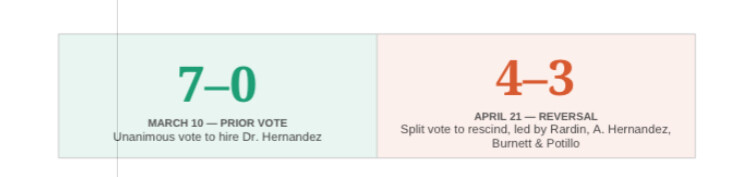
Then came April 21st. In what observers and members of the public have characterized as a political coup, four commissioners — Josh Rardin, Al Hernandez, Stephen Burnett, and Baxter Potillo — maneuvered to overturn that unanimous decision. A contract was never formally offered to Dr. Hernandez between March 10th and April 21st, a lapse that itself raises procedural questions about the commission’s good-faith execution of its own vote.
THE FOUR COMMISSIONERS WHO LED THE REVERSAL — APRIL 21
|
Josh Rardin City Commissioner |
Al Hernandez City Commissioner |
Stephen Burnett City Commissioner |
Baxter Potillo City Commissioner |
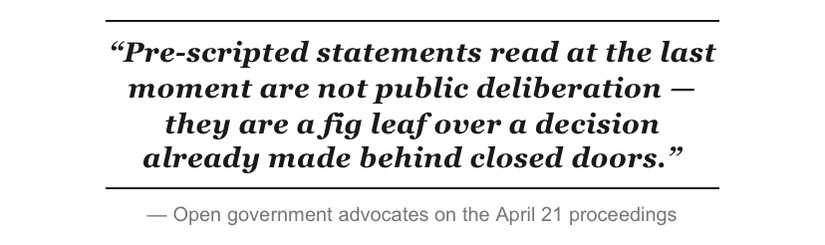
The reversal itself was conducted in a manner that has drawn fierce criticism from the public and the press. The commission retreated into executive session — not once, but on multiple occasions in the lead-up to the April 21st vote — without providing the public any substantive window into the deliberations that led four commissioners to nullify seven votes. When the commission returned to open session, the four offered no real statements in what critics have described as a non-transparent and inadequate attempt to create the appearance of Open Meetings Act compliance without its substance.
There was no robust public debate. No constituent engagement. No testimony invited. No explanation of what had changed between a 7-to-0 vote and a 4-to-3 reversal weeks later. The public, in the assessment of watchdogs and journalists covering the proceedings, was deliberately kept in the dark.
What comes Next?
Dr. Hernandez’s 60-day transition plan now represents the city’s best hope for operational continuity. She has offered to shepherd the handoff of projects, contracts, institutional relationships, and administrative processes — a gift of professional responsibility to a city whose leadership chose not to retain her permanently.
KEY DATES & WHAT’S AHEAD
|
March 10 |
Commission voted 7–0 to hire Dr. Hernandez as city manager. |
|
Mar 10 – Apr 21 |
Multiple executive sessions led by four commissioners. No contract formally offered to Dr. Hernandez. |
|
April 21 |
Rardin, Al Hernandez, Burnett & Potillo lead 4–3 reversal. Canned script offered in lieu of public debate or constituent engagement. |
|
Late May |
City attorney resignation takes effect — city loses both its senior officers simultaneously. |
|
Tuesday (this week) |
Mayor McDonald convenes meeting. Commission votes again without debate to accept Dr. Hernandez’s 60-day transition plan. |
|
60 days out |
Transition plan concludes. City must have replacement leadership in place across a massive project ledger. |
|
TBD |
Potential NM Attorney General / Open Meetings Act investigation. Potential civil litigation against the city for actions of the four commissioners. |
The legal exposure now facing Alamogordo is significant. New Mexico’s Open Meetings Act is explicit: governing bodies must deliberate in public on matters of public concern, and the use of executive session is tightly circumscribed. Legal observers watching the April 21st proceedings — and Tuesday’s repeat of the same silent-vote pattern — believe the conduct of Rardin, Al Hernandez, Burnett, and Potillo may constitute actionable violations. A referral to the state Attorney General’s office for investigation has been requested
Civil litigation against the city, with a May 20th deadline is also being threatened by parties who argue the four commissioners’ actions caused direct harm to the taxpayers violating transparency laws.
The deeper cost, however, may be harder to quantify.
Alamogordo is a city with a full and demanding agenda — infrastructure aging in some cases for decades, a ditch system that has gone unmaintained, water system replacement corridors underway across the city, labor negotiations active with both the fire department and AFSCME, and a budget cycle that must be navigated without the leadership that has carried it for more than two years. The commission that chose to create this crisis now owns the obligation to resolve it — and the clock on Dr. Hernandez’s 60 days is already running.

The commission's vote to accept Dr. Hernandez's settlement was on April 28, 2026, not April 21.
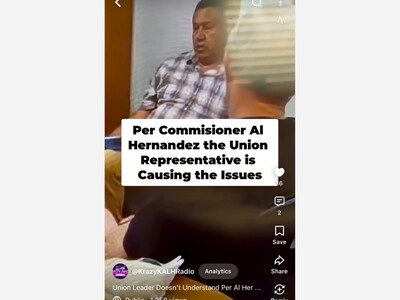
What outstanding qualities does Mr. Hernandez possess that got him appointed as a City Commissioner for District 5?

Patchy rain nearby, with a high of 87 and low of 69 degrees. Patchy rain nearby for the morning,


Thank you for your continued, detailed coverage of both the County Commission and City Commission meetings. Decisions made by both of these governing bodies directly affect everyone in Otero County, Republicans, Democrats, Independents and Undecided.
this is a sad ending, but certainly not unexpected.
What's sad is your time-wasting ***** attitude. The International Space Station replaced these dinosaurs. Neighbor, you need to eat more protein and get some exercise to lose that fat-gut-brain.



Friends of ours talk and are suspicious of her. Why is she still single, without a husband and children? Seems like her highly credentialed attitude got her sideswiped for being too pushy. Now, from the Fox News playbook, she has a radio show. A book too, maybe?