80° and Partly Cloudy
Image

New Mexico Supreme Court Denies AG's Petition — Otero County's ICE Contract Stands -2nd Life Media AlamogordoTownNews.org



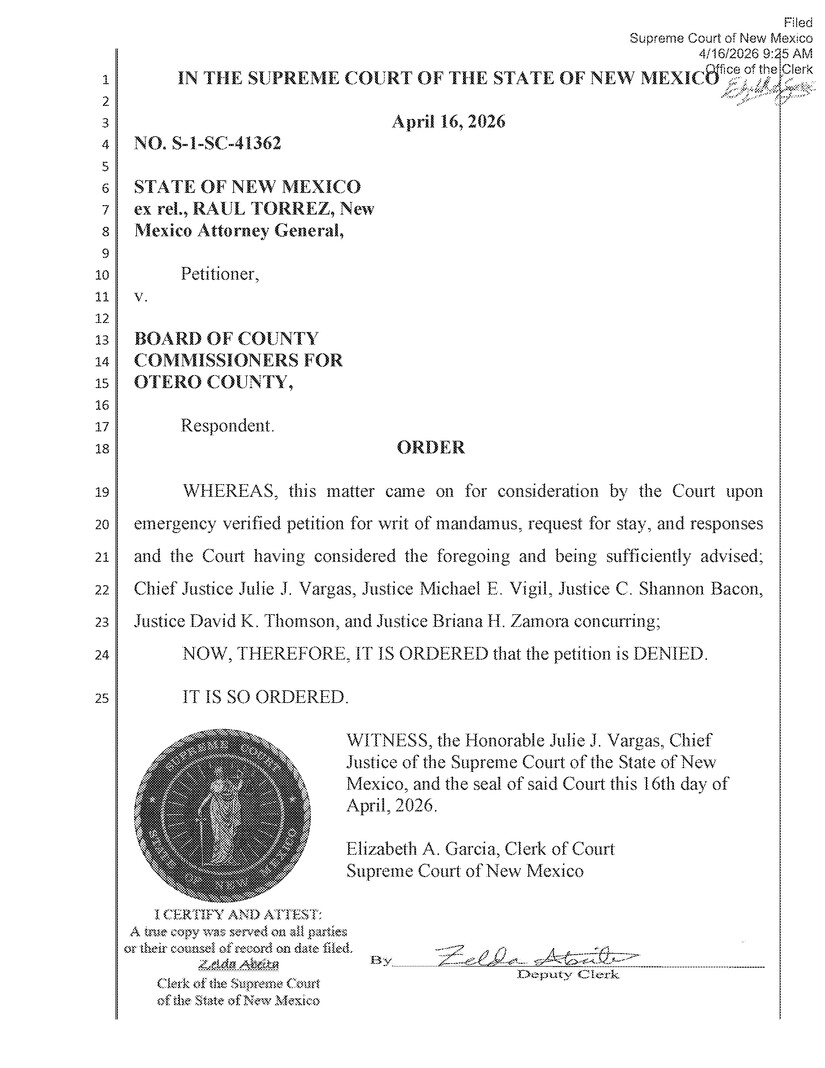
In a terse, unanimous order issued this morning, the New Mexico Supreme Court denied Attorney General Raúl Torrez's emergency petition for a writ of mandamus against the Otero County Board of Commissioners — delivering a sweeping legal victory to Otero County and preserving the five-year Intergovernmental Service Agreement between the county and U.S. Immigration and Customs Enforcement for the continued operation of the Otero County Processing Center in Chaparral.
The order, filed at 9:25 a.m. on April 16, 2026 under Case No. S-1-SC-41362, was joined by all five justices: Chief Justice Julie J. Vargas, Justice Michael E. Vigil, Justice C. Shannon Bacon, Justice David K. Thomson, and Justice Briana H. Zamora — concurring. The order reads simply:
"NOW, THEREFORE, IT IS ORDERED that the petition is DENIED. IT IS SO ORDERED."
No stay. No invalidation. No further proceedings. The petition is gone.
The Supreme Court's denial is a complete victory for the county on the most urgent front of this legal battle. The AG had sought two things simultaneously: an emergency stay to immediately halt the ICE agreement and a writ of mandamus to void it entirely. The court denied both.
For the Otero County Processing Center — which houses approximately 900 federal civil immigration detainees, employs roughly 284 county residents, and secures more than $14 million in outstanding county revenue bonds — the ruling means operations continue without interruption. The facility in Chaparral remains open. Workers keep their jobs. The bond obligations remain backed by the contract's $5.2 million in annual revenue. The next interest payment due October 1, 2026 is not in jeopardy from this ruling.
This ruling is the culmination of one of the most turbulent local government legal disputes in recent New Mexico history. Alamogordo Town News has covered every step:
March 13: Otero County commissioners convened an emergency meeting with only a few hours of public notice, voting unanimously in a session lasting roughly 12 minutes to approve a new five-year IGSA with ICE — the sole revenue source for the county's outstanding Jail Project Revenue Bonds. The commissioners authorized County Manager Pamela Heltner to execute the agreement and approved up to $350,000 in outside litigation counsel.
March 20: AG Torrez declared the emergency meeting invalid, saying "The Open Meetings Act is not optional. It ensures that public business is conducted in the open, not rushed through under the guise of an emergency when no true emergency exists."
March 25: After the county held a properly noticed special meeting and commissioners voted unanimously again to authorize the contract, the AG's office raised a new objection hours before the meeting, arguing DFA approval was required. County Attorney R.B. Nichols rejected that position. The vote proceeded.
March 17: State Rep. Sarah Silva, a Democrat whose district includes the processing facility, formally requested that AG Torrez investigate and issue a legal opinion on the commission's actions, accusing commissioners of potentially circumventing the newly enacted Immigrant Safety Act, bypassing public transparency requirements, and authorizing up to $350,000 in taxpayer-funded outside legal counsel — all with virtually no discussion in a meeting lasting only about 12 minutes.
April 1: The New Mexico Department of Justice filed a petition for a writ of mandamus with the New Mexico Supreme Court, seeking to immediately block the agreement and arguing it was unlawful on two grounds: that New Mexico municipalities lack statutory authority to detain individuals for the federal government based solely on civil immigration violations, and that Otero County failed to obtain required approval from the New Mexico Department of Finance and Administration, rendering the contract void under state law.
AG Torrez declared at the time: "The rule of law requires that all public bodies follow clearly established legal requirements, without exception. Otero County did not obtain the approval state law requires, and the agreement is invalid. We are asking the Court to act swiftly to prevent its enforcement."
The AG also charged that "Otero County's conduct is precisely the kind of maneuver HB 9 was designed to prevent. With minimal public notice, commissioners convened an emergency meeting to rush through a new five-year agreement just days before their previous contract expired. The agreement bars the County from withdrawing for any reason while leaving ICE free to exit at will."
April 8: Otero County fired back with a 29-page response, obtained by ATN through an IPRA request to County Attorney R.B. Nichols, accusing the AG of manufacturing a legal emergency where none existed. The county's brief documented eighteen years of state silence on the county's operation of the facility and argued that the state's own Department of Finance and Administration had previously indicated that agreements like this one are not subject to the Joint Powers Agreements Act the AG was invoking. The county's filing was direct: "If mandamus issues, County residents will suffer."
April 16, 9:25 a.m.: All five justices of the New Mexico Supreme Court denied the petition without qualification.
Today's ruling resolves the mandamus petition — but it does not resolve the underlying fight over the Immigrant Safety Act (House Bill 9), signed by Governor Michelle Lujan Grisham in February 2026. That law, which prohibits local governments from entering into or maintaining ICE civil detention agreements, takes effect May 20, 2026 — just 34 days from today.
Otero County has signaled it will challenge HB 9's constitutionality, arguing it conflicts with federal statutes authorizing ICE to contract with local governments, violates the Contracts Clause, and that the state's own bond pledge statute independently protects the county's right to maintain its revenue-generating agreements.
S&P Global Ratings revised its outlook on the county to negative from stable, citing large general fund deficits that could be exacerbated by the loss of the ICE contract. County Attorney Nichols responded that "the S&P outlook revision puts the real-life consequences of that decision on paper for investors and the public to see clearly."
The county has argued throughout that if the facility were forced to close, detainees would not be released — they would simply be transferred to facilities in Texas, farther from their families and attorneys.
County Attorney R. B. Nichols issued the following statement: “Otero County Attorney R. B. Nichols, together with outside counsel Samantha M.Adams of Adams+Crow Law Firm and Paul J. Kennedy of Kennedy, Hernandez & Harrison, P.C., are honored to have served the County in this proceeding. The legal
arguments the County advanced were grounded in the plain text of New Mexico law, eighteen years of uninterrupted state acquiescence, and the federal government’s exclusive authority over immigration detention. The Court appears to have seen those arguments clearly. The victory today secured the County’s commitments to: its bond obligations, the employees of OCPC, and its financial stability.”
Commission Chair Vickie Marquardt added:
“The Supreme Court did exactly what courts are supposed to do -- apply the law as
written, without regard to political pressure. Otero County is grateful for that.”
With HB 9 taking effect May 20, the next legal battleground is almost certain to be a constitutional challenge in district or federal court. The county's outside litigation counsel — Samantha M. Adams of the Adams+Crow Law Firm and Paul J. Kennedy of Kennedy, Hernandez & Harrison, P.C. — has been preparing for that front.
For the 284 workers at the Otero County Processing Center and the county's bondholders, today's ruling is a major reprieve. For the broader legal and political conflict between Otero County and the state of New Mexico over immigration detention policy, it is the end of round one — not the end of the fight.
Alamogordo Town News will continue to report on this story as it develops.
📰elated Coverage from Alamogordo Town News:
Reporting by Alamogordo Town News. This story was produced using court documents obtained through the New Mexico Supreme Court and IPRA requests to Otero County. Updates will follow as official statements are received.


Thank God for the Politian's we have or this place would be as bad as ABQ.
You are aware that not much is actually changing? I actually went and read the ordinance because I didn’t know what was in it. They are still giving you the option to go to court. And I know Edward’s must find a way to hate everything Amy does but, the current ordinance also reads that the sheriffs office will use licensed tow truck companies to remove vehicles they decide to legally remove, it just uses different legal language that some people might not understand. I had to look it up. So still- there is nothing changing. Shocking right? We go from “using licensed tow truck companies” to “using licensed tow truck companies” except now it’s in terms the public can understand. I would expect someone writing a newspaper article to at least put in that much effort to look into that, but I know it’s hard to look past the hatred of Amy, so I did it for you.
Next up is the ban on unlicensed dismantlers. And I know you want to try as you might to hate the commissioners for this, but you weren’t very happy with holloman poisoning your groundwater, why on earth would you be okay with your neighbor doing it so much closer to home? Junk yards are regulated and required to drain and dispose of chemicals. Do you honestly think Edward down the street is draining all those fluids out and taking them to be disposed of? Or do you think he’s dumping them on the ground somewhere because it’s cheaper and easier? And just like holloman that is seeping into the ground water and it’s not differentiating between his well water and yours. So, no, I don’t think his private property rights supersedes everyone else’s rights here just so you can find a reason to hate this. Go ahead, find a reason to blame Amy for this as well, we will wait.
It sounds like they are increasing private property owner protection on the number of exemptions they are giving, they have a permit process for someone looking to restore a car that can take a few years, and their process is pretty similar to Dona Ana, except Dona Ana only gives you ten days before they take your junk.
Please. Actually read something before you complain about it. Look and see if it’s comparable to your surroundings, and don’t hate it out of principle.
i don't believe that your comments were posted to the article you intended to respond to....time to do a little copy & paste editing.
as i had stated in response to an earlier article regarding the legal question involving otero county and the state attorney general - i predicted the county would dodge the bullet in the near term. in a very general sense, the ag was pleading for HB 9 to be applied retroactively, and i doubted the court would support his petition. but, i will repeat that dodge will not cover this situation five years from now. i very much doubt the poison pill will pass the smell test....permitting DHS/ICE to end the contract at will - but completely prohibiting the county from leaving the agreement under any circumstances.
disputing the constitutionality of HB 9 is a pretty steep hill to climb...but it will provide gainful employment for the county's attorneys.


a well stated article - constitutional lawsuits bring questions such as this into sharp focus - as well they should.

Sunny, with a high of 106 and low of 80 degrees. Sunny in the morning, clear for the afternoon and evening,



70 in a 35, poor person un the Honda didn't have a chance.
vehicular homicide indeed.

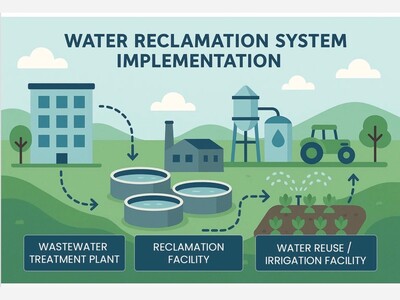
the long term drought conditions serve to underline the importance of long-term vision and planning to meet future water needs.
Now, if there was some way to collect all the storm runoff that goes out to the desert
any water distribution built with schedule 20 pvc piping, has been "a public utility emergency" since it was constructed. the fact that it lasted as long as it has is incredible.

ultimately the price for poor management practices will be equally borne by every property owner in that community - except those who have private wells, i suppose. but even those folks will have a smaller pool of prospective buyers....makes it sound kinda like socialism doesn't it?


I hope Dr. Hernandez is a guest speaker at an upcoming meeting of the Mayor's Youth Advisory Commission. She has so much wisdom and experience to pass on to younger generations.
It's the product of living in a lowly bubble: an immature, undeveloped writing style that has no insight or reasonable conclusion. Those PhD's from Watsamatta U in New Mexico are only a union card for activists to rally 'round and a far cry from what $200k a year should buy.
Your excellence at writing a reply show that you are an intelligent and urbane fellow. Whatever, get me my fries bro.