Image
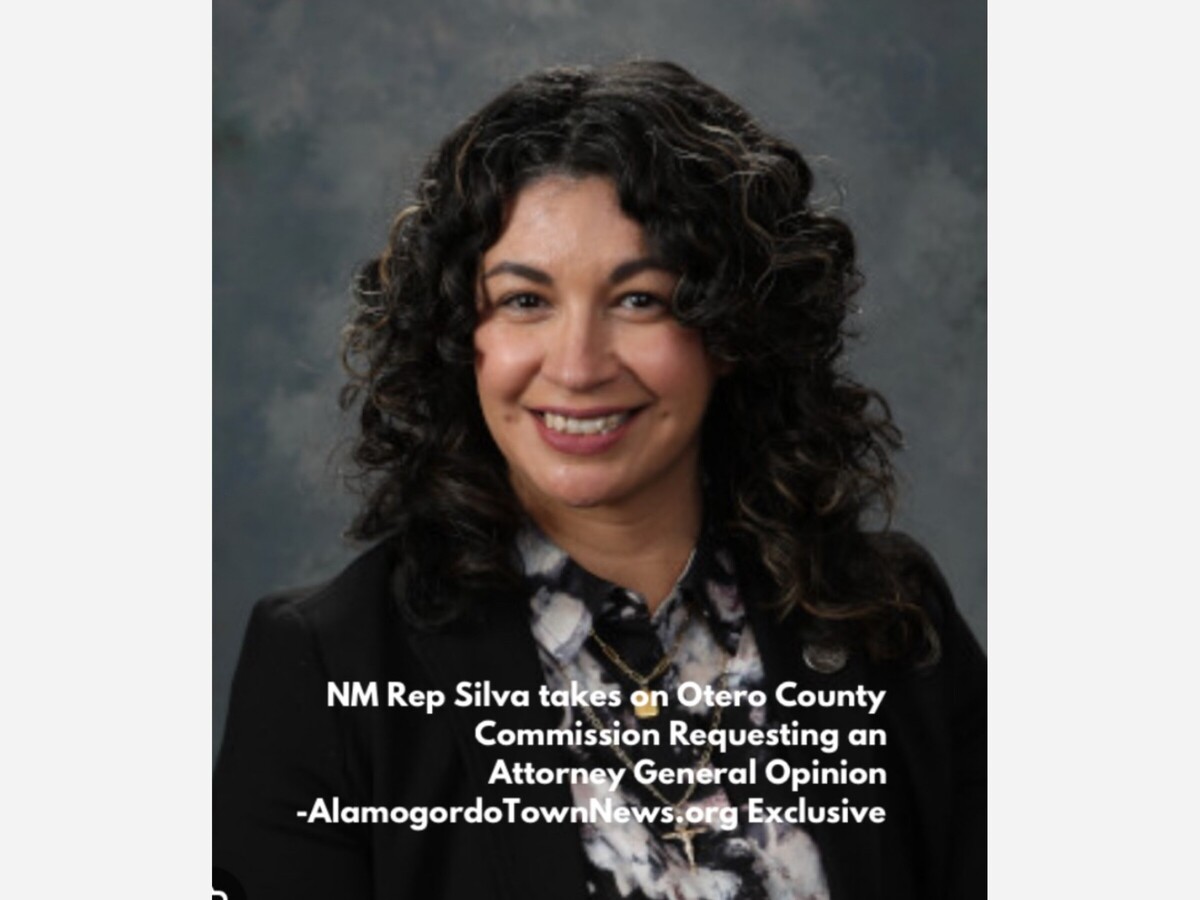
Rep. Sarah Silva Demands Attorney General Investigation into Otero County Commission’s 12-Minute Emergency Meeting and ICE Contract Renewal, Citing Potential Violations of New State Law and Transparency Rules - AlamogordoTownNews.org



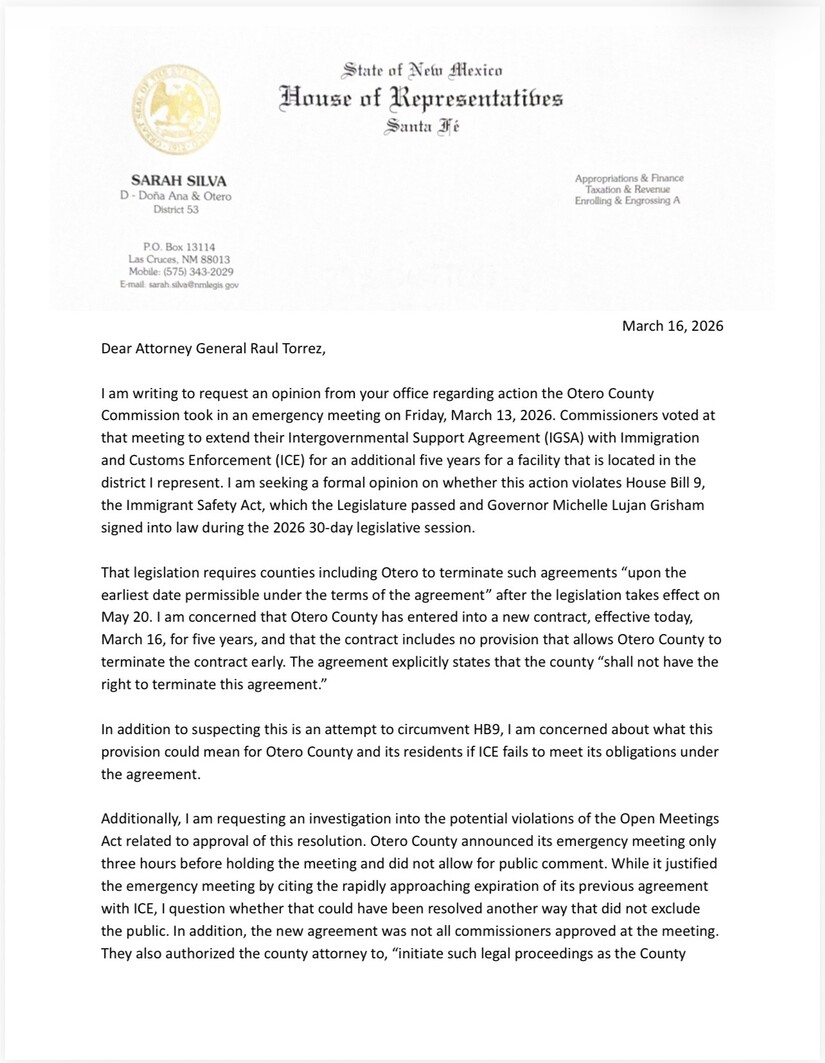
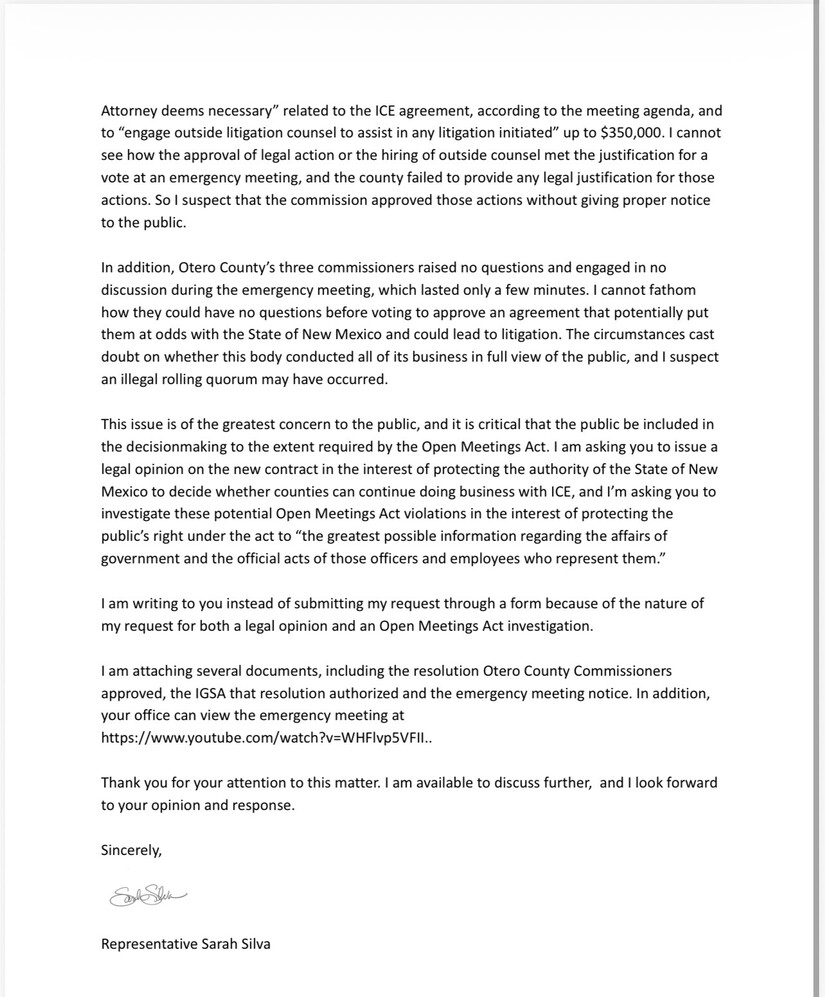
Alamogordo, N.M. (March 17, 2026) – New Mexico State Representative Sarah Silva (D-District 53), representing portions of Doña Ana and Otero counties, has formally requested that Attorney General Raúl Torrez investigate and issue a legal opinion on the Otero County Board of Commissioners’ actions during a hastily called emergency meeting on Friday, March 13, 2026. In a detailed letter dated March 16, Silva accuses the commission of potentially circumventing the newly enacted Immigrant Safety Act (House Bill 9), bypassing public transparency requirements, and authorizing up to $350,000 in taxpayer-funded outside legal counsel—all with virtually no discussion or questions from the three commissioners in a meeting that lasted only about 12 minutes.
The three Otero County Commissioners who unanimously approved the measures are:
The emergency session was convened under the New Mexico Open Meetings Act to address the impending expiration of the county’s Intergovernmental Service Agreement (IGSA) with U.S. Immigration and Customs Enforcement (ICE) for the Otero County Processing Center in Chaparral. County officials declared an emergency because the replacement IGSA (Contract No. 70CDCR26DIG000010) was only transmitted to the county on March 12, leaving fewer than four days before the prior agreement expired on March 15. A standard special meeting with 72-hour notice was deemed impossible per the County Attorney.
Key Actions Taken in the Brief Meeting
During the swift session at the Otero County Administration Building (1101 New York Avenue), the commission unanimously approved Resolution No. 03-13-26/114-62. This resolution:
County Attorney Nichols briefed the board on dire financial consequences of non-renewal: The IGSA generates approximately $5.2 million annually—the sole pledged revenue source for the bonds, which have an outstanding balance of roughly $21.5 million (final maturity April 2028). Without the contract, the county could not make a $4.986 million debt-service payment due April 1, 2026, risking acceleration of all principal, foreclosure on the $68 million facility, loss of 284 local jobs, and damage to the county’s credit and ability to borrow. The Debt Service Reserve Fund would be nearly depleted, triggering further mandatory replenishment obligations the county could not meet.
Notably, according to attendees and reports, the three commissioners raised no questions, engaged in no discussion of the contract terms, legal risks, or ethical implications, and voted in what one local account described as an atmosphere of “quiet compliance.” The entire agenda—call to order, quorum confirmation, emergency declaration, approval of the resolution, and adjournment—was completed rapidly, in about 12 minutes.
Contract Terms Raise Additional Concerns
The new IGSA (Contract No. 70CDCR26DIG000010) locks Otero County into a five-year commitment during which the county “shall not have the right to terminate this agreement,” while ICE can end services with only 60 days’ notice and bears no further payment obligations upon termination.
This structure, combined with the timing just days before the Immigrant Safety Act takes effect on May 20, 2026, has drawn sharp scrutiny.
Rep. Silva’s Letter to AG Torrez: Broad Range of Requested Opinions
In her formal opinion request and call for intervention (titled in associated documents as the Opinion Request for AG Torrez), Rep. Silva outlines multiple areas for Attorney General review:
Silva’s district includes communities directly impacted by the facility, and she voted in favor of HB9 during the 2026 legislative session.
Background and Context
The Otero County Processing Center has long been a flashpoint. The 2007 bonds financed its construction, and ICE revenue has been critical to debt service amid local economic challenges. However, HB9—sponsored in part by Rep. Angelica Rubio (D-Las Cruces)—reflects statewide policy shifts away from immigration detention contracts. Rubio issued a statement criticizing the commission: “The economic argument lacks vision… Our communities deserve leaders who share our values. You don’t build a future for New Mexico on the backs of your neighbors.”
This is not the commission’s first brush with legality concerns: In January 2026, the NM Department of Justice opined that a prior extension of an already-expired contract was “likely improper and invalid.” The current NMDOJ confirmed it is “reviewing the matter” following Silva’s letter.
State Sen. Jim Townsend (R) has noted that existing contracts may be renewable, but sponsors of HB9 maintain the new law voids such actions after May 20 and exposes counties to lawsuits. Nearly $6 million in state funding was earmarked to offset HB9 impacts, but officials say it is insufficient and untimely for the April 1 debt deadline.
Calls for Accountability
Rep. Silva’s request seeks not only a formal Attorney General opinion but broader intervention to ensure compliance with state law, protect taxpayer dollars, and uphold open government principles. As of Tuesday, March 17, no immediate comment had been received from Commission Chair Vickie Marquardt.
The full text of the resolution, contract documents, IGSA summary, and Rep. Silva’s detailed opinion request to AG Torrez are available for public review:
Otero County Issued a Statement via the County Attorney R.B. Nichols, we can assume was drafted as a response to the request for AG review...
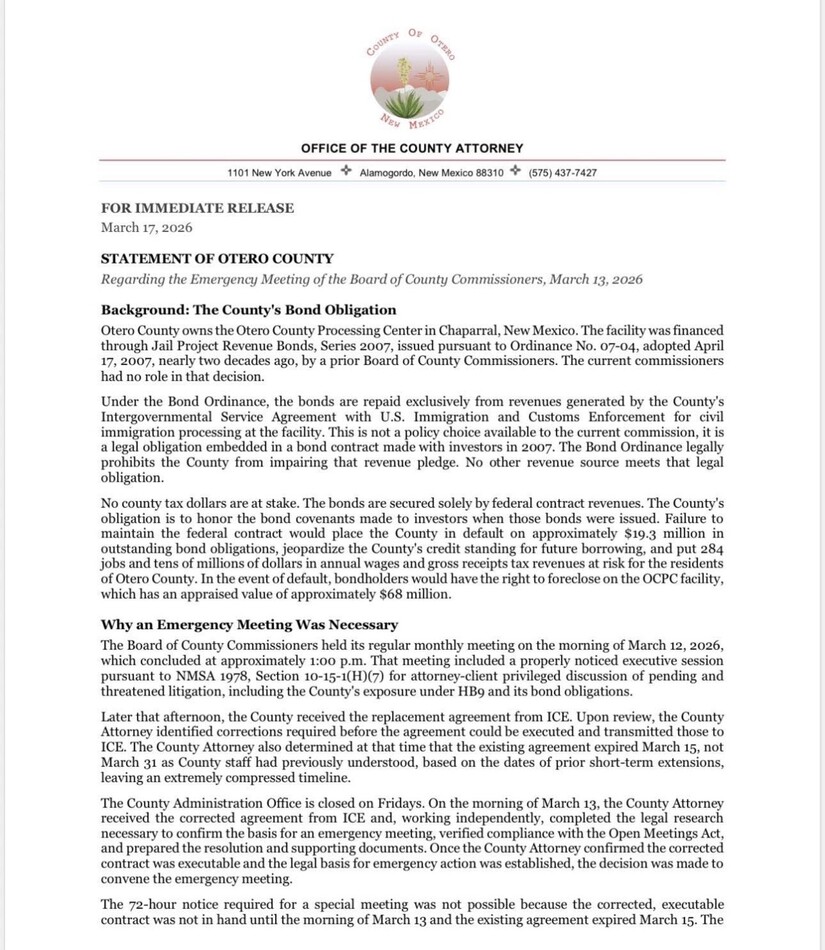
In a statement provided by County Attorney R.B. Nichols, Otero County has defended its actions and addressed several of Rep. Silva’s specific allegations:
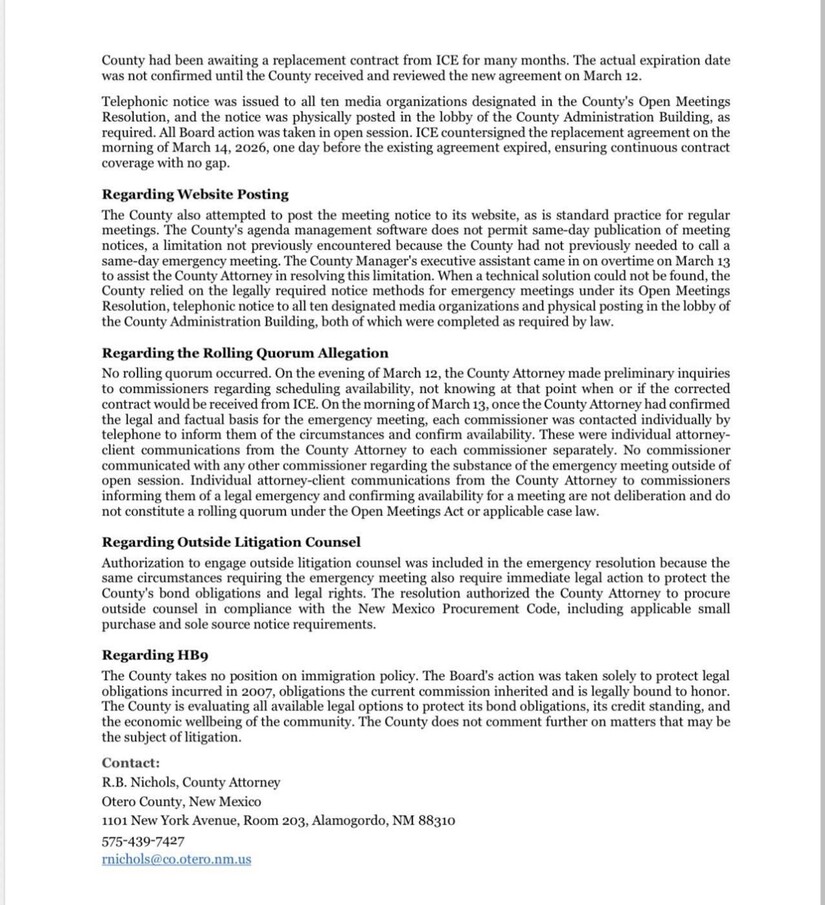
"The county had been awaiting a replacement contract from ICE for many months, with the actual expiration date not confirmed until the new agreement was received and reviewed on March 12. Telephonic notice was issued to all ten designated media organizations, and physical notice was posted in the lobby of the County Administration Building, as required by law for emergency meetings. All board action occurred in open session. ICE countersigned the replacement agreement on the morning of March 14, 2026—one day before the existing agreement expired—ensuring no gap in coverage.
Regarding website posting, the county attempted to post the notice online as standard practice, but its agenda management software does not permit same-day publication for emergency notices—a limitation not previously encountered. When no technical workaround was found, the county relied on the legally required methods for emergency meetings under the Open Meetings Act: telephonic notice to media and physical posting in the lobby, both of which were completed.
On the rolling quorum allegation, Nichols stated that no rolling quorum occurred. On the evening of March 12, the county attorney made preliminary inquiries about commissioners’ scheduling availability, without knowing when the contract would arrive. On the morning of March 13, once the legal and factual basis for the emergency was confirmed, each commissioner was contacted individually by telephone to inform them of the circumstances and confirm availability. These were separate attorney-client communications; no commissioners discussed the substance of the meeting with each other outside open session. Such individual communications do not constitute deliberation or a rolling quorum under the Open Meetings Act or applicable case law.
Authorization to engage outside litigation counsel was included in the resolution because the same circumstances necessitating the emergency meeting also require immediate legal action to protect the county’s bond obligations. The resolution authorizes the county attorney to procure outside counsel in compliance with New Mexico Procurement Code requirements, including small purchase and sole source provisions.
Regarding HB9, the county takes no position on immigration policy. The board’s action was taken solely to protect legal obligations incurred in 2007, which the current commission inherited and is legally bound to honor. The county is evaluating all available legal options to protect its bond obligations, credit standing, and the economic well-being of the community. The county declined to comment further on matters that may be the subject of litigation.
Contact: R.B. Nichols, County Attorney, Otero County, New Mexico; 1101 New York Avenue, Room 203, Alamogordo, NM 88310; 575-439-7427; rnichols@co.otero.nm.us"
Of note, Commissioner Amy Barela also serves as Chair of the Republican Party of New Mexico, a position she assumed in late 2024. Barela is currently embroiled in internal party controversy, including defiance of calls to resign amid a contested primary race for her own Otero County Commission District 2 seat in the upcoming 2026 elections. Reports highlight deepening rifts within the state GOP, with Barela facing challenges from within her party over leadership and local political dynamics.
This story will be updated as the Attorney General’s office responds or further developments occur.

Thank you for speaking up & demanding an investigation. Thanks for standing up for the people.

a deal originally entered into creating substantial public debt - without any sort of bond election. now revealed that the leasing entity is less than forthcoming in their handling of the terms - and that public and political approval for the basic mission of this enterprise has evaporated.... perhaps an ad on craigslist, or facebook marketplace - "get in on a ground floor opportunity, an investment in a growth market! a state of the art facility, fully stocked and completely operational, ideal location, solid contract client, a great passive investment - contact __________ at otero county!" Blue Skies
Once again, Governor clown shoes taking funds from the people of New Mexico simply because her and the rest of the blue crew couldnt get a cut.



Sunny, with a high of 81 and low of 62 degrees. Sunny for the morning, patchy rain nearby in the afternoon and evening, clear overnight.


Having the Sierra Club endorse you is like drinking the runoff from a lithium mine they spent a decade blocking—then calling the metallic taste “sustainability.” This phoney has a really bad dye job.
Just because you do not like someone does not make them phony.
kinda like not liking the blue kool aid so you hate all the kool aid. Besides doesn’t the editor have a vested interest in her campaign?





as per occam's razor, the simplest explanation for stonewalling a request this basic and straight forward, is that transparency will cast a bad light on lincoln county, and/or the entity they pay to run their jail.
The Albuquerque Journal (9/20/26, page C3) has a column written by Jacob Candelaria that is titled "A blacklist for people who ask too many questions". Basically, in 2025, our NM Legislators were debating House Bill 139 would have let any public body petition to have a person designated as "vexatious", and person's