80° and Partly Cloudy
Image
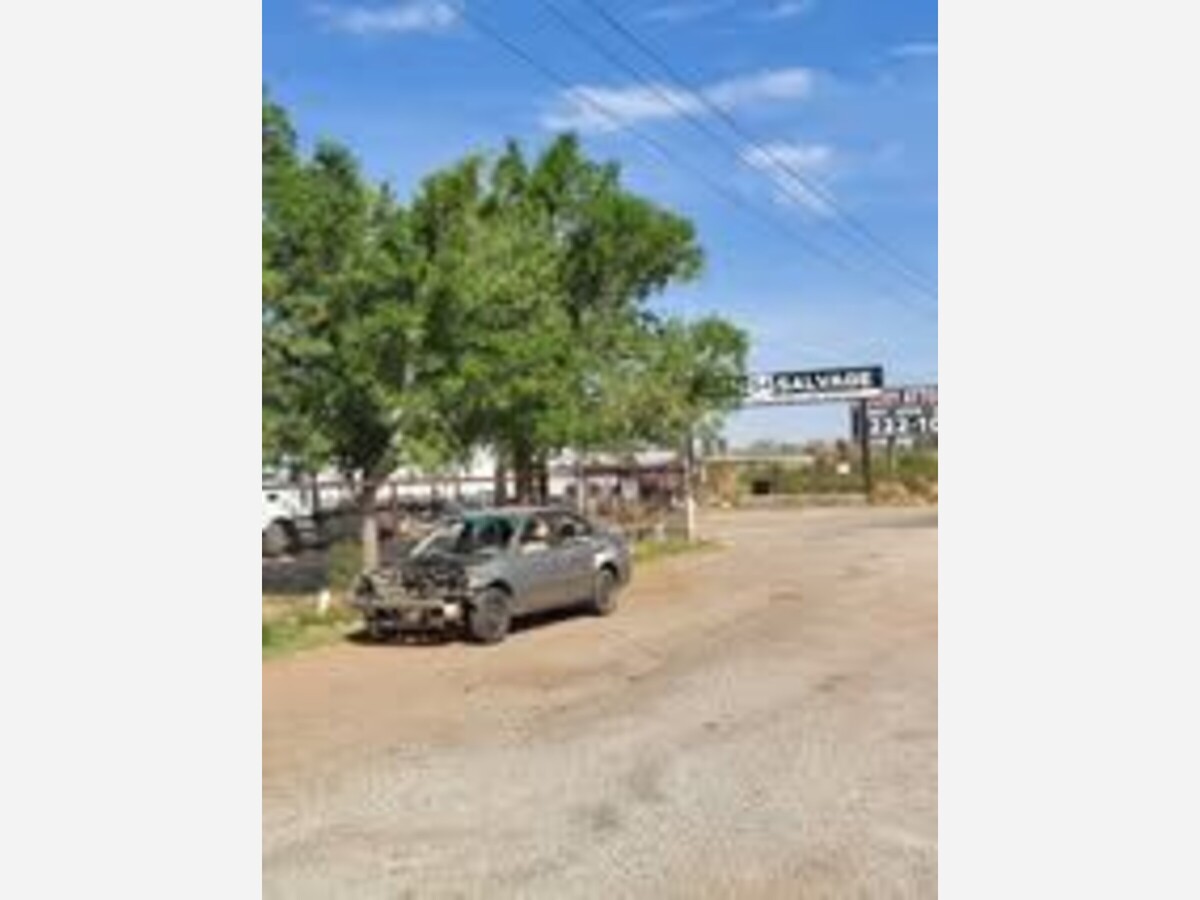



Otero County commissioners are weighing Ordinance No. 26-01, a comprehensive overhaul of rules governing junked, abandoned, and inoperable vehicles in unincorporated areas. Supporters say the update is essential for stronger enforcement of long-ignored nuisance problems that affect property values, public safety, and neighborhood appearance. Critics, however, warn that the proposal expands government power over private land while raising serious questions about who stands to benefit — and whether elected officials with potential conflicts should have stepped aside from the discussion.
The ordinance, listed as agenda item tied to submittal 33104, would fully replace and supersede the existing Chapter 220 (last amended as Ordinance No. 25-03 in April 2025, which itself updated earlier versions from 2003 and 1991). It introduces two independent enforcement tracks and a series of procedural and penalty changes.
Key Proposed Changes
Dual Enforcement Tracks: The current system relies entirely on Magistrate Court citations. The new ordinance adds a standalone administrative notice-and-abate process (Sections 4–9). Code enforcement officers can issue a Notice of Violation with a 15–30 day compliance period. Property owners may request an administrative hearing, submit a Voluntary Compliance Action Plan (up to 90 days), or remove the vehicles. If unresolved, the county can remove the vehicles and place a lien on the real property to recover costs, with a hardship waiver option. The criminal court track remains available in parallel.
Tiered Penalties: First, second, and third violations become fine-only ($100–$300 range) with explicit language stating no jail time attaches, avoiding requirements for appointed counsel or jury trials. A fourth or subsequent violation within 24 months escalates to an aggravated offense (up to 90 days jail with full due-process protections).
Expanded Definitions and Exemptions: The proposal broadens coverage to explicitly include “abandoned” and “inoperable” vehicles alongside junked ones. It also strengthens property-rights protections with ten exemptions, including:
Under the existing ordinance, a junked vehicle is generally one that is dilapidated, wrecked, dismantled, inoperable for 120+ days, without valid plates, or failing safety standards. It is unlawful to keep such a vehicle visible from any public place. Enforcement requires court action, with fines of $100–$300 and a 20-day removal window before county removal at the owner’s expense. Exemptions exist but are narrower, particularly for collectors.
Controversy Over Private Property Rights
While county legal staff highlight the ordinance’s “broad property rights protections” and more teeth to exemptions, many rural residents fear overreach. The administrative fast-track allows quicker removal and liens without initial court oversight, raising due-process concerns. Social media users in groups such as “Alamogordo Eyes and Ears” have repeatedly voiced alarm: “If you live in the county and happen to have what sounds like even 1 vehicle on your property that you are possibly working on or storing it whatever…” Hobbyists, project-car owners, mechanics, and ranchers worry that subjective enforcement could target legitimate private property uses. The visibility-from-public-place rule and broadened “inoperable” definition add to fears that one project vehicle could trigger county action and costly liens.
Conflict-of-Interest Questions Surround Commissioner Amy Barela — Now Amplified by Statewide GOP Ethics Crisis
The debate has intensified because Commissioner Amy Barela (District 2), who also serves as New Mexico Republican Party chairwoman, has actively supported the measure. Barela and her family own towing companies and an auto salvage yard in the area. The Otero County Sheriff’s Office contracts with licensed towing operators to include Barela's for impoundments and removals of junked or abandoned vehicles — work that could increase under stricter enforcement and the new nuisance-per-se declaration against unlicensed salvage operations.
Residents and online commentators have asked whether Barela should have recused herself from discussions or votes to avoid any appearance of personal financial benefit. Photos circulating on local Facebook groups show what appears to be a junked or inoperable vehicle parked near one of her business locations, prompting accusations of selective standards.
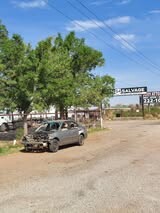 Photos circulating on local Facebook groups show what appears to be a junked or inoperable vehicle parked near Amy Barel's business locations, prompting accusations of selective standards - Online Public Submitted Photo.
Those questions now sit against a backdrop of broader ethics controversies that have engulfed Barela since she became state party chair in 2024. S
Barela is currently in the midst of a heated ethics dispute over her dual role: Barela filed for re-election to her Otero County Commission seat on March 10, 2026, at 9:06 a.m. Two minutes later, Johnathon Emery — a longtime Otero County Sheriff’s Office deputy and IT specialist — filed as her Republican challenger in the June 2, 2026 primary. They were both in line at the same time and processing paperwork at the same time per witnesses at the Clerks office.
Republican Party of New Mexico Uniform State Rule 1-4-4 states that if the state chair “files as a candidate for public office and there is another Republican who has filed for the same office, the state officer shall immediately vacate the party office.” Barela has refused to step down, citing a loyalist commissioned third-party parliamentarian review that found the rule does not apply because she filed first. At least fifteen county Republican organizations — including Bernalillo, Sierra, and Sandoval — have publicly demanded her resignation or temporary step-aside, arguing the refusal violates the spirit of the rules, creates an unfair advantage, and undermines ethical standards. Twenty Two organizations of 2/3'rds of the counties have committed to a June 18th meeting and vote of the SCC.
The standoff has created a deep divide within the Republican Party of New Mexico over rule interpretation, leadership precedent, and Barela’s personal example on ethics. Critics within the party call it a textbook case of self-interest with a middle finger flying against party rules; supporters say the technical timing of the filings clears her. The controversy has played out publicly on social media and in dueling statements, and within the independent and mainstream press further eroding trust in party leadership.
This latest newest chapter fits a pattern. The junk-vehicle ordinance debate has revived parallel concerns about consistent ethics standards on the Otero County commission. Commissioner Vickie Marquardt, who is related to Sheriff David Black, has never recused herself from votes on sheriff’s office budget increases or salary adjustments despite the family connection. Critics argue that such non-recusals set a precedent that weakens public trust when similar potential conflicts — whether personal business interests, towing/salvage contracts, or party leadership roles — arise.
These acts undermine public trust at a time when Otero County faces persistent audit deficiencies, questions of proper fiscal oversight, and the threat of financial crisis. Recent audits have repeatedly identified material weaknesses in internal controls, financial reporting, cash reconciliations, and federal grant compliance, with significant adjustments required and ongoing state monitoring of the county’s financial management. Combined with potential revenue shortfalls from the impending loss of ICE detention contracts and related bond obligations, these issues heighten concerns about accountability in county decision-making.
Social Media Feedback Reflects Deep Divisions
Posts in “Alamogordo Eyes and Ears” and other local groups have generated significant engagement. Supporters argue that years of lax enforcement have allowed blight, fire hazards, vandalism risks, and declining property values to persist, and that clearer rules with better tools are overdue. Opponents counter that the administrative process, lien authority, and nuisance-per-se provision against unlicensed salvage operations tilt power too far toward county government and contracted services, disproportionately affecting working-class landowners while potentially benefiting licensed towing and salvage operators such as Barela— especially when championed by an official already facing ethics questions at the state party level.
What’s Next?
The Board of County Commissioners has scheduled public hearings on Ordinance 26-01. Residents can review the full submittal and proposed text through Otero County agenda materials. Public comment will help determine whether additional clarifications, stronger exemptions, or other amendments are added before any final vote. Email the commissioners and participate in public comment with your thoughts pro or con and concerning the ethics questions raised.
As discussions continue, the core tension remains: balancing the need for cleaner communities against robust protections for what individuals can lawfully store and work on behind their own property lines — while ensuring the officials writing the rules are held to the highest standards of ethics and transparency, both locally and at the state party level. Stay tuned to AlamogordoTownNews.org for further developments.

i would suggest the provision for yard art be pretty broadly worded. a lot of folks out here in the hinderlands - high rolls, mtn park, timberon, etc. - are not likely to appreciate county officials critiquing their homeplaces - certainly not a job i would want.
a well stated article - constitutional lawsuits bring questions such as this into sharp focus - as well they should.

Sunny, with a high of 106 and low of 80 degrees. Sunny in the morning, clear for the afternoon and evening,

70 in a 35, poor person un the Honda didn't have a chance.
vehicular homicide indeed.
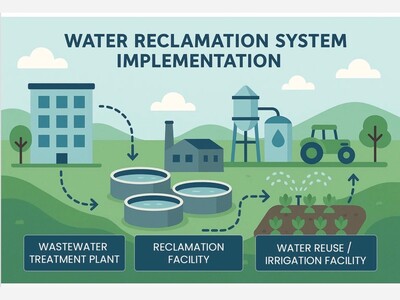
the long term drought conditions serve to underline the importance of long-term vision and planning to meet future water needs.
Now, if there was some way to collect all the storm runoff that goes out to the desert
any water distribution built with schedule 20 pvc piping, has been "a public utility emergency" since it was constructed. the fact that it lasted as long as it has is incredible.
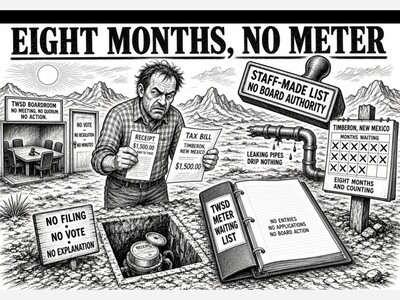
ultimately the price for poor management practices will be equally borne by every property owner in that community - except those who have private wells, i suppose. but even those folks will have a smaller pool of prospective buyers....makes it sound kinda like socialism doesn't it?

I hope Dr. Hernandez is a guest speaker at an upcoming meeting of the Mayor's Youth Advisory Commission. She has so much wisdom and experience to pass on to younger generations.
It's the product of living in a lowly bubble: an immature, undeveloped writing style that has no insight or reasonable conclusion. Those PhD's from Watsamatta U in New Mexico are only a union card for activists to rally 'round and a far cry from what $200k a year should buy.
Your excellence at writing a reply show that you are an intelligent and urbane fellow. Whatever, get me my fries bro.