


Image
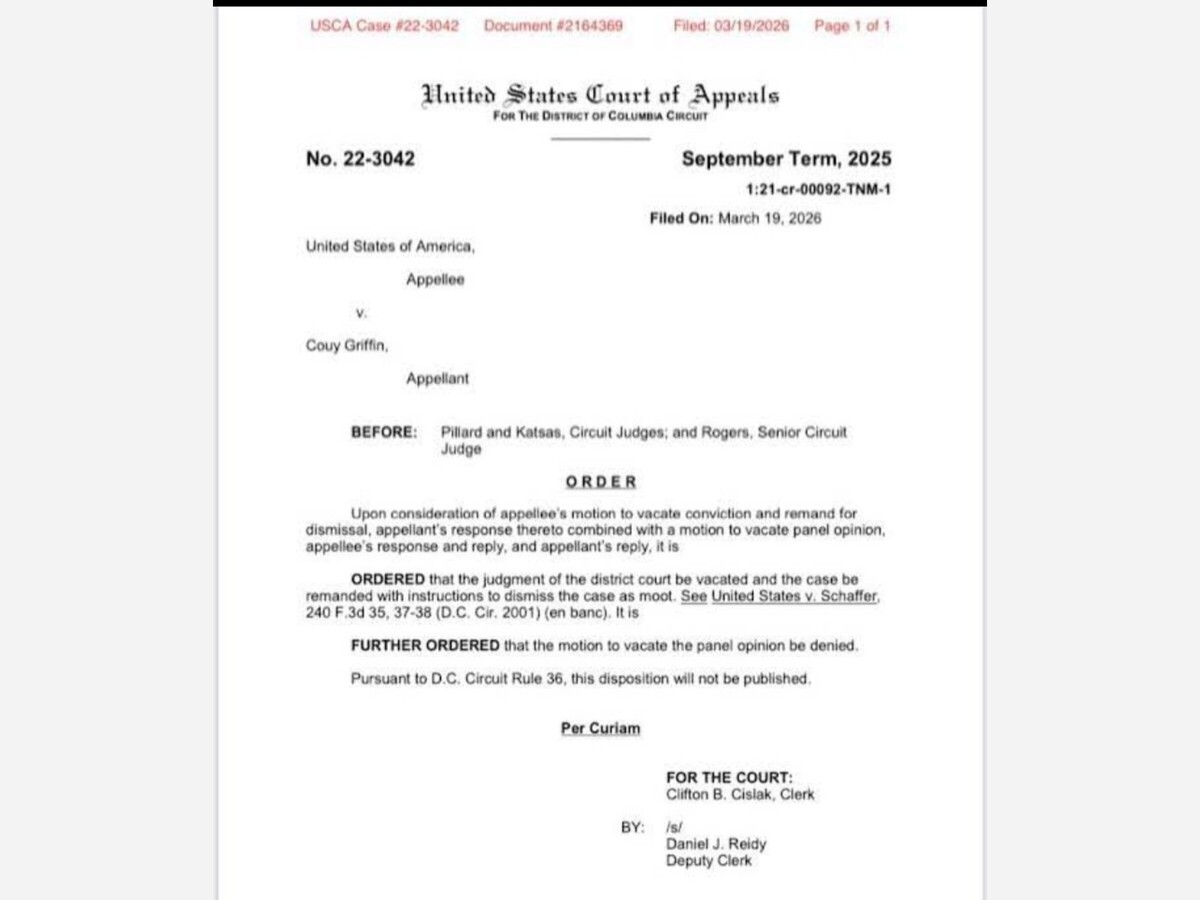
A federal appeals court has vacated the criminal conviction of former Otero County Commissioner Couy Griffin, but the ruling does not restore his ability to hold public office and leaves his political future in doubt.
In an order issued March 19, the United States Court of Appeals for the District of Columbia Circuit set aside Griffin’s misdemeanor conviction related to his presence on restricted grounds during the January 6 United States Capitol attack. The court also directed that the case be dismissed as moot, a legal determination used when a dispute no longer presents an active controversy.
Griffin had already served his sentence by the time the appeal was considered. Under longstanding legal principles, including those outlined in United States v. Schaffer, courts often vacate lower court judgments in such circumstances to prevent an unreviewable conviction from remaining on the books.
The ruling, however, does not address the merits of Griffin’s conduct and does not amount to a declaration of innocence. Instead, it reflects the court’s conclusion that it could no longer provide meaningful relief.
More significantly for Griffin, the decision has no direct impact on the separate civil case that removed him from office in New Mexico. In that proceeding, a state judge found Griffin had engaged in insurrection and was therefore disqualified from holding public office under Fourteenth Amendment Section 3.
That constitutional provision, adopted after the Civil War, bars individuals who have engaged in insurrection against the United States from serving in government. The case against Griffin was brought by the watchdog group Citizens for Responsibility and Ethics in Washington and marked one of the first successful uses of the clause in connection with the events of Jan. 6.
Legal analysts note that the standards in the civil disqualification case differ from those in a criminal prosecution. While criminal cases require proof beyond a reasonable doubt, civil courts apply a lower threshold and do not require a criminal conviction to reach their conclusions.
As a result, the appeals court’s action does not automatically undo Griffin’s removal from office or restore his eligibility to run again. The state court judgment remains in effect unless it is overturned through further legal challenges.
Griffin could attempt to reenter politics by appealing the disqualification ruling or by filing to run for office and prompting a new legal dispute. However, such efforts would likely face significant legal hurdles, particularly given the existing court findings regarding his actions on Jan. 6.
The appeals court also declined a request to vacate a prior panel opinion in the case, allowing its legal reasoning to remain intact, even as Griffin’s conviction itself has been erased.
For now, the ruling closes the federal criminal case but leaves unresolved the broader question of Griffin’s political future—one that would require additional litigation to answer.
Otero County Commissioner and State Republican Chair commented: “It is great when someone stands on their convictions and they are justified by the due process set forth. It is unfortunate that it took this long for Couy and all he has had to endured.”
A live interview with a Mr Griffin will be posted later today.


Sunny, with a high of 81 and low of 62 degrees. Sunny for the morning, patchy rain nearby in the afternoon and evening, clear overnight.




Having the Sierra Club endorse you is like drinking the runoff from a lithium mine they spent a decade blocking—then calling the metallic taste “sustainability.” This phoney has a really bad dye job.
Just because you do not like someone does not make them phony.
kinda like not liking the blue kool aid so you hate all the kool aid. Besides doesn’t the editor have a vested interest in her campaign?





as per occam's razor, the simplest explanation for stonewalling a request this basic and straight forward, is that transparency will cast a bad light on lincoln county, and/or the entity they pay to run their jail.
The Albuquerque Journal (9/20/26, page C3) has a column written by Jacob Candelaria that is titled "A blacklist for people who ask too many questions". Basically, in 2025, our NM Legislators were debating House Bill 139 would have let any public body petition to have a person designated as "vexatious", and person's