
Image
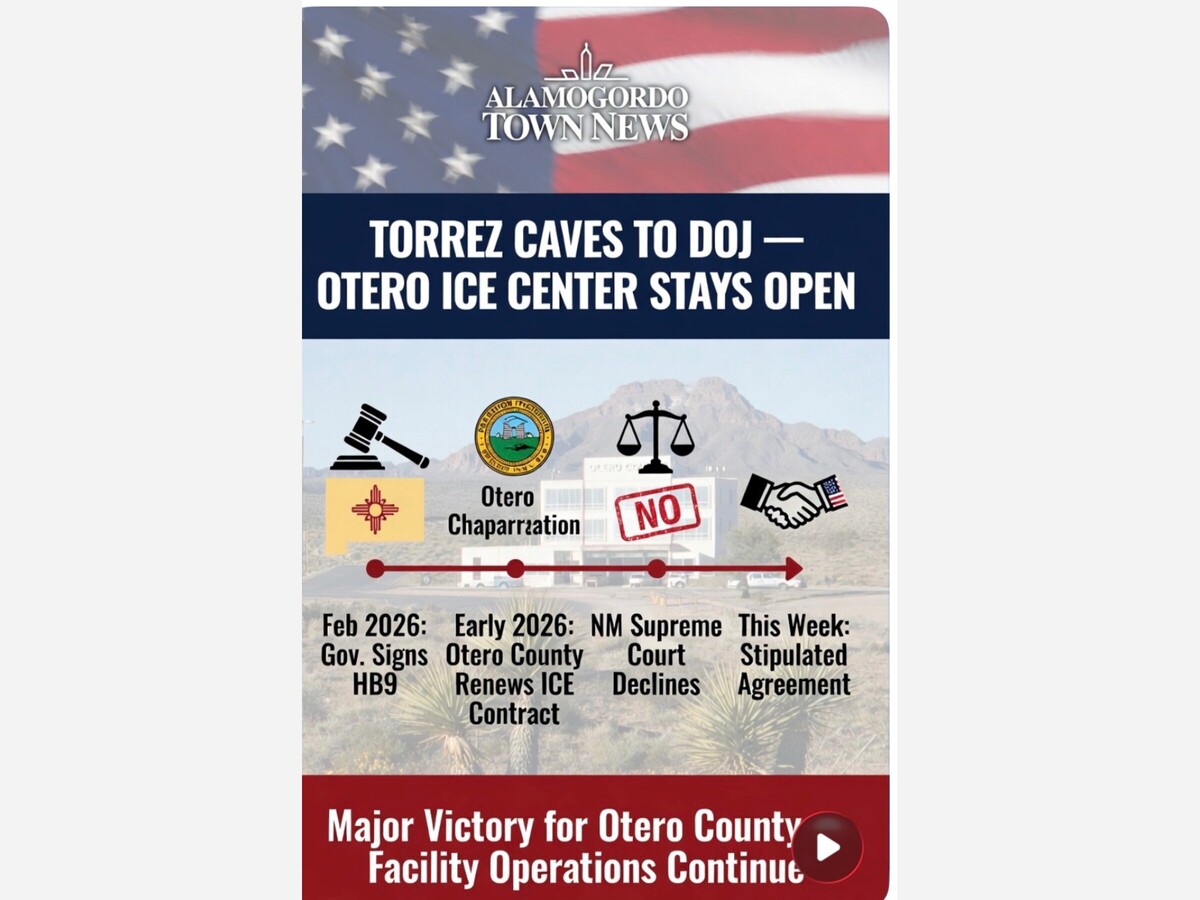



ALAMOGORDO, N.M. — It’s official: New Mexico Attorney General Raúl Torrez has blinked.
After months of legal maneuvering, political pressure, and a stinging rebuke from the state’s own Supreme Court, Torrez and the New Mexico Department of Justice have agreed to temporarily halt all enforcement of House Bill 9 against the Otero County Processing Center in Chaparral. The agreement was filed in federal court this week — and for Otero County, it’s nothing short of a major victory.
How We Got Here: The Full Timeline
February 2026 — The Law That Started It All.
Governor Michelle Lujan Grisham signed House Bill 9 — officially dubbed the Immigrant Safety Act — into law. The measure, set to take effect May 20, 2026, flatly banned state and local governments from entering into or maintaining contracts with U.S. Immigration and Customs Enforcement for civil immigration detention. For Otero County, whose economy has long leaned on the processing center as one of its most significant employers and economic engines, the law landed like a gut punch.
Early 2026 — Otero County Fights Back
Otero County commissioners weren’t about to go quietly. In an emergency session, the county commission voted to renew its intergovernmental service agreement with ICE — a direct act of defiance against the incoming law and a clear signal that local leaders intended to protect their community’s livelihoods and their partnership with federal immigration authorities.
Torrez Moves on the County
With the ink barely dry on the county’s renewed ICE contract, AG Torrez took his fight to the New Mexico Supreme Court, petitioning the state’s highest bench to block Otero County’s agreement with ICE. It was an aggressive move — and it backfired badly.
The New Mexico Supreme Court Says No
The state Supreme Court declined to intervene, handing Torrez one of the most visible legal losses of his tenure. The ruling cleared the way for Otero County to keep its ICE contract intact — at least for the moment — and sent a clear message that the courts weren’t prepared to do the AG’s heavy lifting on HB9.
The DOJ Steps Into the Ring
The legal landscape shifted dramatically when the U.S. Department of Justice filed a federal lawsuit directly against the State of New Mexico and Governor Lujan Grisham. Federal attorneys argued that HB9 is flatly unconstitutional — that a state law cannot override federal immigration authority, and that blocking the Otero facility’s operations would cause real, immediate harm to federal enforcement efforts. Washington, in other words, went over Torrez’s head and straight to federal court.
This Week — Torrez Signs the Stipulated Agreement
Facing federal legal firepower and a losing record in state court, Torrez’s office reached a stipulated agreement with the DOJ. Under the terms of the deal:
• The State of New Mexico will not pursue any civil enforcement actions against Otero County’s existing ICE contract.
• The pause holds until a final judgment is reached on the merits in federal court.
• The state admits no fault or liability regarding HB9’s constitutionality.
• In exchange, the DOJ is dropping its request for an immediate court order blocking the law.
Translation: Torrez agreed to stand down. The Otero County Processing Center stays open, its workers keep their jobs, and the federal government keeps its detention operations running — while the bigger constitutional battle plays out in court.
What Otero County Is Saying
Alamogordo Town News reached out directly to Otero County Attorney R.B. Nichols for comment and copied the County CEO Heltner on the inquiry. Nichols responded:
“Given the pending litigation, the County has no comment at this time. V/r, RB”
Short and measured — exactly what you’d expect from a county that knows it’s winning and sees no reason to spike the football.
A Dissenting View: Not Everyone Is Celebrating
Not all voices in the community see the continued operation of the Otero County Processing Center as cause for celebration. Immigration advocates, civil liberties organizations, and some local residents have long raised concerns about both the county’s reliance on the ICE contract and the broader model of privately operated detention facilities.
Critics argue that tying a county’s economic health to the incarceration of civil immigration detainees creates a troubling incentive — one where the community’s financial interests become intertwined with the expansion of detention, rather than its reform. The facility is managed by a private contractor, a arrangement that opponents say prioritizes profit margins over the humane treatment of detainees.
Advocacy groups have documented concerns over medical care, legal access, and living conditions inside similar facilities nationally, and have called on Otero County leaders to explore economic alternatives that don’t depend on what they describe as a morally compromised revenue stream. For these residents and organizations, today’s legal outcome isn’t a victory — it’s a postponement of a reckoning they believe is still coming.
What It Means for Our Community
For residents of Otero County and the broader Alamogordo area, the practical impact is straightforward: the processing center keeps its doors open. The facility has been a cornerstone of the local economy for years, providing stable jobs and significant revenue to a region that can ill afford to lose either. That reality is safe — for now.
The larger constitutional questions surrounding HB9 are far from settled. judges will ultimately decide whether New Mexico’s law unlawfully intrudes on federal immigration powers. That fight could take months, possibly longer.
But today, in this community, the score reads: Otero County – 1, Santa Fe – 0.
This story is continuing to develop. Alamogordo Town News and KALHRadio.org will continue to monitor the federal proceedings and bring you updates as they become available. Have a tip or information related to this story or others? Reach out to us directly on our tip line ChrisEdwards@KALHRadio.org

Just think, if there was no illegal immigration. The funds spent on this endeavor could be used to assist people immigrating legally. Plus, Grisham is a hypocrite
Yes!
a friendly reminder that although this five-year contract appears safe, it will expire on 05/01/2031. that means it's renewal will occur just over halfway through the next presidential term. the crystal ball is hazy - but that could easily be a democratic administration - in which case the trump worshipers will be gone from the dept. of justice. all of them, from the top to bottom...some may well be in prison. with them gone, otero county's permission slip will be null and void - contingent plans would be wise.



Sunny, with a high of 79 and low of 61 degrees. Sunny in the morning, clear during the afternoon and evening,


Having the Sierra Club endorse you is like drinking the runoff from a lithium mine they spent a decade blocking—then calling the metallic taste “sustainability.” This phoney has a really bad dye job.
Just because you do not like someone does not make them phony.
kinda like not liking the blue kool aid so you hate all the kool aid. Besides doesn’t the editor have a vested interest in her campaign?





as per occam's razor, the simplest explanation for stonewalling a request this basic and straight forward, is that transparency will cast a bad light on lincoln county, and/or the entity they pay to run their jail.
The Albuquerque Journal (9/20/26, page C3) has a column written by Jacob Candelaria that is titled "A blacklist for people who ask too many questions". Basically, in 2025, our NM Legislators were debating House Bill 139 would have let any public body petition to have a person designated as "vexatious", and person's



like 99% of his fellow republicans, block is a servant to the oil & gas industry - a principal constituent of their party.