Image



Two outside investigations obtained through public records requests describe a pattern of years of commissioners pressuring city employees over code enforcement, a "tainted" recruitment the investigator warned could be called discriminatory, and a pattern that has coincided with settlements and the departure of two city managers. Next Tuesday, the commission decides whether to examine a new complaint against one of its own.
Earlier this year, during public comments at an Alamogordo City Commission meeting, Commissioner Josh Rardin told former Mayor Susan Payne that two outside investigation reports into commission conduct would never be released.
Excerpts from both reports are now public. 2nd Life Media Alamogordo Town News obtained them through persistent public records requests and challenges under the New Mexico Inspection of Public Records Act.
Both were written by attorney Clara B. Burns of the law firm Kemp Smith LLP. The first, dated Dec. 22, 2023, examined allegations by former City Manager Brian Cesar. The second, dated July 3, 2025, examined whether the search for a permanent city manager was biased against Acting City Manager Dr. Stephanie Hernandez. Commissioner John Rardin is named in both.
In the first report, Burns found that commissioners had broken the city's own Code of Conduct by going around the city manager to pressure employees.
In the second, she concluded that the recruitment had been compromised and warned that it exposed the city to a discrimination claim.
Both city managers at the center of these reports have since left under settlement agreements.
The reports surface as the commission again faces the question of whether it will hold its own members accountable.
On Tuesday, Sept. 22, commissioners will vote on whether a Code of Conduct complaint against Commissioner Alfonso "Al" Hernandez can move forward. A panel of his fellow commissioners has already recommended dropping it on a 2–1 vote.
Who complained, and in what role prior?
Brian Cesar, former City Manager. Under the City Charter, the city manager is the city's chief executive officer, responsible for enforcing ordinances and hiring and firing employees. On April 11, 2023, Cesar sent a letter to then-Mayor Payne alleging a continued pattern of commissioners violating the Charter, the city's ordinances and the Code of Conduct. According to the report, the letter said commissioners inserted themselves into daily operations and demanded code violations to benefit themselves, friends, family and business partners, at the risk of his job. The city placed his evaluation on an agenda around the same time. Instead of an evaluation, Cesar negotiated a retirement and settlement agreement that required him to cooperate with an investigation. His written answers, dated Oct. 26, 2023, were signed before a notary.
City employees. Burns interviewed current employees whose identities she kept anonymous "to the extent practical" because of their concerns about retaliation. Their accounts supplied much of the evidence behind the credible findings.
Dr. Stephanie Hernandez, Acting City Manager. In 2025, Hernandez was not the complainant. The report says she did not request the investigation and was opposed to it, fearing it "would place a target on her back," though she cooperated. Then-Mayor Payne and then-Mayor Pro Tem Sharon McDonald, now mayor, raised concerns about Josh Rardin to the investigator. McDonald said a former city commissioner had reported Rardin's comments to her.
2023: "Very aggressive" with staff
Cesar's central claim was that commissioners with ties to the building industry pressured city staff to bend codes and standards for developers. Burns found that claim credible. She relied on the accounts of city employees:
“City employees stated that [the former commissioner] was very aggressive with them in his pursuit of exceptions to existing codes or standards on behalf of developers. Employees also stated that Commissioner Rardin had been very aggressive with them in pursuit of exceptions to codes and standards on behalf of developers and other businesses. Employees reported that they feel that their jobs are in jeopardy when Commissioners directly interact with them and are critical of their performance.” — Kemp Smith report, Dec. 22, 2023
Burns found that this conduct broke the city's rules:
“The direct contact by commissioners with City employees in which commissioners attempt to influence how business is conducted violates the Code of Conduct, including the prohibition of engaging in executive management functions and prohibition against conduct that creates an appearance of impropriety. It also affects the public trust by creating a perception of misuse of public positions.” — Kemp Smith report, Dec. 22, 2023
The city's Code of Conduct, Ordinance 2-02-060, bars the commission from running city operations. In a December 2022 email included as an exhibit to the report, then-City Attorney Ashley Smith quoted subsection (q) to a commissioner:
“The Governing Body shall not perform general executive management functions in the administration of city government; these functions shall be delegated to the City Manager…” — Ordinance 2-02-060(q), as quoted by the City Attorney
The former commissioner, who was Mayor Pro Tem in 2023 and is no longer in public office, co-owns a local contracting business with his brother. He denied any financial interest in the subdivisions at issue, but acknowledged that his company does work for the city and local businesses and said he abstains from related votes. He told Burns he had discussed a developer's utilities and paving issue with the Public Works inspector and director, both of whom he felt were not being "business-friendly."
Pressure on the inspector and "substandard work"
Cesar alleged that the city's Public Works inspector and two directors were targeted by the former commissioner. Employee accounts supported the allegation:
“One employee indicated that [the former commissioner] pressured the approval of substandard work in a subdivision and the employee stopped dealing with [the former commissioner] because he was so combative.” — Kemp Smith report, Dec. 22, 2023
“Several commissioners interviewed confirmed that commissioners involved in the building industry have been openly critical of the Utilities and Public Works staff.” — Kemp Smith report, Dec. 22, 2023
The former commissioner denied any verbal abuse but said he had expressed frustration over code enforcement. Burns concluded:
“Mr. Cesar's allegation that elected officials have interfered with the management functions of the City and have attempted to influence how codes and ordinances should be applied is a credible allegation. This conduct by the elected officials identified in this allegation creates an appearance of impropriety and affects the public trust by creating a perception of misuse of public positions.” — Kemp Smith report, Dec. 22, 2023
The "cheater pipe"
Cesar alleged that after the Public Works inspector found a "cheater pipe" installed in a water meter by the former commissioner's company, the former commissioner contacted him about it. In his notarized statement, Cesar said the discovery followed standard procedure: Water Billing was notified, and they notified the Alamogordo Police Department. The report records the former commissioner's account:
“[The former commissioner] acknowledged that a “cheater pipe” was found and that he called the former City Attorney to let her know. He claimed that other contractors also used cheater pipes. … He also questioned whether the Utilities Director ever worked because his employees reported that the Director's truck was always at his house. The Utilities Director was aware that photos were taken of him by employees of [the former commissioner's company] while he was on leave.” — Kemp Smith report, Dec. 22, 2023
Burns found the allegation credible:
“Elected officials should not interfere with or attempt to influence code enforcement. Mr. Cesar's allegations of such interference and efforts to influence are credible.” — Kemp Smith report, Dec. 22, 2023
Commissioner by commissioner: the 2023 and 2025 findings
Burns did not sustain every allegation. The table below summarizes each official, the allegations against them, and her findings.
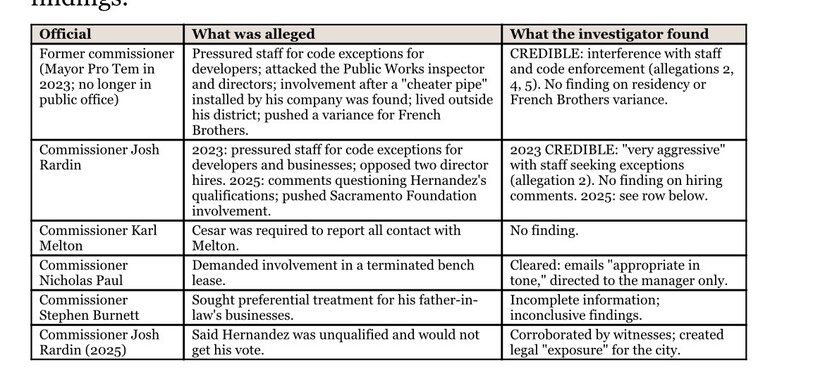
The 2023 report also addressed a sexual harassment allegation. A former city attorney reported in her exit interview that a commissioner alleged by other staff as being, Josh Rardin, had engaged in sexual harassment. The Burns report does not name the commissioner but multiple staff had collaborated it was a “well known unspoken secret it was Josh Rardin”. Burns found no violations by the then mayor Susan Payne of any rules violations related to the handling of the harassment complaint and wrote that Cesar, as the city attorney's supervisor, "should have ensured that steps were taken to investigate it."
The report does not indicate that the allegation was ever investigated internally or in detail as a part of her inquiry.
In his notarized statement, Cesar wrote that the same commissioner later made remarks in front of the former city attorney and staff.
Burns summarized her 2023 findings this way:
“In summary, the allegations found to be credible involved conduct by Commission members in which they were directly interceding in day-to-day operations of the City and doing so with subordinate City staff members, placing those staff members in sometimes untenable positions.” — Kemp Smith report, Dec. 22, 2023
2025: "Credible evidence that the recruitment process has been tainted"
After Cesar's successor, Rick Holden, resigned on Sept. 19, 2024, due to health concerns but during a period of intense commissioner interference into his role as reported via Alamogordo Town News at the time. Dr. Stephanie Hernandez applied for the permanent job as an internal candidate. The 2025 investigation was opened over concerns that the search was biased against her. Burns set out the facts that shaped her analysis:
“She was the highest scorer in the interviews for the City Manager position and was the only passing score. She also is the only female candidate.” — Kemp Smith report, July 3, 2025
“There was corroborated evidence from witnesses that a commissioner (Rardin) made comments questioning Ms. Hernandez's qualifications and specifically suggesting she is not qualified for the position and will not receive that commissioner's vote, along with others.” — Kemp Smith report, July 3, 2025
Burns acknowledged that each commissioner may vote as they wish. She then warned of the legal risk:
“If a candidate is well-qualified, as the evidence supports that Ms. Hernandez is, and if she is the only candidate that passed the interview scoring, as she was, and she is the only female, as she was, but she is not selected, that allows for the argument that her non-selection is not legitimate but is discriminatory.” — Kemp Smith report, July 3, 2025
Witnesses named Rardin. Payne told the investigator she believed Rardin was biased against Hernandez and had pushed for the Sacramento Foundation to fund the search, which she believed was meant to intimidate Hernandez. McDonald gave the following account:
“Ms. (Redacted) reported Commissioner's Rardin's comments to Mayor Pro Tem McDonald and she reported them to the City Attorney, as she felt his comments were inappropriate.” — Kemp Smith report, July 3, 2025
McDonald also told the investigator that some commissioners appeared to treat only male candidates as acceptable, and that the "type" certain commissioners wanted appeared to be a middle-aged white man. Other commissioners disagreed. Commissioner Tapley said he had heard no biased comments, and Commissioners Burnett and Robinson called Hernandez qualified. Robinson told the investigator it was well known that some on the commission did not support her candidacy, but that he was not among them.
Burns found no evidence that the process had been tilted in Hernandez's favor as an internal candidate in fact opposite, against her and “tainted.” She recommended starting over with a search firm hired by the city, not by the Sacramento Foundation, and concluded:
“In summary, my investigation found credible evidence that the recruitment process has been tainted.” — Kemp Smith report, July 3, 2025
Settlements and departures
The reports do not by themselves establish why each official left the city. But the departures that followed track closely with the conduct they describe:
April 2023: Cesar sends his letter. Instead of the scheduled evaluation, he negotiates a retirement and settlement agreement with the city.• 2023: Rick Holden is hired as city manager. He resigns on Sept. 19, 2024. The 2025 report does not state his reasons.
May 2025: The city cancels the recruitment that Burns found "tainted.”
March 10, 2026: The commission votes 7–0 to open contract negotiations with Hernandez
April 28, 2026: After closed sessions, the commission votes 4–3 to accept a settlement tied to an EEOC complaint Hernandez had filed. Rardin, Burnett, Al Hernandez and Baxter Pattillo vote in favor; Mayor McDonald and Commissioners Tapley and Robinson vote against.
On May 5, the commission votes 4-3 to approve final terms that include a 60-day separation
June 30, 2026: Hernandez's last day. The city attorney also resigns, leaving both top administrative posts vacant.
In her farewell remarks, Hernandez described a recurring pattern without naming anyone. "Going around the City Manager to directors has undermined the position," she said. She told the commission she had seen the practice under multiple city managers. This testimony confirms the legal investigations findings in a public forum.
A pattern, and a commission that polices itself
Taken together, the two reports, the harassment claim described by staff, and a pending complaint against a sitting commissioner describe the same recurring problem: elected officials accused of pressuring or disparaging city employees, and a Code of Conduct process that rarely produces consequences.
The pending complaint. Item No. 10 on the Sept. 22 agenda, submitted by City Manager Robert Stockwell, asks the commission to decide whether a Code of Conduct complaint against Commissioner Al Hernandez goes forward. A three-member Preliminary Review Committee made up of fellow commissioners reviewed the four counts. Two members found "No Cause" on all four, and the third found "Cause" on all four. Because of the split, city code sends the question to the full commission. The motion needs five votes to pass, and Hernandez cannot vote. According to the agenda report, if the motion fails, "no further action on the complaint may be taken." The vote decides only whether the allegations will be examined, not whether they are true.
The airport board video. The complaint comes as a clip from a public airport board meeting circulates online. In it, Commissioner Hernandez appears to call the leader of the city employees' union "stupid" and says she is causing problems for the city. A related public records request, No. 26-1438, is on file with the city.
https://youtube.com/shorts/THi1Cm40-Rw?is=SvHAX3KDlzu_58e4
Outside counsel found problems; the commission did not. Both the 2023 and 2025 findings came from an outside attorney hired by the city, not from the commission's own review process. The 2023 report also shows how thin that process was. It said Code of Conduct complaints about workplace discrimination or harassment go to an ethics panel that had not yet been formed:
“The Code of Conduct provides that any complaint regarding workplace discrimination or harassment in violation of the Code of Conduct should be presented to the ethics panel (which is to be created under the Code of Conduct) by delivering a complaint to the City Attorney's office.” — Kemp Smith report, Dec. 22, 2023
On the former city attorney's harassment report, Burns found "no clear guidance from the Code of Conduct on how the complaint should be handled." The Code of Conduct itself, the report notes, prohibits elected officials from harassing anyone or retaliating against anyone who has complained of a violation.
Some commissioners resisted the code from the start. In his notarized statement, Cesar recounted that during the April 2023 executive session on his letter, Commissioner Melton said, "This is why I was against passing the Code of Conduct Ordinance." Cesar also wrote that Commissioner Rardin said, "If an investigation happens, Nancy needs to be investigated." Nancy Beshaler was the Public Works Director whom the 2023 report found commissioners had criticized directly.
Two codes, no fix. Commissioners have identified two overlapping Code of Conduct ordinances, one from 2014 and one from 2022, with inconsistent language on complaint procedures and remedies. They asked staff to merge or repeal one, and the issue came up again in 2025. The 2023 report's recommendation of regular commission training on the limits of its role appears in the record only as a recommendation. In March of 2026, under acting City Manager, Dr Hernandez the commissioners held a public meeting in which OMA compliance and conduct training was held. During that session the commissioners in question to include Josh Rardin, Al Hernandez and Stephen Burnett seemed distracted, were on their cell phones looking or texting and were not deeply engaged in the presentation.
Critics point to three structural weaknesses in the current process and with the city charter. There is no independent investigator or hearing officer.
A five-vote supermajority lets a minority of commissioners end a complaint without any public review of the evidence.
And employees who are the subject of a commissioner's conduct have no formal role in the decision.
Supporters of the system counter that commissioners answer to voters, not staff, and that a high bar protects officials from politically motivated complaints.
Residents can also take complaints outside City Hall, to the New Mexico Attorney General or the State Ethics Commission.
For employees, the stakes are the ones Burns described in 2023, when she found commissioners were placing city staff "in sometimes untenable positions."
Potential legal consequences under state and federal law
The conduct described in the reports touches several state and federal laws. What follows describes those laws in general terms. Whether any official or the city is liable would be decided by the agencies and courts that enforce them.
Title VII of the Civil Rights Act (federal). Title VII bars employers, including cities, from refusing to hire someone because of sex or national origin. It is enforced through complaints to the Equal Employment Opportunity Commission, the process Hernandez used. Burns's warning that Hernandez's non-selection could be argued to be "discriminatory" describes this kind of claim. Title VII contains exceptions for certain policy-level appointees of elected officials, and how those exceptions apply to a city manager is a question for attorneys.
New Mexico Human Rights Act (NMSA 1978, § 28-1-7). The state law separately prohibits hiring discrimination based on sex, national origin and other protected traits. Complaints go through the state Human Rights Bureau, and remedies can include damages and attorney fees.
U.S. Constitution, Equal Protection Clause (42 U.S.C. § 1983). Government officials acting in their official roles can face federal civil-rights suits alleging intentional sex discrimination in public employment decisions.
New Mexico Whistleblower Protection Act (NMSA 1978, §§ 10-16C-1 to -6). Public employers may not retaliate against employees who report unlawful or improper conduct. Remedies include reinstatement, double back pay and attorney fees. The employees who told Burns they feared for their jobs, and Cesar's written complaint about commission conduct, are the kinds of reports the law protects.
New Mexico Public Employee Bargaining Act (NMSA 1978, § 10-7E-19). Public employers may not interfere with, restrain or coerce employees in exercising their collective bargaining rights, or discriminate against them for union activity. When an elected official publicly disparages a union leader in an official meeting, the legal exposure falls on the city, not on the official personally.
New Mexico Governmental Conduct Act (NMSA 1978, § 10-16-1 et seq.). The act requires public officers to treat their office as a public trust and to use their powers for the public interest, not private gain. It also restricts official acts that affect an officer's own financial interest. The 2023 report's findings about a then commissioner whose company did work in the city he helped govern raise questions this law is designed to address.
Commission-Manager Act (NMSA 1978, § 3-14-12) and the Open Meetings Act (NMSA 1978, § 10-15-1 et seq.). Citizen complaints filed with the State Ethics Commission and the Attorney General's Office cite these laws. They allege that commissioners directed staff around the city manager and made key personnel decisions in closed session.
Under the Open Meetings Act, an action not taken in compliance with the law is invalid. Cesar's notarized statement also recounts the assistant city manager warning commissioners in April 2023 about creating a "rolling quorum" over email. Rolling quorum concerns continue and are a component of the open meetings act litigation ongoing against the city in the Case Edwards v Alamogordo City Commission being litigated in the 12th Judicial Circuit.
Inspection of Public Records Act (NMSA 1978, § 14-2-1 et seq.). Public records in New Mexico are presumed open to inspection. Agencies that wrongly withhold them can be ordered to pay damages and the requester's attorney fees.
Beyond any penalties to individual officials, the cost falls on taxpayers. Settlements with departing managers, legal defense and repeated recruitment are paid from the city's budget at taxpayer expense.

This is really good news because publicly we see that Brian Caesar is Amy Barela's cousin. Both are big fat losers who do nothing but whine and cry after riding the gravy train and doing nothing for decades. Let's Make Alamogordo Great Again and buy some Pampers for the crybabies.
Heck yeah! What size do you wear?
I see constant belittling by Josefosky? Notice what makes political opinions unique. Nobody lectures their electrician about voltage, but this one holds strong opinions on politics and economics because these things feel knowable because of low-education blogs. Ignorance of electricity threatens nothing about how electrons flow; the engineers proceed regardless. But his divisiveness is meant to sway city business. His ignorance does not stay in the voting booth. It converts directly into bad policy, and bad policy into bad outcomes. I'd bet if you compare his checkbook with the majority's, it would be the case that he has more time than money, due to his thinking.
Yet, here you are. Thank you for participating. It is refreshing to see someone cry about a comment they perceive as “mean” yet participate with with their own form of name calling and a feeble attempt at being “I’m smarter than you and I know it”. Do you feel more self important now?
Excellent reporting.


Just thought the one thing all these first-timers have in common is no qualifications. Wanting to serve, help, or partake isn't enough. None of these people have any professional experience. Where are the engineers, CPA's, Ph.D's?
Business owners, a practicing attorney, one with a PHD, seems to me you didn't review the video.
Sounds like the author is a gordito themself.

Sunny, with a high of 78 and low of 62 degrees. Sunny for the morning, patchy rain nearby for the afternoon, clear overnight.



as per occam's razor, the simplest explanation for stonewalling a request this basic and straight forward, is that transparency will cast a bad light on lincoln county, and/or the entity they pay to run their jail.



like 99% of his fellow republicans, block is a servant to the oil & gas industry - a principal constituent of their party.


like many others, i have experienced work-place environments where favoritism and cliques were present - adding unnecessary stresses to any job. two observations about such places; that the ultimate goal of governmental ethics regulations is to prevent the appearance of imp
Just to weigh in on this. Whatever the editor thinks about his right to publish is certainly his point of view, but it's getting to the embarrassing stage of conjuring divisiveness bent on turning a functioning government he doesn't like, but the people have elected.
The editors point of view is we need a functioning government. The viewpoint allegations were not of the editors making it was mailed to the city with a copy to the editor.
i would say that while our economy is "the hottest in the world" according to el presidente, this would be an excellent time for block to seek employment in the private sector....just like barela.
Pipqueak is a prime example of the defects of their party. They don't recruit qualified leaders. It's duplicitous, unemployed people who know all they have to do is start an internet site and walk the neighborhood dressed up on Sundays. The population here doesn't know how to vote.