66° and Overcast
Image
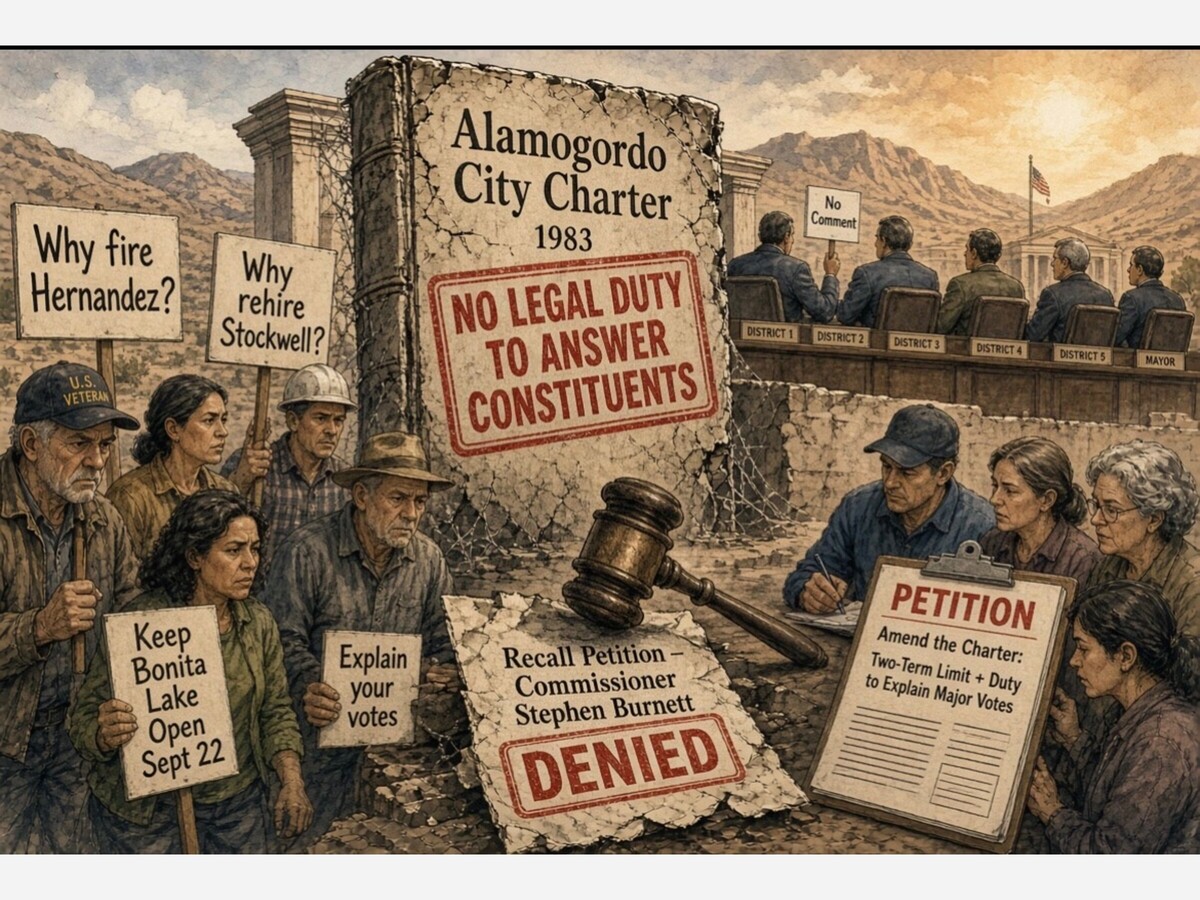



When a district judge threw out the recall petition against City Commissioner Stephen Burnett, the most troubling part of the ruling wasn't the outcome. It was the reasoning. Under Alamogordo's existing charter and ordinances, the court found, an elected commissioner has no legal duty to answer to the constituents who put him in office.
Read that again. The people's representatives are not required to explain themselves to the people.
That is not a failure of one judge or one commissioner. It is a failure of the document that governs this city, and it is one Alamogordo voters have the power to fix.
Alamogordo's charter was adopted in 1983. It has been amended a handful of times since, mostly on procedural matters such as how runoff elections work. It sets up a commission-manager government in which six commissioners and a mayor set policy and hire a city manager to run daily operations.
What the charter does not do is give residents meaningful tools to hold that commission accountable between elections. Recall is the only real remedy, and in New Mexico it is a narrow one. Petitioners must convince a judge there is probable cause of legal misconduct. Voting against the public's clearly stated wishes, refusing to explain a decision, or making costly choices behind closed doors does not clear that bar.
The past year has shown what that gap looks like in practice.
This spring, weeks after voting unanimously to negotiate a contract with Acting City Manager Dr. Stephanie Hernandez, the commission reversed course on a 4-3 vote and accepted a taxpayer-funded settlement to push her out. It then installed Robert Stockwell, a former city manager the commission fired in 1997 and declined to rehire in 2016. The hiring process itself is now the subject of a lawsuit alleging Open Meetings Act violations.
Residents asked why. Many are still waiting for an answer, and under the charter as the court has read it, they may never get one.
Now the fate of Bonita Lake, a place residents have told commissioners in no uncertain terms they want kept open, is headed to a vote on Sept. 22. Citizens deserve to know that whatever commissioners decide, they will be obligated to say why.
Term limits. A commission with no ceiling on service invites entrenchment. Long-tenured blocs build relationships with insiders, not with the broader public, and incumbency makes them hard to dislodge. Limiting commissioners to two consecutive terms would bring in fresh perspectives, loosen the grip of any single faction, and remind officeholders that their seats belong to the voters, not to them.
A duty to respond. The charter should require commissioners to publicly explain their votes on major decisions such as hiring or firing a city manager, approving settlements, and closing or selling public assets. It should also set a reasonable deadline for commissioners to respond to written questions from constituents. Accountability should not depend on whether an official feels like talking.
Critics of term limits argue that voters can already remove officials at the ballot box, and that forcing out experienced commissioners sacrifices institutional knowledge. Those are fair points. But ballot-box accountability works only when voters have full information, and a commission with no duty to explain itself withholds exactly that. As for institutional knowledge, this city has just watched that phrase used to justify rehiring a manager who was fired a generation ago.
Others may worry that a response requirement would bog down city business. A few paragraphs explaining a major vote is not a burden. It is the job.
The charter gives voters a path to amend it themselves. A petition signed by enough qualified voters, based on recent city election turnout, can place amendments before the electorate. Residents do not need the commission's permission, and they should not wait for it.
The recall effort against Commissioner Burnett did not succeed in court. But it succeeded in exposing the real problem. Alamogordo's government answers to a charter that asks too little of the people in power. It is time for the people to ask for more, and to write it down.
Stay tuned a process exists, the organization begins…



Patchy rain nearby, with a high of 74 and low of 55 degrees. Patchy rain nearby for the morning,



Love your shop in Las Cruces! Haven’t been to the one here in Alamo yet.
Hi Troy,
What do you think of the manga Jaadugar: A Witch's Life in Mongol (Tomato Soup). It's now an anime from Saru Science/Crunchyroll.
Enjoy!



Thank you Sheriff!

She lectures her expertise like she was running SpaceX. Home Service Contractors and Darnold Plumbing could get any of those things built in a month. These unqualified people use it to justify their lives. We have to work to pay off their excess spending.
Neither have the proper license try again!
Hey Rube! I think the point is expertise. A 'proper licesne' is always the thinking of those educated by The Machine. Let the free market rule, not the paper pushers.
He did the same thing when he ran against Rachel. He's a pathological liar who just keeps proving it over and over.
he senses trouble....and i smell blood - time to send him to private sector employment - maybe his oil & gas friends can find something for him to do.
Lets ask the editor.
sir, are you not involved in the campaign?