Image




ALAMOGORDO — Before New Mexico voters approved paying legislators a salary, the Legislature took recorded votes on two lobbyist-transparency bills and on the pay amendment itself. Every Otero County legislator voted no on every one of those measures that came before them.
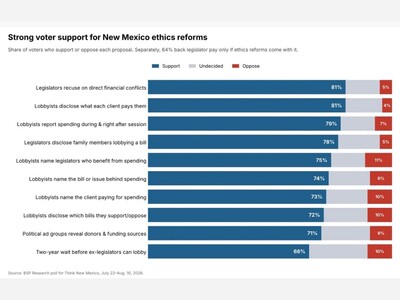
The votes matter as lawmakers prepare for a January session in which Think New Mexico is pressing a package of ethics reforms: recusal on conflicts of interest, a two-year lobbying ban for ex-legislators, fuller lobbyist disclosure and limits on dark money. (Read our story on those proposals.)
Otero County is represented by Rep. John Block (R-Alamogordo, House District 51), Rep. Jonathan Henry (R, House District 54), Sen. Jim Townsend (R, Senate District 34) and Sen. Rex Wilson (R, Senate District 33). Wilson was appointed in January 2026, replacing Sen. Nicholas Paul of Alamogordo, who resigned for health reasons. Rep. Sarah Silva (D-Las Cruces, House District 53), a neighboring southern New Mexico lawmaker, sponsored both lobbying bills.
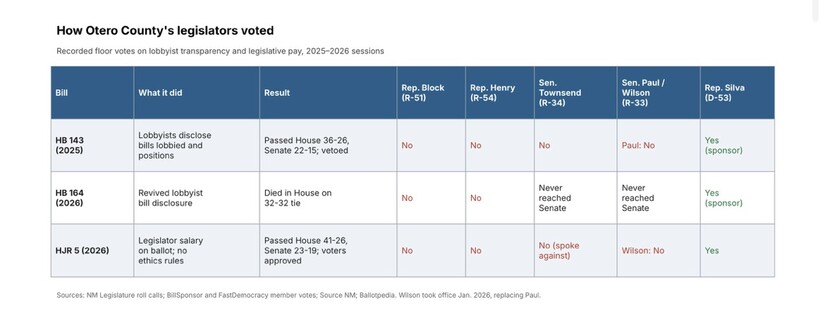
House Bill 143 (2025) would have required lobbyists to file a report within 48 hours of lobbying on a bill, naming the bill, the client and the position taken. It is the bill-tracking reform Think New Mexico now recommends.
Republicans argued the bill did not go far enough. A House Republican amendment to limit lobbyist spending on lawmakers' meals and drinks was stripped in the Senate. They offered amendments requiring lobbyists to disclose gifts to lawmakers, including food and drink, and requiring grassroots groups to disclose lobbying. Democrats defeated both.
House Bill 164 (2026), a revised version from Silva and Sen. Jeff Steinborn, died on a 32-32 tie on Feb. 14, 2026. Block and Henry again voted no. The vote did not split on party lines: several Democrats, including Reps. Patricia Lundstrom and Linda Serrato, voted no, and Republican Rep. Nicole Chavez voted yes.
The bill died by the narrowest possible margin. A single no vote switched to yes, including from either Otero County House member, would have broken the tie.
House Joint Resolution 5 (2026) put Constitutional Amendment 4 on the ballot, setting legislator pay at the state median household income starting in 2029. It carried no minimum duties, outside-income limits or new ethics rules.
Republicans did try to attach guardrails. In the House, Henry offered an amendment barring per diem on top of a salary for work close to home; Democrats voted it down. In the Senate, Democrats rejected Republican amendments for 16-year term limits and for ending per diem for meetings within 50 miles of a legislator's home.
A competing approach from Republican Sens. Craig Brandt and Pat Boone, Senate Joint Resolution 2, would have had an independent citizens commission set legislative pay, paired with term limits. It did not reach the ballot. That is the model Town News's editorial board urged before the election.
The local delegation's no votes on HJR 5 line up with Town News's objection to pay without guardrails. But their no votes on the lobbying bills cut the other way: those bills were among the few transparency measures to reach a floor vote.
Voters approved a salary. They did not approve a blank check. Three guardrails proposed in the 2025 and 2026 sessions deserve a second chance now that lawmakers will be paid.
Legislators collect $247 a day in per diem during sessions and interim meetings, on top of mileage and a pension. Starting in 2029 they will also draw about $67,800 a year. In a 60-day session year, salary plus session per diem alone reaches $82,620, according to Town News's October analysis.
Per diem exists to cover the cost of being away from home. Paying it to a lawmaker who sleeps in their own bed after a meeting across town is extra pay, not reimbursement. The legislator pension is also calculated from the per diem rate, so every per diem increase raises retirement pay too.
The fixes are modest. Henry's House amendment would have barred per diem on top of salary for work close to home. Senate Republicans proposed ending per diem for meetings within 50 miles of a legislator's home. SJR 2 would have tied per diem to the federal government's lodging rate for Santa Fe. Democrats rejected the first two; SJR 2 never got a hearing.
Lobbyist spending on New Mexico lawmakers set a record in 2025, passing $1.25 million by October. Current reports rarely say which legislators were treated. One 2026 filing listed $22,710 on flowers for legislators; another listed 31 restaurant meals for "various legislators and staff."
State law caps gifts from lobbyists at $250 per donor per year, but meals and entertainment still flow freely during session. In 2025 the House adopted a Republican amendment to HB 143 that many read as a $50-a-day cap on lobbyist spending per legislator during session. The Senate Rules Committee stripped it out.
The bill's Senate sponsor, Sen. Jeff Steinborn, called the cap a distraction from disclosure but said he would back a full ban on such meals in separate legislation. That opening should be taken. A paid legislator has less reason to accept a free dinner from someone seeking their vote.
Sixteen states limit how long legislators may serve. New Mexico does not. In 2026, Senate Republicans proposed a 16-year cap as an amendment to HJR 5, and Sens. Craig Brandt and Pat Boone proposed a 12-year cap in SJR 2. The amendment was rejected and SJR 2 was postponed indefinitely on its first day.
The case is strongest now. A salary turns a citizen post into a paying job, and limits keep it from becoming a career. Turnover breaks up long-standing relationships between lawmakers and the lobbyists who court them, and it opens seats to newcomers in a district like Henry's, where he ran unopposed this year.
Term limits carry real costs, covered below. A 12- to 16-year cap is long enough to let lawmakers build expertise while still forcing regular renewal.
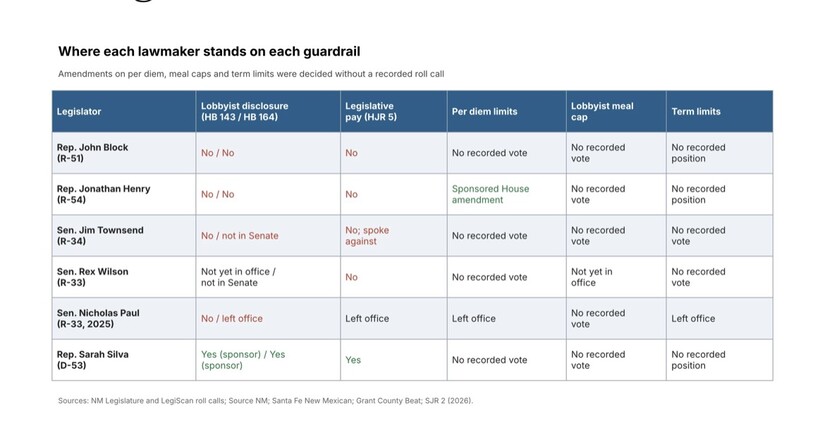
The per diem, meal-cap and term-limit amendments were decided without a recorded roll call, so no individual votes exist in the Legislature's or LegiScan's records. SJR 2 died before any vote. The Legislature broadcasts floor sessions, and these lawmakers can be asked directly where they stand.
Most of what Think New Mexico now proposes has never reached a floor vote, so there is no recorded position for local lawmakers.
The State Ethics Commission cannot carry this load alone, and its own rules show why.
Real accountability means rules with consequences voters can see:
These ideas have serious opponents, and readers should weigh their arguments.
The 60-day legislative session opens Tuesday, Jan. 19, 2027. Block, Henry and Silva won re-election Nov. 3, Wilson won his seat outright, and Townsend's term runs through 2028. All five will be voting. Gov.-elect Deb Haaland takes office Jan. 1, 2027, and will decide whether any reform that passes becomes law.
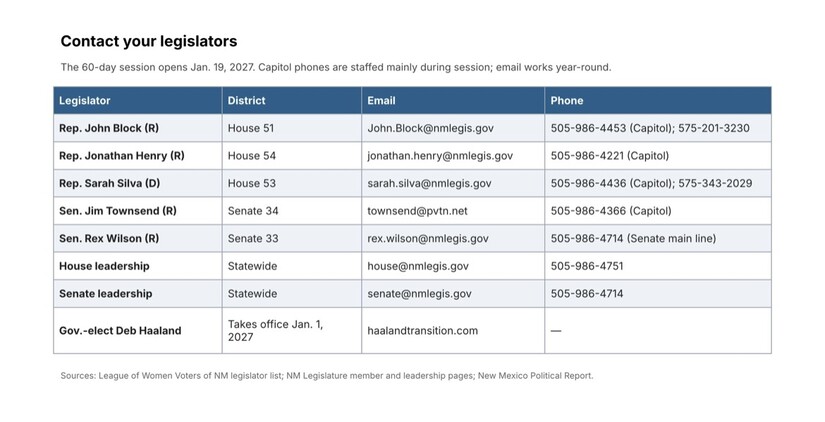
Lawmakers voted themselves a path to a paycheck. Now it is your turn to set the terms. Call or email every official below before the session opens. Ask each one, by name, to commit publicly to:
Your Otero County legislators
Neighboring southern New Mexico lawmaker
Legislative leadership, which decides which bills get heard
State party leadership
The incoming governor's office
Not sure who represents you? Use the Legislature's district finder.
Capitol offices are staffed mainly during session; email works year-round. A reform that dies in committee never reaches your legislator's vote, so contact leadership, both parties and the governor's office too. Ask for a yes or no. Write down the answer. Then hold them to it at the ballot box.
Related coverage
Official records, HB 143 (2025)
Official records, HB 164 (2026)
Official records, HJR 5 (2026)
Legislators
Guardrails and enforcement
Make the call. Send the email. Demand term limits, a job description and real accountability before the session opens Jan. 19.


Sunny, with a high of 65 and low of 45 degrees. Sunny during the morning, clear in the afternoon and evening,

Chris, when the heck are you going to see through this regurgitated manure? No educated investors will ever get involved in anything with the corrupt tentacles of layers of incompetent bureaucrats who know nothing about entrepreneurialism. Cut to the chase Amigo and WTFU






just like the old fram oil filter commercials, timberon is experiencing a pay me now - or pay me later revelation. the longer they wait, the more they will pay - at this point receivership looks like the only real option.

Isn't disagreement about ******* legal?

I think it's Rardin, not Riordin