78° and Heavy rain at times
Image
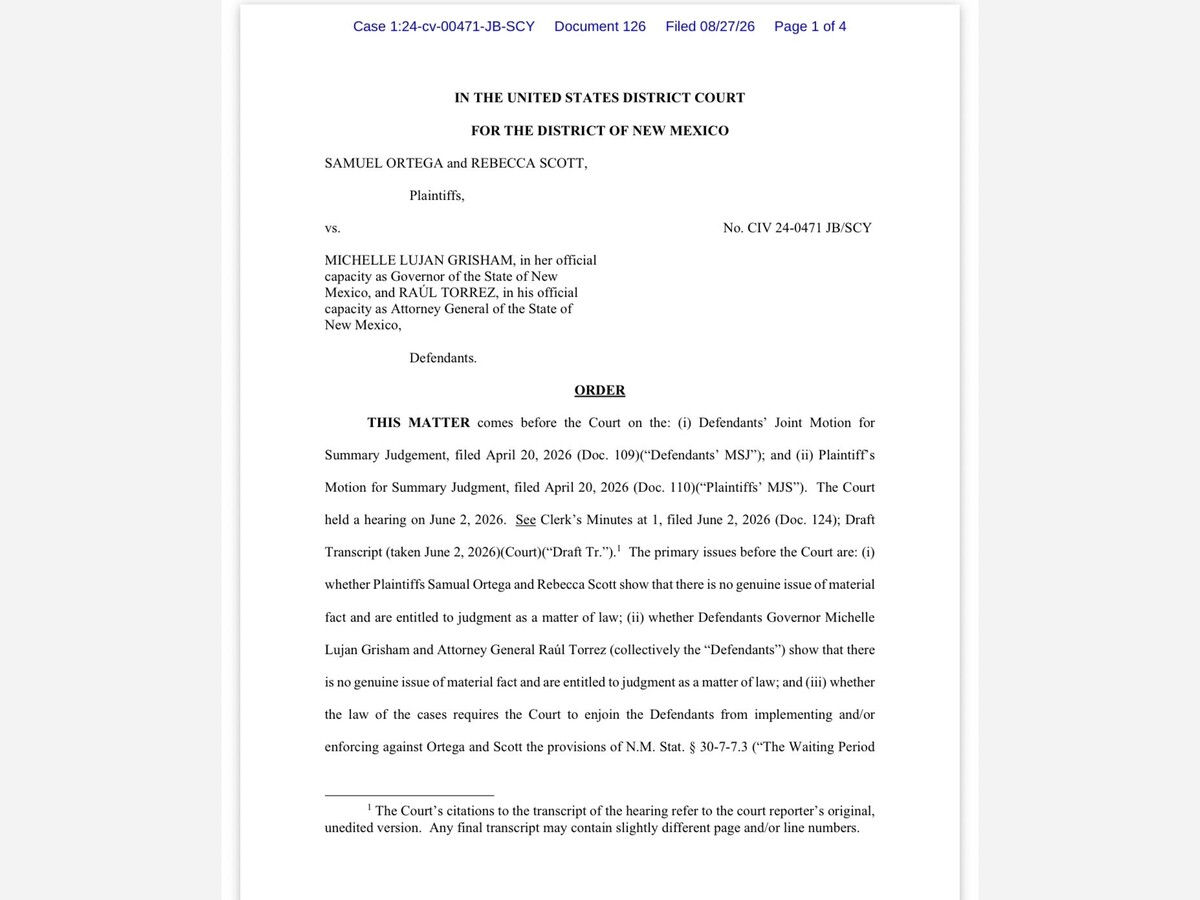



Albuquerque, NM — A federal judge on Thursday entered final judgment in Ortega v. Grisham, permanently enjoining the State of New Mexico from enforcing its 7-day firearm waiting period against the two plaintiffs who challenged it. Within hours, social media filled with declarations that the waiting period was “dead.” State Rep. Stephanie Lord quickly countered that the celebration may be premature, noting the injunction names only two people.
Both readings contain truth. Neither tells the whole story.
What the Court Ordered
U.S. District Judge James O. Browning granted summary judgment to plaintiffs Samuel Ortega and Rebecca Scott in their challenge to N.M. Stat. § 30-7-7.3, the waiting-period provision enacted in 2024. The order denies the State’s cross-motion, enjoins Governor Michelle Lujan Grisham, Attorney General Raúl Torrez, their officers and agents, and state law enforcement with knowledge of the order from enforcing the statute against Ortega and Scott, and takes effect immediately. The State must transmit notice of the order — with a full copy attached — to the New Mexico Department of Public Safety for posting on its website by September 10, 2026.
Notably, Judge Browning did not hide his own view. He wrote that the Court “continues to believe the Waiting Period Act is constitutional.” But in August 2025, the Tenth Circuit Court of Appeals reversed his earlier denial of a preliminary injunction, holding that waiting periods “are neither longstanding nor widespread practices” and diverge from the nation’s history and tradition — the test that governs Second Amendment claims after the Supreme Court’s 2022 Bruen decision. An inferior court, Browning wrote, has no power to deviate from the mandate of an appellate court. Bound by that mandate, he entered judgment for the plaintiffs and closed the case.
Why Rep. Lord Is Right Partially
The injunction is party-specific. This was not a facial ruling striking § 30-7-7.3 from the statute books, and it was not a statewide or universal injunction. Federal courts — particularly in the wake of the Supreme Court’s growing skepticism of universal injunctions — increasingly confine relief to the litigants actually before them. On the face of the judgment, a gun buyer in Alamogordo or Las Cruces enjoys no formal protection from it. Rep. Lord’s reading of the document is accurate, and her demand that the Attorney General state publicly how the State intends to treat the statute going forward is exactly the right question.
Why the Celebration Isn’t Wrong Either
Here is the part the victory laps and the caution flags both tend to skip: the injunction is not the only thing the case produced. The Tenth Circuit’s published opinion, Ortega v. Grisham, 148 F.4th 1134 (10th Cir. 2025), is binding precedent throughout the circuit — New Mexico, Colorado, Utah, Wyoming, Kansas, and Oklahoma. Any other New Mexican delayed or prosecuted under the waiting period could invoke that precedent and would be overwhelmingly likely to prevail. State officials know this. Continuing to enforce a statute that the circuit’s own appellate court has held fails constitutional analysis would invite immediate litigation, near-certain defeat, and attorney’s-fee liability under 42 U.S.C. § 1988.
The required public posting on the Department of Public Safety website compounds the practical effect. Every licensed dealer and law enforcement agency in the state will have official notice that the waiting period has been held to violate the Second Amendment as to at least two citizens — and why.
This is how our system is designed to work. Courts decide cases between parties; precedent, not the injunction itself, is what protects everyone else. The apparent contradiction Rep. Lord highlights — a law declared constitutionally infirm yet formally enjoined as to only two people — is not a trick by the State. It is the ordinary architecture of as-applied relief. The oddity is real, but it is a feature of judicial restraint, not a loophole.
What Happens Next
The decisive move belongs to Attorney General Torrez and the Governor.
Three paths are open:
The State can announce it will not enforce the waiting period against anyone, effectively conceding the statute is a dead letter until the Legislature repeals it.
It can attempt continued enforcement against non-parties, which would draw a swift follow-on suit — likely a class action or facial challenge — that circuit precedent all but guarantees the State loses.
Or it can petition the U.S. Supreme Court, gambling that the justices will take up waiting periods and resolve a question on which lower courts have divided since Bruen.
Until the State declares its position, dealers and buyers remain in a gray zone: a statute still on the books, a precedent that says it cannot survive, and an injunction that names two people.
A Constitutionalist’s Coda
From a pure constitutional standpoint — the framework this author applied in Shall Not Be Infringed: Redemption, Restoration, and the Fight for Full Second Amendment Citizenship — the ruling is welcome but incomplete. The Second Amendment’s text contains no seven-day asterisk, and the Tenth Circuit was right to find no historical tradition supporting one.
But the same textual absolutism that condemns waiting periods for law-abiding buyers should provoke equal discomfort with New Mexico’s 10-year firearm prohibition on felons who have completed their sentences, including nonviolent offenders — a restriction rooted in 20th-century policy, not founding-era tradition, and one this publication has examined at length.
Constitutional fidelity is not a menu. If “shall not be infringed” means what its defenders say it means, it must be applied consistently — to the buyer waiting seven days, and to the rehabilitated citizen waiting ten years.
Ortega and Scott won their case. Whether every New Mexican won theirs now depends on what the Attorney General does next. Put the champagne in the refrigerator — but leave it near the front.
Note: Journalist Chris Edwards has 8 published books around repatriation of rights for ex-felons, positive life affirmation books, history and how-tos. He is the lead journalist for the multiple brands of 2nd Life Media and General Manager of KALHRadio.org


Just thought the one thing all these first-timers have in common is no qualifications. Wanting to serve, help, or partake isn't enough. None of these people have any professional experience. Where are the engineers, CPA's, Ph.D's?
Business owners, a practicing attorney, one with a PHD, seems to me you didn't review the video.


Sunny, with a high of 79 and low of 62 degrees. Sunny during the morning, overcast during the afternoon and evening, clear overnight.

like many others, i have experienced work-place environments where favoritism and cliques were present - adding unnecessary stresses to any job. two observations about such places; that the ultimate goal of governmental ethics regulations is to prevent the appearance of imp
Just to weigh in on this. Whatever the editor thinks about his right to publish is certainly his point of view, but it's getting to the embarrassing stage of conjuring divisiveness bent on turning a functioning government he doesn't like, but the people have elected.
The editors point of view is we need a functioning government. The viewpoint allegations were not of the editors making it was mailed to the city with a copy to the editor.

like 99% of his fellow republicans, block is a servant to the oil & gas industry - a principal constituent of their party.


i would say that while our economy is "the hottest in the world" according to el presidente, this would be an excellent time for block to seek employment in the private sector....just like barela.
Pipqueak is a prime example of the defects of their party. They don't recruit qualified leaders. It's duplicitous, unemployed people who know all they have to do is start an internet site and walk the neighborhood dressed up on Sundays. The population here doesn't know how to vote.

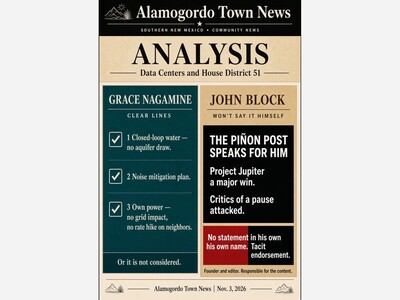
It is so important to understand the differences in the candidates' stand on this critical issue! Protecting our water in the desert is understood by all political parties living here! Nagamine is taking a stand to protect us!
many politicians claim to represent common sense, but here in new mexico, defending our water supplies and electrical power generation is pretty much the definition of common sense - and sucking up to billionaires is not.