78° and Heavy rain at times
Image
War-Inflated Oil Prices Hand New Mexico Lawmakers $924 Million in New Money — But Economists Warn the Windfall Masks a Weakening Economy - AlamogordoTownNews.org



SANTA FE, N.M. — New Mexico lawmakers will have an estimated $924.2 million in “new money” to spend when they build the fiscal year 2028 budget, state economists announced this week — a 6.7 percent cushion over current spending that owes much of its existence to a war half a world away and to investment earnings on the state’s swelling permanent funds.
The August 2026 Consensus Revenue Estimate, presented to the Legislative Finance Committee, projects recurring general fund revenues of $14.53 billion in fiscal year 2027 and $14.76 billion in fiscal year 2028. Both figures are sharply higher than what the same group of economists forecast in December: FY26 and FY27 were each revised upward by more than $617 million, and FY28 by $302 million.
But the headline numbers, the report cautions, are doing a lot of hiding.
A forecast propped up by oil and Wall Street
The single biggest force behind the upward revision is the price of oil. The U.S. military conflict with Iran that erupted in late February shocked global crude markets, briefly pushing prices above $110 per barrel. New Mexico oil averaged $72 per barrel in FY26 — well above what forecasters assumed before the conflict — and the consensus group now expects $75.50 in FY27, a full $18 higher than its prior forecast. Every $1 change in the annual average price of New Mexico oil swings state revenues by roughly $56.5 million.
The other pillar is investment income. Fed by years of record oil and gas contributions, the land grant permanent fund has grown to more than $40.9 billion and the severance tax permanent fund to $13.5 billion. Distributions from those funds and other interest earnings are growing about 11.5 percent a year — fast enough that, for the first time, investment earnings are expected to surpass personal income taxes in FY27 to become the state’s second-largest revenue source, behind only gross receipts taxes.
Strip out those two forces, and the picture darkens considerably. The report projects overall recurring revenue growth of just 1.5 percent in FY28 — and without investment earnings, underlying revenue growth actually turns negative, at minus 0.2 percent.
“Investment income and oil and gas revenues hide the weaker underlying economic revenue growth,” the report states plainly.
Cracks in the labor market
The economic backdrop is uneasy. U.S. employment fell by 23,000 jobs in July, and three-month average job growth collapsed from 77,000 to just 20,000. The national unemployment rate ticked down to 4.1 percent, but for what economists call “the wrong reasons”: nearly 1.4 million Americans have left the labor force since the start of the year.
New Mexico is following suit. The state’s labor force participation rate slid from 57.6 percent in January to 56.9 percent in June, and forecasters expect the labor force to shrink 0.4 percent in FY27. Personal income tax collections grew a tepid 2.8 percent in FY26, and gross wage growth in the state turned briefly negative in the third quarter of fiscal 2026.
Inflation, meanwhile, remains stuck above the Federal Reserve’s target — 3.4 percent in July — and the report notes the Fed’s July decision to hold rates featured the first three-way dissent in favor of a rate hike in a decade.
The growth that does exist is strikingly concentrated. Nationally, Moody’s Analytics estimates artificial intelligence investment and AI-driven stock wealth added roughly six-tenths of a percentage point to 2026 GDP growth — nearly all of it — while tariffs, immigration restrictions, and the Iran conflict subtracted more than a full point combined. In New Mexico, the mirror image is construction: the industry drove nearly 40 percent of the state’s growth in taxable gross receipts, and a single county — Doña Ana — accounted for 72 percent of that construction surge. Retail activity in the oil patch counties of Eddy and Lea has grown 29.9 percent since 2023, while the rest of the state, at 8.8 percent, has failed to keep pace with inflation.
The earmark squeeze
A quirk of the forecast is that revenue growth craters to 1.5 percent in FY28 not because the money stops flowing, but because the Legislature has redirected it. New earmarks divert general fund revenue into project-specific accounts — the early childhood trust fund, the new behavioral health and Medicaid trust funds, the severance tax permanent fund, and a health care affordability fund — before it ever reaches the general fund ledger.
The sums are enormous. A $4 billion federal oil and gas lease sale, mostly in New Mexico, will help push gross federal mineral leasing revenue to $5.1 billion in FY27 — a 67 percent jump — with roughly $2.3 billion flowing to the early childhood and Medicaid trust funds and $1.2 billion to the severance tax permanent fund. From FY26 through FY30, the forecast anticipates $4.41 billion deposited into the three trust funds and more than $13.8 billion into the severance tax permanent fund.
Some earmarks produce sudden cliffs in individual revenue streams: oil conservation tax receipts to the general fund plunge from a projected $124.7 million in FY27 to effectively zero by FY30, and insurance tax revenue drops nearly $95 million in FY28 as more premium tax dollars are routed to the health care affordability fund.
The report also flags a new worry about the early childhood trust fund itself. Once considered overfunded, the fund now faces a planned $700 million in nonrecurring withdrawals plus new revenue intercepts — a combination that, under current law, would cause distributions for early childhood programs to shrink in the early 2030s rather than grow.
Reserves: healthy, but overstated
On paper, New Mexico’s reserves look formidable: an estimated $4.38 billion at the end of FY26, or 40.4 percent of recurring appropriations. But the report cautions that roughly $1.1 billion of that total consists of funds that are “not true reserves” — money that is illiquid, held for other purposes, or subject to volatile dedicated distributions, counted only because statute requires it. True reserves sit closer to 30 percent.
Stress testing suggests that cushion matters. In a low-oil-price scenario — Moody’s assumes crude falling to $31 per barrel in FY28 — general fund revenues would come in $789 million below forecast in FY27 and $1.73 billion below in FY28. The state would need roughly $2.5 billion from reserves or other funds to avoid spending cuts through FY28, even with flat budgets. The trust fund architecture provides a buffer: about 60 percent of the total hit in that scenario would be absorbed by reduced transfers to trust and permanent funds before touching the general fund.
Recession odds have eased — the Wall Street Journal’s July survey of economists puts the probability at 25 percent, down from 33 percent in April — but the risk map remains crowded. Moody’s assigns a combined 35 percent probability to scenarios in which the AI boom either collapses into a stock selloff and recession or displaces workers faster than the economy can absorb them. A renewed flare-up with Iran, a bond market meltdown, and Federal Reserve missteps all rank among the risks that grew in likelihood or severity this cycle.
What it means for the session
For budget writers, the arithmetic is straightforward: FY28 recurring revenue exceeds FY27 recurring spending by $3.59 billion, but once elevated nonrecurring spending — still more than a fifth of the total budget each year — is counted, the true new money available is $924.2 million. That is a dramatic improvement over the roughly $106 million in growth estimated a year earlier, and it arrives as reserves, even conservatively measured, remain among the strongest in state history.
The question the report leaves hanging is durability. New Mexico’s budget is increasingly a bet on three volatile propositions: that oil prices inflated by geopolitical conflict stay high, that financial markets keep delivering double-digit investment growth, and that a construction boom concentrated in one county keeps propping up the sales tax base. The economists’ own trend analysis shows both gross receipts and income tax revenues falling hundreds of millions of dollars below their 10-year trajectories through the end of the decade — with only investment earnings running above trend, lifting everything else.
Source: The consensus estimate was produced by economists from the Legislative Finance Committee, the Department of Finance and Administration, the Taxation and Revenue Department, and the Department of Transportation. The next update is expected in December, ahead of the 2027 legislative session. The report can be found via the following link and is the basis of this report by Journalist Chris Edwards, 2nd Life Media Alamogordo Town News…

any mineral extraction industry is expansive - until the well runs dry - and anyone who paints a picture of profits into a limitless future is either a fool, or a con artist. look at the remains of old oil/gold/silver/uranium/copper/lead booms....what is left is a mess for somebody else to clean-up. it's the nature of the beast, and ignoring that is not a sign of intelligence.
and betting the farm on booms caused by totally external forces is no commendation either...

Just thought the one thing all these first-timers have in common is no qualifications. Wanting to serve, help, or partake isn't enough. None of these people have any professional experience. Where are the engineers, CPA's, Ph.D's?
Business owners, a practicing attorney, one with a PHD, seems to me you didn't review the video.


Sunny, with a high of 79 and low of 62 degrees. Sunny during the morning, overcast in the afternoon and evening, clear overnight.



like many others, i have experienced work-place environments where favoritism and cliques were present - adding unnecessary stresses to any job. two observations about such places; that the ultimate goal of governmental ethics regulations is to prevent the appearance of imp
Just to weigh in on this. Whatever the editor thinks about his right to publish is certainly his point of view, but it's getting to the embarrassing stage of conjuring divisiveness bent on turning a functioning government he doesn't like, but the people have elected.
The editors point of view is we need a functioning government. The viewpoint allegations were not of the editors making it was mailed to the city with a copy to the editor.
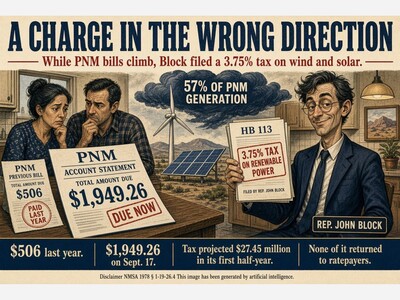
like 99% of his fellow republicans, block is a servant to the oil & gas industry - a principal constituent of their party.


i would say that while our economy is "the hottest in the world" according to el presidente, this would be an excellent time for block to seek employment in the private sector....just like barela.
Pipqueak is a prime example of the defects of their party. They don't recruit qualified leaders. It's duplicitous, unemployed people who know all they have to do is start an internet site and walk the neighborhood dressed up on Sundays. The population here doesn't know how to vote.


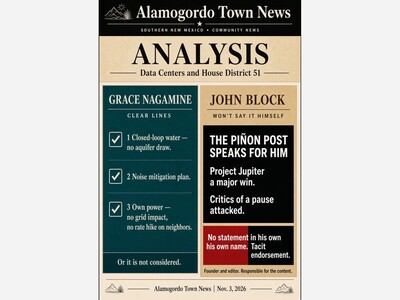
It is so important to understand the differences in the candidates' stand on this critical issue! Protecting our water in the desert is understood by all political parties living here! Nagamine is taking a stand to protect us!
many politicians claim to represent common sense, but here in new mexico, defending our water supplies and electrical power generation is pretty much the definition of common sense - and sucking up to billionaires is not.