
Image
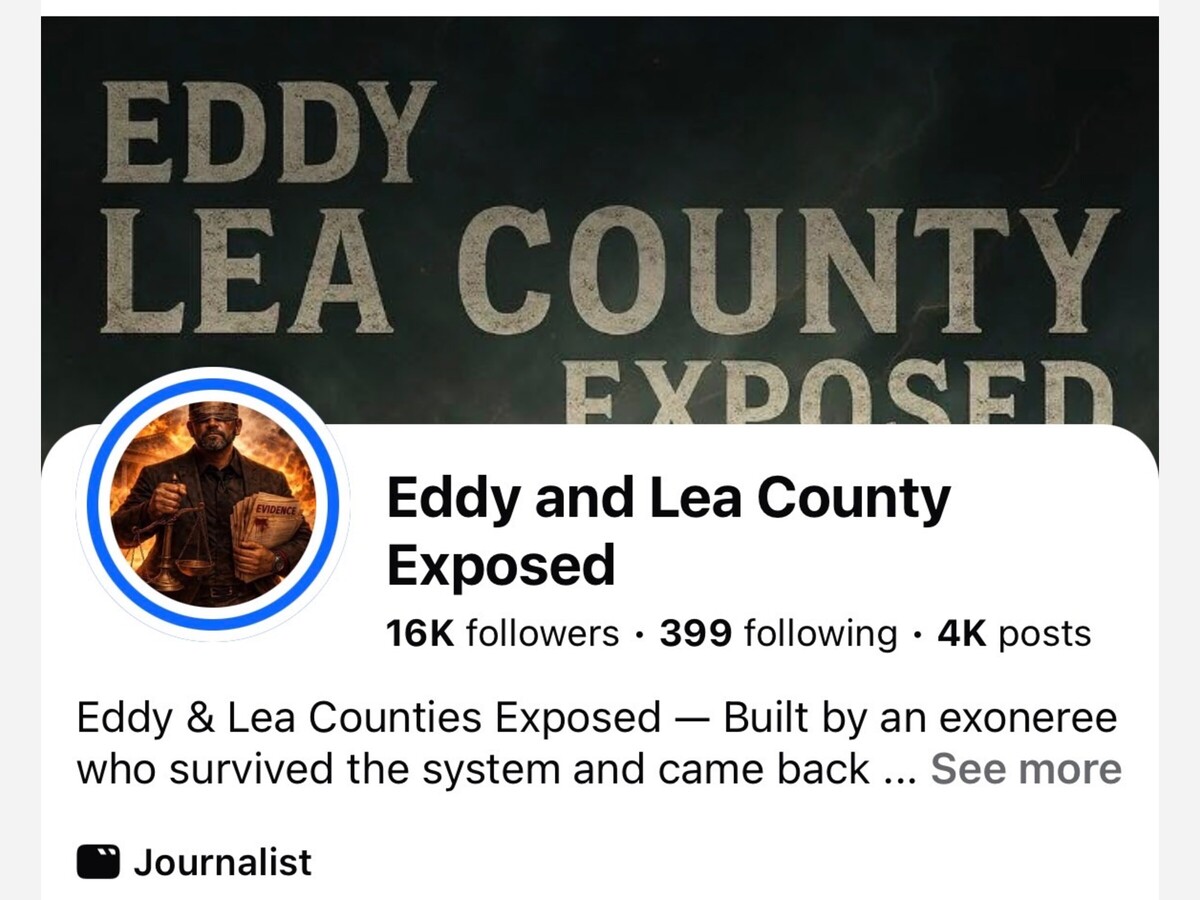
From Personal Lawsuit to Accountability Journalism: How One Civil Rights Case Sparked a Movement Exposing Eddy County Corruption - AlamogordoTownNews.org



Roswell — What began as a single lawsuit against Eddy County officials has evolved into a grassroots accountability movement with more than 16,000 followers documenting alleged political corruption and Inspection of Public Records Act (IPRA) violations. The plaintiff, wrongfully prosecuted and incarcerated according to court records and personal statements, initially created an online presence to document their own case. When reports from others with similar experiences began flooding in—stories of citizens being ignored, silenced, wrongfully charged, and intimidated—the effort transformed into something larger.
“When I started this page, it was about getting justice for what happened to me. Then I started hearing your stories,” the plaintiff wrote. “That is when this became bigger than me.”
Now, as the case heads toward a critical settlement conference on September 18, 2026, the accountability journalism organization continues to shed light on patterns of alleged abuse within Eddy County’s justice system. The movement emphasizes its independence from traditional power structures: “I do not have political connections. I do not have status. I do not have powerful people protecting me. I am not riding anyone’s coattails.”
The Legal Framework: IPRA, Qualified Immunity, and Accountability
Central to the movement is New Mexico’s Inspection of Public Records Act (IPRA)—a tool the organization uses to expose alleged governmental misconduct. By documenting instances where agencies fail to provide public records or obstruct transparency, the movement builds evidence of institutional resistance to accountability.
The plaintiff argues that IPRA violations work in concert with prosecutorial misconduct and qualified immunity to shield officials from consequences. Qualified immunity—a legal doctrine that shields government officials from civil liability unless they violated a “clearly established” constitutional right—has historically insulated officials from personal liability, even when their conduct was allegedly unlawful.
The underlying lawsuit (Case No. 25-226 MIS/GJF) names Michael Gallagher and the Eddy County Board of Commissioners as defendants and involves claims under 42 U.S.C. § 1983, which provides remedies for constitutional violations committed under color of state law. The movement contends that absent accountability mechanisms, these protections become tools to enable abuse.
September 18: A Test of Institutional Power
The settlement conference, scheduled for 10:00 a.m. MDT on Friday, September 18, 2026, at the United States District Court in Roswell, has become a symbolic focal point for the 16,000-follower movement. The plaintiff views it as a test of whether ordinary citizens can successfully challenge institutional power that has historically insulated government officials from consequences.
“On September 18, I’ll be walking back into the same judicial district that prosecuted me and where I was wrongfully incarcerated—this time standing up for my constitutional rights,” the plaintiff wrote, framing the moment as emblematic of a larger struggle.
According to the court order filed July 22, 2026, all parties and their lead trial counsel are required to appear in person with “full and final authority” to discuss binding settlement options. The plaintiff has called for peaceful public presence outside the courthouse that day and specifically named Fifth Judicial District Attorney Diana Luce, Lea County Sheriff’s Office, and other public officials as representatives of the accountability issues the movement addresses.
A Movement Beyond One Case
The accountability organization has become a repository for public complaints about prosecutorial overreach and IPRA violations—transforming individual grievances into documented evidence of systemic patterns. With 16,000 followers, the movement has established itself as a force for governmental transparency in Eddy County, attracting attention from citizens and observers interested in the intersection of qualified immunity with aggressive prosecutorial tactics.
“This fight was meant to show everyone that you can stand your ground—even when people laugh at you, mock you, belittle you, and tell you that you will never win,” the plaintiff stated, describing the larger significance the movement now carries.
Regardless of the outcome on September 18, the organization plans to continue monitoring official conduct, documenting alleged IPRA violations, and amplifying the experiences of those who believe they have been subjected to prosecutorial misconduct. The settlement conference represents a critical juncture, but it is not an endpoint. Federal rules require good faith settlement negotiations; if no agreement is reached, the case will proceed toward trial.
The IPRA Task Force: A Critical Moment for Transparency
As the accountability movement gains traction, New Mexico’s IPRA Task Force is currently traveling the state to discuss the Inspection of Public Records Act and its implementation. The timing is significant—and contested.
According to the accountability organization and allied independent media outlets such as AlamogordoTownNews.org, government officials have attempted to weaponize the IPRA process itself, using procedural restrictions and hostile interpretations of the law to close down records requests and obstruct the transparency mechanisms designed to hold officials accountable. This approach effectively reverses IPRA’s purpose: rather than ensuring public access to records, officials have exploited technicalities and compliance burdens to deny access.
“When government uses IPRA procedures and noncompliance as a weapon to prevent transparency rather than facilitate it, they undermine the very foundation of accountability,” claims IPRA advocate, Chris Edwards
Multiple independent news organizations view the task force’s statewide tour as a critical opportunity to educate the public about IPRA’s essential role in democratic oversight and to counteract attempts to weaken public access by government officials and bureaucrats.
Public Comment: Your Voice Matters
This accountability organization, alongside Eddy and Lea County Exposed and other independent media organizations, and other statewide transparency advocates, is urging the public to submit formal comments supporting IPRA and its critical role in holding government accountable. Public comment periods represent one of the few direct mechanisms citizens have to influence policy discussions occurring at the state level.
Citizens are encouraged to submit comments emphasizing:
• IPRA’s essential role in government accountability and transparency
• Examples of government obstruction of public records requests
• The importance of maintaining strong IPRA protections against erosion
• Support for robust implementation of existing IPRA statutes
Submit Your Public Comment: https://nmdoj.gov/get-help/inspection-of-public-records-act/
Whether you’ve personally struggled to access public records, witnessed government obstruction, or simply believe transparency is essential to democracy, your voice matters. The task force meetings are where policy direction gets set and where the balance between government convenience and public accountability is negotiated.
“Do not assume someone else will speak up,” accountability advocates emphasize. “These comment periods are where ordinary citizens can directly influence whether IPRA remains a tool for transparency or becomes another mechanism for government control.”



Sunny, with a high of 74 and low of 54 degrees. Sunny for the morning, clear in the afternoon and evening,




The choice we have this year is between a sliperycoxsuker and an exabuser. Can one straight person step up for us to support?
I find it interesting that the rhetoric posted is eerily similar amongst all these brave individuals with their interesting stage names. Too bad they didnt use a good one like Biggus Dickus.
Very grateful to Hilary Clinton and Kamala Harris for showing us what happens when political ladies have vision. Looks like a smoky cloud; she's pushing around.

They'll do the right thing. Vote for Gracie, a political lady, with vision in the smoky tradition.