65° and Clear



Image
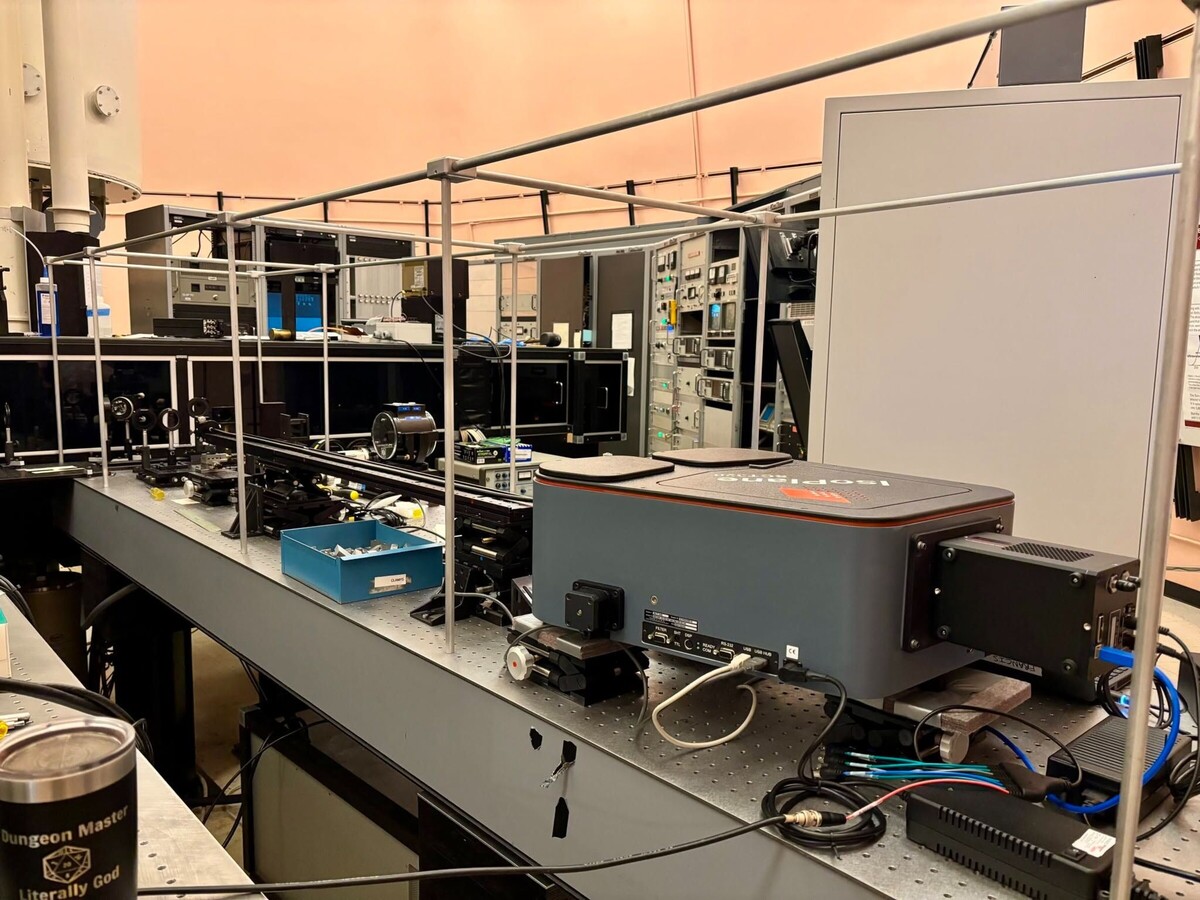
aption: FRANCIS — the acronym for a new camera using optical fiber to gather data from solar images — is one of several instruments that seem likely to be lost when the Dunn Solar Telescope is demolished. (NMSU photo)
Sunspot, Otero County N.M.- It appears that a faulty weld doomed the Dunn Solar Telescope at Sunspot before it started operating in 1969.
This is implied in the Dunn Solar Telescope Assessment conducted by SET Environmental of Milwaukee, WI, for the Association of Universities for Research in Astronomy (AURA), the parent organization for the National Solar Observatory (NSO). Alamogordo Town News obtained a copy of SET’s Feb. 5 summary report to AURA.
Demolition crews are reportedly on site now, and some science instruments may be lost because of contamination. This includes a new instrument developed by Queens University Belfast.
“Only a small number of items were recovered, decontaminated, and returned to their PIs [Principal Investigators],” NSF told ATN. “The DST continues to be an unsafe environment, and as this situation remains active, no further items will be recovered from the DST or the attached labs due to ongoing safety and environmental concerns.”
In its Feb. 5 report, SET wrote that a mercury drainpipe from the Dunn’s main bearing had a slow leak caused by a “faulty weld at the base of the cylinder” (emphasis added). When enough mercury leaked through the surrounding sleeve, it forced the weld open. This defect may have been there since the Dunn was built in the 1960s since weld repairs are not mentioned.
Sunspot Solar Observatory’s history starts in 1947 when two U.S. Air Force observers started observations to determine if it was a good spot for space weather forecasting. It quickly grew into a world-class solar observatory with its crowning achievement being the Vacuum Tower Telescope, later named in honor of designer Richard B. Dunn, which started operations in 1969.
(Sunspot was transferred to the National Science Foundation [NSF] in 1976 following a change in defense funding, and AURA was contracted to operate it. The land, however, belongs to the U.S. Forest Service, which has a say in the final disposition of Sunspot.)
The Dunn’s unique design — which inspired the designs of several later telescopes — included a main barrel hanging inside a concrete tower that is visible across the Tularosa Basin. This design kept the telescope straight and, with the observing platform attached to the barrel to stabilize images, let it rotate to follow the Sun across the sky.
To ensure smooth rotation, Dunn borrowed a technique from 19th Century lighthouses: mercury bearings. This was a key to the Dunn’s success and demise.
The Dunn had three bearings, from top to bottom: 1) a float bearing for the heliostat turret that followed the Sun, 2) a larger float bearing that supported the 250-ton main barrel and observing platform, and 3) a much smaller bearing almost 200 feet underground to stabilize the barrel just below the main mirror.
On Jan. 5, the large float bearing leaked about 186 pounds (roughly 6 quarts) of liquid mercury. New Mexico State University, then the operator, and NSO immediately closed the Dunn. Following that, Veolia Group, “a global leader in environmental services,” apparently was first to enter the Dunn and locate the leak. AURA next contracted SET to survey and determine the best entries and exits for a team to drain the mercury.
The eight-man team wore “level C Personal Protection Equipment [including] full face air purifying respirators equipped with mercury vapor cartridges, and hard hats.” They used a portable detector that shines ultraviolet light to measure mercury concentration in micrograms per cubic meter (a 3-1/4 foot cube) of air. One microgram is the weight of a grain of salt. Safety guides set the maximum safe level at 25 to 100 micrograms per cubic meter. Because mercury is six times denser than salt, a 100 microgram dot is narrower than a human hair.
While many people have briefly handled liquid
mercury (not a wise thing to do) without ill effect, the vapor is highly dangerous. Persistent handling lets the skin absorb it. Inhaling takes it straight to the bloodstream and the nervous system.
The team was inside the Dunn for just 25 minutes and found extensive mercury contamination. They recorded mercury vapor levels ranging from zero at a sewer manhole connection to 2,410 at a tunnel floor, 24 times the recommended threshold. More worrisome were readings up to seven times higher than the threshold in work areas: 260 in the lobby, 230 in the office hallway, and 700 in the kitchen/breakroom. The letter did not report readings for the observing platform.
Filtering the air is not a viable solution because surfaces can adsorb mercury: the vapor adheres and can easily be released. A 1982 study by the University of Auckland (New Zealand) showed that painted surfaces and vinyl flooring are strongest in this respect.
This led NSF to decide, on Feb. 26, that the safest option was draining and demolition. NSF contracted Thornton Tomasetti Inc. of New York with three sole-source contracts worth more than $13.7 million. The latest started Sept. 23 and runs through March 23, 2027.
At the Enchanted Skies Star Party outside Magdalena last Wednesday, astronomer John Briggs reported that a demolition contractor is on site. Briggs, who worked at Sunspot more than 20 years ago, was on site to remove key optical components from the Evans Solar Facility, which has two telescopes.
Briggs confirmed that the demolition plan is to dump most of the remains of the Dunn — which has three-foot-thick concrete walls — into the telescope pit, which is solid rock, and cap it.
Note: The author, Dave Dooling, is a veteran aerospace writer who was Sunspot’s education officer during 2002–12


Very grateful to Hilary Clinton and Kamala Harris for showing us what happens when political ladies have vision. Looks like a smoky cloud; she's pushing around.

Sunny, with a high of 77 and low of 59 degrees. Sunny in the morning, clear for the afternoon and evening,



The choice we have this year is between a sliperycoxsuker and an exabuser. Can one straight person step up for us to support?


They'll do the right thing. Vote for Gracie, a political lady, with vision in the smoky tradition.

truly international sports are a great thing for all concerned - and doing this up right is a feather in ruidoso's hat!