65° and Clear



Image
When we elect officials, whether at the federal, state, or local level, we tend to focus on what they will do within their individual offices. But I think we should also ask another question: How willing are they to work with other government entities for the benefit of the communities they serve?
Our city, county, and schools have very different responsibilities, budgets, and challenges. Each has its own mission. Yet they serve many of the same people. The family experiences the community, even when government operates in separate pieces.
My stance has always been to work together when we can. That requires respecting each entity’s responsibilities while recognizing where cooperation can improve people’s lives.
Where responsibilities overlap
At the employee level, collaboration often happens naturally and with little public attention. A school resource officer may work for a municipal police department or county sheriff’s office while serving on a school campus. Police officers, firefighters, and emergency medical personnel coordinate at incidents because the situation requires it.
Emergency preparedness should be paramount in these relationships. A wildfire, flood, or school emergency can require coordinated transportation, evacuation routes, shelters, communications, and family reunification. We should be planning those responsibilities together before an emergency tests them.
The overlap extends to everyday services. Road repairs affect school access and bus routes. Sidewalks, drainage, and pedestrian crossings affect whether students can get to school safely. Schools and recreation departments can explore shared fields and facilities, with clear agreements about scheduling, costs, and maintenance.
Economic development also connects these institutions.
Opportunities at the Local Level
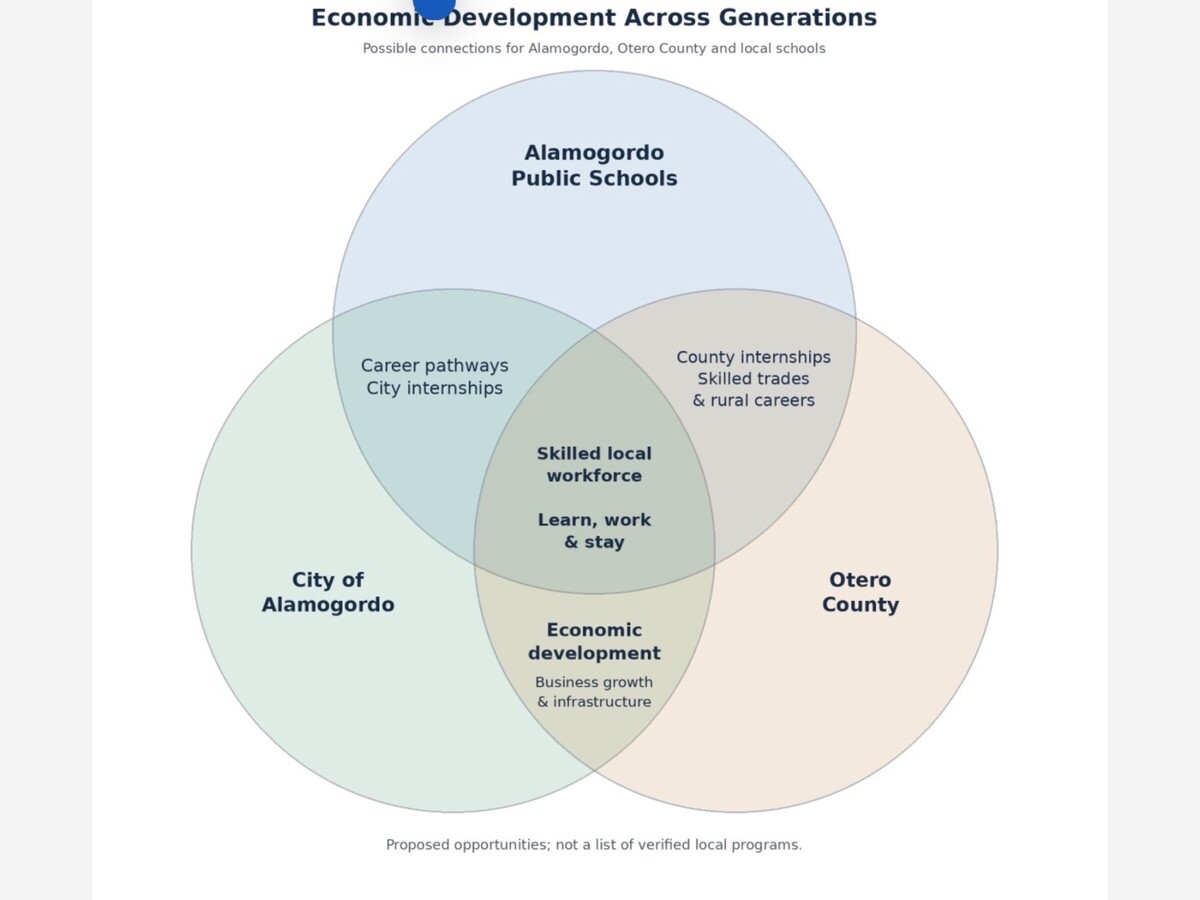
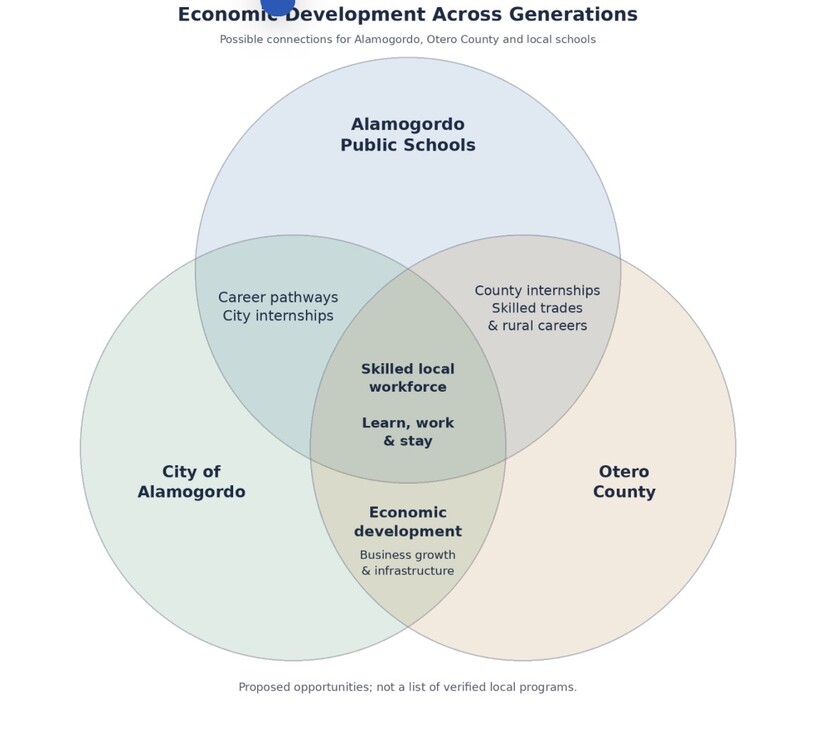
There are opportunities we can create by being more intentional about these connections. If the city and county are working to attract businesses or improve infrastructure, we should also ask how our schools can help students prepare for the jobs those efforts may generate. Schools can introduce career pathways, while local government departments provide internships, mentorship, and practical experience.
For example, a water-system improvement could become an opportunity to introduce students to engineering, water operations, accounting, or skilled trades. Students interested in public safety could explore those careers through programs such as the Ferguson Academy. County departments could explore similar partnerships based on their workforce needs.
These connections can help students see a future for themselves here. Economic development should include preparing the next generation to participate in, benefit from, and eventually lead the community we are building.
Unfortunately, politics and personalities sometimes get in the way. I have seen situations where the question becomes who gets the credit rather than what is best for the community. If employees can recognize the need to work across organizational boundaries, why shouldn’t we expect the same from elected leadership?
Research helps explain why leadership matters. Ansell and Gash (2008) reviewed 137 cases of collaborative governance and identified factors including leadership, prior conflict or cooperation, and differences in power and resources. Their research concerns broader public and private partnerships, but it offers a useful lesson for local government: cooperation requires attention to relationships and how decisions are made.
Working together still requires accountability. Each entity should understand its responsibilities, what it is contributing, and how the partnership’s results will be evaluated.
Preparing future public servants
When I was city manager, one of my priorities was getting our departments more involved with our schools. I encouraged, and in some instances required, that engagement for two reasons.
First, we faced workforce challenges. I wanted students to understand that local government offers careers ranging from professional positions to skilled trades. There are opportunities in accounting, engineering, technology, public safety, water operations, recreation, and maintenance. Students cannot consider careers they have never been shown.
The Ferguson Academy and our internship programs reflected that thinking. Over two years, approximately 30 students graduated from the Ferguson Academy. The academy connected Alamogordo Public Schools and the city through public safety career exploration. Internships gave students opportunities to experience the work of government and learn from the people providing those services.
I wanted young people to discover their interests and recognize that they could have a future here. We should be asking who will provide our public services tomorrow and what we are doing today to help prepare them.
Second, I wanted young people to understand that government belongs to them, too. I often referred to children as our “silent citizens.” They cannot vote yet, but decisions affecting their lives are often made without input from them. We should never minimize their interests in our planning simply because they cannot vote yet.
Making participation accessible
Kahne and Sporte (2008) help put this concern into context. Their article discusses how economic advantage can translate into a stronger civic voice. Their study also found that family discussions about public issues and civically responsive neighborhoods supported students’ commitment to participation. Young people arrive at school with different opportunities to experience civic life. The researchers also found that civic learning opportunities in school were associated with stronger commitments to civic participation.
For me, the implication is clear: partnering with schools can help reduce barriers tied to wealth and access. Students should have opportunities to participate regardless of their family’s income, connections, or involvement in politics. We can show them that they have a role in shaping government decisions and that the outcomes can belong to them, too.
That was the thinking behind our partnership with APS to let high school students vote on an event designed specifically for them. They had four choices, and their votes determined the outcome: Winter Wonderland at the Zoo, paid for by the city.
It was a simple exercise, but it demonstrated something important: Their voices mattered. They made a choice and could see the result. I wanted them to experience that connection before they were old enough to cast a ballot in a public election.
Those opportunities should not end with a single event. That is one reason I was excited when Mayor McDonald asked me to serve on the Mayor’s Youth Advisory Commission. With the students now sworn in, I look forward to mentoring them as they learn more about their community and contribute their perspectives.
I have always had a genuine love and appreciation for education and children. Serving as city manager allowed me to bring that commitment into public service. Our young people are future public servants and voting citizens, and they are members of our community whose voices matter right now.
Collaboration across levels of government
The same thinking extends beyond our city, county, and schools. State and federal officials can help connect local priorities with funding, programs, and technical assistance. Local leaders bring knowledge of community needs and responsibility for carrying projects forward. Their ability to work together can shape the opportunities available to our residents.
Alamogordo has examples of these connections. Through the Community Development Block Grant program, federal funding goes to New Mexico, and the city can apply through the state for eligible infrastructure, housing, and economic-development projects (City of Alamogordo, n.d.). Holloman’s school liaison also connects military families with Alamogordo Public Schools and community resources (Paczkowski, 2024).
The diagram below illustrates where these relationships can create opportunities. It gives us another way to evaluate candidates for state and federal office: Will they understand our local needs and work with community leaders to help address them?
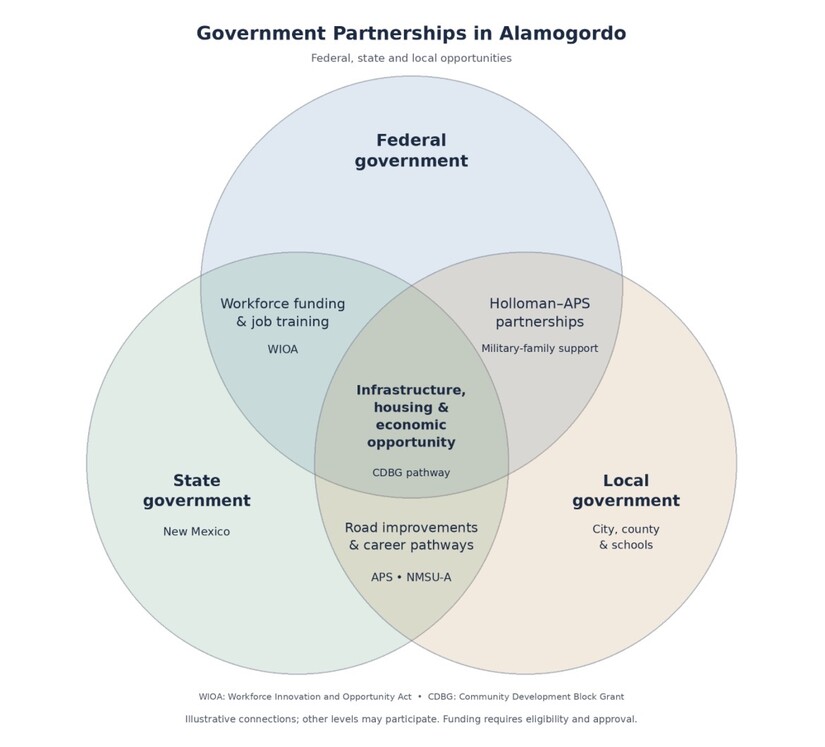
Diagram examples draw on City of Alamogordo (n.d.), New Mexico Department of Workforce Solutions (n.d.), New Mexico State University Alamogordo (n.d.), and Paczkowski (2024).
What we should ask of candidates
This brings me back to elections. The people we elect at all levels of government make decisions that affect more than their individual agencies. Their willingness to collaborate can influence emergency preparedness, economic development, workforce opportunities, and the future of our children.
As we head to the polls, we should ask: How do these candidates approach working with other entities? What have they done to support partnerships? Can they put differences aside and work together for the good of the community, even when someone else receives the credit?
An “R” or a “D” does not answer those questions. A candidate’s record, priorities, and willingness to collaborate tell us more.
Our city, county, and schools may have different responsibilities, but our citizens depend on all three. The decisions we make at the ballot box affect the services we receive today and the opportunities available to multiple generations. When we vote, we should look for leaders who understand their office and can see the community beyond it.
Here Dr Stephanie Hernandez companion piece on KALHRADIO.org via the link below…
References
Ansell, C., & Gash, A. (2008). Collaborative governance in theory and practice. Journal of Public Administration Research and Theory, 18(4), 543–571. https://doi.org/10.1093/jopart/mum032
City of Alamogordo. (n.d.). Grant coordinator. https://ci.alamogordo.nm.us/161/Grant-Coordinator
Kahne, J. E., & Sporte, S. E. (2008). Developing citizens: The impact of civic learning opportunities on students’ commitment to civic participation. American Educational Research Journal, 45(3), 738–766. https://doi.org/10.3102/0002831208316951
New Mexico Department of Workforce Solutions. (n.d.). WIOA. https://www.dws.nm.gov/WIOA
New Mexico State University Alamogordo. (n.d.). Continuing education. https://alamogordo.nmsu.edu/continuing-ed/index.html
Paczkowski, N. (2024, February 14). School liaison acts as a link between military families and Alamogordo Public Schools. Holloman Air Force Base. https://www.holloman.af.mil/News/Display/Article/3677489/school-liaison…


Very grateful to Hilary Clinton and Kamala Harris for showing us what happens when political ladies have vision. Looks like a smoky cloud; she's pushing around.

Sunny, with a high of 77 and low of 60 degrees. Sunny for the morning, clear in the afternoon and evening,
They'll do the right thing. Vote for Gracie, a political lady, with vision in the smoky tradition.
truly international sports are a great thing for all concerned - and doing this up right is a feather in ruidoso's hat!