
 77° and Overcast
Image
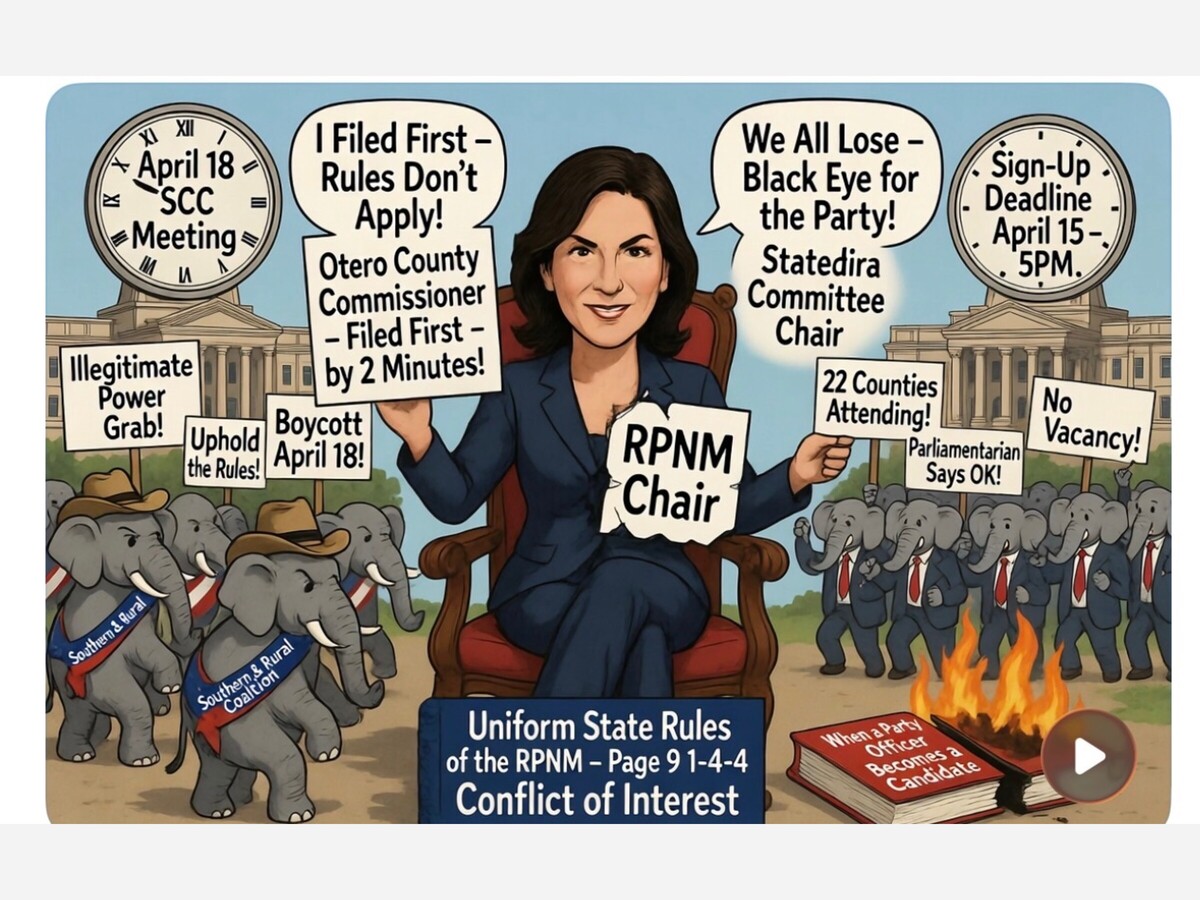



Several Southern counties are boycotting. Attendance is disputed. The New Mexico party chair has yet to produce a single legal opinion defending her position—and has instead turned her allies fo fire on the reporters asking the questions. The April 18 SCC meeting in Belen may be the last chance for accountability before the court cases are filed to decide for the party.
New Mexico Political Coverage Journalist Chris Edwards
New Mexico — The clock is running. Six days from now, on Saturday, April 18, State Central Committee members of the Republican Party of New Mexico are scheduled to gather in Belen to address one of the most consequential questions the party has faced in years: did Chair Amy Barela violate the RPNM’s own rules by filing for elected office without stepping down from her leadership post—and if so, what happens next?
The sign-up deadline for SCC members who wish to attend is Wednesday, April 15, at 5:00 p.m. That deadline is not a formality. It will determine whether a quorum exists, whether the meeting proceeds as scheduled, and whether the Republican Party of New Mexico resolves this dispute on its own terms—or hands that resolution to a judge.
Every SCC member who stays home hands that power to someone else.
The Rule. The Filing. The Failure to Step Down.
The dispute centers on USR 1-4-4, a provision in the RPNM’s Uniform State Rules titled “When a Party Officer Becomes a Candidate for Public Office.” The rule exists for a straightforward reason: a party chair who is simultaneously a candidate for office has divided loyalties. The rule was designed to prevent exactly the kind of conflict—real or perceived—that is now consuming the party’s bandwidth heading into a critical election year.
On March 10, Barela filed for Otero County Commissioner. Her challenger, Jonathan Emery, filed on the same day— both in lin at the same time and Barela's paperwork was completed by approximately two minutes ahead of Emery's. Barela did not step down as RPNM Chair. She was offered the opportunity to drop her county commissioner race and remain chair, which would have cancelled the April 18 meeting entirely. She declined.
Those who believe the rule was triggered point to the plain text: the moment Barela became a candidate, the conflict of interest provision applied. Barela’s camp argues that because she filed first—before a challenger existed—the rule was never triggered. It is a parsing of the rule’s language that a hand selected parliamentarian has supported, but that a growing number of Republicans across the state have found unpersuasive—and unresolved.
Worth noting: USR 1-4-4 was brought forward for removal at three separate previous SCC meetings. It failed each time. The rule is still on the books. That history matters.
A Parliamentary Opinion Is Not Enough—And Barela Knows It.
Barela and the RPNM Executive Board have anchored their defense to a parliamentary opinion issued by parliamentarian Kay Allison Crews, which concluded that no vacancy exists under USR 1-4-4. That opinion has been treated by Barela’s allies as a final verdict. It is not and it has been disputed by other parliamentarians.
Parliamentary opinions carry weight within deliberative assemblies. They do not carry the force of law. No licensed attorney has issued an independent legal opinion on the question. No court has weighed in. The party’s own members have asked, repeatedly, for that higher standard of clarity—a formal legal finding from a qualified attorney, or a ruling from a court with jurisdiction. Those requests have gone unanswered and no court case has been filed yet.
Reports indicate that Barela has dug in. RPNM financials, by multiple accounts, are not being disclosed to SCC members and some suggest are in disarray. And questions arise as to what the impact on the internal civil war has been in recent weeks to support statewide candidates. That is not transparency. That is a problem.
Southern Counties Are Boycotting. Here’s Why That Makes April 18 More Important, Not Less.
The Southern & Rural New Mexico County Officers Coalition (SRNMCOC)—representing officers from Chaves, Curry, Doña Ana, Eddy, Lea, Otero, Quay, and Roosevelt counties, along with additional rural affiliated groups—has issued a joint statement formally opposing the April 18 meeting and announcing a boycott.
The coalition characterizes the meeting as an “illegitimate power grab” orchestrated by Bernalillo County and urban interests, arguing it bypasses the 1st Vice Chair and duly elected officers. They stand with Barela, they reject the meeting’s legitimacy, and they warn that proceeding would “plunge the party into immediate chaos and instability at the worst possible moment.”
That is a serious statement from a serious coalition, and it deserves to be heard. But a boycott does not make the question go away. The conflict of interest concern embedded in USR 1-4-4 does not dissolve because one side of the argument refuses to show up. If anything, the absence of southern and rural voices from the Belen meeting weakens the very bloc that claims to represent the party’s legitimate interests. Empty chairs cast no votes.
On the other side, pro-meeting voices report that 22 counties have confirmed attendance or representation at the April 18 gathering—a figure that, if it holds, would be sufficient to establish quorum and allow the SCC to conduct legitimate party business. Whether those commitments firm up before the April 15 deadline will tell the story.
Instead of Legal Answers, Barela’s Camp Attacks the Reporters.
Perhaps the most telling development in this dispute is not the rule, the parliamentary debate, or the boycott. It is what Barela and her allies chose to do when journalists started asking hard questions.
When Alamogordo Daily News (2nd Life Media) and New Mexico Conservative News began reporting on the rule violation claims, the boycott declarations, and the competing interpretations of USR 1-4-4, the response from Barela’s camp was not to produce a legal opinion. It was not to address reports that Barela’s county commissioner challenger, Jonathan Emery, has faced threats and attacks on his reputation being carried out by those with close ties to Barela and the Party Treasurer. It was not to clarify who party financial position.
The response was to attack the journalism. Barela’s allies dismissed those outlets as biased, framing their coverage as a coordinated effort to disrupt the Republican Party rather than accountability reporting—as if the reporters were the problem, rather than the conduct they were describing.
That posture was difficult to sustain when the story lived in regional outlets. It is untenable now. The Albuquerque Journal and the Santa Fe New Mexican have both picked up the story, bringing the RPNM’s internal conflict to a statewide readership with no particular allegiance to either faction—but a clear eye for the difference between a leader defending their position on the merits and a leader deflecting because the merits aren’t there.
Attacking reporters is not a defense. It is an admission that a real defense is unavailable.
What Is Actually at Stake on April 18
Let’s be clear about what the April 18 meeting is and what it is not. It is not a coup. It is not an urban power grab. It is the RPNM’s governing body—the SCC, as defined by USR 1-3-1—meeting to exercise the authority those rules explicitly give it. The SCC is the governing body of the RPNM. That is not a disputed fact. That is the rule.
What is in dispute is whether Chair Barela violated the party’s conflict of interest provisions. That dispute has already damaged the party’s credibility, distracted from election preparation, divided county organizations against each other, and generated statewide news coverage that paints New Mexico Republicans as ungovernable. The longer it goes unresolved, the worse the damage gets.
Republican candidates across New Mexico are watching. They need a functional state party. Donors are watching. Voters—including the independents whose support any winning coalition requires—are watching. What they are seeing is a party that cannot enforce its own rules, cannot produce straight answers to straight questions, and responds to scrutiny by attacking the scrutinizers.
That is not strength. It is not leadership. And it will not win elections in November.
The Ask Is Simple: Show Up.
There is one thing SCC members can do right now that costs nothing and forecloses nothing: sign up to attend the April 18 meeting before the Wednesday, April 15 deadline at 5:00 p.m.
Attendance is not a vote for any particular outcome. It is not an endorsement of one faction or another. It is a declaration that the governing body of the Republican Party of New Mexico has the standing to address its own affairs—before a court potentially does it for them.
The boycott crowd is banking on empty chairs. The question is whether the SCC members who believe in the rule of law, the integrity of their own party’s rules, and the necessity of accountability will give them those chairs—or show up and do the work the party needs done.
The clock is running. Sign up. Show up. The party is watching.
SOURCES
Santa Fe New Mexican — April 10–12, 2026; coverage of ouster efforts and Barela’s response.
Albuquerque Journal — March–April 2026; coverage of internal RPNM discord and parliamentarian review.
Alamogordo Daily News / 2nd Life Media — April 1–3, 2026; reports on boycott declarations and leadership responses.
New Mexico Conservative News — April 2026; coverage of USR 1-4-4 enforcement dispute.
Southern & Rural New Mexico County Officers Coalition (SRNMCOC) — Joint boycott statement, Facebook, April 2026.
Roosevelt County GOP / Doña Ana County GOP — Individual boycott declarations, Facebook, April 2026.
RPNM Uniform State Rules (USR), adopted September 6, 2025 — newmexico.gop/wp-content/uploads/2026/02/USRs-FINAL-9.6.2025.pdf
RPNM Executive Board communications and parliamentary review (Kay Allison Crews, parliamentarian), 2026.
Open letter circulated to RPNM SCC members, April 2026 (author on file).
X (formerly Twitter) and local Republican group posts, April 2026.

This explains a lot. Kinda what happened to the Otero Democrat Party
not really - when the county democrat's chapter became fractious, the state party did the responsible thing and took control until the controversy was settled. the gist of this article is the fact that the republican's problems involve the big boss lady, and it is not clear whether their state party has either the guts, or the power, to take responsibility. there is an old saying in politics - when your opponents are committing suicide, don't get in the way.
One more time, ATN gets it wrong. Now they have to find someone else besides Kim Night Owl Pampers to impeach the four commissioners ELECTED to run our city. Clearly, a landslide is coming, and the two rogue actors will be out.

Light rain shower, with a high of 65 and low of 61 degrees. Light rain shower for the morning, moderate or heavy rain shower in the afternoon, light rain shower in the evening,
Man-oh-man. You wrote, "The attorney only checked the paperwork." *** do you want? The trial at Nuremberg? Doubting every little thing you can pick on reveals your paranoia. Stephanie is OUT for a legal reason. The smoky mayor feeding you garbage is clickbait.
Nice comment. I believe your sheet and hood are ready to be picked up at the kkkleaners.
Racist garbage.

once again; complete transparency should be expected with any entity that enjoys status as a natural monopoly.
Absolutely


well stated, sir.
Thank you for the transparency this town deserves. Your due diligence is much appreciated. 🌿
another opportunity to watch the voting block...

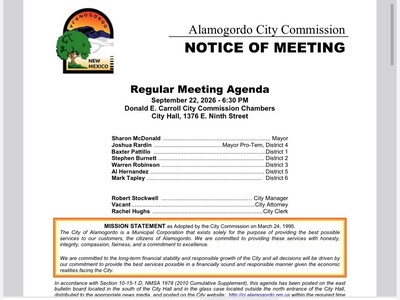
this meeting will be the opportunity to see if the 4 vote majority on the city commission will stand or fold - i'm inclined to think they will stick together, and if that is the case, their control over the city's business will be established.