
Image
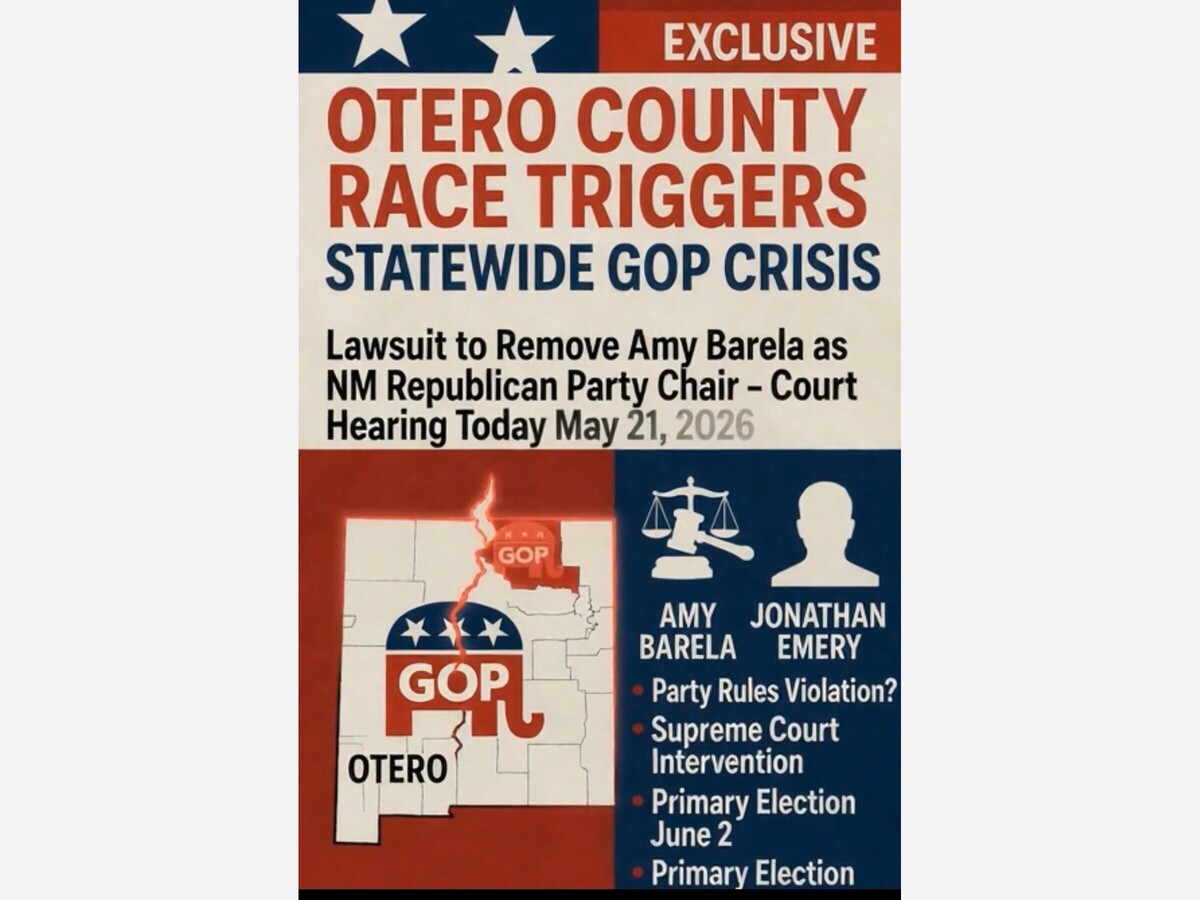



A courtroom battle is unfolding in real time over a question that cuts to the heart of fairness in Republican primary elections: Can the chairwoman of the Republican Party of New Mexico continue to run that organization while simultaneously running as a candidate against one of her own members for a seat on the Otero County Commission?
As of this morning — the very day a hearing in the case is scheduled — that question remains unanswered in court. What the documents reveal is a rapidly escalating legal conflict that has drawn in the New Mexico Supreme Court, produced a full recusal of every judge in the Twelfth Judicial District, sparked a parallel lawsuit in Albuquerque, and left one Alamogordo-area candidate arguing he cannot get a fair primary while the head of his own party runs against him and controls its resources.
The Parties and the Case
The lawsuit is Jonathan Emery, et al. v. Amy Smith Barela, et al., Case No. D-1215-CV-2026-00406, filed in the Twelfth Judicial District Court, Otero County, New Mexico.
Plaintiffs:
• Jonathan Emery — Alamogordo-area Republican, candidate for Otero County Commissioner District 2 in the June 2, 2026 primary
• Aubrey Blair Dunn — Certified Republican candidate for Lt. Governor
• Duke Rodriguez — Certified Republican candidate for Governor
• “Mr. X” and “Ms. Y” — Two duly elected members of the RPNM State Central Committee (SCC), identified anonymously in the filing
Defendants:
• Amy Smith Barela — Current chairwoman of the Republican Party of New Mexico (RPNM), also a candidate for Otero County Commissioner District 2; resides in, Tularosa, NM 88352
• Republican Party of New Mexico (RPNM) — headquartered at 5150 San Francisco Rd. NE, Albuquerque, NM 87109
• Jim Townsend — RPNM National Committeeman; resides in Artesia, NM 88210
• Kimberly Skaggs — RPNM Treasurer; resides in Tularosa, NM 88352
Plaintiff’s Attorney: Gary C. Mitchell, Gary C. Mitchell, P.C., P.O. Box 2460, Ruidoso, NM 88355
Defense Attorneys: Carter B. Harrison IV, Harrison & Hart, LLC, 924 Park Avenue SW, Suite E, Albuquerque, NM 87102 — representing Barela, RPNM, and Townsend.
The Two Rules at the Center of Everything
The entire case revolves around two specific provisions of the RPNM’s own Uniform State Rules (USR):
USR 1-4-4 — When a Party Officer Becomes a Candidate for Public Office:
“In the event the state chairman or any other state officer of the Republican State Central Committee files as a candidate for public office and there is another Republican who has filed for the same office, the state officer shall immediately vacate the party office. In that event, the successor shall be selected in the manner for filling vacancies as provided for in these rules.”
USR 1-4-3 — Party Officers, Endorsements Prohibited:
“Officers shall not publicly endorse one Republican candidate over another Republican candidate in a primary.”
According to plaintiffs and multiple supporting letters from Republican officials, both rules have been violated — and Barela has not only refused to comply, but attempted to remove these rules altogether on three separate occasions at SCC meetings in Farmington, Hobbs, and Ruidoso. Each time, the SCC voted her down.
A Complete Timeline of Events
December 16, 2025 — Barela issues a memo to SCC members stating that RPNM will “continue to fundraise as a party because we are committed to not charging the candidates to attend the convention.” Shortly thereafter, candidates were in fact charged fees — contradicting that statement, according to the Open Letter to the SCC filed as Exhibit 2.
Three prior SCC meetings (Farmington, Hobbs, Ruidoso — dates spanning approximately 2025–early 2026) — Barela attempts to amend or remove USR 1-4-4 from the RPNM rulebook on three separate occasions. The SCC defeats the proposal each time.
March 10, 2026 — The triggering event. Both Amy Smith Barela and Jonathan Emery file as declared candidates for the Republican primary for Otero County Commissioner District 2 in the Otero County Clerk’s office. According to court filings, the two were physically present in the clerk’s office at the same time and were fully aware of each other’s filings. Under USR 1-4-4, Barela’s act of filing against another Republican automatically vacated the chairmanship by operation of the rule — no resignation required and no further action needed.
Week of March 10, 2026 — Robert J. Aragon, Albuquerque attorney, hand-delivers a letter to RPNM Vice Chair Mike Nelson formally notifying him that a vacancy in the chairmanship was created by Barela’s March 10 filing. Aragon’s letter cites USR 2-1-4(C), which requires the Vice Chair to convene the State Executive Committee within 30 days to select a new permanent Chair. The letter sets a deadline of March 16, 2026 for Nelson to publicly commit to compliance, warning that 10 or more SCC members are prepared to call such a meeting themselves if he does not.
March 16, 2026 (on or before) — John Billingsley, Chairman Emeritus of RPNM and former chair of the Advisory State Rules Committee (ASRC), issues a formal letter to Republican officials confirming that USR 1-4-4 is “mandatory and not up for discussion or debate and stands.” He notes that Barela and Emery were in the clerk’s office together when they signed up, confirming she was fully aware of the opposition. He states that the Vice Chair has a fiduciary duty to call an SCC meeting within 30 days of March 10 to elect a new chair.
March 27, 2026 — RPNM publishes a “Parliamentarian Review” statement on the party’s official website (newmexico.gop), signed by the full RPNM Executive Leadership: Barela, Townsend, National Committeewoman Tina Dziuk, Vice Chairs Michael Nelson, Rachel Martinez, Shona Neff, and Teresa Barncastle, Secretary Kathleen Apodaca, Treasurer Kim Skaggs, and Executive Director Leticia Munoz. The statement declares that “the leadership has determined that the claim that the Chairwoman’s office has been vacated is unsupported under the uniform state rules, and there is no legitimate basis to move forward with any effort to fill the position on that premise.” It calls the matter “resolved” and redirects county chairs to focus on the general election. Barela is quoted stating: “Our party cannot afford any more internal distractions when the real fight is ahead of us.” This statement is included in the lawsuit as Exhibit 4 — the document plaintiffs identify as Barela’s direct refusal to leave.
April 30, 2026 at 4:20 PM — Plaintiffs file their Complaint for Declaratory Judgement and Request for Injunctive Relief in the Twelfth Judicial District Court, Otero County. Case number D-1215-CV-2026-00406 is assigned to Hon. Daniel A. Bryant, Chief Judge.
May 1, 2026 — A peremptory challenge to Judge Bryant is filed by plaintiffs’ attorney Gary C. Mitchell pursuant to N.M.S.A. 38-3-9, recusing Bryant from the case. On the same date, a parallel lawsuit — Daphne Orner, et al. v. Amy Smith Barela, et al., Case No. D-202-CV-2026-04390 — is filed in the Second Judicial District Court, Bernalillo County, by a coalition of Republican county chairs and SCC members represented by attorney Robert J. Aragon. Plaintiffs in that case include Daphne Orner (Bernalillo County GOP Chair), Elizabeth “Beth” Dowling (Sandoval County GOP Chair), Kevin Berry (Chavez County Chair), Lisa Shin (Los Alamos County Chair), John Brenna, Brett “Dutch” Lee Shaver, Anthony Aemisegger, and Janice Arnold Jones.
May 4, 2026 at 10:20 AM — Chief Judge Daniel A. Bryant issues a formal Order of Recusal, recusing himself and all judges of the Twelfth Judicial District from the Emery case.
May 4, 2026 at 3:32 PM — The New Mexico Supreme Court, noting all Twelfth District judges are unavailable, issues an order signed by Chief Justice Julie J. Vargas designating Hon. Cindy M. Mercer of the Thirteenth Judicial District to preside over the case. The order is filed simultaneously in the Twelfth District Court at 3:40 PM.
May 4, 2026 at 4:55 PM — Now assigned to Judge Mercer, plaintiffs file their Verified Emergency Motion for Temporary Restraining Order and Preliminary Injunction with Brief in Support. The motion asks the court to (a) enforce USR 1-4-4 by recognizing that Barela has automatically vacated the chairmanship and enjoining her continued exercise of it, and (b) enforce USR 1-4-3 by enjoining Barela, Townsend, Skaggs, and RPNM from publicly endorsing any candidate in a contested primary. The brief argues the June 2 primary is just 31 days away and that “each day of delay deepens the harm.”
May 5, 2026 (approximately) — Plaintiffs’ process server, Michael Tinker, attempts personal service of the TRO motion at RPNM headquarters, 5150 San Francisco Rd. NE, Albuquerque. He finds a sign reading “We are out in the field, please email contact@gopnm.org” — no one answers the door.
May 6, 2026 at 12:05 PM — Judge Mercer issues the first court ruling in the case: Order Denying Motion for an Ex Parte Temporary Restraining Order and Setting a Hearing on Plaintiffs’ Motion for a Preliminary Injunction. The court denies the ex parte TRO because it finds no evidence that plaintiffs certified their efforts to provide notice to defendants as required by Rule 1-066(B) NMRA. However, the court sets a preliminary injunction hearing for Thursday, May 21, 2026 at 10:00 a.m. by video conference (Google Meet). The court further orders plaintiffs to provide all defendants with a copy of their motion and this order by Monday, May 11, 2026 at 5:00 p.m.
May 8, 2026 at 10:00 a.m. — Process server returns to RPNM headquarters a second time. The same sign remains; no answer.
May 8, 2026 at approximately 4:55 p.m. — Barela is personally served by a process server at Veterans’ Park in Tularosa. According to a sworn statement by the process server, she told him that Kimberly Skaggs lives in Las Cruces (not Tularosa, as her address of record shows). Jim Townsend is served in Artesia the same day.
May 8, 2026 at 1:15–1:18 p.m. — Plaintiffs’ paralegal Patricia A. Tully emails documents to the official RPNM contact email addresses: Barela at amy@gopnm.org, Skaggs at kim@gopnm.org, and Townsend at townsend@pvtn.net. All emails show delivery. However, RPNM’s email server returns a notice that it has no delivery confirmation, suggesting possible non-delivery issues with the official party email system.
May 11, 2026 at 2:10 p.m. — Process server attempts service at RPNM headquarters again. Same sign remains; no answer. A written note is deposited through the mail slot.
May 12, 2026 at 2:50 p.m. — Another attempt at RPNM headquarters. Same result. A written note is deposited through the mail slot.
May 13, 2026 at 12:55 p.m. — Process server returns to RPNM headquarters. The sign has been removed. An adult female responds via intercom and states she will not accept service of any documents, and advises that “Laticia” (Executive Director Leticia Muñoz) is out of the office and will not return until the following week.
Week of May 12–18, 2026 — Barela and Townsend travel to South Florida to attend Republican National Committee (RNC) spring training meetings at Trump National Doral, according to defendants’ brief. RPNM publishes a statement from Executive Director Leticia Muñoz-Kaminski about their attendance.
May 15, 2026 — The Orner v. Barela case in Bernalillo County schedules its own preliminary injunction hearing for May 21 at 11:00 a.m. in person — set one hour after the Otero County video hearing. Defendants’ brief argues this double-booking was itself a prejudicial consequence of plaintiffs’ failure to provide proper notice in the Emery case.
May 18, 2026 — RPNM is first emailed a copy of the court’s May 6 Order — seven days after the court’s May 11 deadline, according to defendants’ filings.
May 19, 2026 — Defense counsel Carter Harrison first speaks with Kimberly Skaggs about the case and relays the general contents of the court’s order.
May 20, 2026 — Harrison & Hart, LLC formally enters its appearance in the Emery case on behalf of RPNM, Barela, and Townsend. Skaggs, having never been formally served, has not retained counsel as of this date. Defendants file two key documents: (1) a Declaration of RPNM Executive Director Leticia Muñoz-Kaminski detailing the service failure timeline, and (2) a Declaration of Defendant Kimberly Skaggs stating she has still never been formally served.
May 20, 2026 at 11:09 AM — Defendants file their Motion for Peremptory Denial of Preliminary Injunction Motion for Lack of Notice, arguing that plaintiffs have now failed twice to provide proper notice — first when filing the TRO without certification, and second when they missed the court’s May 11 deadline to serve all defendants. Defense counsel argues this repeated noncompliance is grounds for the court to deny the preliminary injunction outright rather than simply continue the hearing.
May 20, 2026 at 11:09 AM (simultaneous) — Defendants also file their Substantive Opposition Brief against the preliminary injunction. The 13-page brief makes two primary arguments:
First, a procedural/notice argument: plaintiffs failed to comply with the court’s order, the hearing was prejudicially rushed, and defendants were forced to burn their one peremptory judicial excusal in the Bernalillo County Orner case just to avoid a double-booking conflict — a real forfeiture of rights caused by plaintiffs’ conduct.
Second, and more fundamentally, a constitutional argument: courts across the United States — from the U.S. Supreme Court down — have consistently held that courts may not substitute their judgment for that of a political party in internal governance matters. The brief cites Tashjian v. Republican Party of Connecticut (479 U.S. 208, 1986), Democratic Party of the United States v. Wisconsin ex rel. LaFollette (450 U.S. 107, 1981), and numerous other cases for the principle that political parties are private voluntary associations whose internal decisions are protected by the First Amendment right of association. Defendants argue that Barela went through the proper RPNM dispute-resolution process — and both the RPNM and the RNC determined she had not vacated the chairmanship — and that outcome is not subject to judicial override.
The brief also argues the preliminary injunction must be denied under New Mexico’s four-factor test (irreparable injury, balance of harms, public interest, and likelihood of success on the merits), contending plaintiffs cannot satisfy any prong, and that denial is “not just right, but relatively obvious.”
May 21, 2026 — TODAY — 10:00 a.m. — Preliminary injunction hearing before Hon. Cindy M. Mercer via Google Meet video conference. As of this writing, no court ruling on the preliminary injunction has been issued. The June 2 primary is 12 days away.
The Open Letter: A Window Into the Broader Dispute
Included as Exhibit 2 in the complaint is an 11-page Open Letter to the SCC — a document that reveals tensions extending well beyond the chairmanship question. The letter, submitted by a coalition of county-level Republican officials ahead of the Ruidoso SCC meeting, details multiple additional concerns about Barela’s leadership, including:
• The SCC Roster, which USR rules require be updated and published within three days of any change, was 90 days out of date at the time of the Ruidoso meeting, and no updated list was provided to attendees;
• The entry fee for the Ruidoso SCC meeting had doubled to $100, with delegate fees of an additional $350 — a total that reached $500 with candidate debates and an after-party — after Barela had previously stated in writing that candidates would not be charged to attend;
• 17 agenda items were crammed into a 2-hour meeting with no advance input from county chairs;
• Barela authored a Facebook post calling sitting U.S. Senators “traitors” — including 10 Republicans — prompting calls from Congressional staffers;
• A second post about “cockroaches” was widely understood as directed at her critics within the party, which Barela admitted in response to email queries could be a reasonable interpretation;
• The RPNM convention had “the lowest turnout in many years,” attributed in part to mismanagement and fee changes;
• Members of the SCC were holding dual SCC slots — elected locally and appointed by Barela for state-level roles — violating USR 2-1-5B, which provides that SCC membership shall be “by only one of the aforementioned methods.”
The letter concludes: “We did not elect an oligarch. We will continue to reach out and listen to our colleagues.” It calls on SCC members to vote down the proposed rule changes and calls Townsend’s appointment to the rules committee a conflict of interest, given his support for Barela’s campaign.
The Defense: Party Rules Are for Parties, Not Courts
Defendants’ arguments are not simply procedural. Their substantive brief presents a direct challenge to the court’s authority to intervene at all.
Barela’s team argues she followed the proper internal process: the RPNM leadership reviewed the matter, obtained a parliamentarian’s opinion, and concluded that USR 1-4-4 did not require her to vacate. The RNC similarly reviewed the matter and reached the same conclusion. The brief argues this internal dispute-resolution process is exactly what the law and the First Amendment contemplate — and that courts have no business overriding it.
The defense also raises a broader constitutional point: enjoining party officers from “publicly endorsing” candidates would constitute a judicially imposed prior restraint on political speech — a near-categorical violation of the First Amendment, regardless of what the party’s internal rules say.
The brief’s bottom line is blunt: “This case, with genuine respect, appears to be more of a symbolic gesture than it is designed to actually prevail in court.”
What Plaintiffs Say Is at Stake
Plaintiffs’ brief is equally direct in the other direction. Noting that Barela tried and failed three times to change USR 1-4-4 through the proper process — meaning the SCC, the party’s own governing body, has repeatedly reaffirmed the rule — plaintiffs argue she cannot now claim the rule does not apply to her simply because party leadership agreed with her interpretation. The plain text of the rule is unambiguous, they argue, and “the successor shall be selected” language leaves no room for executive-branch interpretation.
The brief also frames the harm in contractual terms: the RPNM Uniform State Rules are the contract between the party and its members. Emery paid the costs of gathering signatures, campaigning, and running in a primary. He is owed a primary contest that is not pre-tilted by the very person sworn to remain neutral — someone who, as Chair, controls the party’s Facebook page, its financial resources, its mailing lists, and its staff.
The Facebook post endorsing “Doug W. Turner” for Governor and “David Gallegos” for Lt. Governor — the direct opponents of plaintiffs Rodriguez and Dunn — on the RPNM’s official party page, for an event the other candidates were not invited to attend, is cited as a concrete example of the harm already occurring.
A Second Lawsuit in Albuquerque
The Bernalillo County case, Orner v. Barela (No. D-202-CV-2026-04390), filed May 1, 2026, raises identical legal claims. Its plaintiffs — county GOP chairs from Bernalillo, Sandoval, Chavez, and Los Alamos counties, plus several other SCC members including former Republican candidate Janice Arnold Jones — are represented by Robert J. Aragon’s firm, Aragon Moss George Jenkins, LLP. That case also had a preliminary injunction hearing scheduled for May 21 at 11:00 a.m. in Albuquerque — creating the double-booking problem that, ironically, defendants cite as further evidence of plaintiffs’ litigation tactics.
Where Things Stand Today
The hearing in Emery v. Barela was scheduled for this morning at 10:00 a.m. before Judge Mercer an additional IPRA for transcript or any court action is pending for a further update.
Key unresolved questions before the court include:
• Whether plaintiffs’ notice failures justify outright denial of the preliminary injunction, or merely a procedural ruling;
• Whether the court has jurisdiction to enforce a political party’s internal bylaws against its own officers;
• Whether the plain text of USR 1-4-4 requires automatic vacation of the chairmanship upon the act of filing, or whether the RPNM’s internal interpretation process has legal weight;
• Whether enjoining party endorsements constitutes an unconstitutional prior restraint.
Meanwhile, the June 2 Republican primary is 12 days away. If no injunction issues before the primary, the plaintiffs have acknowledged in their brief that the relief they seek will be “effectively foreclosed regardless of how the Court ultimately rules on the merits.” The underlying declaratory judgment case could still proceed — but for Jonathan Emery, running against the person who controls his own party’s apparatus, that may be too late.
Note: Court documents in this case are on file with the Twelfth Judicial District Court, Otero County, New Mexico — Case No. D-1215-CV-2026-00406. The hearing before Judge Mercer was held today, May 21, 2026. Alamogordo Town News will report the outcome as soon as it is available.
The June 2, 2026 Republican primary election is 12 days away.

i'm not sure if other observers have noticed this - but, from here in the cheap seats, it seems to me there is considerable similarity between two recent legal conflicts here-abouts.
one between otero county and the state (represented by the attorney general), regarding the right of the county to ignore legislation pertaining to the existing CBP/ICE contract.
and in this situation - whether, or not, the state republican party by-laws can uniformly be applied to the party chairman - kinda hard to miss the overlap involved....


Sunny, with a high of 81 and low of 61 degrees. Sunny in the morning, patchy rain nearby in the afternoon and evening, clear overnight.
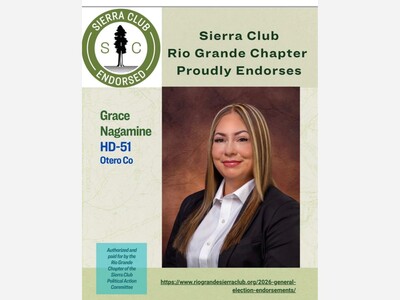
Having the Sierra Club endorse you is like drinking the runoff from a lithium mine they spent a decade blocking—then calling the metallic taste “sustainability.” This phoney has a really bad dye job.
Just because you do not like someone does not make them phony.
kinda like not liking the blue kool aid so you hate all the kool aid. Besides doesn’t the editor have a vested interest in her campaign?



as per occam's razor, the simplest explanation for stonewalling a request this basic and straight forward, is that transparency will cast a bad light on lincoln county, and/or the entity they pay to run their jail.
The Albuquerque Journal (9/20/26, page C3) has a column written by Jacob Candelaria that is titled "A blacklist for people who ask too many questions". Basically, in 2025, our NM Legislators were debating House Bill 139 would have let any public body petition to have a person designated as "vexatious", and person's

like 99% of his fellow republicans, block is a servant to the oil & gas industry - a principal constituent of their party.