73° and Overcast
Image

New Mexico GOP Chair Amy Barela's Media Dominance Over Challenger Jonathan Emery Highlights Institutional Advantage and Purpose of Resignation Rule - AlamogordoTownNews.org



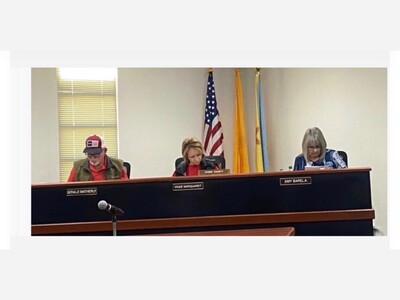
Alamogordo, NM – March 16, 2026 – Numbers matter, statistics tell the real story. In the Republican primary race for Otero County Commissioner District 2, incumbent Amy Barela—who also serves as Chairwoman of the Republican Party of New Mexico (RPNM)—has overwhelmingly dominated media coverage since the March 10, 2026, candidate filing deadline, compared to her challenger, Lt. Jonathan Emery , a retired Otero County Sheriff's lieutenant and veteran.
This imbalance, evident in Google-indexed news stories across local and statewide outlets, illustrates the structural advantages of holding the state party chair position and explains the intent behind RPNM Uniform State Rules (USR) Rule 1-4-4, which requires party officers to vacate their roles immediately upon entering a contested primary for public office.
The controversy began on March 10 when Barela filed for re-election at 9:06 a.m., followed two minutes later by Emery, creating a contested Republican primary. Rule 1-4-4 mandates: "the state officer shall immediately vacate the party office," with no exceptions for incumbents. Supporting rules (1-4-3 on no endorsements in primaries and 1-4-2 barring party resource use for candidates) aim to preserve neutrality. Barela has refused to resign, answering "no" to questions as recently as mid-March, fueling accusations of conflict of interest, rule violation, and party division.
Google & Bing searches (date-restricted to period 2026-03-10 thru 2026-03-16) for terms including "Amy Barela," "Jonathan Emery," "Otero County," "RPNM," "County Commission" "Otero County Commission" "Otero County Election" and related keywords reveal a pattern:
Barela's coverage surges with both the recent state convention, stories around her candidacy while still remaining state party chair, and actions by the Otero County Commission, while Emery's is minimal and almost always secondary mention in stories related to her.
Totals (March 10–16):
Across the state, coverage remains predominantly local/regional (Otero County/Alamogordo-focused), with limited pickup beyond pre-existing party statements and dedicated party pages.
Emery's visibility is derivative—tied to Barela's controversy—while Barela benefits from her chair role enabling official commentary, event ties, and self-sustaining news cycles.
This disparity demonstrates the chair's clear institutional edge: access to party platforms, authority for statements, and inherent newsworthiness (especially in self-created controversies) generate far more "press real estate." A non-officer challenger like Emery lacks these tools, resulting in passive, secondary mentions.
Rule 1-4-4 exists to counteract exactly this imbalance. Party officers hold influence over resources, visibility, and perceived neutrality that could unfairly tilt primaries. Mandating resignation levels the field, prevents conflicts (e.g., self-endorsement risks or resource favoritism), and upholds trust in the GOP nomination process—critical in a state where Republicans seek to overcome Democratic advantages through unified, fair grassroots efforts.
Note the following post from Senator Townsend suggested the party leadership is in receipt of a letter calling for the Vice Chair to step up…
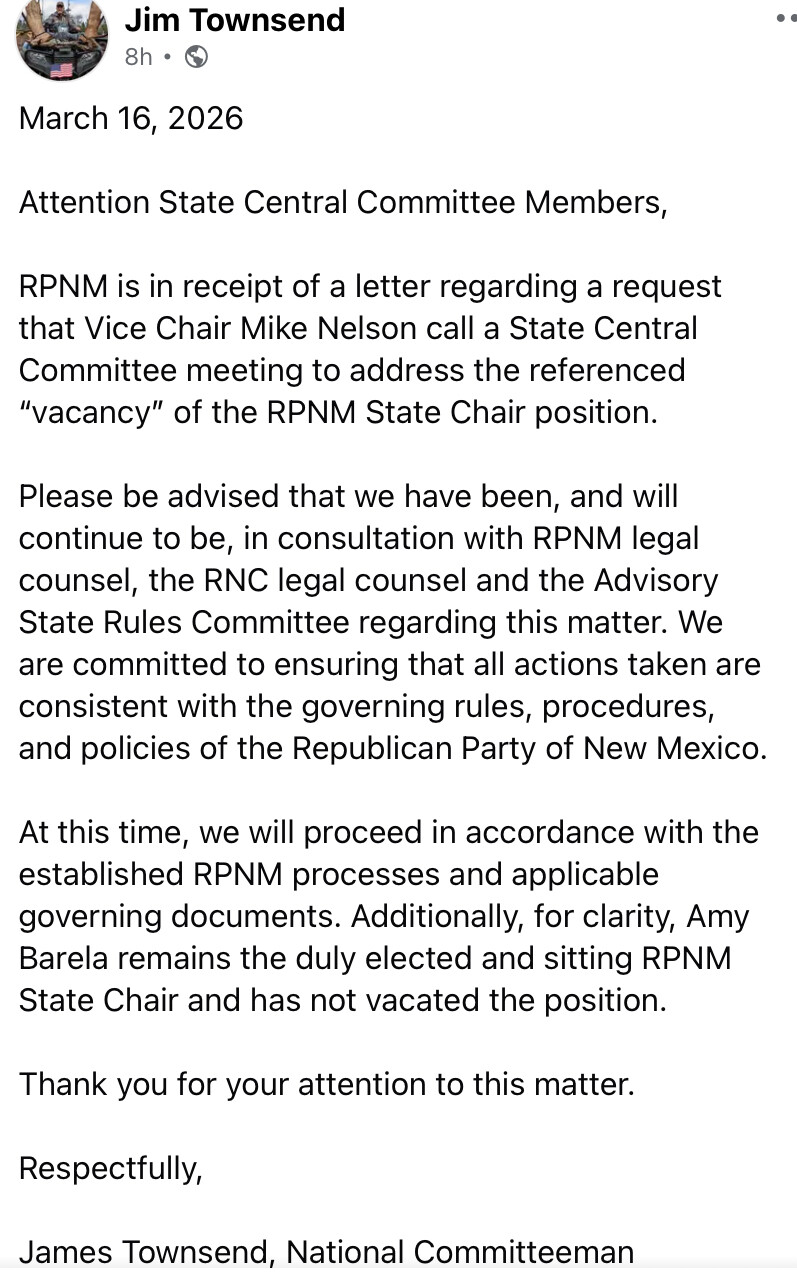
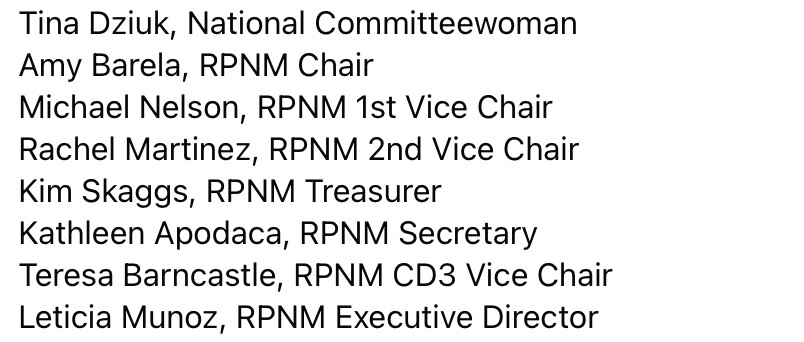
In Otero County District 2, voters weigh Barela's experience (fiscal oversight, infrastructure) against Emery's law enforcement/veteran credentials as an "outsider" focused on public safety and community service. The ongoing rift risks distracting from these issues and fracturing party unity ahead of the June primary.
As of March 16, Barela remains chair with no apparent enforcement, leaving the controversy—and the media gap—unresolved. There have been multiple calls to temporarily step aside and once the primary is over, retake the state chair throne. Will the ethical decision prevail? Stay tuned...

I notice Amy Barela's campaign sign today. "Your voice matter" So thought I would like Ms. Barela know, not stepping down as chairwoman you lost my vote. I want all my elected officials to be of high caliber, ethical be a cut above & stay on principles. Not following your own party's rules shows you are more interested in power vs doing the right thing. How is this following your FAITH?
"Rules? We don't need no stinking rules!"


Cloudy, with a high of 89 and low of 73 degrees. Overcast during the morning, sunny during the afternoon, cloudy overnight.