59° and Patchy rain nearby
Image
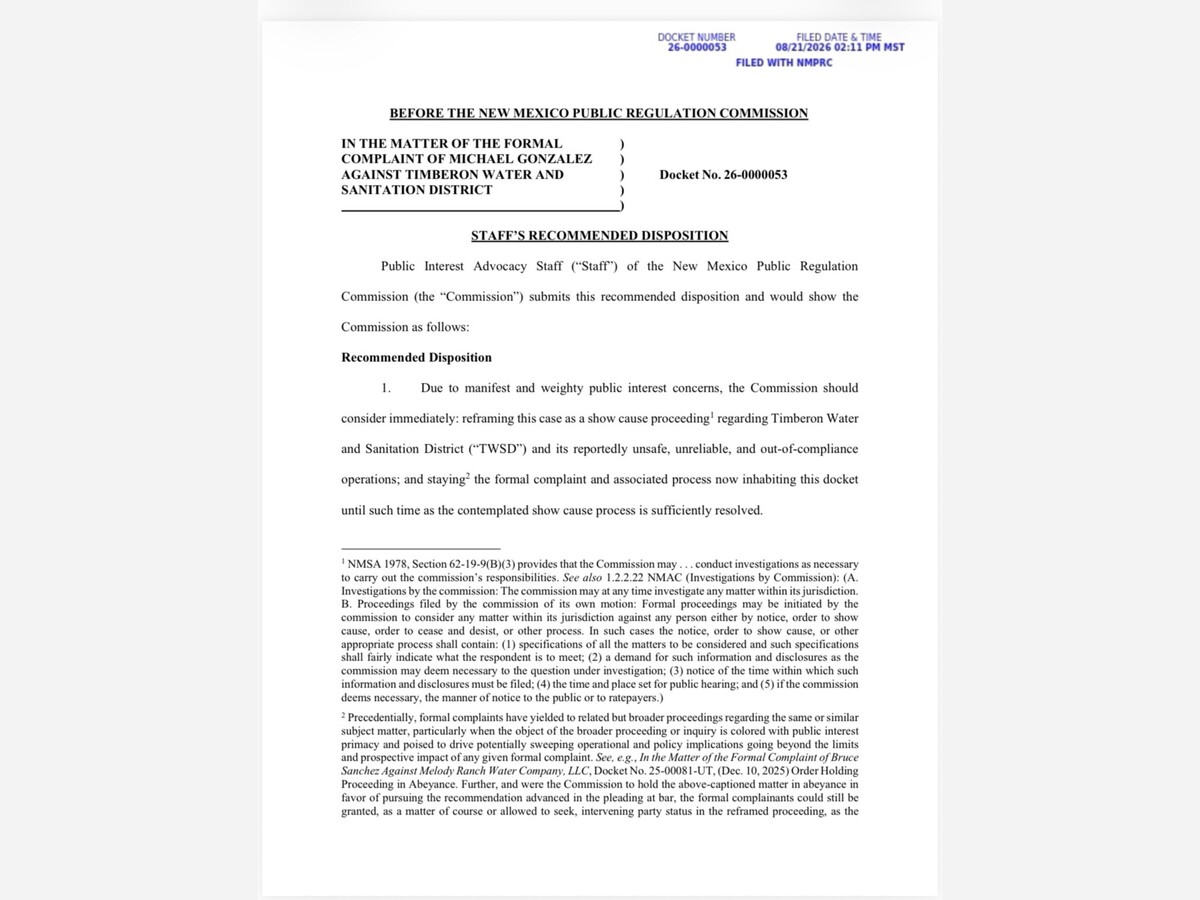



In a dramatic regulatory escalation, staff recommends flipping the rules—the district must now prove it didn’t do something wrong, or face potential takeover
Santa Fe, New Mexico — The New Mexico Public Regulation Commission’s Public Interest Advocacy Staff has fundamentally changed how Timberon Water and Sanitation District’s regulatory crisis will be handled.
In a recommendation filed August 21, 2026, Staff rejected the normal complaint process—where Gonzalez must prove TWSD did something wrong. Instead, Staff is asking the Commission to launch a “show-cause” proceeding that flips the burden: TWSD must now prove it didn’t do something wrong.
Think of it this way:
• Regular complaint: “Complainant, you prove TWSD did something wrong”
• Show-cause escalated complaint: “TWSD, you prove you didn’t do something wrong”
This is not a subtle procedural shift. It is the opening move in what could become regulatory takeover of a water system serving 1,502 customers in rural Otero County.
Why the Burden Shifted: The NMED Report Changed Everything
When TWSD filed blanket denials to Gonzalez’s complaint, the district thought it had room to maneuver. The burden was on Gonzalez to prove wrongdoing.
Then, in June, the New Mexico Environment Department issued a report documenting:
• 17 significant deficiencies in a 2025 sanitary survey; 11 still unresolved in 2026
• Water loss of 70–90% of production (a system-crippling rate), the system has known of this issue since 2022 and took the attitude “we can just pump more water.”
• Recurring treatment failures and operator instability
• $62,620 in civil penalties issued August 2025
NMED concluded: no single regulatory action would fix this. The PRC had to act.
That’s when PRC Staff rejected TWSD’s denials as hollow. The recommendation doesn’t ask for more evidence or another hearing. It shifts the legal footing entirely.
What the District Must Do Now
Staff is asking the Commission to require TWSD to submit a verified response within 10 days, admitting or denying each point in the NMED report—indexed by page and line. Unsupported denials will be deemed admitted as fact.
This is the opposite of normal litigation, where vague denials are acceptable. Here, TWSD must either:
1. Admit the NMED findings and move to remedy, or
2. Deny with detailed explanation and evidence, or
3. Voluntarily admit the statutory grounds for receivership (if management decides the game is over).
Any response that lacks competent support can be treated as an admission. This is the burden shift in action.
Receivership Is Now Real—But Not Automatic
Staff explicitly puts receivership on the table. TWSD could face appointment of a receiver if the Commission finds the district is:
• Unable or unwilling to adequately serve customers, or
• Guilty of consistent violations of Commission rules
But receivership requires multiple steps: Commission findings, notice and hearing, and district court appointment. It won’t happen overnight—but it can happen if TWSD’s response fails the burden-shift test.
One Catch: The Original Complaint Gets Paused
Staff recommends putting Gonzalez’s original fee and billing claims on hold while the show-cause investigation runs. This is a trade-off: a broader investigation could uncover financial evidence that strengthens the fee case, but months could pass with no individual relief unless the Commission expressly protects the original complaint.
The Board’s Silent Response
On the same day PRC Staff filed its recommendation (August 21, 2026), TWSD posted notice of a special board meeting for August 24, 2026
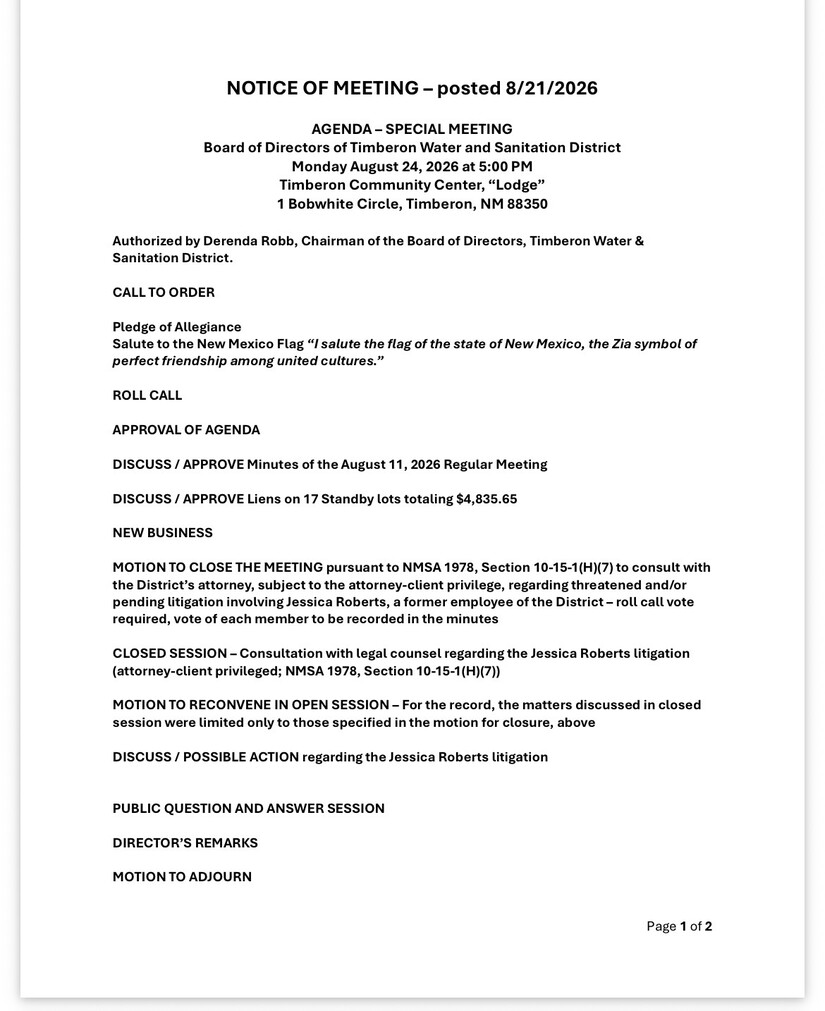
Notably absent from the publicly posted agenda: any discussion of the Staff filing, the show-cause proceeding, or response strategy. The board meeting agenda lists routine matters—approval of liens, discussion of unrelated employee litigation matters—but nothing about the regulatory crisis now bearing down on the district.
This is significant. A water system facing potential receivership, a 10-day response deadline, and the explicit recommendation that it “prove you didn’t do something wrong” has called a special meeting but placed no public discussion of the threat on the agenda.
It suggests either the board has not fully grasped what the Staff recommendation means, or it is avoiding public accountability during the crisis.
Either possibility raises even greater governance concerns for the 1,502 customers the district serves.
What Happens Next
The Staff recommendation is not a Commission order—it is advocacy. The Commission will decide whether to adopt, modify, or reject it. The resulting order will establish the actual show-cause framework, the response deadline, and the scope of issues.
That order is the event to watch. Everything depends on what the Commission decides.
Why This Matters Now
Timberon WSD serves 1,502 customers in rural Otero County. A water system losing 70-90% of production cannot guarantee service. A district that unilaterally creates accounts, bills during outages, and asks customers to repair infrastructure is in crisis.
Regulators no longer see this as a private dispute. The NMED and PRC now view it as a public-utility emergency.
For TWSD, the message is unambiguous: blanket denials won’t work anymore. The burden has shifted. The district must prove its case—or face the possibility of losing operational control.
Read the Full Filing
Staff’s Recommended Disposition (PDF) — The complete recommendation and all exhibits, filed August 21, 2026 - https://drive.google.com/file/d/1xv-sYrykJutQykVpfB8HzlH1NYlH3RTf/view?usp=drivesdk
NMED Letter to PRC (June 24, 2026) — The environmental agency’s detailed findings on water loss, deficiencies, and enforcement action
TWSD’s Amended Answer (June 23, 2026) — The district’s blanket denials, now facing the burden shift
Original Formal Complaint (March 4, 2026) — What started this proceeding
All documents the documents above are available through the New Mexico Public Regulation Commission docket portal.
Note: this article continues our coverage on the regional infrastructure concerns after years of neglect and the crises now plaguing the TWSD. This crisis is due to a number of issues converging at once: infrastructure failure from neglect, multiple litigation concerns and NMED and PRC pressures due to violations of state reporting and compliance statutes by management and the board.

any water distribution built with schedule 20 pvc piping, has been "a public utility emergency" since it was constructed. the fact that it lasted as long as it has is incredible.



Overcast, with a high of 82 and low of 63 degrees. Overcast in the morning,

there is our future, kudos to both the students and the organizers.
Sounds overblown by the reporting of this party. On base we have something like this, but it's training leaders. Pic is a few kids with some volunteers who act to shape their opinions. If the schools were good enough the kids would learns this in a classroom.

the problems facing the republican party of new mexico pale in comparison with those of their national party - as the old saying - Meaning: Problems in an organization or society start at the top, with its leaders.
The fish rots from the head down
True. A prime example of this was the DNC failures in the 2020 election.
I have voted Republican in the past, but not this time. Our church group knows a few people who have tried to run or get involved and the old school fools won't let anyone they don't know get in at all. You can't solve any problem with the same people who created it. That's why we have terrible doctors here.

when public utilities are taken private the ultimate goal is to generate profits for their investors - come on, ray charles could see that.
If they are truly public utilities, why do they charge?
I follow theatres across the county, and know, this report is very sparse with details. Impossilbe to spend a million dollars on removing a fly loft, rigging and weights. New roof . . other upgrades, no where near a million bucks. The defamation should be on the managers who awarded inexperienced developers.
2nd Life Media is not an owner. We sold our share and that owner sold it to the present owner. Might want to check your facts. Also LEDA requires receipts and documentation. We had an estimated when we were an owner of aproximately $3 million needed to make it operational. Check your facts.
It will take well over a million dollars to make the theater usable to the public. We have not yet spent a million dollars, but we are far from complete. Our projected open date is Summer/Fall 2027.