
 78° and Heavy rain at times
Image



At Tuesday night’s Alamogordo City Commission meeting, Commissioner Josh Rardin used a public microphone to call out a fellow resident over an unpaid account, naming the account number and dollar amount on the record and stating she “needs to pay her bill.”
The moment — already controversial on its own — has revived a harder question for Rardin himself: when it was his own balance on the city’s books, he didn’t pay it himself. He let the commission write it off.
A Familiar Pattern with Rardin
In a 2021 commission meeting, Rardin raised an issue involving his own account: a roughly $1,500 receivable from 2017 for a one-inch water service line that had been billed to him personally rather than to the customer he said the work was actually performed for. He disclosed the discrepancy in open session, asked the commission how it wanted to handle it, and recused himself from the vote.
To his credit, that disclosure and recusal were the procedurally correct steps.
But disclosure is not the same as accountability.
Rardin had the option to simply pay the balance himself and resolve the matter privately, the way most residents in a billing dispute eventually do.
Instead, he put the decision in front of his fellow commissioners — and they wrote it off.
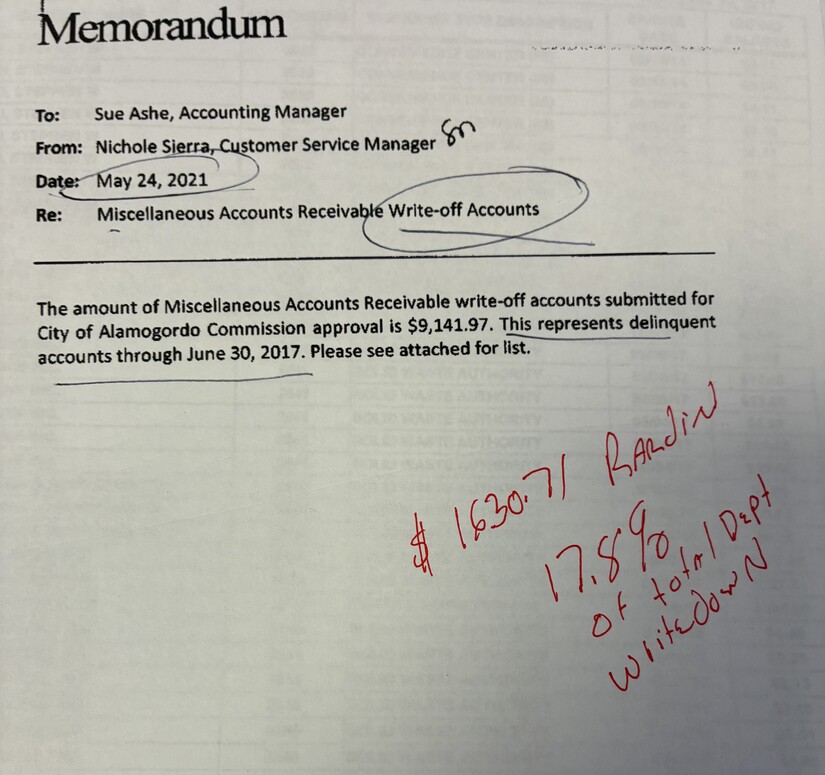
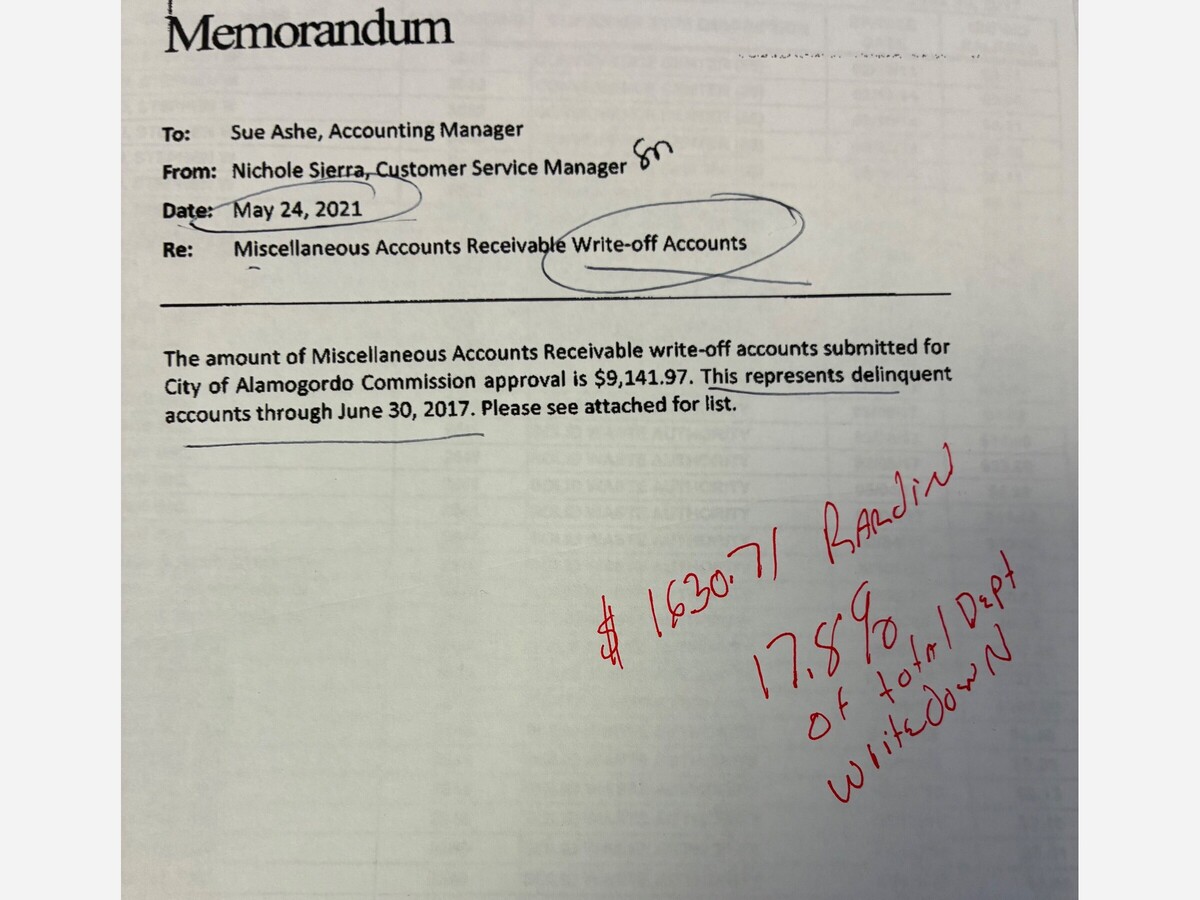
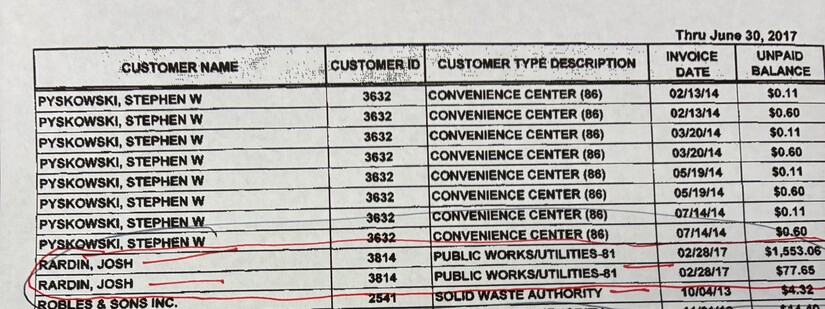
The account was ultimately listed at $1,553.06 plus a related $77.65 charge, for a combined $1,630.71. City records show the total miscellaneous accounts-receivable write-off submitted for commission approval in that batch was $9,141.97 — meaning Rardin’s own balance made up roughly 17.8 percent of the entire miscellaneous write-off list approved that year for that department.
The Question Alamogordo Taxpayers Are Asking
That history is what makes Tuesday’s exchange land differently.
A commissioner, Josh Rardin, who once let the city absorb his own four-figure balance rather than pay it down himself stood up at a public meeting and pressed another resident, over a few hundred dollars she says if legitimate she is willing to pay.
It raises the question from residents in a city with a poverty rate of 16.6% or 5296 individuals. Allegedly Mr. Rardin has bragged to those around him of his 6 figure income and if that is indeed the case why are the taxpayers absorbing his debt?
Is an average taxpayer with an unpaid city account ever offered the option the commission gave Rardin — to simply have a sympathetic vote from elected colleagues erase the balance
Delinquent accounts are typically pursued through collections, late fees, or service disconnection.
Commissioners voting on a write-off list that happens to include one of their own creates, at minimum, an appearance problem — disclosed and recused or not.
A Broader Pattern, and a Sharp Exchange Over Public Records
Tuesday’s meeting also surfaced a pointed back-and-forth over Rardin’s record more broadly. Former Mayor Susan Payne told the commission Rardin has been the subject of multiple investigations during his tenure — a claim broadly consistent with public reporting this year, including a referenced EEOC complaint tied to the city manager search and ethics complaints filed with the New Mexico State Ethics Commission and Attorney General’s office naming Rardin among several commissioners.
Payne encouraged residents to file Inspection of Public Records Act (IPRA) requests to obtain the underlying records. Rardin responded, “no, no, no, those will never be released.
Payne replied that she couldn’t say whether his conduct had been illegal, but that he had “certainly done things unethical.” Rardin maintained, “I’ve done nothing illegal.”
It’s worth noting that under New Mexico’s IPRA, releasability isn’t an individual commissioner’s call to make — record custodians determine what’s exempt under specific statutory categories, and denials can be challenged in court. Whether Rardin’s flat assertion that the records will “never” come out reflects confidence in a legitimate exemption or something else is a fair question raised by his own words, not one this report can resolve.
Open Questions
• Whether Rardin has had other balances adjusted or written off by the city beyond the 2017 entry has not been independently verified.
• Whether the city offers any resident the option to have a delinquent account placed before an elected body for forgiveness, rather than routed through standard collections, has not been confirmed.
• Whether write-offs involving sitting officials’ own accounts carry any disclosure or reporting obligation beyond recusal has not been addressed by the city.
• The substance, number, and outcome of any investigations involving Rardin referenced at Tuesday’s meeting have not been independently confirmed by this outlet but additional IPRA’s have been filed. We already have copies of some past reports in which Rardin is named released in prior IPRA requests. We will be doing a data dump in the near future for public access.
The Law Doesn’t Leave This to Chance
New Mexico has already legislated against the exact conflict at the center of this story. The Governmental Conduct Act, NMSA 10-16-4(B), requires a public officer to disqualify himself from any official act directly affecting his own financial interest — meaning Rardin’s 2017 recusal wasn’t a courtesy he extended to the public, it was the legal floor the state already requires.
The law itself recognizes what residents are now asking aloud: a commissioner voting to erase his own debt is a conflict serious enough to be written into statute. He recused himself but took no personal accountability.
And on the records fight, New Mexico courts have not been kind to officials who try to declare documents off-limits by assertion alone
Under the “rule of reason” set out in City of Farmington v. The Daily Times, a custodian must affirmatively justify withholding records against the public’s right to know, not simply announce that they won’t be produced.
The Court of Appeals went further in Energy Policy Advocates v. Balderas, holding that a generalized claim of privilege doesn’t even survive summary judgment — and the New Mexico Supreme Court this year rejected the Corrections Department’s attempt to shield records behind nothing more than internal policy.
If records touching Rardin’s conduct have already been partially released through prior IPRA requests tied to past city manager settlements, as has been reported, the city has no clean legal path to reverse course and declare the rest permanently sealed.
Rardin can say those records will “never” be released. New Mexico law says otherwise — and sooner or later, a district court will be the one to say so.
This is a developing story.
This report draws on a city memorandum and itemized write-off ledger, and a transcript of the 2021 commission discussion.
Links to that 2021 commission meeting can be found at
https://www.youtube.com/live/mWmx-HZPnmI?is=6GJ5tv9xIr8iRlm6

This gets more entertaining by the day. Something about glass sunroofs and throwing stones. Lol
just another standard-issue politician, who will use every loophole, and advantage their office provides for their own interests, and grandstand against someone else doing the exact same thing - a pox on them all.

Just thought the one thing all these first-timers have in common is no qualifications. Wanting to serve, help, or partake isn't enough. None of these people have any professional experience. Where are the engineers, CPA's, Ph.D's?
Business owners, a practicing attorney, one with a PHD, seems to me you didn't review the video.

Sunny, with a high of 78 and low of 63 degrees. Sunny during the morning, patchy rain nearby in the afternoon, clear for the evening,

like many others, i have experienced work-place environments where favoritism and cliques were present - adding unnecessary stresses to any job. two observations about such places; that the ultimate goal of governmental ethics regulations is to prevent the appearance of imp
Just to weigh in on this. Whatever the editor thinks about his right to publish is certainly his point of view, but it's getting to the embarrassing stage of conjuring divisiveness bent on turning a functioning government he doesn't like, but the people have elected.
The editors point of view is we need a functioning government. The viewpoint allegations were not of the editors making it was mailed to the city with a copy to the editor.
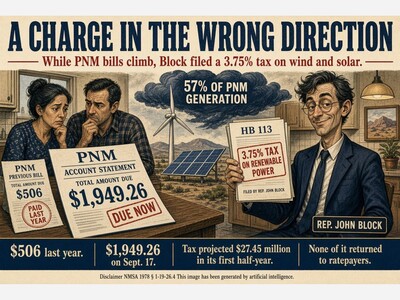
like 99% of his fellow republicans, block is a servant to the oil & gas industry - a principal constituent of their party.

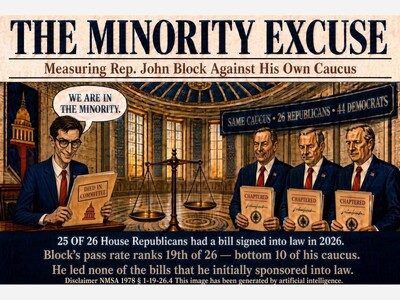
i would say that while our economy is "the hottest in the world" according to el presidente, this would be an excellent time for block to seek employment in the private sector....just like barela.
Pipqueak is a prime example of the defects of their party. They don't recruit qualified leaders. It's duplicitous, unemployed people who know all they have to do is start an internet site and walk the neighborhood dressed up on Sundays. The population here doesn't know how to vote.


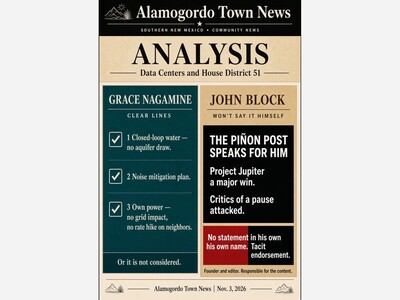
It is so important to understand the differences in the candidates' stand on this critical issue! Protecting our water in the desert is understood by all political parties living here! Nagamine is taking a stand to protect us!
many politicians claim to represent common sense, but here in new mexico, defending our water supplies and electrical power generation is pretty much the definition of common sense - and sucking up to billionaires is not.