80° and Partly Cloudy
Image
The Fastest Place on Earth Holloman's Rocket Sled Track Turns 75 - 2nd Life Media AlamogordoTownNews.org



How a $451,000 desert rail laid in 1950 became America's most critical hypersonic test asset — and what comes next as Mayor Sharon McDonald and Alamogordo's city leadership join Holloman AFB to celebrate a milestone that belongs to the whole community.

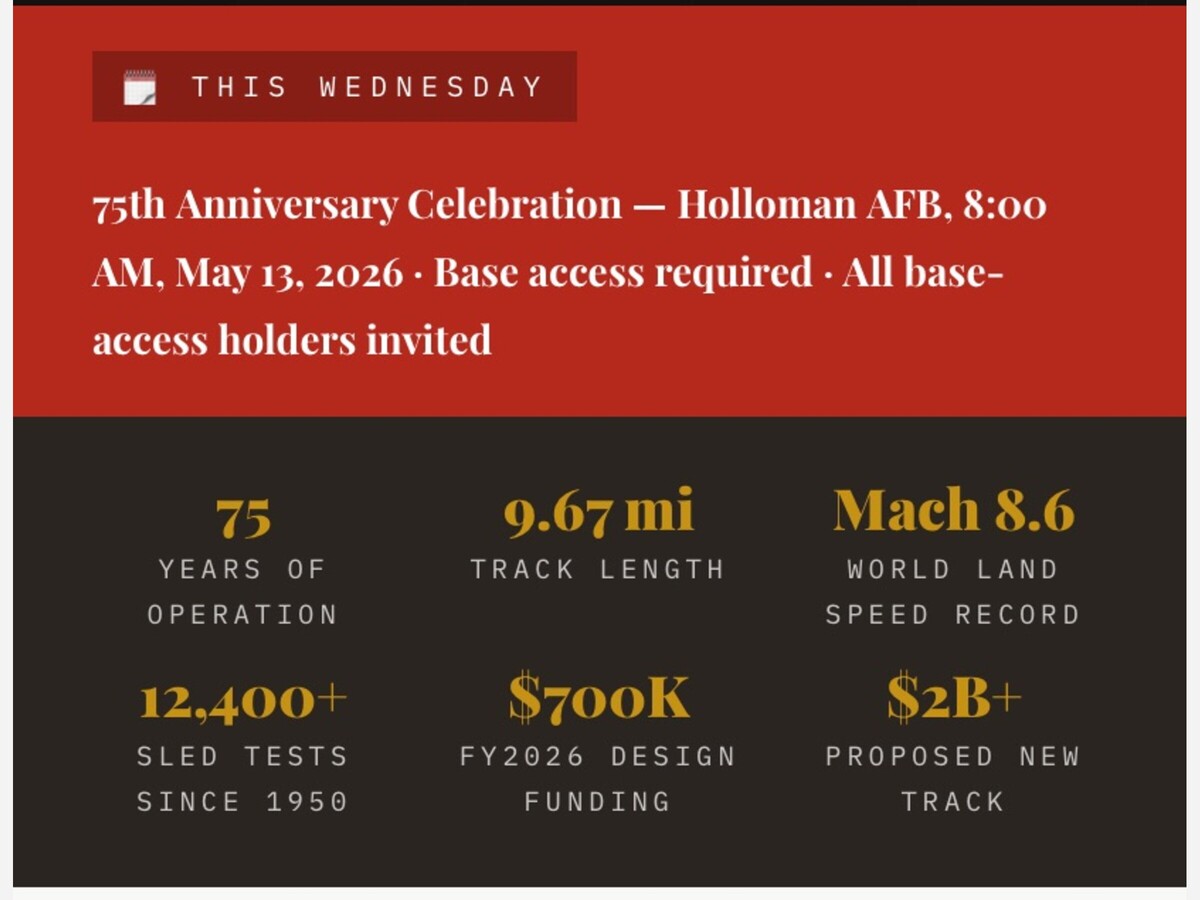
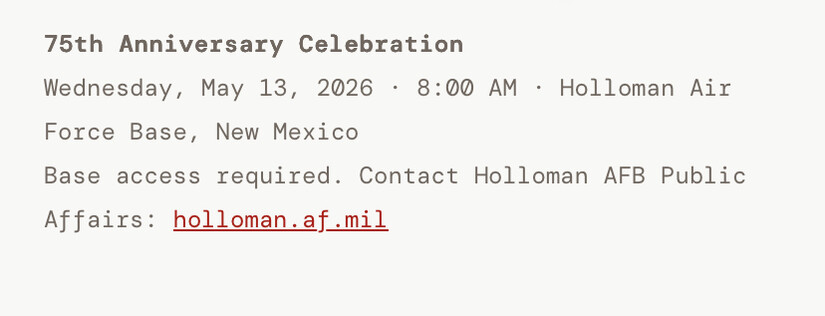
This Wednesday at 8:00 in the morning, a military anniversary will double as a community celebration. Mayor Sharon McDonald will join Holloman Air Force Base leadership, the 846th Test Squadron, and invited guests to mark 75 years of the Holloman High Speed Test Track. The event is open to all current base-access holders and was announced publicly by Lt. Col. Esther "Cape" Anderson and Master Sgt. Derek Spencer via a radio newscast this morning on 94Key.
For Mayor McDonald, who campaigned on the phrase "making Alamogordo great one block at a time" and has made the Holloman-city relationship collaboration and celebration a key of her economic agenda, the ceremony carries meaning beyond a birthday. The test track is one of the most consequential pieces of defense infrastructure in the United States — and Otero County residents live closer to it than anyone else in the world.
What exactly are they living next to? The answer requires going back 76 years, to a patch of flat desert, a construction crew from El Paso, and a government contract worth less than half a million dollars.
In August 1949, a $451,000 contract was awarded to Ponsford Brothers of El Paso, Texas, to build a precision rail facility on a repurposed World War II airfield in the Tularosa Basin. The site had been designated two years earlier, in 1947, by Air Materiel Command as its primary center for testing guided missiles and pilotless aircraft. The base was named for U.S. Army Air Corps Col. George Holloman, himself an early pioneer in unmanned aircraft research.
The basin's geography made it ideal. Flat, wide, and remote, it offered unobstructed sightlines, predictable weather, and proximity to the restricted airspace over White Sands Missile Range — all necessary for the kind of high-velocity testing that couldn't happen anywhere near a city. Secrecy was an added benefit; the Cold War was beginning, and the programs being tested at Holloman were not for public discussion.
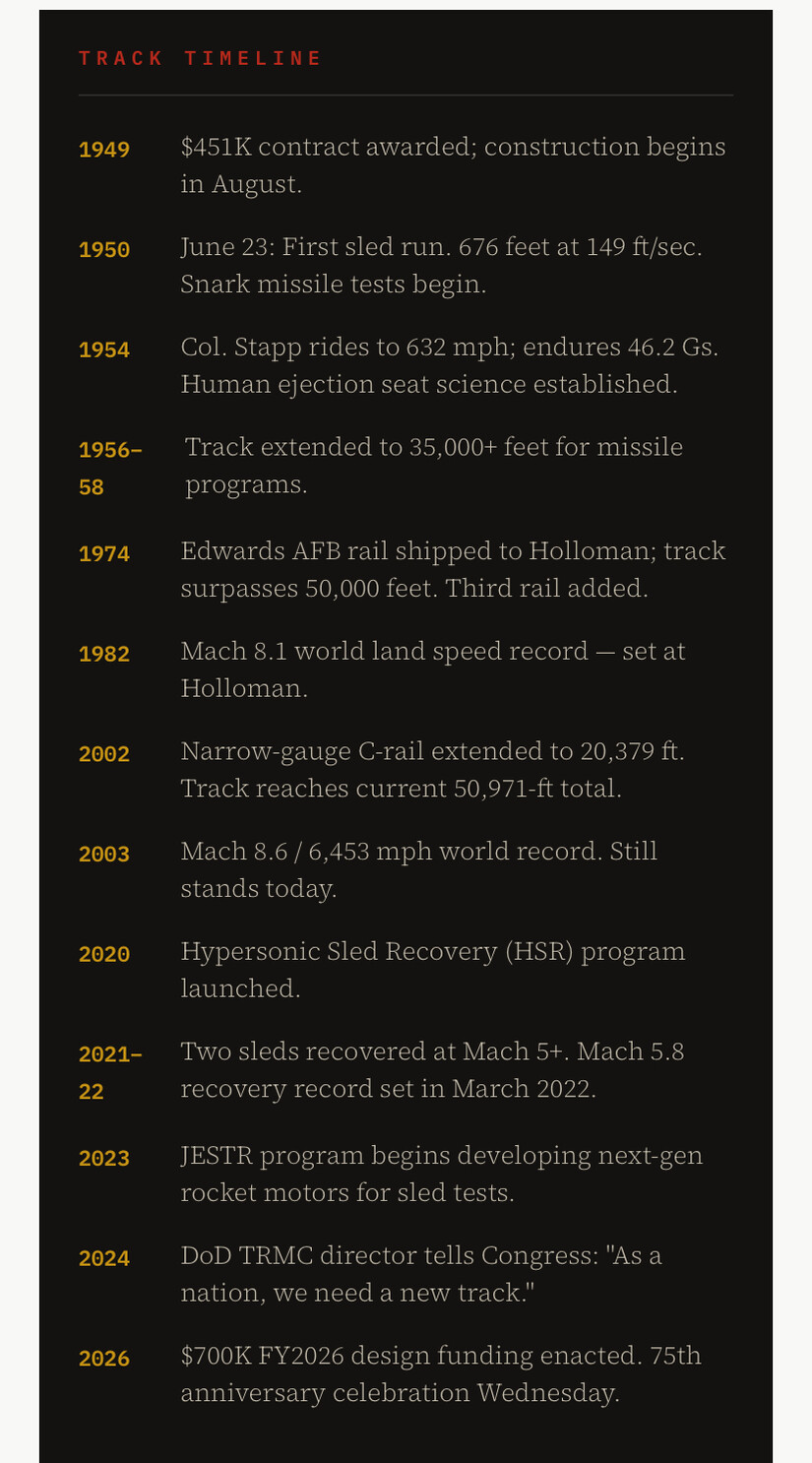
Construction finished in the spring of 1950. The initial track measured 3,350 to 3,550 feet — roughly two-thirds of a mile — and was designed as a launch platform for the Northrop N-25 Snark, an experimental pilotless intercontinental cruise missile. On June 23, 1950, the first rocket sled made its run: 676 feet of travel at 149 feet per second. Modest by any future standard, but the beginning of something that would eventually go nearly sixty times faster.
The track's most consequential early chapter had nothing to do with missiles. It had to do with a flight surgeon who wanted to know exactly how much the human body could take.
Col. John Paul Stapp was a physician, biophysicist, and U.S. Air Force flight surgeon who arrived at Holloman with a specific and alarming question: could a pilot safely eject from a supersonic aircraft? The jet age was accelerating. New aircraft were pushing beyond the speed of sound, and nobody had a reliable answer about the forces a pilot's body could survive during emergency ejection. Stapp set out to find one — by becoming the test subject himself.
Between 1947 and 1954, Stapp made 29 rocket sled runs, incrementally pushing the forces higher with each test. He absorbed broken bones, detached retinas, and injuries that sent observers to the hospital just from watching. He insisted on riding himself because he refused to risk another person's life on an experiment whose outcome he could not predict.
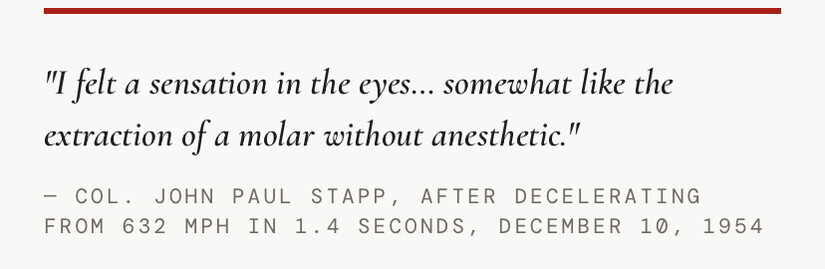
On December 10, 1954, Stapp climbed into "Sonic Wind No. 1" — a sled powered by nine solid-fuel rockets producing 40,000 pounds of total thrust — for his final and most extreme run. The sled propelled him 632 miles per hour in five seconds, setting a land speed record and making him, in the Air Force's phrase, "the fastest man on Earth." Faster than a .45-caliber bullet. Then the water brake engaged. In 1.4 seconds, Stapp decelerated to a complete stop — absorbing 46.2 times the force of gravity, the highest G-force ever voluntarily endured by a human being. The deceleration was equivalent to a car striking a brick wall at 120 miles per hour, with his body absorbing the full impact. When the ground crew reached him, the capillaries in both his eyes had burst. He could not see. He managed a half-smile as they lifted him from the sled.
By the next morning, enough of his vision had returned that doctors released him, though his eyesight never fully recovered. Stapp did not consider this a failure. His data proved that pilots could survive ejecting from aircraft traveling at supersonic speeds — knowledge that reshaped every military ejection seat ever built and directly informed the automotive seat belt standards that now save tens of thousands of lives every year. He was the last human being to ride a rocket sled at Holloman.
After Stapp, the track's purpose shifted from human tolerance testing to weapons and systems evaluation — and the track itself grew to match that ambition. Four major expansions over five decades transformed the original 3,350-foot rail into the ten-mile facility that exists today.
In 1956, the track was extended to 5,000 feet to support the expanding aeromedical research program. In 1957, a major upgrade pushed it to 35,000 feet — nearly seven miles — enabling the higher velocities needed for missile and aerospace testing that had outgrown the original length.
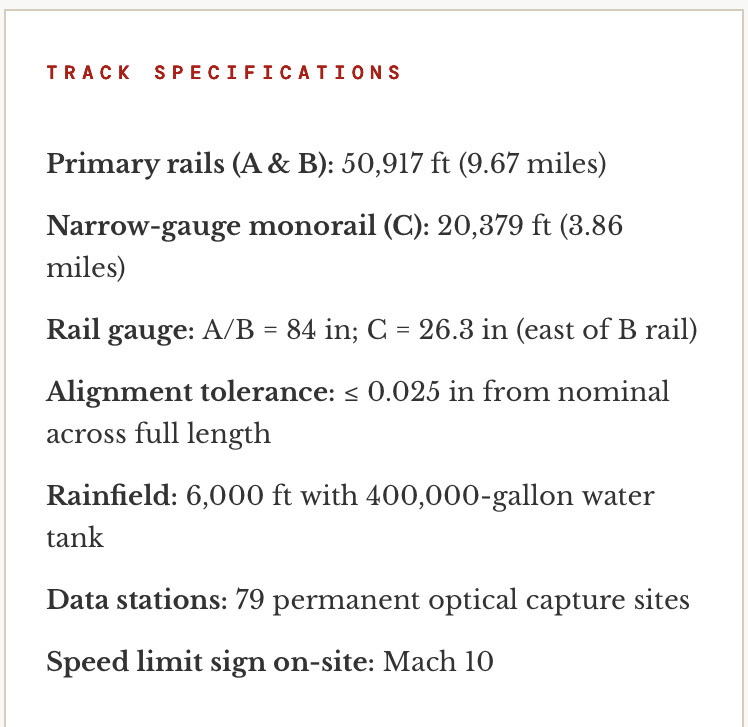
The most resourceful expansion came in the early 1970s. When Edwards Air Force Base in California decommissioned its own 20,000-foot test track, the Air Force had 18,900 feet of high-quality rail removed and shipped to Holloman. Incorporated into the existing structure — along with a new narrow-gauge third rail for specialized high-speed monorail testing — the additions brought the total length to over 50,000 feet by 1974. Two smaller extensions in 2000 added 149 feet to the north end of the primary A and B rails, and a final upgrade in 2002 lengthened the narrow-gauge C-rail to 20,379 feet, completing the current configuration: 50,917 feet of primary rail and 20,379 feet of monorail, all aligned to within 0.025 inches of the nominal reference line across the entire length. No other track system in the world has been built to this tolerance.
Three infrastructure elements define the track's capability beyond raw length: a 6,000-foot rainfield with a 400,000-gallon water tank that simulates the erosive effects of supersonic and hypersonic flight through rain clouds; the helium-filled tube sections used during the highest-speed runs to reduce aerodynamic drag and simulate high-altitude conditions; and 79 permanent optical data-capture stations positioned along the track's full length. Together they give engineers a controlled laboratory that reproduces flight conditions no wind tunnel can match at full scale.
In October 1982, Holloman set the world land speed record for a railed vehicle when an unmanned sled delivered a 25-pound payload to a target at 6,119 miles per hour. That record stood for over two decades — until Holloman broke it again.
On April 30, 2003, the 846th Test Squadron ran a four-stage rocket sled carrying a 192-pound, fully instrumented Missile Defense Agency payload. The sled was powered by 13 rocket motors firing in sequence, each stage detaching as it burned out before the next ignited. Part of the run took place inside a large helium-filled tube to reduce drag and simulate the thinner atmosphere at high altitude. Near the end of the run, explosive bolts released the payload from the sled; it flew free and struck its intended target.
The sled traveled more than three miles in 6.04 seconds and reached 9,465 feet per second — Mach 8.6, or 6,453 miles per hour. That is more than 31 football fields every second. The payload struck its target with energy equivalent to a car hitting a wall at over 2,000 mph. The run validated the track's Hypersonic Upgrade Program and broke the standing world land speed record for any vehicle on rails by a significant margin.
That record has never been beaten. It still belongs to the Tularosa Basin.
The 2003 record was not an end point. It was a proof of concept for what the track would need to become — because within a few years, the United States found itself in a serious strategic race it had not fully anticipated.
China and Russia have both developed and fielded hypersonic glide vehicles capable of traveling above Mach 5 while maneuvering in ways that traditional missile defense cannot intercept. The United States had let its hypersonic weapons programs atrophy after the Cold War and was behind. The catch-up effort has been urgent and expensive: the Pentagon's FY2025 budget requested $9.8 billion for hypersonic and long-range missile development. Its FY2026 request set $3.9 billion specifically for hypersonic research — a figure that reflects restructured program timelines, not reduced strategic priority, according to the Congressional Research Service.
The Holloman track is the single most important ground facility in that effort. It is the only sled track in the United States — and one of very few in the world — long enough to accelerate a test article to Mach 5 or above and then recover it intact. That recovery capability is essential: it allows engineers to examine what actually happened to materials, guidance systems, seeker heads, and structural components at hypersonic speeds, rather than simply measuring an impact on a target. As the 846th Test Squadron's own documentation states, the track delivers "90 percent of flight test data at 10 percent of the cost" of actual flight tests — while also providing the only practical method for repeated, controlled, recoverable testing of full-scale hypersonic payloads.
The range of testing the track supports is broader than most people realize. Beyond hypersonic weapons, the 846th runs ejection seat qualification tests for new aircraft — most recently for the Air Force's T-7A Red Hawk trainer — parachute recovery system tests, rain erosion studies, bunker-penetrating munitions impact tests, aerodynamic heating studies, guidance seeker evaluations, and structural stress tests at forces far exceeding anything a wind tunnel can produce at full scale. Across all these missions, the track has logged more than 12,400 sled runs since 1950, with no signs of slowing.
In 2020, the 846th launched the Hypersonic Sled Recovery program to push the track's capabilities further still. The specific goal was to not only hit Mach 5-plus but to stop the sled safely enough to recover the test article for post-test analysis — a technically demanding challenge requiring specialized high-speed braking on the narrow-gauge monorail. By July 2021, two sleds had been successfully recovered after traveling above 5,000 feet per second. In March 2022, a reusable sled was recovered after reaching 6,400 feet per second — Mach 5.8 — the fastest recovery at Holloman in over 30 years. In 2023, the Joint Effort for Sled Track Rockets (JESTR) program began developing purpose-built propulsion systems specifically for the next generation of test runs, since the motors that had served the track for decades are now operating at the edge of their design limits.
Much of the track's infrastructure was built in the 1950s and 1970s. Rail sections are aging. Foundations require replacement. Electrical systems, water systems, and data infrastructure need modernization. This is not a secret inside the Air Force — it is the subject of active planning and public budget requests.
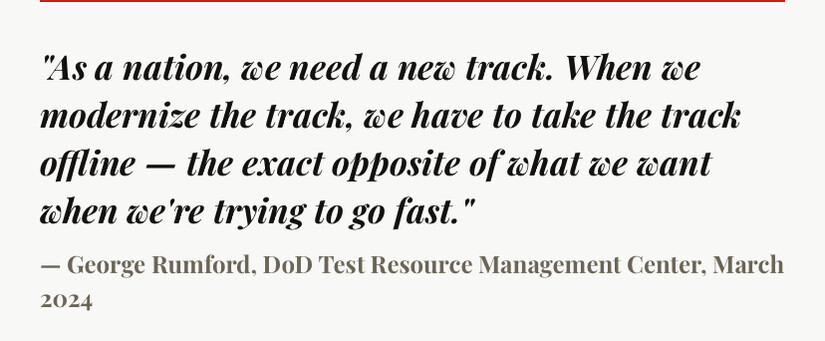
In March 2024, George Rumford, director of the Pentagon's Test Resource Management Center, told the House Armed Services Strategic Forces subcommittee that modernizing the existing track creates an unavoidable operational conflict: every period the track goes offline for maintenance is time lost from the national hypersonic test schedule, "the exact opposite of what we want to be doing when we're trying to go fast and take on more risk." He called for a second track to solve this dilemma and allow continuous operations while one facility undergoes upgrade work.
The Defense Department is studying that option. Independent defense policy analysts have called on Congress to "resource the construction of a second hypersonic test track at Holloman Air Force Base" as part of a broader set of recommendations to close the U.S. hypersonic testing gap. Holloman is the clear candidate site based on its existing infrastructure, institutional knowledge, and access to White Sands Missile Range's restricted airspace.
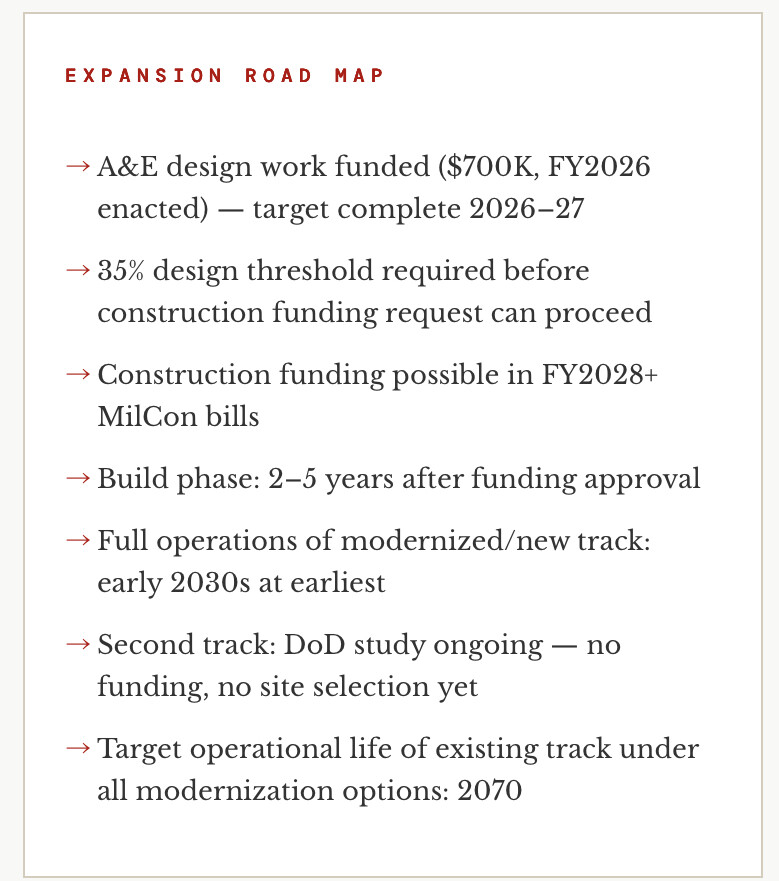
Here is the precise status of all funding and plans as of May 2026, drawn from public records:


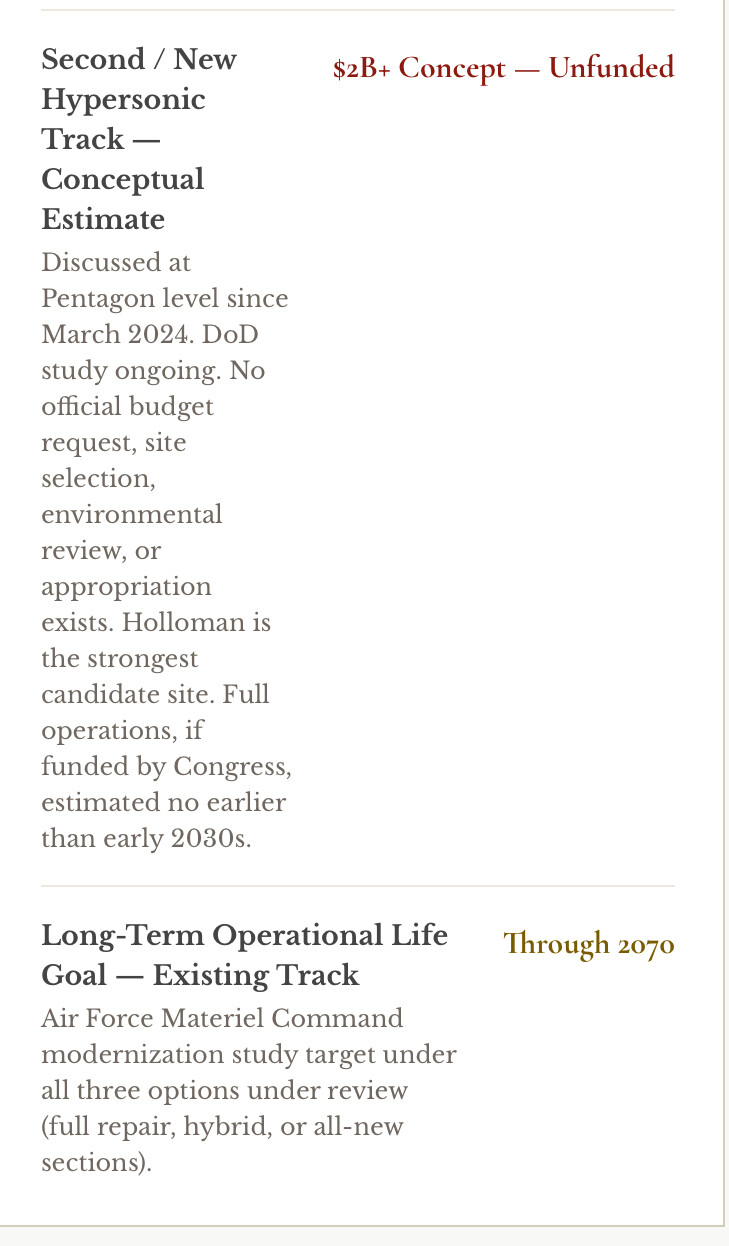
The path from current design funding to a modernized or expanded facility is a multi-year federal process. Design work finishes, then a construction request enters the budget, then Congress appropriates, then a contractor builds. Under the most optimistic scenario, a significantly upgraded track or new second facility would not be fully operational until the early 2030s. The $700,000 in FY2026 funds is not the endgame — it is the key that unlocks the gate to the next phase.
If Congress were to fund a second track alongside the existing one, the economic and strategic implications for Alamogordo would be significant and lasting. A second facility would enable simultaneous test campaigns — running a recovery mission on the long monorail while conducting impact testing on the primary rails — eliminating the scheduling bottlenecks that currently delay weapons programs by months. It would also permit the existing track to undergo the deep structural modernization it needs without interrupting national defense testing schedules.
A new-build track designed from the outset for the hypersonic era could incorporate extended narrow-gauge sections for Mach 6-plus recovery missions, permanent helium-tube infrastructure for high-altitude drag simulation, magnetically levitated sled capability to eliminate vibration artifacts at extreme speeds, and next-generation data systems built around the needs of 21st-century weapons engineers. Private-sector partnerships — already contemplated in DoD planning — could accelerate construction and reduce lifecycle costs.
For Mayor McDonald, who took office in January 2026 with an explicit commitment to military-civilian partnership collaboration and economic development, a major expansion of the test track represents exactly the kind of durable, high-skill investment that anchors a regional economy for decades. The 846th Test Squadron already employs a substantial technical and engineering workforce whose expertise has no equivalent anywhere else. Growth would mean more of the same.
The anniversary that Lt. Col. Anderson and Master Sgt. Spencer announced on 94KEY is not a closed ceremony. It is an invitation — to those with base access — to come stand beside 75 years of history and hear from the people who carry it forward. Mayor McDonald and Alamogordo's city leadership will be there. Holloman's base leadership will be there. The Rail Rattlers of the 846th Test Squadron will be there.
That name — "Rail Rattlers" — is the 846th's informal nickname, worn with pride by a unit whose work is classified in part and celebrated far too little in public. They build the sleds by hand, machine the components to ten-thousandths of an inch, align the rails to tolerances that would embarrass a Swiss watch, and then stand at the edge of the desert and watch something streak down that track faster than any human being has ever traveled on land.
Seventy-five years ago, a crew from El Paso laid 3,350 feet of rail into the Tularosa Basin and changed American aerospace forever. The man who rode that track to 632 miles per hour in 1954 eventually retired to Alamogordo, where he spent his final years as president of the New Mexico Research Institute before his death in 1999. The Sonic Wind No. 1 rocket sled he rode is now in the Smithsonian. The track he rode it on is still breaking records.
That is what is being celebrated on Wednesday morning. And it belongs to this community as much as it belongs to the Air Force.
Wikipedia — Holloman High Speed Test Track (dimensions, extensions, speed records): en.wikipedia.org/wiki/Holloman_High_Speed_Test_TrackHolloman AFB Official Fact Sheet — 846th TS Hypersonic Upgrade Program / April 2003 World Record: holloman.af.mil/About/Fact-Sheets/Display/Article/317342
Holloman AFB — "60 Years Later: Still the Fastest Man on Earth" (Col. Stapp, Dec. 2014): holloman.af.mil/News/Features/Display/Article/663846
National Air & Space Museum — "The Man Behind High-Speed Safety Standards" (Stapp biography): airandspace.si.edu
New Mexico Museum of Space History — John P. Stapp inductee profile: nmspacemuseum.org/inductee/john-p-stapp
Wikipedia — John Stapp (29 rides, 46.2 G, December 10 1954 confirmation): en.wikipedia.org/wiki/John_Stapp
Air Force Flight Test Center / AFTC — "March 23, 1972: Edwards Rocket Sled Track Packed and Shipped to Holloman" (Edwards rail transfer): aftc.af.mil
"Modernization Effort Underway to Keep Holloman High Speed Test Track on the Rails" (Dec. 2021): dvidshub.net/news/407097
Afmc — "Holloman High Speed Test Track Sets Record: Fastest Recovery in 30-Plus Years" (June 2022, Mach 5.8): afmc.af.mil/News/Article-Display/Article/3050771
Holloman AFB — "846th TS Brings the Need for Speed to Holloman" (squadron overview, May 2023): holloman.af.mil/News/Display/Article/3394456
"Pentagon May Build a Second Track for Hypersonic Ground Testing" (Rumford testimony, March 2024): c4isrnet.com
Defense Scoop— "MDA Director: 'We Need to Get Into a Faster Clip' on Hypersonic Testing" (June 2024): defensescoop.com
Rebuilding .tech — "Closing the Hypersonic Testing Loop" (policy recommendation for second Holloman track): rebuilding.tech/posts/closing-the-hypersonic-testing-loop
2nd Life Media Alamogordo — "Fact vs. Fiction: HHSTT Modernization — What We Know as of December 29, 2025": 2ndlifemediaalamogordo.town.news
US Senate Committee on Appropriations — FY2026 Congressionally Directed Spending (P.L. 119-37, MilCon-VA, signed Nov. 12, 2025): appropriations.senate.gov/fy-2026-congressionally-directed-spending
Congressional Research Service (Congress.gov) — "Hypersonic Weapons: Background and Issues for Congress" (updated August 2025, FY2026 $3.9B figure): congress.gov/crs-product/R45811

Great History lesson on a one-of-a-kind facility and its importance to the nation's security, and fuels our local economy.
Now, I know what some of these guys that I occasionally have a beer with do out there. I know better than to ever ask them; fore, at one time, holding a TS SCI myself, it's operations security.
As a student aide working there in 1978, I was in awe of the work, the people and the technology at the time. I was so lucky to be able to work with not only the surveyors, one of which was **** Golly, and also work with the dam setters which included Mr. Coyazo, Mr. Baca, Mr. Aragon and also the high speed photography unit headed by Mr. Cox. I will never forget the sled runs and the absolute dedication of all the people there from the 6585th Test Group. Thanks for reminding everyone of the importance of and the work of these super people.


a well stated article - constitutional lawsuits bring questions such as this into sharp focus - as well they should.

Sunny, with a high of 106 and low of 80 degrees. Sunny in the morning, clear for the afternoon and evening,


70 in a 35, poor person un the Honda didn't have a chance.
vehicular homicide indeed.
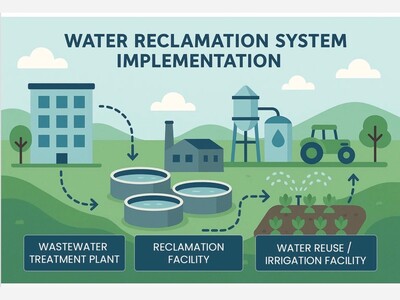
the long term drought conditions serve to underline the importance of long-term vision and planning to meet future water needs.
Now, if there was some way to collect all the storm runoff that goes out to the desert
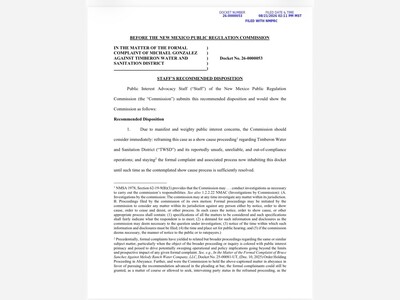
any water distribution built with schedule 20 pvc piping, has been "a public utility emergency" since it was constructed. the fact that it lasted as long as it has is incredible.

ultimately the price for poor management practices will be equally borne by every property owner in that community - except those who have private wells, i suppose. but even those folks will have a smaller pool of prospective buyers....makes it sound kinda like socialism doesn't it?


I hope Dr. Hernandez is a guest speaker at an upcoming meeting of the Mayor's Youth Advisory Commission. She has so much wisdom and experience to pass on to younger generations.
It's the product of living in a lowly bubble: an immature, undeveloped writing style that has no insight or reasonable conclusion. Those PhD's from Watsamatta U in New Mexico are only a union card for activists to rally 'round and a far cry from what $200k a year should buy.
Your excellence at writing a reply show that you are an intelligent and urbane fellow. Whatever, get me my fries bro.